房地产市场预期管理

Search documents
房企座次再洗牌,万科下滑中旅投资成“黑马”
第一财经· 2026-02-01 05:21
Core Insights - In January 2026, the total sales of the top 100 real estate companies amounted to 190.52 billion yuan, a year-on-year decrease of 18.9% [3] - The equity sales for the same group reached 132.14 billion yuan [3] - The top ten companies by sales include Poly Development, China Overseas, China Resources, Greentown China, China Travel Investment, China Merchants Shekou, China Jinmao, Jianfa Real Estate, Vanke, and Binjiang Group, with only Poly, China Overseas, and China Resources exceeding 10 billion yuan in sales for the month [3] Sales Performance - The average sales for the top 10 companies was 9.33 billion yuan, down 11.6% year-on-year, while the average for companies ranked 11-30 was 2.6 billion yuan, also showing a decline [4] - The ranking of companies has shifted significantly compared to the previous year, with Vanke dropping from 5th to 9th place, while China Travel Investment emerged as a "dark horse" in 5th place [3][4] Market Trends - The decline in sales is attributed to the high base from January of the previous year when the market was more active following the September 2024 policy changes [6] - The industry is undergoing an adjustment phase, with a decrease in the number of companies achieving over 10 billion yuan in sales, while those achieving over 5 billion yuan have increased, indicating a shift from "scale competition" to "quality competition" [6] - In January 2026, 32 companies among the top 100 saw year-on-year sales growth, with 10 companies experiencing growth exceeding 100% [6] Real Estate Market Dynamics - The new housing market showed weak performance in January, with approximately 8.1 million square meters of new residential sales in 50 key cities, while the second-hand housing market saw a notable increase, with transaction volumes rising by 33% year-on-year [7][8] - The second-hand market's recovery is contributing to stabilizing market expectations, with some cities experiencing a reduction in listing volumes [8] Policy and Future Outlook - The central government has been signaling a focus on stabilizing market expectations, with recent policy measures including interest rate cuts and adjustments to down payment ratios for commercial properties [9] - The upcoming Spring Festival may lead to increased marketing efforts from real estate companies, and the introduction of quality projects could maintain a certain level of market activity in core cities [9] - As of the end of 2025, 21 distressed real estate companies have made progress in debt restructuring, but the challenge remains in converting financial relief into sustainable operational capacity [9]







12月一线城市新房成交量大涨
21世纪经济报道· 2026-01-20 04:45
Core Viewpoint - The real estate market in China is still adjusting as of 2025, but positive factors are accumulating, indicating potential recovery in 2026 [1][8]. Price Trends - In December 2025, new and second-hand home prices in first-tier cities fell by 0.3% and 0.9% month-on-month, respectively, with the decline narrowing compared to the previous month [3][4]. - Shanghai showed relatively better performance, with new home prices rising by 0.2% in December 2025, making it the only first-tier city with an increase [4]. Sales Performance - The sales area of newly built commercial housing in 2025 was 88,101 million square meters, down 8.7% year-on-year, while sales revenue was 83,937 billion yuan, a decrease of 12.6% [7]. - Despite the negative growth, the decline in sales metrics was less severe than in 2024, indicating some stabilization in market demand [7]. Market Inventory - By the end of 2025, the total unsold housing inventory was 76,632 million square meters, an increase of 1.6% year-on-year, but the growth rate had slowed compared to previous years [7]. - The reduction in inventory is attributed to both proactive de-inventory measures and market self-balancing, which helps stabilize market expectations and confidence [7]. Policy Signals - As of 2026, clear "stabilizing expectations" signals have been released, including policies like extending housing tax rebates and lowering down payment ratios for commercial properties [1][8]. - The emphasis on managing market expectations is crucial for stabilizing the real estate market, with a focus on maintaining policy strength to avoid market-policy conflicts [8]. Future Outlook - Analysts expect that the effects of various favorable policies will further materialize in 2026, leading to positive adjustments in real estate indicators [8]. - The real estate market is anticipated to gradually stabilize and transition towards high-quality development in the mid to late stages of the 14th Five-Year Plan [8].
求是重磅发声,释放楼市积极信号(2025.12.29-2026.1.4)
中指研究院· 2026-01-15 01:19
Investment Rating - The report indicates a positive outlook for the real estate industry, emphasizing the importance of stabilizing market expectations and improving demand through policy measures [4][5]. Core Insights - The Ministry of Finance and the State Administration of Taxation have reduced the VAT rate on the sale of residential properties held for less than two years from 5% to 3%, which is expected to lower transaction costs and enhance market activity [4][10]. - The article published in "Qiushi" highlights the significance of the real estate sector as a crucial part of the national economy and suggests that the market still has substantial growth potential, with annual new housing construction projected to be between 10 million and 14.9 million units [5][10]. - Various local governments, including Gansu, Yunnan, and Shenzhen, have released their "14th Five-Year Plan" proposals, focusing on high-quality development in real estate and tailored strategies to meet local market needs [6][7][8]. Summary by Sections Policy Developments - The report outlines significant policy changes, including the reduction of VAT on property sales and the emphasis on maintaining policy consistency to stabilize market expectations [4][10]. - Local governments are actively implementing measures to stimulate housing demand, such as providing subsidies for home purchases and optimizing housing loan policies [8][9]. Regional Initiatives - Gansu's plan emphasizes the establishment of a robust real estate development model, enhancing the supply of affordable housing, and improving housing quality [6][14]. - Yunnan's strategy focuses on aligning real estate development with population trends and public service needs, promoting high-quality housing projects [7][14]. - Shenzhen's approach prioritizes affordable housing and the needs of new citizens and young workers, aiming to create a comprehensive housing supply system [8][14].
《求是》刊文:改善和稳定房地产市场预期
Sou Hu Cai Jing· 2026-01-09 11:45
Core Viewpoint - The article emphasizes the importance of managing expectations in the real estate market to stabilize it and support the overall economy, especially in light of recent significant changes in supply and demand dynamics [2][4]. Group 1: Current Market Conditions - The real estate market in China is undergoing a deep adjustment, with a shift from a housing shortage to a balance in total supply, but structural supply issues remain, particularly in affordable housing [4][6]. - The average urban housing area per person reached 38.6 square meters in 2020, with projections to increase to around 41 square meters by the end of 2024, indicating a significant improvement in living conditions [3]. - The real estate sector's contribution to GDP is projected to be 13% in 2024, directly supporting over 70 million jobs, highlighting its critical role in the economy [5]. Group 2: Policy Measures and Future Directions - The Central Political Bureau meeting in September 2024 called for measures to stabilize the real estate market, including a combination of policies aimed at risk prevention and promoting transformation [7]. - Policies such as "four cancellations, four reductions, and two increases" are being implemented to enhance housing supply and improve living conditions, with a focus on quality and safety in housing [7][8]. - The government is encouraging a shift from high-leverage real estate development models to more sustainable practices, emphasizing the need for a transition to a new development model that integrates product, service, and operation [4][9]. Group 3: Market Potential and Challenges - Despite recent declines in investment, sectors like housing services and second-hand transactions continue to grow, indicating substantial market potential [5][6]. - The urbanization rate is projected to reach 67% by 2024, with significant housing demand from new urban residents, suggesting ongoing opportunities for the real estate market [6]. - The article notes that the traditional real estate development model is reaching its limits, necessitating a transformation to meet evolving consumer demands for quality housing [4][5].

高端项目“捂热”楼市 12月百城新房均价环涨0.28%
Feng Huang Wang· 2026-01-08 00:43
Core Insights - The new housing prices in December showed a slight increase, influenced by structural factors, with an average price of 17,084 yuan per square meter, reflecting a month-on-month increase of 0.28% and a year-on-year increase of 2.58% [1] - The second-hand housing market continues to decline, with an average price of 13,016 yuan per square meter in December, showing a month-on-month decrease of 0.97% and a year-on-year decrease of 8.36% [1] Group 1: New Housing Market - The slight increase in new housing prices is attributed to the entry of high-end improvement projects in major cities like Beijing, Shanghai, and Shenzhen, which has driven prices up [1] - A total of 68 out of 100 cities experienced a month-on-month decline in new housing prices, indicating a broader market adjustment [1] Group 2: Second-hand Housing Market - The second-hand housing prices have been on a downward trend for four years, with the decline in December showing an expansion in the year-end drop [1] - The overall performance of the second-hand housing market remains weak, with all monitored cities reporting a decrease in prices [1] Group 3: Market Outlook and Policy Implications - The real estate market is still in an adjustment phase, but signals of a price bottom may be emerging, as indicated by a slowdown in the decline of second-hand housing prices in November [2] - The article from "Qiushi" magazine emphasizes the importance of managing expectations in the real estate market, highlighting the significant impact of real estate on the economy and financial systems [2][3] - The focus for 2025 is expected to be on stabilizing prices and expectations, with a potential for slight price increases in core urban areas, while lower-tier cities may continue to face inventory challenges [3]
港股异动 | 内房股延续昨日上涨 贝壳-W(02423)再涨超5% 机构称房地产领域预期管理得到重视
智通财经网· 2026-01-06 02:52
Group 1 - The core viewpoint of the article highlights the continued rise of Chinese property stocks, indicating a positive market sentiment following a commentary published in a prominent magazine emphasizing the need to improve and stabilize real estate market expectations [1] - Key property stocks mentioned include Beike-W (02423) rising by 3.98% to HKD 45.98, Longfor Group (00960) increasing by 4.37% to HKD 9.56, China Jinmao (00817) up by 3.82% to HKD 1.36, and China Resources Land (01109) gaining 2.47% to HKD 29.84 [1] - Huatai Securities reports that the overall expectations for the real estate market remain weak, but the central government's focus on managing these expectations is seen as a positive signal that could accelerate market stabilization [1] Group 2 - Zheshang Securities notes that systemic risks in the real estate sector are being addressed, and the impact of individual company risk events on the overall sector is expected to be limited, suggesting that the resolution of risks could benefit sector valuation recovery [1] - The report emphasizes the importance of monitoring the effectiveness and pace of policy implementation, as well as the progress in clearing risks at the corporate level [1]

内房股延续昨日上涨 贝壳-W再涨超5% 机构称房地产领域预期管理得到重视
Zhi Tong Cai Jing· 2026-01-06 02:47
Core Viewpoint - The article highlights a positive shift in the Chinese real estate market, driven by government efforts to stabilize market expectations and address systemic risks in the sector [1] Group 1: Market Performance - Real estate stocks continued to rise, with notable increases: Beike-W (02423) up 3.98% to HKD 45.98, Longfor Group (00960) up 4.37% to HKD 9.56, China Jinmao (00817) up 3.82% to HKD 1.36, and China Resources Land (01109) up 2.47% to HKD 29.84 [1] Group 2: Government and Policy Insights - An article in the January 1 issue of "Qiushi" magazine emphasized the need to improve and stabilize expectations in the real estate market, indicating increased government focus on managing market expectations [1] - Huatai Securities reported that the overall expectations for the real estate market remain weak, but the "Qiushi" article signals a positive shift in government policy, which could accelerate market stabilization [1] Group 3: Risk Assessment and Recommendations - Zheshang Securities noted that systemic risks in the real estate sector are being addressed, and individual company risks are expected to exert limited downward pressure on the overall sector, suggesting that risk resolution may benefit valuation recovery [1] - The report recommends monitoring the effectiveness and pace of policy implementation, as well as the progress of risk clearance at the corporate level [1]
【房地产】《求是》刊文稳预期,2026年期待政策加力——光大地产板块及重点公司跟踪报告(何缅南)
光大证券研究· 2026-01-05 23:05
Group 1: Real Estate Development and Property Services Market Performance - The real estate development sector's price-to-book ratio (PB) is 0.81 as of December 31, 2025, with a historical percentile of 25.79% since 2018. The Hang Seng real estate and construction sector's PB is 0.41, with a historical percentile of 22.98% [4] - For the period from January 1 to December 31, 2025, the top three A-share real estate developers by stock performance are Shanghai Lingang (+18.24%), Binjiang Group (+17.70%), and New Town Holdings (+16.64%). The top three H-share developers are Jianfa International Group (+30.36%), China Resources Land (+27.21%), and China Jinmao (+25.81%) [4] - The property services sector's price-to-earnings ratio (PE) is 39.76 as of December 31, 2025, with a historical percentile of 45.44% since 2018. The Hang Seng property services and management sector's PE is 45.63, with a historical percentile of 86.96% [5] - For the same period, the top three A-share property service companies by stock performance are Nandu Property (+53.47%), Xinda Zheng (+37.53%), and Shilianhang (+10.04%). The top three H-share companies are China Resources Mixc Lifestyle (+57.57%), Greentown Service (+28.23%), and Jianfa Property (+20.00%) [5] Group 2: Fund Holdings and Market Expectations - As of the end of Q3 2025, public funds hold real estate stocks worth a total market value of 55.81 billion, representing 0.15% of net value, an increase from 0.14% at the end of Q2 2025. This accounts for approximately 0.62% of stock investment market value, down from 0.67% in Q2 2025 [6] - The article from "Qiushi" magazine emphasizes the importance of managing expectations to stabilize the real estate market, highlighting the significant financial asset nature of real estate. It notes that the housing service, second-hand housing transactions, and real estate asset management sectors still have substantial growth potential [7] - The article also mentions that there is an accumulated housing stock of approximately 35 billion square meters in urban areas, with an estimated annual depreciation rate of 2%, leading to a replacement demand of about 700 million square meters [7]

ETF盘中资讯|资金重金买入地产板块!全市场唯一地产ETF(159707)实时净申购超2亿份!机构:政策端值得期待
Jin Rong Jie· 2026-01-05 06:39
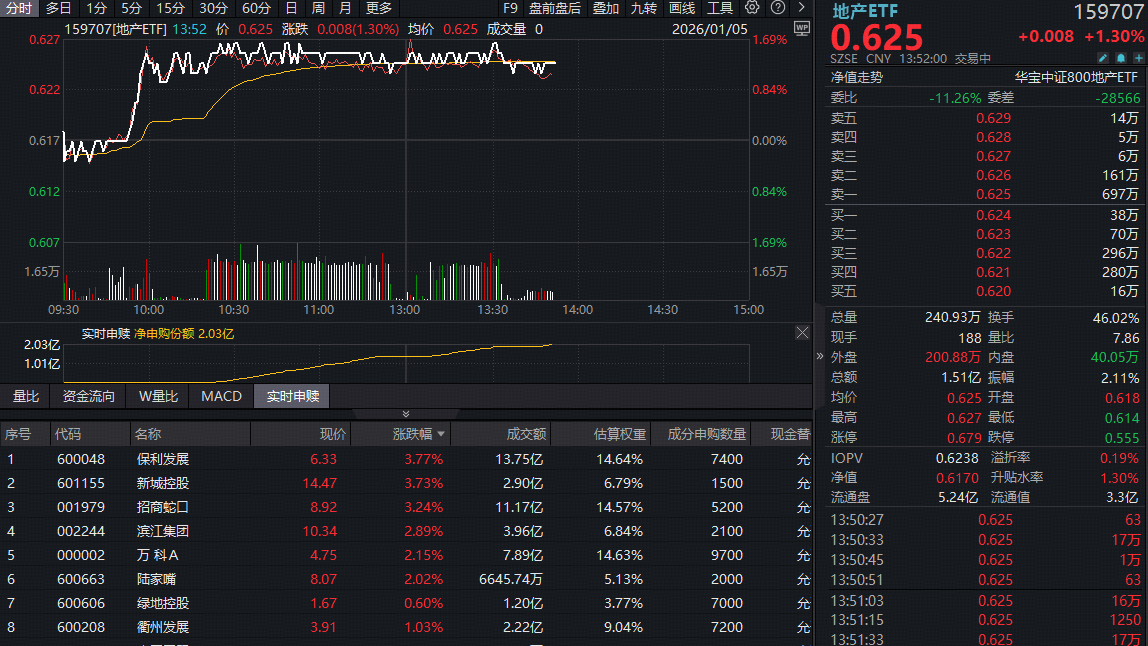
Group 1 - The real estate sector saw significant capital inflow on the first trading day of 2026, with the only ETF tracking the CSI 800 Real Estate Index (159707) rising by 1% and experiencing a net subscription of 200 million shares, indicating a surge in trading activity [1] - Leading real estate companies such as Poly Developments, New Town Holdings, and China Merchants Shekou all saw their stock prices increase by over 3% [1] Group 2 - A commentary article published in the January issue of "Qiushi" magazine emphasized the need to improve and stabilize expectations in the real estate market, signaling the central government's heightened focus on managing market expectations [3] - Starting January 1, 2026, the interest rates for existing housing provident fund loans and commercial loans will be reduced, with a specific decrease of 0.25 percentage points for loans issued before May 8, 2025 [3] - Ping An Securities anticipates that the policy environment in 2026 will remain promising, particularly regarding adjustments to mortgage rates and urban renewal policies, suggesting a new product iteration cycle is underway [3] Group 3 - Huatai Securities noted that recent real estate policies and key statements align with the central government's strategy to stabilize the real estate market, indicating that targeted policy measures could accelerate market recovery [4] - The firm recommends prioritizing investments in real estate stocks characterized by "good credit, good cities, and good products," as well as companies that can maintain cash flow during market adjustments [4] - The real estate ETF (159707) is highlighted for its concentration on top-tier companies, with over 90% of the top ten constituent stocks, suggesting a strong focus on state-owned enterprises and high-quality firms [4]
楼市可能要下猛药了
Sou Hu Cai Jing· 2026-01-05 04:19
Core Viewpoint - The article indicates that significant policy measures for the real estate market may be forthcoming in 2026, driven by a recent article from Qiushi.net that emphasizes the importance of stabilizing market expectations [3][4][12]. Group 1: Market Conditions - The article highlights a notable decline in real estate sales and prices, which has had a substantial impact on the economy and financial institutions [6]. - It points out that the traditional real estate development model has reached its limits, as indicated by various economic indicators such as home ownership rates and the ratio of housing prices to income [7]. - The article also addresses misconceptions regarding the declining importance of real estate in the national economy, asserting that real estate remains a critical sector [8]. Group 2: Policy Expectations - The article suggests that future policies may be implemented in a more decisive manner, contrasting with previous gradual approaches [10]. - It emphasizes the need for policy measures to align with market expectations and to avoid piecemeal implementations that could lead to market confusion [9]. - The article indicates that the management of market expectations is becoming a priority for regulators, with a focus on improving communication and monitoring key indicators [12][17]. Group 3: Public Sentiment and Market Confidence - The article discusses the importance of managing public sentiment and market confidence, noting that these psychological factors significantly influence market dynamics [18]. - It highlights recent efforts by various cities to combat negative narratives about the real estate market, including the removal of misleading information and the regulation of accounts spreading panic [17].