
托宾Q理论

Search documents
敦志刚:全球金融体系重构前夜,中国的机会来了
Sou Hu Cai Jing· 2025-11-29 07:54
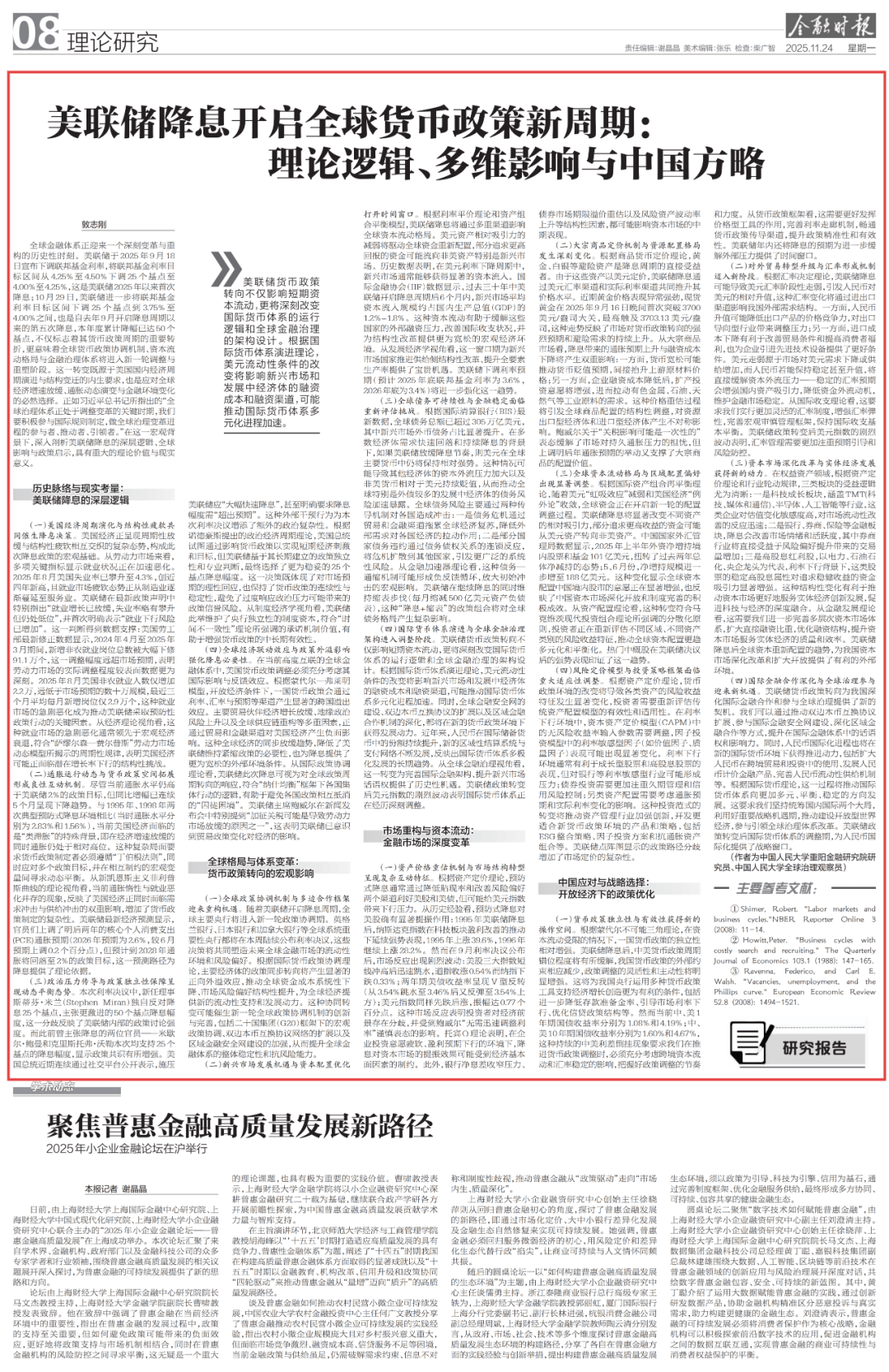
Core Viewpoint - The global financial system is undergoing profound changes, marked by the Federal Reserve's recent interest rate cuts, which signal a significant shift in monetary policy and its implications for global economic coordination and financial governance [1][13]. Group 1: Federal Reserve's Rate Cuts - The Federal Reserve announced a reduction in the federal funds rate target range from 4.25%-4.50% to 4.00%-4.25% on September 18, 2025, marking its first rate cut since 2025 [1][13]. - On October 29, 2025, the Fed further lowered the target range to 3.75%-4.00%, totaling a 50 basis point reduction for the year, indicating a critical turning point in its monetary policy cycle [1][13]. - This shift is driven by both domestic economic conditions and the need to address global economic slowdown and inflation dynamics [1][13]. Group 2: Economic Indicators and Labor Market - The U.S. labor market is showing signs of deterioration, with the unemployment rate rising to 4.3% in August 2025, the highest in nearly four years, indicating a complex interplay of cyclical and structural economic challenges [2][14]. - The number of non-farm payroll jobs added has been significantly revised down, with a reduction of 911,000 jobs from April 2024 to March 2025, highlighting deeper adjustments in the labor market than previously reported [2][14]. - The Fed's acknowledgment of increased risks in the labor market reflects a broader concern about potential economic recession [2][14]. Group 3: Inflation Dynamics - Despite inflation levels remaining above the Fed's 2% target, the year-on-year increase has shown a declining trend for five consecutive months, indicating a complex inflationary environment [3][15]. - The current economic backdrop resembles a "stagflation" scenario, where economic growth slows while inflation remains relatively high, complicating monetary policy decisions [3][15]. - The Fed's updated forecasts suggest a gradual return to the 2% inflation target by 2028, providing a theoretical basis for the recent rate cuts [3][15]. Group 4: Global Economic Impact - The Fed's monetary policy adjustments are expected to have significant international repercussions, influencing capital flows and financing conditions in emerging markets and developing economies [4][22]. - The interconnectedness of the global financial system necessitates that U.S. monetary policy considers its international effects, particularly in light of slowing growth among major trading partners [5][18]. - The Fed's actions may catalyze a shift towards a more diversified international monetary system, as changes in dollar liquidity conditions affect financing costs in emerging markets [4][22]. Group 5: Market Reactions and Asset Pricing - The initial market reactions to the Fed's rate cuts have been volatile, with significant fluctuations in stock indices and bond yields, reflecting investor uncertainty about the economic outlook [7][23]. - Historical patterns suggest that preventive rate cuts can boost stock market performance, yet current economic fundamentals may limit the effectiveness of such measures [7][23]. - The pricing mechanisms for commodities and other assets are undergoing adjustments, with gold prices surging in response to the anticipated monetary policy changes [7][24]. Group 6: Capital Flow and Investment Strategies - The Fed's rate cuts are likely to alter global capital flow patterns, with a potential shift of investments from dollar-denominated assets to emerging markets seeking higher returns [6][20]. - Recent data indicates a reversal in foreign investment trends in China, with significant net inflows into domestic stocks and funds, reflecting increased global capital interest [6][25]. - Investment strategies will need to adapt to the changing risk-return profiles of various asset classes, necessitating a reevaluation of traditional asset allocation models [6][25].

专访滕泰|两百万亿市场蓝图下,资本市场五大功能赋能“十五五”
2 1 Shi Ji Jing Ji Bao Dao· 2025-11-05 07:52
Core Viewpoint - The Chinese economy is transitioning to a new phase that relies more on technological innovation and capital markets, with the "15th Five-Year Plan" being crucial for solidifying foundations and driving comprehensive efforts towards achieving modernization by 2035 [1][3]. Group 1: Capital Market Goals - The total market value of China's capital market is expected to exceed 200 trillion yuan by the end of the "15th Five-Year Plan," relying on endogenous market growth rather than new stock issuance [1][3][4]. - To align with the economic goals, the capital market's market value should increase to match GDP growth, aiming for a market-to-GDP ratio of 120% to 140% by 2030 [3][4]. Group 2: Strategic Functions of Capital Market - The capital market must enhance five strategic functions: supporting technological advancements, deepening financial reforms, promoting market-oriented reforms, boosting domestic demand, and improving social welfare [5][6][7]. - The capital market is essential for supporting the construction of a modern industrial system and narrowing the technology gap with the U.S. in areas like AI [5][6]. Group 3: Enhancing Consumer Spending - A rising stock market can amplify consumer spending through wealth effects, with projections indicating that an increase in market value could lead to additional consumer spending of several trillion yuan annually [8][9]. - Improving social security levels, particularly for rural elderly residents, is crucial for unlocking consumption potential, with proposals to transfer a higher percentage of state-owned equity to social security funds [9]. Group 4: Liquidity and Long-term Market Health - The capital market's health is supported by improved liquidity, with expectations for M1 growth to exceed 8%, which typically indicates a rising stock market [10][11]. - A significant reduction in interest rates is necessary to alleviate financial burdens on households and businesses, encouraging more funds to flow into consumption and investment [11][12]. Group 5: Market Ecosystem for Long-term Investment - A diverse investment ecosystem is needed to attract long-term capital, encouraging participation from various institutional investors while also accommodating speculative and quantitative investment strategies [12].
滕泰:资本市场牛市有望成为提振消费的放大器
Sou Hu Cai Jing· 2025-10-27 09:37
Core Viewpoint - The capital market is expected to play a crucial role in achieving China's economic development goals during the "15th Five-Year Plan" period, focusing on technology advancement, wealth accumulation, private investment stimulation, consumption enhancement, and social welfare improvement. Group 1: Role of Capital Market in Economic Development - The capital market should support the development of a modern industrial system and technological advancements, with a target of maintaining over 50% annual growth in AI computing power investments during the "15th Five-Year Plan" [1] - A long-term bull market could lead to a rapid increase in residents' property income, potentially allowing the middle-income group to exceed 400 million people, thus becoming a significant reservoir of wealth [1] Group 2: Stimulating Private Investment - A sustained bull market can act as an accelerator for private investment, as higher market valuations increase companies' willingness to invest, contrasting with the low investment levels seen during previous market downturns [2] Group 3: Enhancing Consumption and Domestic Demand - The capital market is expected to contribute to the construction of a unified market and the expansion of domestic demand, with stock market growth leading to increased consumer spending, potentially adding several trillion yuan to consumption by 2030 [2] Group 4: Improving Social Welfare - The capital market's support is essential for enhancing social welfare, with a goal to increase the proportion of social security spending to GDP from under 10% to 15%-20% during the "15th Five-Year Plan," relying on better investment returns from social security funds [2]
滕泰:股市能否接力房地产,成为经济新引擎
Di Yi Cai Jing· 2025-08-20 05:18
Group 1 - The capital market is expected to become a new engine for consumption growth as the real estate sector's driving effect weakens [1][7] - The stock market is being looked at to take over the four major functions previously held by real estate: wealth accumulation, investment promotion, consumption stimulation, and land finance [2][8] - The rise in stock prices enhances corporate financing and investment capabilities, allowing companies to expand R&D and new investments [4][5] Group 2 - Stock market growth can stimulate consumer spending through the wealth effect, as rising stock values increase disposable income expectations [6][7] - The relationship between stock market performance and consumer spending is influenced by the Tobin's Q theory, where a Q value greater than 1 encourages new investments [3][4] - The potential for the stock market to reshape the wealth accumulation model is significant, with projections indicating a possible market capitalization growth to 300 trillion yuan by 2030 [8][9] Group 3 - The transition from real estate to the stock market as a wealth reservoir reflects a broader shift in economic structure and investment channels [8][11] - The stock market's ability to drive investment and consumption is contingent on maintaining a healthy growth trajectory and addressing structural economic challenges [10][11] - The increasing confidence of investors in the stock market is evident, with a notable rise in new accounts opened in July, indicating a recovery in market sentiment [11][12]