
政策稳定性

Search documents
日股日元齐涨,高市早苗让步,市场选择暂时相信!
Hua Er Jie Jian Wen· 2026-02-09 10:25
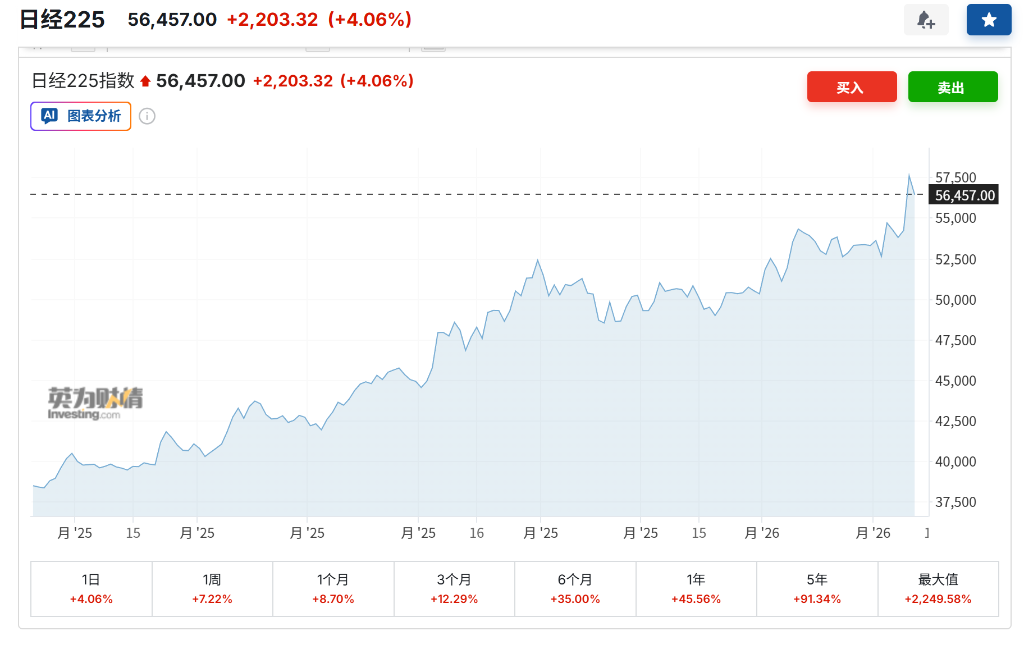
Core Viewpoint - The market's reaction post-Japan's election indicates a temporary "presumption of innocence" towards Prime Minister Fumio Kishida, as investors believe his overwhelming victory will provide policy clarity and reduce risks associated with fiscal conditions [1][3]. Market Reaction - Following the election results, Japan's stock market surged to a historical high, with the Nikkei 225 index rising by 5.7% to surpass 57,000 points [1]. - The Japanese yen and government bond markets remained relatively stable, contrary to previous volatility concerns regarding fiscal sustainability [1][5]. Policy Stability Expectations - Investors' positive response is largely driven by expectations of policy stability, as Kishida committed to funding tax cuts through non-tax revenues and subsidy reviews rather than issuing deficit bonds [3][7]. - The ruling coalition's "supermajority" in the House of Representatives reinforces market confidence in policy continuity and manageability [3]. Stock Market Insights - The election results have led to a significant increase in stock market forecasts, with JPMorgan raising its year-end target for the Nikkei 225 index to 61,000 points due to enhanced political stability expectations [4]. - Analysts believe that sectors benefiting from Kishida's spending plans, such as defense and semiconductors, may experience a new wave of growth [4]. Bond Market Reactions - Despite initial concerns about Kishida's expansionary policies leading to bond sell-offs, the Japanese government bond market showed relative stability after policymakers issued reassuring signals [5][7]. - The 10-year Japanese government bond yield initially rose by 4 basis points to approximately 2.27% but quickly retreated, alleviating fears of disorderly selling [5]. Currency Movements - Contrary to typical expectations, the yen strengthened against the dollar, rising by 0.6% to 156.22, distancing itself from the intervention-triggering 160 level [8][11]. - Analysts attribute this unusual movement to Kishida's commitment to fiscal sustainability and the finance minister's statements on stabilizing the yen [11]. Future Outlook - The market's focus will shift to how Kishida implements his "bold measures," with plans for a visit to the U.S. and discussions on defense spending and investment commitments [12]. - While the market currently finds comfort, future challenges remain, particularly regarding the details of fiscal expansion plans, which could lead to increased volatility in the bond market [12].

欧元区经济数据边际改善
Jin Tou Wang· 2025-12-01 02:58
Group 1 - The core viewpoint of the articles highlights the strengthening of the euro against the US dollar, driven by a combination of a weakening dollar index and stable policy expectations from the European Central Bank (ECB) [1][2] - As of December 1, the euro to dollar exchange rate was reported at 1.1607, reflecting a 0.1035% increase from the previous day's closing price of 1.1592, with a trading range indicating cautious market sentiment ahead of key policy decisions [1] - ECB President Lagarde's statement on November 30 emphasized that the current deposit rate of 2.00% is appropriate, successfully controlling inflation, and indicated no urgent need for adjustments to borrowing costs, reinforcing market expectations for policy stability [1][2] Group 2 - The ECB has maintained interest rates unchanged since July 2025, with a high probability of continuing this trend in the upcoming December meeting, despite market expectations of an 87% chance of a rate cut [2] - Technical analysis shows the euro to dollar exchange rate is in a balanced range, with a "double bottom" pattern forming at 1.1502 and a resistance level at 1.1625, indicating a short-term bullish signal [2] - Institutional forecasts are divided, with Fidelity International suggesting a potential rise to 1.25 if both the Fed and ECB complete their easing cycles by 2026, while ING warns of risks from the dollar's safe-haven status and economic disparities within the eurozone [3]
15分钟血洗30%!美股崩盘,加密货币竟被腰斩
Sou Hu Cai Jing· 2025-10-11 16:53
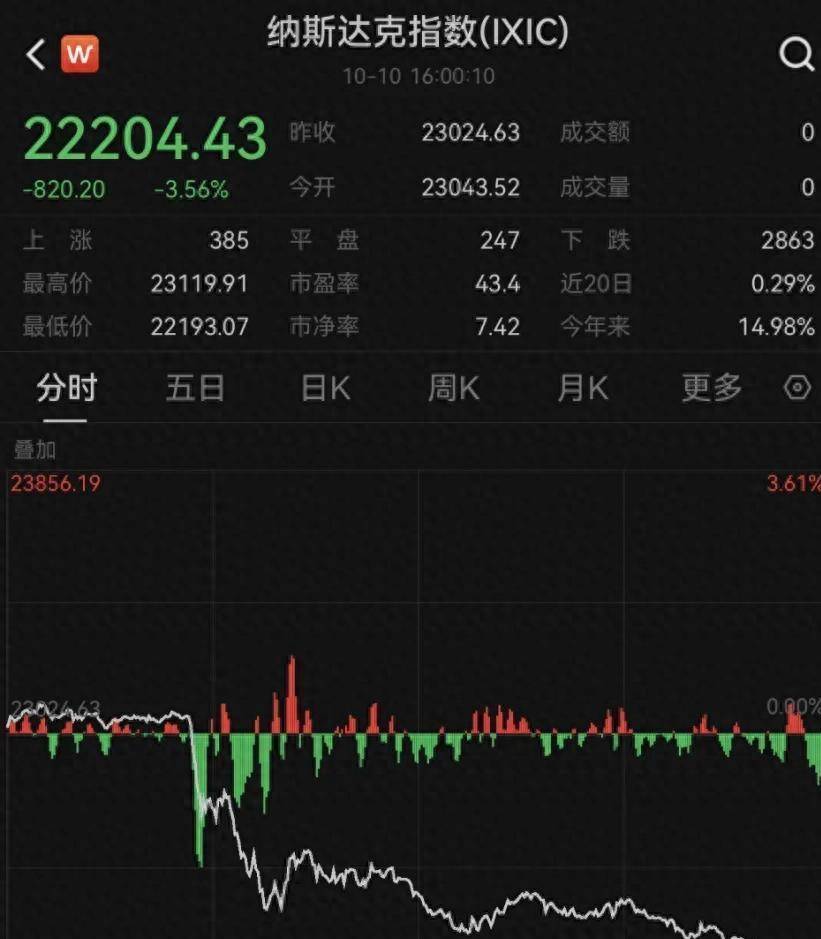
Group 1 - The Nasdaq index experienced a significant drop of 3.56%, marking its largest decline since April of this year, with major tech companies like Nvidia losing $229 billion in market value in a single day [1] - Chinese stocks also faced severe losses, with the Nasdaq Golden Dragon China Index plummeting by 6.1%, and companies like Alibaba and Baidu seeing declines exceeding 8% [1] - The S&P 500 technology sector's static P/E ratio has risen to 28 times, placing it in the 95th percentile since 2008, indicating a high valuation level [8] Group 2 - Concerns over a global economic slowdown have intensified, as consumer spending decreases and companies cut production, leading to a sharp decline in oil demand expectations [2] - Bitcoin and Ethereum saw drastic declines of 13% and over 17% respectively, while alternative cryptocurrencies experienced drops exceeding 30% [4] - The direct trigger for the market sell-off was Trump's threat to impose a 100% tariff on Chinese goods and implement key software export controls, which could increase average annual household spending by $4,000 [6] Group 3 - The U.S. consumer confidence index fell to its lowest level since May, with 63% of respondents expecting an increase in unemployment next year, indicating a potential contraction in future consumer spending [6] - Companies are prioritizing cash flow protection and pausing non-essential investments, with energy firms reducing oil extraction budgets and shifting focus to renewable energy [8] - Regulatory bodies have failed to provide stabilizing signals amid market volatility, leading to a 200% increase in insider trading reports [10]


乱成一锅粥了!关键时刻,特朗普连收三大噩耗,白宫罕见披露,博弈正在升级,事情果然不简单
Sou Hu Cai Jing· 2025-07-23 02:21
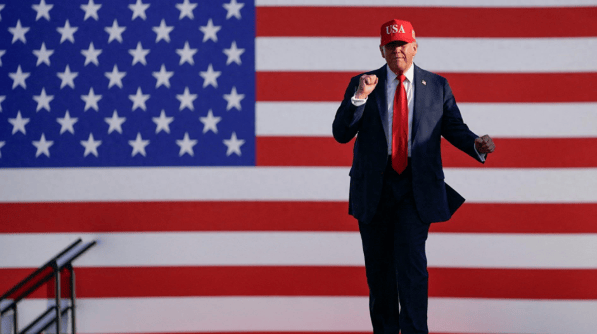
Group 1 - Trump's political ambitions are facing significant challenges due to the Epstein incident, Federal Reserve policy disagreements, and health issues, marking the most severe test of his presidency [1] - The Epstein controversy has undermined Trump's previously established image as an opponent of Epstein, with a recent revelation about a suggestive birthday letter he sent to Epstein in 2003 [3] - The political fallout from the Epstein incident is more damaging than anticipated, as it has led to a sense of betrayal among his supporters, especially after the Justice Department stated there is no evidence of a "client list" [3][8] Group 2 - Tensions between Trump and the Federal Reserve have escalated, with Trump publicly criticizing Chairman Powell and threatening to dismiss him before his term ends in May [4] - The Federal Reserve has maintained interest rates at 4.25%-4.5% and lowered its economic growth forecast for 2025 to 1.4%, while Trump demands an immediate 3% rate cut to save $360 billion annually in refinancing costs [5][4] - The Senate's recess has stalled the nomination of a new Fed chair, and a forced dismissal of Powell could lead to a leadership vacuum detrimental to the economy facing inflation pressures [7] Group 3 - Trump's health issues have been publicly acknowledged, with a report confirming he suffers from chronic venous insufficiency, a common condition in older adults, raising concerns about potential heart or kidney problems [7] - The timing of the health report's release appears strategic, aiming to address public concerns and project transparency while allowing for explanations regarding any future health changes [7][8] - The combination of the Epstein incident, Federal Reserve tensions, and health issues collectively challenges Trump's personal authority and raises concerns about the stability of U.S. policies and market confidence [8][10]
因对美担忧加剧,投资者蜂拥欧洲寻求稳定
Shang Wu Bu Wang Zhan· 2025-07-22 13:50
Group 1 - The article highlights a shift in investor focus from the US to Europe due to increasing uncertainty in US trade policies and the desire for a more stable investment environment [1] - European infrastructure and defense spending plans are attracting capital inflows, providing policy continuity and predictability, contrasting with the erratic nature of US policies under Trump [1] - Data from LSEG indicates that European equity funds have seen inflows exceeding $100 billion this year, three times the amount from the same period last year, while US equity funds have experienced outflows of nearly $87 billion [1] Group 2 - Germany, as the largest economy in the EU, has seen foreign direct investment double to €46 billion in the first four months of 2025, marking a new high since 2022 [2] - There are warnings from investors that Europe must act quickly to maintain this momentum, with KfW's head emphasizing the need for Europe to view current sentiment as both a warning and an incentive [2] - Deutsche Bank's CEO confirmed strong investor interest in Europe and Germany but stressed the necessity for long-term stable conditions to sustain this interest [2]

探索设立民营企业政策观察员制度,加快落实“负面清单”制度
Sou Hu Cai Jing· 2025-04-20 03:31
Core Viewpoint - The current stage of high-quality development in China emphasizes the importance of private capital as a core driver of market vitality, with its investment willingness directly impacting economic stability and growth [1][4]. Group 1: Investment Environment - The ongoing "streamlining administration and delegating power" reforms have faced challenges, including abrupt policy changes and hidden barriers that hinder private enterprise investment [1][2]. - The 2022 version of the "Negative List for Market Access" has been reduced to 117 items, yet private enterprises still face entry barriers in sectors like energy, communications, and finance, with actual entry rates below 30% [1]. - A survey indicates that 32% of private enterprises have encountered market access barriers, particularly in sectors with high hidden costs for qualification approvals [1]. Group 2: Financial and Operational Challenges - Private enterprises are currently under pressure from financing, costs, and transformation, with average loan rates for small and micro enterprises being 1.5-2 percentage points higher than state-owned enterprises [1][6]. - The social security contributions for manufacturing enterprises exceed 20% of profits, and the costs associated with digital transformation are rising [1][6]. Group 3: Policy Recommendations - To stabilize the economy and support private enterprises, a combination of policy tools and long-term mechanisms is recommended, including targeted monetary policy adjustments and the establishment of a national private enterprise development fund [6][7]. - Suggestions include enhancing tax incentives, increasing the R&D expense deduction rate to 150%, and promoting a "technology commissioner" system to support innovation [6][7]. Group 4: Legal and Competitive Environment - Establishing a fair competitive market environment is crucial, with recommendations to eliminate hidden barriers and ensure equal treatment for all types of enterprises [5][8]. - The construction of a unified national market and the promotion of competitive allocation mechanisms in public services and infrastructure are essential for breaking regional monopolies [5][8]. Group 5: Trust and Communication - Building a "clear and friendly" government-business relationship is vital, with a focus on establishing a negative list for government-business interactions to clarify roles and responsibilities [8]. - Strengthening the legal framework and improving public perception of private enterprises are necessary to foster a supportive environment for business development [8].