政策补贴

Search documents
整车东南亚专家交流
2026-03-24 01:27
Summary of Conference Call Records Industry Overview - The conference call discusses the electric vehicle (EV) market in Southeast Asia, focusing on countries such as Thailand, Indonesia, Malaysia, Singapore, Vietnam, and the Philippines. The overall target for ASEAN's terminal sales in 2026 is set at 180,000 units, representing a 30% increase from previous figures [1][13]. Key Insights and Arguments Market Dynamics - **Thailand** is identified as the core growth market, with monthly orders reaching 7,000-8,000 units. Indonesia and Malaysia follow, with monthly orders of approximately 3,000 and over 2,000 units, respectively [2][1]. - The geopolitical situation has led to a 20% increase in oil prices, resulting in a 20%-30% increase in foot traffic and intention orders at dealerships [1][2]. - The Thai government has introduced a second wave of subsidies (10,000-30,000 THB) that equalizes the price of electric vehicles (EVs) with Japanese fuel vehicles [1][3]. Pricing and Product Strategy - The average price of vehicles is expected to rise above 200,000 RMB by 2026, driven by a shift towards high-end models such as the Tengshi Z9 and Yangwang U7, while new small car models are being deprioritized [1][15]. - In Singapore, the price difference between gasoline and electricity is significant, with gasoline costing about 15 RMB per liter compared to electricity at 1.5 RMB per kWh, leading to a projected EV penetration rate of 30%-40% [4][5]. Regional Market Characteristics - **Vietnam** is shifting from protecting local brand VinFast to a more open market, with plans to export through KD factories and supercharging technology [1][9]. - **Australia** has seen BYD surpass Tesla with a market share of about one-third, driven by the introduction of pickup trucks and ongoing government subsidies [1][17]. - The **Indian market** is focused on commercial vehicles, particularly electric buses, with limited growth in private passenger vehicles due to infrastructure and subsidy challenges [1][16]. Competitive Landscape - In Vietnam, the company plans to leverage local partnerships and KD factories to navigate the competitive landscape dominated by VinFast [9][11]. - The Philippines faces high energy costs, with gasoline prices around 10 RMB per liter and electricity costs nearing 2 RMB per kWh, limiting the growth of EVs despite some recent tax incentives [12][13]. Additional Important Insights - The average selling price in the ASEAN market for 2025 is projected at 180,000 RMB, with expectations for an increase in 2026 due to a shift towards higher-value models [15][16]. - The company is focusing on standardizing channel management and enhancing local service capabilities to compete with established brands like Toyota [13][14]. - The potential for growth in the Indian market is significant, but challenges remain due to a lack of strong policy support and infrastructure [16][18]. Conclusion - The Southeast Asian EV market is poised for growth, driven by government subsidies, changing consumer preferences, and competitive pricing strategies. However, regional differences in oil and electricity prices, along with varying government policies, will significantly influence market dynamics and company strategies moving forward [1][19][20].

沪铜日报:美元下挫,推高铜价-20260120
Guan Tong Qi Huo· 2026-01-20 11:05
Report Summary 1. Report Industry Investment Rating - Not provided in the given content 2. Core View of the Report - Since 2026, the sulfuric acid price has slightly declined, narrowing smelter profits and weakening spot processing fees. Smelters plan to reduce production this year. Last week, the Shanghai copper price corrected, and recycled copper enterprises made low - price purchases to fulfill historical orders. With the shortage of copper concentrates and increasing losses of smelters, scrap copper has gradually become the main source of smelting copper, but both upstream and downstream are cautious, and raw material procurement is poor. In January, refined copper production is expected to decline. On the demand side, downstream copper purchasing sentiment is low, leading to a significant increase in copper inventory. The terminal new - energy market performs poorly, but subsequent policy subsidies and the New Year small peak season are expected to improve production and sales. The short - term decline does not mean a long - term trend. The US dollar index has dropped significantly, and market risk - aversion sentiment has pushed up non - ferrous metals, causing Shanghai copper to rise. The long - term fundamentals are in a tight - balance structure, and it is bullish in the medium - to - long - term, with attention on the short - term impact of the macro - environment on copper [1] 3. Summary by Relevant Catalogs 3.1. Market Analysis - Shanghai copper opened and closed higher today. Since 2026, smelter profits have narrowed, and spot processing fees have weakened. Smelters plan to reduce production this year. In January, refined copper production is expected to decline. Downstream copper purchasing sentiment is low, and the new - energy market performs poorly in the short - term. The US dollar index dropped on January 17, pushing up non - ferrous metals and causing Shanghai copper to rise. The long - term fundamentals are in a tight - balance structure, and it is bullish in the medium - to - long - term [1] 3.2. Futures and Spot Market Conditions - Futures: Shanghai copper opened and closed higher today. Spot: The spot premium in East China is - 100 yuan/ton, and in South China is - 160 yuan/ton. On January 19, 2026, the LME official price is 12871 US dollars/ton, and the spot premium is + 129 US dollars/ton [4] 3.3. Supply Side - As of January 15, the spot rough smelting fee (TC) is - 46.2 US dollars/dry ton, and the spot refining fee (RC) is - 4.80 cents/pound [5] 3.4. Inventory - SHFE copper inventory is 148,200 tons, a decrease of 4462 tons from the previous period. As of January 15, the copper inventory in the Shanghai Free Trade Zone is 105,600 tons, a decrease of 5400 tons from the previous period. LME copper inventory is 147,400 tons, an increase of 3850 tons from the previous period. COMEX copper inventory is 542,900 short tons, an increase of 4197 short tons from the previous period [9]
政策红利精准激活消费活力
Yang Shi Wang· 2026-01-06 00:06
Core Viewpoint - The new policy for consumer goods trade-in subsidies, effective from January 1, 2026, aims to stimulate consumption by providing financial incentives for purchasing energy-efficient appliances and digital products, thereby enhancing consumer spending and market vitality [2][5]. Group 1: Policy Implementation - The trade-in subsidy program will cover four major areas: vehicle scrapping and replacement, six categories of home appliances, and four categories of digital and smart products [4]. - Consumers can receive a 15% subsidy on the purchase price for energy-efficient appliances and digital products, with a cap of 1,500 yuan for home appliances and 500 yuan for digital products [4][6]. - The program is designed to encourage the purchase of high-efficiency appliances by focusing on first-level energy efficiency or water efficiency products, while eliminating subsidies for lower efficiency categories [8]. Group 2: Market Response - The launch of the subsidy program has led to increased consumer enthusiasm, particularly during the New Year holiday, with many consumers upgrading their home appliances [5][7]. - In major appliance stores in Chengdu, there has been a noticeable increase in foot traffic and inquiries about energy-efficient products [7]. - The market response indicates a shift in consumer preference towards first-level energy efficiency products, with reports showing that 90% of air conditioners sold are of this category [10].
丹东政策金融双驱动筑牢渔业安全防线
Liao Ning Ri Bao· 2025-11-30 00:48
Core Insights - The article highlights the proactive measures taken by Dandong City to modernize its fishing fleet and enhance safety protocols, reflecting a positive shift in the mindset of local fishermen towards upgrading their vessels and ensuring safer operations [1][2][3] Group 1: Policy and Financial Support - Dandong City has established a special task force led by top government officials to oversee the modernization and reduction of fishing vessels, with a clear division of responsibilities among 37 leaders and 89 staff members [1] - Substantial financial incentives are provided, including a maximum subsidy of 1 million yuan for vessel upgrades, and dismantling subsidies of 5,000 yuan and 3,000 yuan per kilowatt for different types of fishing vessels [1] - Additional employment transition rewards ranging from 30,000 to 50,000 yuan are offered to guide fishermen through the transition process [1] Group 2: Safety and Regulatory Measures - Dandong City is accelerating the upgrade of Beidou positioning equipment, aiming for full installation by the end of the year, and has implemented a new regulatory model with 81 staff members stationed at 37 ports to monitor fishing vessels [2] - A "Thunder" special operation has been launched to combat illegal activities, resulting in inspections of over 2,900 fishing vessels and the handling of 132 administrative cases related to marine and fishing regulations [2] - The local government has initiated a comprehensive risk prevention campaign, reaching over 10,000 individuals, and has increased the online monitoring rate of fishing vessels from 94% to 97% [3] Group 3: Community Engagement and Awareness - The government has conducted safety awareness campaigns, including lectures led by top officials and the distribution of over 9,000 safety alert messages to fishermen [3] - The initiative has successfully engaged more than 350 fishing vessel owners in policy briefings, emphasizing the importance of safety and compliance within the fishing industry [3]
多家车企创单月销量纪录
Jin Rong Shi Bao· 2025-08-13 02:58
Core Insights - The overall performance of the new energy vehicle market in July showed a retail sales volume of 1.003 million units, representing a year-on-year growth of 14% [1] Group 1: New Energy Vehicle Sales Performance - New energy vehicle companies have reported impressive sales figures in July, with several companies setting monthly sales records [1] - BYD led the market with sales exceeding 344,000 units in July, maintaining its position as the top seller in the new energy vehicle sector [5] - New entrants like Leap Motor and Xiaomi achieved significant milestones, with Leap Motor delivering over 50,000 units and Xiaomi surpassing 30,000 units for the first time [2][3] Group 2: Company-Specific Performance - Xiaopeng Motors delivered 36,700 new vehicles in July, marking a year-on-year increase of 229% and achieving a monthly delivery record [2] - Li Auto delivered 30,700 new vehicles, experiencing a year-on-year decline of nearly 40% due to organizational changes [2] - NIO delivered 21,000 new vehicles, with its second brand, Ladao, launching a new model that received positive market feedback [3][4] Group 3: Market Trends and Policies - The new energy vehicle market remains vibrant, supported by government subsidies and policies that enhance consumer confidence [8] - The average price reduction for new energy vehicles in July was 17,000 yuan, reflecting an 11.1% decrease [8] - The industry is shifting from price competition to value competition, focusing on technology upgrades and service quality [8]
7月乘用车市:政策空档致增速放缓 纯电重夺新能源主导地位
Jing Ji Guan Cha Wang· 2025-08-09 07:10
Core Insights - In July, China's retail sales of passenger cars reached 1.826 million units, a year-on-year increase of 6.3%, while the cumulative retail sales from January to July totaled 12.728 million units, up 10.1% year-on-year [2] - The growth rate in July was lower compared to the 15% increase seen from March to June, attributed to a gap in subsidy funding and rising consumer costs [2] - The market for new energy vehicles (NEVs) showed a retail sales figure of 987,000 units in July, reflecting a year-on-year growth of 12.0% [4] Market Performance - The overall passenger car market is experiencing strong demand despite the traditional summer slowdown, with July's sales indicating resilience [2] - The price war in the car market has eased, with only 17 models seeing price reductions in July, compared to 23 in the same month last year [3] - The promotional intensity for NEVs remained high at 10.2%, while traditional fuel vehicles maintained a promotional level of 23.4% [3] New Energy Vehicles - NEVs accounted for a retail penetration rate of 54.0% in July, an increase of 2.7 percentage points year-on-year, with domestic brands leading at 74.9% [4] - Pure electric vehicles (EVs) saw a significant year-on-year growth of 24.5%, reclaiming market dominance over plug-in hybrids and range-extended vehicles [4] - The market share of domestic brand NEVs remained stable at 70%, while mainstream joint venture brands saw a decline to 3.6% [4] Brand Performance - Domestic brands continued to grow, with July retail sales reaching 1.21 million units, a 14% increase year-on-year, and a market share of 65.9% [5] - Joint venture brands experienced slight growth, with retail sales of 450,000 units in July, but market shares generally declined [5] - Luxury brands faced challenges, with July retail sales dropping to 170,000 units, a year-on-year decrease of 20% [6] Export Trends - In July, total passenger car exports reached 475,000 units, a year-on-year increase of 25%, with NEVs making up 44.7% of the total exports [6] - Domestic brand exports reached 415,000 units, reflecting a 34% year-on-year growth [6] Future Outlook - The upcoming launch of new models in August is expected to enhance market supply and stimulate retail sales, particularly for fuel vehicles [6]


国补版iPhone16Pro被抢空:补贴政策刺激消费热潮
Sou Hu Cai Jing· 2025-05-14 05:51
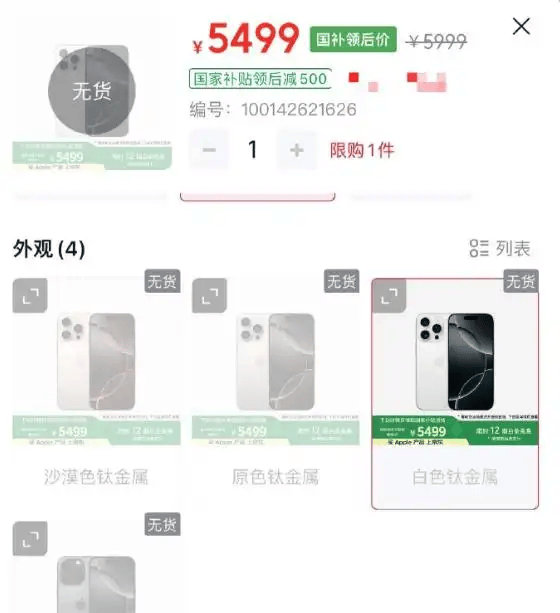
Core Insights - The recent price reduction of the iPhone 16 Pro 128GB version allows it to qualify for government subsidies, indicating strong demand and effective pricing strategy by Apple [3][4] - The sales surge of the "national subsidy version" iPhone 16 Pro highlights Apple's strong brand appeal in China and the positive impact of subsidy policies on high-end consumer electronics [4][5] - The competitive landscape in the high-end smartphone market is intensifying, with domestic brands like Huawei, Xiaomi, and OPPO adjusting their strategies to counter Apple's market presence [4] Group 1 - The iPhone 16 Pro 128GB version has sold out on a major e-commerce platform, while higher storage versions remain available but are priced above 6000 yuan, thus ineligible for subsidies [3] - Apple issued a price adjustment notice to its channel partners on May 10, leading to price cuts of up to 1400 yuan in authorized stores, with some e-commerce channels offering discounts of 2000 yuan compared to Apple's official prices [3] Group 2 - The success of the "national subsidy version" reflects consumer demand for high-value products and the combined effects of policy incentives and brand strength [5] - As the year-end shopping season approaches, competition in the smartphone market is expected to intensify, providing consumers with more purchasing opportunities [5] - Apple faces challenges in balancing supply and demand while addressing issues related to scalpers in the market [5]

【乘联分会论坛】2025年2月乘用车区域市场流向分析
乘联分会· 2025-03-25 08:22
Overall Market Trends - In the context of the national "two new" policies promoting passenger car consumption, the retail market for passenger cars in January-February 2025 showed a year-on-year growth of 1.1% [1] - The retail sales in February 2025 reached 1.385 million units, marking a 26% increase year-on-year, despite a 23% month-on-month decline [3] - Cumulatively, retail sales for January-February 2025 reached 3.18 million units, reflecting a strong recovery in the market [4] Regional Market Characteristics - The growth pattern of the car market has shifted to a "strong North, weak South" dynamic, with notable growth in the Northeast and Northwest regions, while the Central and Southern regions lag behind [5][6] - The Northeast and Northwest regions have shown the fastest growth compared to 2019, while the Central region, particularly the Yellow River area, has seen a decline in market performance [5][6] Sales Performance by Province - Northern provinces such as Ningxia, Inner Mongolia, Heilongjiang, and Liaoning have demonstrated strong sales growth, while regions like Tianjin and Qinghai have experienced significant declines [7] - The overall performance of the Southern provinces, including Guangxi and Yunnan, has been weaker compared to the North, indicating a disparity in consumer demand [7] Policy Impact on Market Structure - The subsidy policies have significantly benefited the sales of economic vehicles, particularly in the Northeast, North China, and Northwest regions, where the share of A00 and A0 class vehicles has increased by over 5% year-on-year [11][12] - The promotion of small and micro electric vehicles through subsidies reflects a positive trend in the effective popularization of these models [12] New Energy Vehicle Market Analysis - The new energy vehicle market is showing strong performance, especially in pure electric and plug-in hybrid segments, with traditional fuel vehicles still holding a significant share in the Midwest and Northern regions [10][11] - In regions like Hainan and Tianjin, the proportion of new energy vehicles has reached 60%-70%, indicating robust growth [11] SUV Market Dynamics - The demand for SUVs remains strong in the Midwest, driven by geographical factors, while the Eastern regions show a preference for lower-end electric vehicles due to their flat terrain [10]