新兴市场牛市

Search documents
全球资金上演“大迁徙”! AI基建狂潮与弱美元点燃新兴市场牛市
Zhi Tong Cai Jing· 2026-02-26 07:26
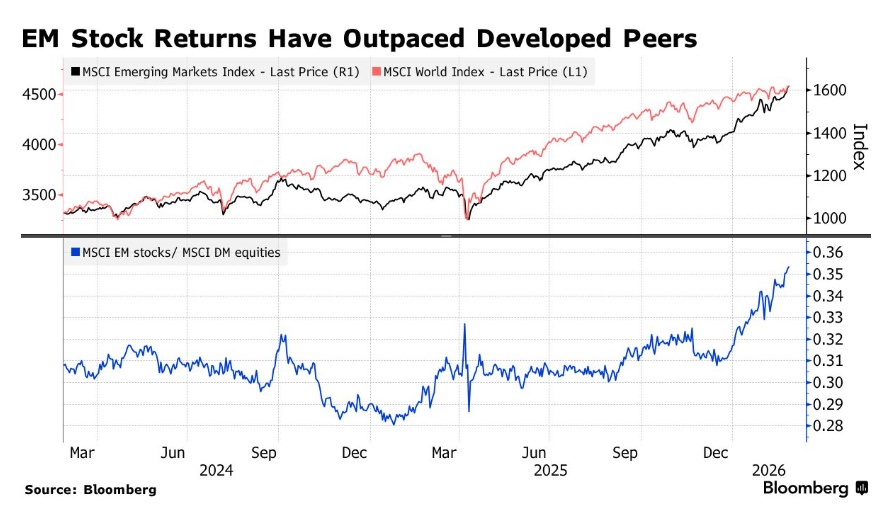
Core Viewpoint - Emerging market stocks are becoming one of the hottest investment themes globally in 2023, with top fund managers increasingly favoring a broad range of emerging market assets, including stocks, bonds, and sovereign currencies [1][5]. Group 1: Investment Trends - Major asset management firms, managing over $20 trillion, are significantly increasing their long positions in emerging market stocks, ETFs, and local currency bonds, betting on strong global economic growth and a weakening dollar [1][5]. - The MSCI Emerging Markets Index has been outperforming U.S. stocks and developed market indices, reaching historical highs and showing a year-to-date increase of 16% for the iShares MSCI Emerging Markets ETF [2][5]. - Fund managers are favoring emerging market bonds over U.S. Treasuries and core European sovereign bonds, with emerging market corporate debt receiving the largest allocation [5][11]. Group 2: Market Dynamics - The shift towards emerging markets reflects the uncertain investment backdrop in developed markets, where rising yields on long-term sovereign bonds in the U.S., Japan, and Germany are suppressing bullish sentiment [2][11]. - The recent overturning of the global tariff policy by the U.S. Supreme Court has led to a resurgence in emerging market assets, with significant inflows into funds like the iShares MSCI Emerging Markets ETF [2][5]. - The strong performance of key companies in the AI supply chain, such as TSMC and Samsung, has contributed to the rising prices of emerging market ETFs, which have outperformed the S&P 500 [2][5]. Group 3: Future Outlook - Analysts predict that emerging markets will continue to outperform U.S. markets, driven by a shift in global capital allocation and the concentration of AI infrastructure in Asia [4][11]. - The current market environment is favorable for semiconductor and AI infrastructure stocks, primarily located in emerging markets, as they benefit from a transition in global economic focus [5][12]. - The emerging market bull market is characterized by a combination of Asian technology, Latin American resources, and local currency bond yield recovery, indicating a more diversified growth trajectory compared to traditional resource-driven emerging market rallies [12].


新兴市场牛市浪潮席卷全球!最高法院关税裁决点火 贝莱德新兴市场ETF再创新高
智通财经网· 2026-02-21 01:33
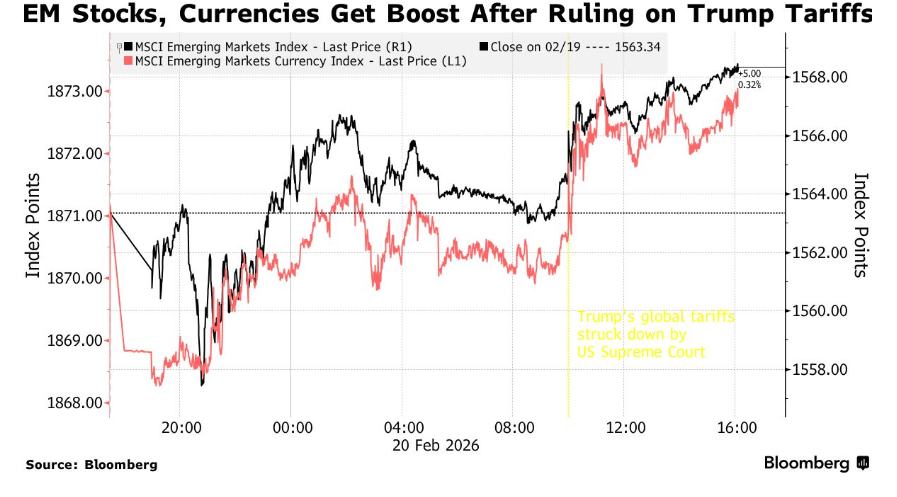
Group 1 - The U.S. Supreme Court's ruling against Trump's tariffs has led to a strong rally in emerging market assets, with a benchmark index for emerging market currencies reversing weekly losses and an emerging market ETF reaching a historical high [1][5] - Michael Hartnett, a strategist at Bank of America, emphasizes that emerging markets are likely to outperform the U.S. market amid the decline of "American exceptionalism" and a shift in global growth focus [1][7] - The iShares MSCI Emerging Markets ETF has seen a rare "ten consecutive days of gains," reaching a historical peak, with trading volume significantly above its 20-day average [1][4] Group 2 - The strong performance of key stocks like TSMC, Samsung, and SK Hynix has contributed to the iShares MSCI Emerging Markets ETF's rise, which has increased by 14% in 2026, outperforming the S&P 500 and Nasdaq 100 [4] - The ongoing global AI boom and the "sell America" narrative have positioned the Korean stock market as one of the best-performing markets globally, with a 40% increase in its benchmark index this year [4][8] - The Supreme Court's tariff decision is seen as a catalyst for emerging market currencies, highlighting significant uncertainty in U.S. government policies and driving diversification trends [5][8] Group 3 - Recent U.S. economic data indicates weakness, with GDP growth falling short of expectations and inflation measures exceeding forecasts, creating mixed signals for the Federal Reserve's interest rate outlook [6] - Despite geopolitical tensions, most Wall Street strategists believe that these will not escalate into a full-scale war, allowing emerging markets to maintain their strong upward momentum [6][7] - The uncertainty surrounding U.S. fiscal policies and high valuations in the U.S. market are prompting large investors to seek diversification in emerging markets, which are seen as more attractive in terms of valuation and growth expectations [8]
美股全线大涨,特斯拉市值一夜增超5400亿元
21世纪经济报道· 2025-05-27 23:49
Core Viewpoint - The article discusses the recent performance of the US stock market, highlighting the impact of President Trump's decision to delay tariffs on EU goods, which led to significant gains in major indices and tech stocks like Tesla [1][3][6]. Group 1: Stock Market Performance - On May 27, the US stock market saw a notable increase, with the Dow Jones rising by 1.78%, the S&P 500 by 2.05%, and the Nasdaq by 2.47% [1]. - Major tech stocks experienced substantial gains, with Tesla's stock price increasing by nearly 7%, adding approximately $75.9 billion (around ¥546.1 billion) to its market capitalization [3][4]. Group 2: Economic Outlook - The US economy has been developing in an environment of high interest rates, high growth, and elevated inflation, leading to increased financing costs for companies [6]. - Analysts predict that the return rate of US stocks may decline from the previous range of 15%-20% to 5%-10% over the next five years due to high valuations and potential shifts in investor preference towards other assets [6][7]. - Current valuations of US stocks are above 21 times earnings, which is considered high compared to other countries, suggesting limited short-term upside unless trade negotiations progress [6][7]. Group 3: Investor Sentiment - A survey conducted at the JPMorgan Global Markets Conference indicated that 36% of investors expect European markets to outperform by 2025, while only 17% favor the US market [7]. - Emerging markets are anticipated to enter a "new bull market," driven by a weaker dollar, peak US bond yields, and a recovering Chinese economy [7].

全球金融市场正在发生一些“更深层次”的事情?日债、美债拍卖遇冷,黄金、比特币新高
Di Yi Cai Jing· 2025-05-22 06:54
Core Viewpoint - Emerging markets are being identified as the "next bull market" globally, driven by a weakening dollar, high U.S. Treasury yields, and a recovering Chinese economy [1][10]. Group 1: U.S. Treasury and Market Dynamics - The recent sell-off in U.S. Treasuries has led to significant declines in U.S. stocks, with the S&P 500 experiencing its worst sell-off since April [3]. - The 20-year U.S. Treasury auction saw a maximum yield of 5.047%, marking the second instance in history where it exceeded 5%, alongside a notable drop in bid-to-cover ratio [3]. - Concerns over high U.S. debt levels and potential increases in the deficit due to proposed fiscal policies are driving investor sentiment away from U.S. assets [3][4]. Group 2: Global Market Reactions - The rise in U.S. Treasury yields is increasing borrowing costs for businesses and consumers, leading to further sell-offs in dollar-denominated assets [4]. - The current fiscal challenges in the U.S. are causing a significant rise in term premiums, which may lead to a self-fulfilling debt crisis [5]. - The increase in Japanese bond yields is also impacting global liquidity, potentially affecting U.S. and European markets [6]. Group 3: Precious Metals and Cryptocurrencies - Gold has reached a new high of over $3,340 per ounce, with expectations that it could surpass $3,500 in the near future due to its safe-haven appeal amid economic uncertainty [7]. - Bitcoin has also hit a record high of $109,500, driven by macroeconomic factors and increased institutional interest, with significant inflows into Bitcoin ETFs [9]. - Analysts suggest that both gold and Bitcoin are becoming focal points for investors seeking alternatives to traditional dollar assets [9]. Group 4: Emerging Markets Outlook - Emerging markets are being viewed favorably, with JPMorgan upgrading their rating from neutral to overweight, citing attractive valuations and easing trade tensions [10]. - The MSCI Emerging Markets Index has outperformed the S&P 500 this year, rising by 8.55% compared to the S&P's 1% increase [10]. - There is a growing demand among global investors for diversified exposure to emerging markets, which are currently undervalued compared to developed markets [11].