AI基建狂潮

Search documents
全球资金上演“大迁徙”! AI基建狂潮与弱美元点燃新兴市场牛市
Zhi Tong Cai Jing· 2026-02-26 07:26
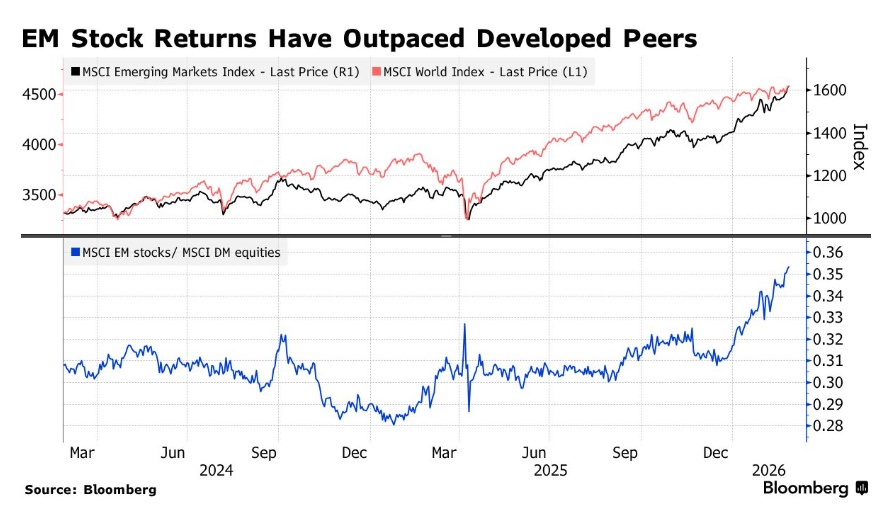
Core Viewpoint - Emerging market stocks are becoming one of the hottest investment themes globally in 2023, with top fund managers increasingly favoring a broad range of emerging market assets, including stocks, bonds, and sovereign currencies [1][5]. Group 1: Investment Trends - Major asset management firms, managing over $20 trillion, are significantly increasing their long positions in emerging market stocks, ETFs, and local currency bonds, betting on strong global economic growth and a weakening dollar [1][5]. - The MSCI Emerging Markets Index has been outperforming U.S. stocks and developed market indices, reaching historical highs and showing a year-to-date increase of 16% for the iShares MSCI Emerging Markets ETF [2][5]. - Fund managers are favoring emerging market bonds over U.S. Treasuries and core European sovereign bonds, with emerging market corporate debt receiving the largest allocation [5][11]. Group 2: Market Dynamics - The shift towards emerging markets reflects the uncertain investment backdrop in developed markets, where rising yields on long-term sovereign bonds in the U.S., Japan, and Germany are suppressing bullish sentiment [2][11]. - The recent overturning of the global tariff policy by the U.S. Supreme Court has led to a resurgence in emerging market assets, with significant inflows into funds like the iShares MSCI Emerging Markets ETF [2][5]. - The strong performance of key companies in the AI supply chain, such as TSMC and Samsung, has contributed to the rising prices of emerging market ETFs, which have outperformed the S&P 500 [2][5]. Group 3: Future Outlook - Analysts predict that emerging markets will continue to outperform U.S. markets, driven by a shift in global capital allocation and the concentration of AI infrastructure in Asia [4][11]. - The current market environment is favorable for semiconductor and AI infrastructure stocks, primarily located in emerging markets, as they benefit from a transition in global economic focus [5][12]. - The emerging market bull market is characterized by a combination of Asian technology, Latin American resources, and local currency bond yield recovery, indicating a more diversified growth trajectory compared to traditional resource-driven emerging market rallies [12].


阿斯麦(ASML.US)将“卡脖子”演绎到极致! 当AI基建狂潮与存储超级周期来袭 “人类科技巅峰”踏上主升浪
智通财经网· 2026-01-22 09:28
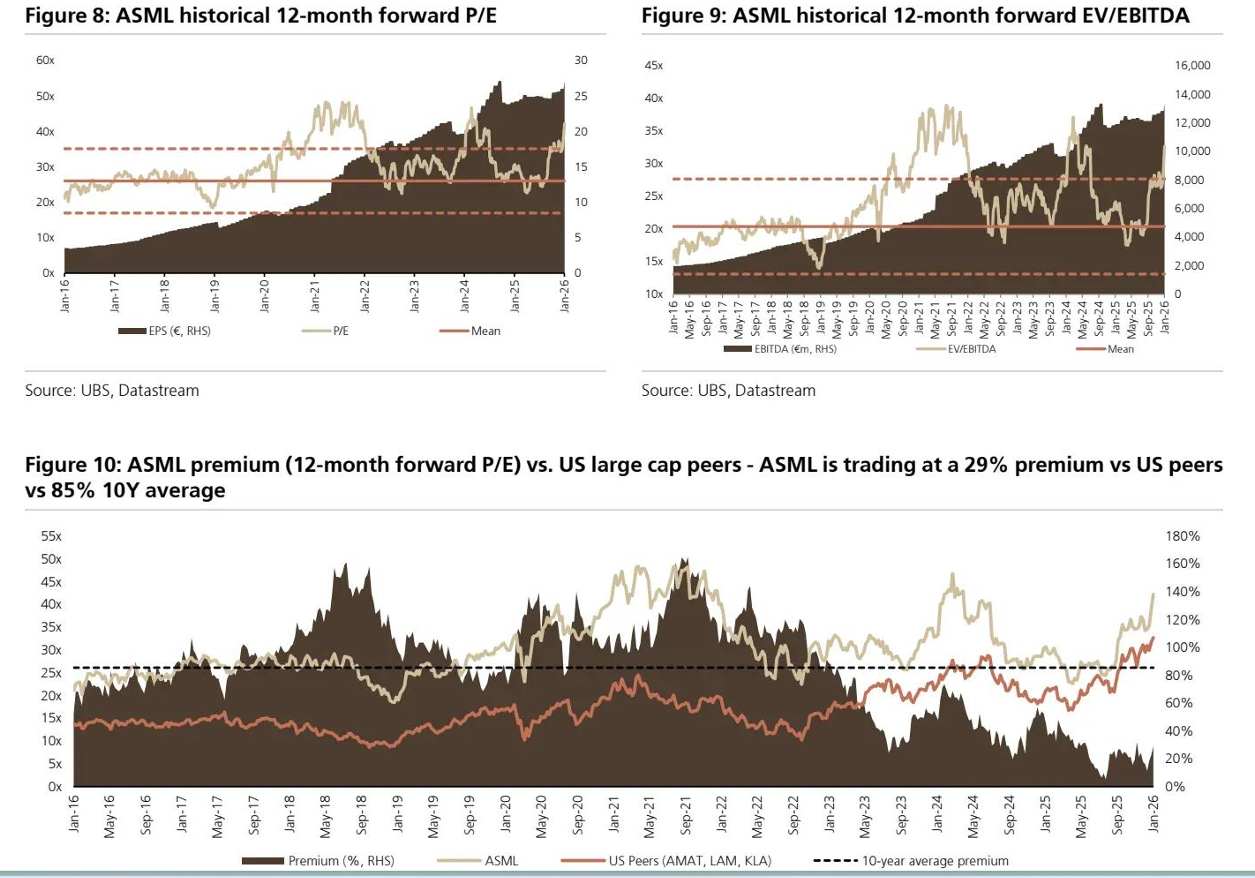
Core Viewpoint - UBS maintains a "Buy" rating for ASML Holding NV, raising the 12-month target price from €1030 to €1400, driven by stronger capital expenditures and optimistic revenue expectations from the Chinese market [1][13]. Company Performance - ASML's stock price reached €1154, with a cumulative increase of 25% since 2026, driven by strong semiconductor equipment spending amid AI infrastructure and a "storage chip super cycle" [1][2]. - ASML's ADR in the US also saw significant gains, with a year-to-date increase of 27% and a market capitalization of $527 billion [2]. Market Trends - Major investment firms, including KeyBanc and Citigroup, predict a stronger demand year for the global semiconductor industry, particularly benefiting companies like ASML, Lam Research, and Applied Materials due to the AI infrastructure boom and storage chip super cycle [8][9]. - The semiconductor equipment sector is expected to enter a "Phase 2 bull market," with a focus on leading companies in the field [9]. Financial Projections - UBS forecasts ASML's revenues to grow significantly, with 2026 revenue expected to reach €40.149 billion, a 23% increase from previous estimates [19]. - The expected EPS for ASML in 2026 is projected at €33.83, exceeding market consensus by 26% [19]. Product Development - ASML's EUV lithography machines are critical for advancing chip manufacturing processes, enabling the transition from 7nm to 3nm and below, which is essential for AI applications [10][11]. - The introduction of High-NA EUV machines is expected to further enhance manufacturing capabilities, making them indispensable for leading chip manufacturers like TSMC and Intel [10][11]. Investment Drivers - The strong capital expenditure in advanced logic and storage chips is expected to create a structural demand for semiconductor equipment, positioning ASML favorably in the market [16][18]. - The ongoing AI infrastructure development is driving unprecedented demand for both advanced chips and storage solutions, reinforcing the long-term bullish outlook for the semiconductor equipment sector [17][18].

铜价破1.3万美元再创新高 美铜关税信号或成“牛转熊”拐点
2 1 Shi Ji Jing Ji Bao Dao· 2026-01-14 16:33
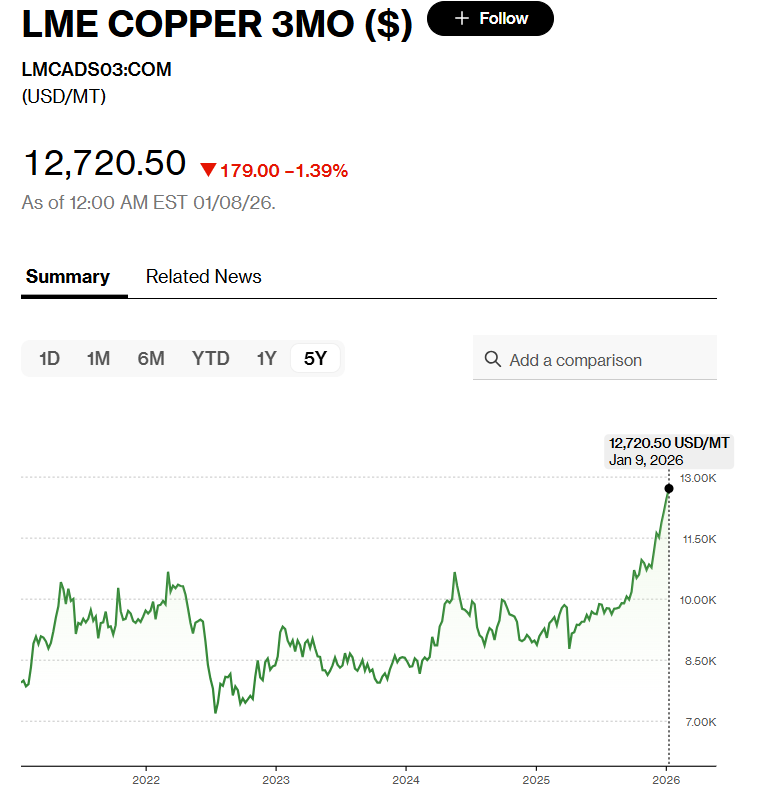
Core Viewpoint - The copper market is experiencing significant price volatility, with prices nearing record highs due to supply disruptions and increasing demand expectations, particularly in the context of energy transition and technological advancements [1][2][4]. Group 1: Price Trends - As of January 14, LME copper prices reached $13,186 per ton, having surged 6.14% over the past month, with a peak increase of 22% within that timeframe [1]. - Since November 20, 2022, LME copper prices have risen from $10,686 to $13,189 per ton, marking an increase of nearly 24% [3]. - UBS forecasts a structural shortage in the copper concentrate market by 2026/27, contrasting with Goldman Sachs and Citigroup's short-term warnings about price sustainability [2][11]. Group 2: Supply Dynamics - Supply pressures are evident, particularly from South America, where Chile's market share has decreased from 30% to 24% over the past decade, while production growth is shifting towards Africa [5][7]. - Recent mining incidents, including earthquakes and strikes in major copper-producing regions, have exacerbated supply concerns, leading to significant price increases [6][10]. - The approval delays for new copper mining projects are contributing to ongoing supply tightness, with UBS noting that the number of final investment decisions remains low [7]. Group 3: Demand Factors - The demand for copper is expected to grow rapidly due to its critical role in electric vehicles and renewable energy technologies, with each electric vehicle requiring three to four times more copper than traditional vehicles [8][12]. - The ongoing energy transition and AI infrastructure development are driving increased copper consumption, further widening the supply-demand gap [7][12]. Group 4: Market Sentiment and Speculation - Market sentiment is polarized, with some analysts viewing the current price surge as a temporary reaction to U.S. tariff expectations, while others see it as a reflection of genuine supply constraints [8][9]. - The current market is characterized by a backwardation structure, indicating immediate supply tightness, as evidenced by low inventory levels [9][10]. Group 5: Alternative Materials - The rising copper prices have led industries to explore alternatives like aluminum, particularly in air conditioning and electrical applications, although challenges remain in terms of performance and cost [12][13]. - While "aluminum replacing copper" is gaining traction, experts caution that its impact on overall copper demand may be limited, as copper remains irreplaceable in high-performance applications [13].
铜“牛市叙事”即将崩塌? 特朗普铜关税信号或成“牛转熊”最锋利拐点
智通财经网· 2026-01-09 10:08
Core Viewpoint - Goldman Sachs presents a mixed outlook on copper prices, acknowledging short-term bullish factors driven by scarcity and demand from the energy transition and AI infrastructure, while cautioning about a potential mid-term correction due to fundamental market conditions and U.S. tariff policies [1][5][9]. Group 1: Price Predictions - Goldman Sachs has raised its copper price forecast for the first half of 2026 from $11,525 per ton to $12,750 per ton, citing a "scarcity premium" and insufficient inventory outside the U.S. as key drivers [1][7]. - The firm maintains a cautious outlook for the fourth quarter of 2026, predicting a price of $11,200 per ton, indicating that prices above $13,000 per ton are unlikely to be sustainable in the long term [1][7]. Group 2: Market Dynamics - The recent surge in copper prices is attributed to two main factors: U.S. tariff expectations causing a "cross-regional depletion" effect and strong demand driven by AI-related investments [5][6]. - The U.S. copper market is experiencing a structural mismatch, with rising Comex copper inventories and declining LME copper stocks, leading to increased scarcity premiums [5][6]. Group 3: Tariff Implications - The uncertainty surrounding U.S. tariffs on refined copper products is a critical factor influencing market behavior, with potential announcements expected in the second quarter of 2026 [9][10]. - Goldman Sachs outlines various scenarios regarding tariff implementation, with a baseline scenario suggesting a 15% tariff announcement in mid-2026, while a delay could lead to significant downward pressure on copper prices [10][11]. Group 4: Speculative Positioning - The copper futures market is currently characterized by a crowded speculative long position, which may lead to increased volatility and sensitivity to market catalysts [11][12]. - A shift in the narrative from scarcity to potential oversupply could trigger a rapid price decline if the "hoarding logic" weakens [11][12].