新兴经济体工业化

Search documents
外贸数据点评:出口飙升的“春节效应”?
Shenwan Hongyuan Securities· 2026-03-10 10:45
Group 1: Export Data Overview - Exports in January-February increased by 21.8% year-on-year, significantly higher than the expected 7.3% and previous value of 6.6%[3] - The surge in exports is primarily attributed to the "Spring Festival effect," which contributed an estimated 8.4 percentage points to the growth, while external demand improvement added 6.8 percentage points[4] - The export rebound is particularly pronounced in labor-intensive sectors such as textiles and furniture, which are directly impacted by the Spring Festival timing[4] Group 2: Import Data Insights - Imports also saw a year-on-year increase of 19.8%, surpassing the expected 6.9% and previous value of 5.7%[3] - Processing trade imports rose significantly, up 19.1 percentage points to 37.9%, indicating a continuation of export improvements[5] - Key imports included electrical machinery, which increased by 14.9 percentage points to 23.7%, and integrated circuits, which rose by 23.2%[5] Group 3: Country-Specific Export Trends - Exports to the United States rebounded by 13.4 percentage points to -16.7%, reflecting improved demand despite previous declines[5] - Exports to Africa surged by 18.3 percentage points to 40.1%, while exports to ASEAN increased by 9.2 percentage points to 20.3%[5] - The overall export growth is supported by the industrialization acceleration in emerging economies and the release of domestic demand[5] Group 4: Future Outlook - The "Spring Festival effect" is expected to lower March export figures, but overall annual export growth is projected to remain high due to stable external demand and improved market conditions[6] - The strong export data for January-February reflects ongoing improvements in external demand, inventory replenishment in the U.S., and favorable tariff conditions[6]
化工和农业,涨价乘风起
Orient Securities· 2026-02-01 12:42
Group 1 - The report emphasizes the importance of the chemical and agricultural sectors, highlighting their potential for price increases driven by geopolitical tensions and industrial transformation [2][5][12] - The macroeconomic logic behind the current commodity price increases is characterized by external factors rather than internal dynamics, with non-energy commodities benefiting the most [13][30] - The report identifies two main lines of price increase: the industrialization of emerging economies and the geopolitical turmoil affecting import prices [48][49] Group 2 - In agriculture, the report notes that upstream price transmission is expected to lead to a comprehensive upward trend in agricultural products, particularly in pigs, rubber, sugar, corn, and oilseeds [5][3][20] - The chemical sector is anticipated to undergo a transformation in supply expectations, with new export opportunities emerging, particularly due to the decline of chemical industries in Europe and Japan [5][4][20] - The report suggests that the current low allocation of funds to the agricultural sector presents a significant investment opportunity, with selected active equity funds and passive ETFs recommended for investors [5][22][36] Group 3 - The report outlines a shift in the investment landscape, with a focus on mid-cap blue-chip stocks as a key area of interest, particularly in the cyclical sectors of chemicals and agriculture [58][5][48] - It highlights that the current market environment favors a risk preference shift towards mid-risk characteristics, which aligns with the performance of mid-cap blue-chip stocks [58][5][48] - The report indicates that the cyclical nature of the chemical and agricultural sectors positions them well for future investment opportunities [5][58][48]
策略周度思考 20260201:中盘蓝筹系列:大宗涨价的两条主线
Orient Securities· 2026-02-01 07:45
Group 1: Price Trends and Historical Context - Historical price trends for commodities follow a sequence: precious metals, industrial metals, petrochemicals, and agricultural products, with significant bull markets occurring five times since the 1970s when prices increased by over 50%[9] - The typical price increase sequence is less than one quarter for precious metals, about two quarters for petrochemicals, and approximately one quarter for agricultural products[12] - In the current cycle, precious metals have surged ahead, while industrial metals, petrochemicals, and agricultural products have lagged behind[9] Group 2: Current Market Dynamics - The current market is influenced by two main factors: domestic industrial transformation and global political changes, leading to a divergence in commodity performance[28] - Commodities closely tied to traditional industries, such as real estate, are expected to show weak performance despite policy support, as seen in the contrasting performance of tungsten-iron and iron[30] - Emerging economies are expected to drive future demand growth, with a decoupling from developed economies, particularly in Asia, Africa, and Latin America[30] Group 3: Future Price Pathways - The current price increase is characterized by external factors rather than internal ones, focusing on two main lines: price increases driven by industrialization in emerging economies and geopolitical tensions affecting import prices[43] - The industrialization of emerging economies is anticipated to sustain demand for industrial products, supported by China's technology and capital[43] - Geopolitical risks, including issues in Japan, the Middle East, and Latin America, are expected to impact commodity prices, particularly for imports like agricultural products and crude oil[44] Group 4: Investment Outlook and Risks - The report favors investment in the chemical and agricultural sectors due to their potential for price increases, while being conservative on commodities closely linked to the real estate sector[44] - Risks include market performance falling short of expectations, insufficient pricing of geopolitical risks, and potential underperformance in industry developments[45][46][47]
策略周度思考 20260201:中盘蓝筹系列:大宗涨价的两条主线-20260201
Orient Securities· 2026-02-01 07:02
Group 1: Historical Price Trends - Historical price trends of commodities follow a sequence: precious metals, industrial metals, petrochemicals, and agricultural products[9] - Since 1970, there have been five significant commodity bull markets, defined by a price increase of over 50%[10] - The typical price increase sequence occurs in less than one quarter for precious metals, about two quarters for petrochemicals, and approximately one quarter for agricultural products[12] Group 2: Current Market Dynamics - Current market dynamics are influenced by domestic industrial transformation and global political changes[28] - Commodities closely tied to traditional industries, such as real estate, are expected to perform poorly due to reduced demand elasticity[30] - Emerging economies are expected to drive future demand growth, with a decoupling from developed economies observed[30] Group 3: Price Increase Pathways - The current price increase is characterized by external rather than internal factors, focusing on two main lines: industrialization in emerging economies and geopolitical tensions affecting import prices[43] - The first main line involves price increases driven by industrialization in emerging economies, which is expected to continue due to China's support[44] - The second main line is influenced by geopolitical risks, which can directly threaten commodity prices and create cost transmission effects[44] Group 4: Investment Outlook - The report is optimistic about the price outlook for the chemical and agricultural sectors while being conservative about commodities closely related to the real estate chain[44] - Risks include market performance falling short of expectations, insufficient pricing of geopolitical risks, and potential underperformance in industry development[45]
碳酸锂期货大涨超3%,盛新锂能获百亿长单!有色50ETF(159652)爆量上涨!有色年内涨幅领跑大市,2026年将如何演绎?
Xin Lang Cai Jing· 2025-11-20 05:38
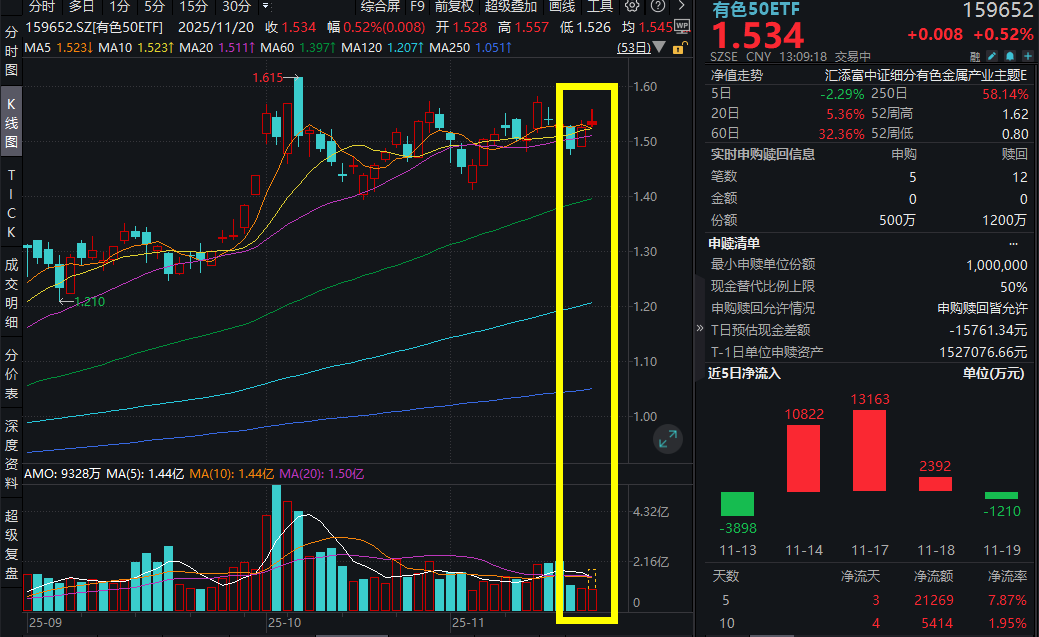
Group 1: Market Overview - The A-share market showed slight recovery on November 20, with the non-ferrous sector opening high and fluctuating, as evidenced by the significant trading volume of the Non-Ferrous 50 ETF (159652) which rose by 0.52% and reached a trading volume of over 90 million yuan [1] - The Non-Ferrous 50 ETF index components mostly surged, with Zhongkuang Resources rising over 5%, while other stocks like Northern Rare Earth and Huayou Cobalt also saw gains exceeding 1% [3] Group 2: Lithium Market Dynamics - On November 19, lithium carbonate futures prices broke through 100,000 yuan/ton, indicating a clear recovery in spot lithium carbonate prices. Ganfeng Lithium's chairman stated that if demand growth exceeds 30% to 40% next year, prices could potentially exceed 150,000 yuan/ton or even 200,000 yuan/ton due to supply constraints [2] Group 3: Supply Chain and Pricing Trends - The supply chain for non-ferrous metals is facing disruptions, with several large mines experiencing operational issues, which highlights the vulnerability of global non-ferrous resource supply [6] - The copper market is expected to see average prices reach 4.55 USD per pound by 2026 due to supply concerns stemming from accidents at major mines [5] Group 4: Investment Opportunities in Non-Ferrous Metals - The non-ferrous metals sector has outperformed other industries this year, with a year-to-date increase of 79% for the CITIC non-ferrous metals index, significantly leading other sectors [5] - The Non-Ferrous 50 ETF (159652) is highlighted for its high "gold-copper content" of 46%, making it a leading choice among similar investment products [12] Group 5: Future Outlook and Strategic Considerations - The geopolitical landscape and resource security concerns are expected to drive demand for strategic commodities, with a notable increase in green demand for copper and aluminum anticipated by 2030 [8] - The ongoing industrialization in emerging economies and the reshaping of trade patterns are likely to provide new growth opportunities for commodity demand, particularly in countries involved in the Belt and Road Initiative [9]





中金2026年展望 | 大宗商品:秩序新章的三重奏(要点版)
中金点睛· 2025-11-04 23:48
Core Viewpoint - The article discusses the reshaping of global trade patterns due to the 2025 U.S. tariff policy, leading to increased asset volatility and economic uncertainty, while also highlighting opportunities in the commodity market amidst geopolitical tensions and industry innovations [2]. Group 1: Geopolitical Risks and Supply Challenges - Geopolitical tensions and resource protectionism are expected to further challenge the already fragile supply elasticity in energy and metal markets [4]. - The decline in upstream investment in global energy and metals has persisted for nearly a decade, with capital expenditures decreasing compared to 2024 levels, which may suppress investment willingness among upstream companies [5]. - The copper market is experiencing supply constraints due to insufficient upstream investment, while the oil market is facing a potential turning point in non-OPEC production due to declining investment and rising costs [5][10]. Group 2: Strategic Security and Demand Dynamics - The focus on strategic security is increasing, with energy transition and reserve construction becoming essential trends, potentially providing resilience for strategic commodity resources [12]. - The demand for green transition metals and biofuels is expected to grow, driven by policies in countries like Indonesia, Malaysia, the U.S., and Brazil [13]. - Non-OECD countries are showing increased demand for oil reserves and gold purchases, reflecting a heightened concern for resource security amid rising geopolitical uncertainties [16]. Group 3: Emerging Demand and Industrialization - Emerging demand is gaining momentum, particularly from AI investments and the industrialization of emerging economies, which may drive the next supercycle in commodities [17]. - The ongoing restructuring of trade patterns and industrial divisions is expected to support the industrialization processes in emerging economies, with India and Belt and Road countries likely to be key drivers of future demand [19]. - The resilience in exports of intermediate goods, such as steel from China, indicates a marginal uplift in commodity demand [19]. Group 4: Commodity Market Outlook for 2026 - Despite high macroeconomic uncertainties, the supply disruptions and localized demand changes may lead to a marginal improvement in the oversupply situation in the commodity market by 2026 [24]. - Non-ferrous and precious metals are anticipated to continue their upward trend, with copper facing both long-term capital expenditure constraints and short-term supply disruptions [24]. - Oil and agricultural products are expected to rebound due to cost support and supply risks, while black metals may face continued pressure from domestic demand slowdowns [25].