新兴需求增长

Search documents
乐观预期与市场情绪共振 锡价维持强势
Qi Huo Ri Bao· 2026-01-26 00:32
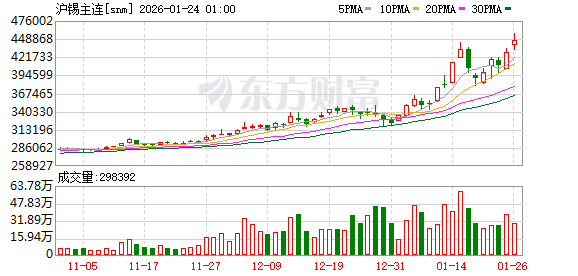
Core Viewpoint - The recent rise in tin prices is primarily driven by improved macroeconomic sentiment and geopolitical policy disturbances, with the main support coming from a stable inflation environment in the U.S. and pressure on the Federal Reserve to lower interest rates, creating a weak dollar scenario [2] Group 1: Price Movements and Influencing Factors - As of last Friday, the main contract price for tin on the Shanghai Futures Exchange closed above 447,140 yuan per ton, marking a 6.56% increase [2] - The significant price increase on Friday was closely linked to allegations of monopolistic practices in port logistics by Indonesia's Qingshan Industrial Park, despite limited actual export impact [2] - The approval delay for mining explosives in Myanmar has resulted in the resumption level of the Manxiang tin mine being only 40%-50% of pre-ban levels [2] Group 2: Market Dynamics and Sentiment - The exuberance in the funding environment has amplified the rise in tin prices, with a surge in precious metals like silver boosting market risk appetite and leading to increased capital inflow into the non-ferrous metals sector [3] - There is a divergence between market expectations and actual demand, with current consumption being notably weak due to the seasonal slowdown and high prices, leading to widespread production cuts among downstream processing enterprises [3] Group 3: Supply and Demand Outlook - Global tin visible inventory has significantly increased to approximately 16,000 tons, with domestic social inventory rising from below 8,000 tons to around 10,000 tons, and LME inventory climbing from 3,000 tons to over 7,000 tons [3] - The core operational logic for tin prices in the medium to long term revolves around resource scarcity and emerging demand growth, with potential supply disruptions and depletion risks due to fragile overseas mining operations and resource protection policies [4] Group 4: Future Projections - Even if Myanmar's supply returns to normal levels, a supply gap for tin is still expected in 2026, with limited elasticity on the supply side and optimistic demand projections from sectors like renewable energy and AI [5] - The overall short-term volatility in tin prices may arise from a retreat in market sentiment and inventory pressures, but the medium to long-term supply-demand balance remains tight, suggesting that the price center is likely to stay elevated [5]

乐观预期与市场情绪共振,锡价维持强势
Qi Huo Ri Bao· 2026-01-26 00:17
Group 1 - The core viewpoint of the article highlights that the recent rise in tin prices is driven by improved macroeconomic sentiment and geopolitical policy disturbances [3] - As of last Friday, the main contract price of tin on the Shanghai Futures Exchange closed above 447,140 yuan per ton, marking a 6.56% increase [2] - The supply of tin is facing significant uncertainties due to geopolitical and policy disturbances in Myanmar, Congo (DRC), and Indonesia, which are major tin-producing regions [3] Group 2 - The market is currently experiencing a divergence between expectations and reality, leading to uncertainty in tin price trends ahead of the Spring Festival [4] - Global visible tin inventories have significantly increased to approximately 16,000 tons, with domestic social inventory rising from below 8,000 tons to around 10,000 tons [4] - Short-term tin price movements are expected to largely depend on market sentiment, with potential for prices to reach new highs if sentiment remains strong [4] Group 3 - From a medium to long-term perspective, the core logic of tin price movements revolves around resource scarcity and emerging demand growth [5] - Despite potential weak loosening in static supply-demand projections for 2026 due to the resumption of production at certain mines, risks of supply interruptions and depletion remain [5] - Overall, while short-term fluctuations may occur due to sentiment and inventory pressures, the medium to long-term supply-demand balance is expected to remain tight, supporting high tin price levels [5]

大幅跑赢黄金!铂金年内翻倍涨幅背后的三重驱动力
Jing Ji Guan Cha Wang· 2025-12-17 12:59
Core Viewpoint - The NYMEX platinum futures prices have surged significantly, reaching a high of $1955 per ounce, marking a more than 110% increase year-to-date, driven by structural supply shortages, rising demand, and supportive macroeconomic conditions [1][3][9]. Price Movement - Since December, NYMEX platinum futures have increased over 15%, with notable monthly gains of 30% in June and 18% in September [2][6]. - The domestic market has also seen significant price increases, with the main contract on the Shanghai Futures Exchange rising from 405 yuan per gram to a peak of 527.55 yuan per gram, a 30% increase since its listing [2]. Supply and Demand Dynamics - Approximately 70% of global platinum production comes from South Africa, where supply is constrained due to underinvestment, power shortages, and aging infrastructure [3]. - The World Platinum Investment Council (WPIC) forecasts a supply shortfall of about 20 tons in 2025, marking the third consecutive year of supply deficits [3]. Emerging Demand Factors - The demand for platinum is diversifying, with significant growth expected in hydrogen energy applications, where platinum is essential for fuel cells [4][7]. - China's investment demand for platinum is projected to surge by 100% by 2025, positioning it as the largest retail investment market globally [4]. Macroeconomic Influences - The recent Federal Reserve interest rate cut and expectations of continued monetary easing have bolstered platinum prices [5][10]. - The correlation between platinum and gold prices has been highlighted, with both metals benefiting from macroeconomic uncertainties and geopolitical risks [6]. Market Outlook - Analysts suggest that while the price of platinum may continue to rise, there could be periods of high volatility and potential corrections due to profit-taking [10][11]. - The future price predictions for platinum in 2026 vary widely, reflecting market uncertainties and differing views on economic conditions [10].

碳酸锂期货大涨超3%,盛新锂能获百亿长单!有色50ETF(159652)爆量上涨!有色年内涨幅领跑大市,2026年将如何演绎?
Xin Lang Cai Jing· 2025-11-20 05:38
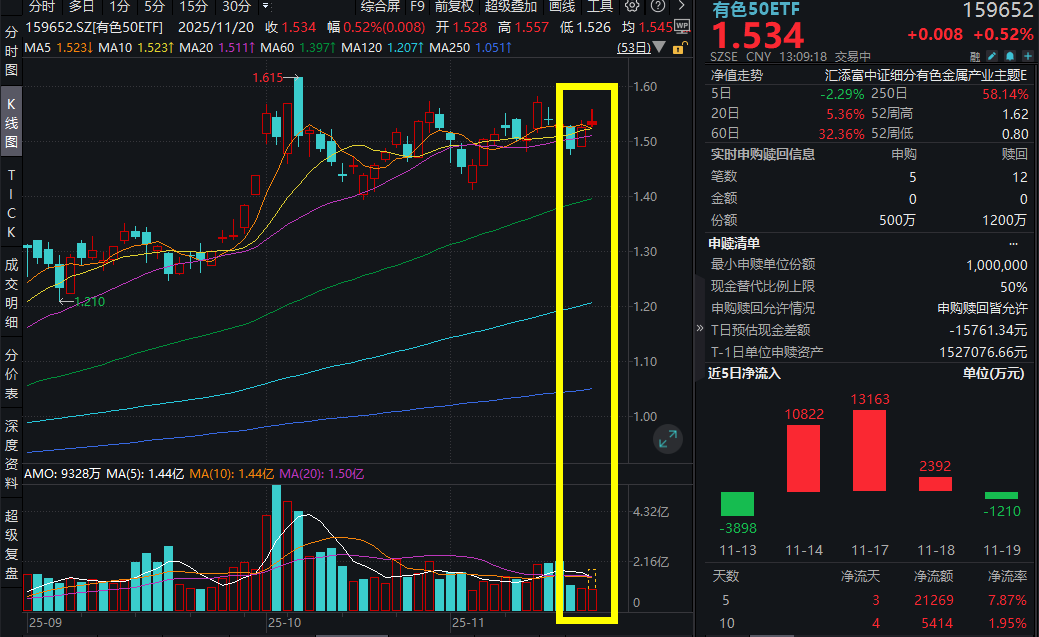
Group 1: Market Overview - The A-share market showed slight recovery on November 20, with the non-ferrous sector opening high and fluctuating, as evidenced by the significant trading volume of the Non-Ferrous 50 ETF (159652) which rose by 0.52% and reached a trading volume of over 90 million yuan [1] - The Non-Ferrous 50 ETF index components mostly surged, with Zhongkuang Resources rising over 5%, while other stocks like Northern Rare Earth and Huayou Cobalt also saw gains exceeding 1% [3] Group 2: Lithium Market Dynamics - On November 19, lithium carbonate futures prices broke through 100,000 yuan/ton, indicating a clear recovery in spot lithium carbonate prices. Ganfeng Lithium's chairman stated that if demand growth exceeds 30% to 40% next year, prices could potentially exceed 150,000 yuan/ton or even 200,000 yuan/ton due to supply constraints [2] Group 3: Supply Chain and Pricing Trends - The supply chain for non-ferrous metals is facing disruptions, with several large mines experiencing operational issues, which highlights the vulnerability of global non-ferrous resource supply [6] - The copper market is expected to see average prices reach 4.55 USD per pound by 2026 due to supply concerns stemming from accidents at major mines [5] Group 4: Investment Opportunities in Non-Ferrous Metals - The non-ferrous metals sector has outperformed other industries this year, with a year-to-date increase of 79% for the CITIC non-ferrous metals index, significantly leading other sectors [5] - The Non-Ferrous 50 ETF (159652) is highlighted for its high "gold-copper content" of 46%, making it a leading choice among similar investment products [12] Group 5: Future Outlook and Strategic Considerations - The geopolitical landscape and resource security concerns are expected to drive demand for strategic commodities, with a notable increase in green demand for copper and aluminum anticipated by 2030 [8] - The ongoing industrialization in emerging economies and the reshaping of trade patterns are likely to provide new growth opportunities for commodity demand, particularly in countries involved in the Belt and Road Initiative [9]




中金2026年展望 | 大宗商品:秩序新章的三重奏
中金点睛· 2025-11-09 23:37
Core Viewpoint - The article discusses the restructuring of global trade patterns accelerated by the 2025 U.S. tariff policy, leading to a reconfiguration of global industrial division and macro order, which may significantly increase asset volatility and economic uncertainty [2][8]. Group 1: Geopolitical and Supply Challenges - Geopolitical tensions and resource protectionism are expected to further challenge the already fragile supply elasticity in energy and metal markets, with a decade-long down cycle in upstream investments leading to unstable existing supplies and insufficient incremental supplies [5][16]. - The ongoing geopolitical risks and resource protectionism are likely to increase macro uncertainties, further challenging the supply elasticity in energy and metal markets [5][23]. Group 2: Demand Dynamics and Energy Transition - The focus on strategic security is shifting demand-side attention towards energy transition and reserve construction, indicating that energy transition remains a significant trend and reserve building is essential for strategic commodities [5][36]. - The global energy system has seen a new round of investment expansion since 2021, with a significant shift towards renewable energy and related sectors, reflecting a steady advancement in energy transition [36][39]. Group 3: Emerging Demand and Industrialization - Emerging demand is gaining momentum, driven by AI narratives and the ongoing electrification trend, which is expected to provide sustained demand growth for commodities like copper [6][48]. - The restructuring of trade patterns and industrial division is likely to support the industrialization processes in emerging economies, with significant demand potential from countries along the Belt and Road Initiative [6][56]. Group 4: Commodity Market Outlook for 2026 - The article anticipates that geopolitical tensions, resource security demands, and emerging demand growth will form a "triple play" for the commodity market as it enters a new chapter [2][8]. - The supply-demand balance in the commodity market is expected to improve marginally in 2026, with a focus on micro-level differences and fundamental changes in various commodities [58][60]. Group 5: Specific Commodity Insights - The copper market is projected to face a supply gap due to insufficient upstream investment and increasing demand from electrification, with prices expected to remain elevated [68]. - The oil market may experience a shift from surplus to a more balanced state, with potential upward price adjustments driven by geopolitical risks and supply constraints [64][65]. - Agricultural commodities are expected to see a gradual recovery, influenced by trade policies, weather risks, and the growth of biofuels [70][71].