原油化工

Search documents
金信期货日刊-20260327
Jin Xin Qi Huo· 2026-03-26 23:39
金信期货日刊 本刊由金信期货研究院撰写 2 0 2 6 / 3 / 2 7 GOLDTRUST FUTURES CO., LTD 美伊冲突过去后,原油价格大概率回落? 一、美伊冲突过去后,原油价格大概率回落 GOLDTRUST FUTURES 数据来源:公开资料、金信期货 观点仅供参考,市场有风险,入市需谨慎 ibaotu.com 热点聚焦 - 地缘冲突对油价的影响多为短期情绪溢价,而非长期趋势。历史复盘显示,多数中东地缘事件后,原油风 险溢价会在数周至2-3个月内快速回吐,回归供需基本面定价。 感谢您下载包图网平台上提供的PPT作品,为了您和包图网以及原创作者的利益,请勿复制、传播、销售,否则将承担法律责任!包图网将对作品进行维权,按照传播下载次数进行十倍的索取赔偿! - 本次冲突若快速平息、霍尔木兹海峡恢复通航,布伦特原油大概率从当前高位回落至62-73美元/桶区间, 地缘溢价消退。 - 只有出现实质性长期封锁或核心产油区供应持续中断,油价才可能长期高位;当前看这种情景概率较低。 二、原油回落时,原油化工板块与期货的走势 - 原油化工期货整体跟随原油回调,但呈现结构性分化。 - 直接油化工品种(如石脑油裂 ...
中观景气跟踪3月第3期:原油链持续涨价,出海制造景气提升
GUOTAI HAITONG SECURITIES· 2026-03-20 05:11
策 略 研 究 原油链持续涨价,出海制造景气提升 [Table_Authors] 方奕(分析师) 中观景气跟踪 3 月第 3 期 本报告导读: 中观景气分化,原油供给扰动加剧,原油化工链价格持续上行;新兴科技景气中枢 进一步上移,出海制造增速提升;一季度旅行出行和大众品消费增速亮眼。 略 观 投资要点: | | | | | 021-38031658 | | --- | --- | | | fangyi2@gtht.com | | 登记编号 | S0880520120005 | | | 陶前陈(研究助理) | | | 0755-23976164 | | | taoqianchen@gtht.com | | 登记编号 | S0880125070014 | | | 张逸飞(分析师) | | | 021-38038662 | | | zhangyifei@gtht.com | | 登记编号 | S0880524080008 | [Table_Report] 相关报告 地缘波动之下:全球外资流出美国,南水大幅买 入港股 2026.03.17 成交活跃度上升,沪深 300 领涨 2026.03.15 科技景气中枢上移,原 ...
2026年全球经济和大类资产白皮书:穿越周期,洞见新机
Ge Lin Qi Huo· 2026-03-06 08:08
1. Report Industry Investment Rating No information provided in the report. 2. Core Views of the Report - The global economy is undergoing a paradigm shift from globalization to geopolitics, with geopolitical risks becoming a core variable in asset pricing. The global economy is at the end of the depression phase of the previous information technology cycle, and 2026 - 2027 is expected to be a global economic trough, followed by a new cycle centered on artificial intelligence and new energy [4]. - The world economic pattern is being reshaped, with the US - China game leading to the reorganization of the order. The US economy shows signs of stagflation and faces policy dilemmas, while the Chinese economy has both challenges and resilience. Other economies are also experiencing differentiation [4]. - The core driving forces include the technological revolution, energy transformation, and geopolitical games, which will have a profound impact on the global economy and asset prices [4]. - In 2026, different asset classes have different investment strategies, such as gold as a core asset, copper and aluminum as strategic assets, and attention to structural opportunities in various markets [6]. 3. Summary by Relevant Catalogs Chapter 1: Historic Turn in the Context of a Century - Long Change - **Paradigm Shift from Globalization to Geopolitics**: The global political - economic pattern is shifting from globalization to geopolitics, with geopolitical risks becoming a key factor in asset pricing. Trump's potential radical trade policies are an extreme manifestation of this trend [17]. - **Positioning from the Perspective of the Kondratieff Cycle**: The global economy is at the end of the depression phase of the previous information technology cycle, expected to end in 2026. This will resonate with the bottom of the Kitchin inventory cycle, and 2026 - 2027 may be a significant global economic trough [18]. Chapter 2: Fission and Reconstruction of the Global Macroeconomy - **World Economic Pattern and Order Reorganization**: The "east - rising and west - falling" trend is non - linear. The US - China game will lead to the reorganization of the monetary system, trade rules, and international political order, and the global economy is moving towards "grouping" and "camp - forming" [23]. - **US Economic Stagflation and Policy Dilemmas**: The US economy shows signs of stagflation, with weakening growth momentum and stubborn inflation. The government's debt has exceeded $38 trillion, and the Fed is in a dilemma between cutting interest rates and controlling inflation [24][27]. - **China's Economic "New Normal"**: China's economy faces challenges such as population aging, high leverage, and real - estate adjustment, but also shows resilience in exports and the development of new - quality productivity. In 2026, active fiscal policies and real - estate stabilization policies will support the economy [49]. - **Differentiation and Risks of Other Major Economies**: Europe's manufacturing PMI is contracting, facing recession risks; Japan's interest - rate hike cycle is fragile, which may trigger a Japanese debt crisis; India's economic growth shows signs of slowing down [71][74][75]. Chapter 3: Analysis of Core Driving Forces: Technology, Energy, and Politics - **New - Round Technological Revolution**: The core driving force is "artificial intelligence + new energy + digital finance". The Juglar cycle is in an upward phase, spurring investment in high - tech industries. AI will reshape traditional industries and drive demand for underlying hardware [80]. - **Energy Revolution and Reconstruction**: The new - energy revolution is reshaping the global energy demand pattern, but resource nationalism is on the rise, increasing global mining costs. Localization policies distort global pricing [81]. - **Great - Power Games and Geopolitics**: The US - China game is a core variable, with a "fight - but - not - break" situation in areas such as technology decoupling and key - mineral control. Geopolitical conflicts in various regions bring uncertainties to the global market [89]. Chapter 4: 2026 Asset Allocation Strategies - **Precious Metals**: Gold is a "ballast stone" due to central - bank purchases, safe - haven demand, and interest - rate cuts. Silver has strong industrial demand and is suitable for tactical allocation [91]. - **Industrial Metals**: Copper is a core strategic asset. Supply is limited, while demand from the new - energy revolution is strong, making copper prices likely to rise [99]. - **Energy and Chemicals**: Global crude - oil demand growth is slowing, but supply is fragile. Geopolitical events drive short - term price fluctuations, and investors should focus on structural opportunities [103]. - **Equity Markets**: Global stock markets face complex situations. US stocks face risks of AI bubbles and profit pressure, while A - shares and Hong Kong stocks have structural opportunities [104]. - **Fixed - Income Markets**: US Treasury yields may steepen, with limited downward space for long - term yields. Chinese bonds have downward space for yields and are suitable for risk - aversion [109]. - **Foreign - Exchange Markets**: The US dollar may show a volatile pattern, and the RMB is expected to remain stable within the range of 6.8 - 7.2 [114]. Chapter 5: Risk Warnings and Summary Outlook - **2026 Investment Strategy Summary**: In 2026, the market will be highly volatile and uncertain, with structural opportunities. The core idea of asset allocation is to focus on defense, seize opportunities, and emphasize structure. Strategic allocation of gold, core offensive in strategic metals, and attention to China's new - quality productivity direction [125].
中观景气跟踪 3月第1期:周期资源价格大涨,建工复产偏强
GUOTAI HAITONG SECURITIES· 2026-03-04 09:30
1. Report Industry Investment Rating No information provided. 2. Core Viewpoints of the Report - In the week from 02.23 - 03.01, the mid - level economic performance showed differentiation. The rising Middle - East situation led to significant price increases in cyclical resources such as crude oil, chemical, shipping, and non - ferrous metals. The construction industry's resumption of work was stronger than the same period in the lunar calendar, possibly supported by the warming of real - estate sales and the early implementation of fiscal funds in 2026. The AI computing power industry's prosperity center continued to move up, while the traditional commodity consumption was under pressure [4]. 3. Summary According to the Table of Contents 3.1 Upstream Resources: Soaring Crude Oil Chain Prices and Significant Increase in Non - ferrous Metal Prices - **Oil and Chemicals & Shipping**: Due to the escalating Middle - East situation after the US - Israel air strike on Iran on 2026.02.28, the threat to the safety of crude oil transportation in the Strait of Hormuz led to significant disruptions in global crude oil supply. As of 03.03, the Brent crude oil futures settlement price increased by 12.3% compared to 02.27, and the domestic chemical product price index rose by 4.8%. The crude oil transportation index (BDTI) and refined oil transportation index (BCTI) increased by 43.9% and 54.0% respectively [7]. - **Coal**: As of 02.28, the ex - works price of Qinhuangdao Port's Q5500 steam coal was 751 yuan/ton, with a week - on - week increase of 4.0%. The increase was mainly due to the uncertainty of coal supply from Indonesia and the rise in international coal prices [8]. - **Non - ferrous Metals**: As of 02.27, the COMEX gold price increased by 3.3% week - on - week. Industrial metals such as SHFE copper and aluminum also saw price increases. Small metals like black tungsten, molybdenum, and cobalt rose by 6.5%, 2.1%, and 13.1% respectively, driven by AI capital expenditure [10]. 3.2 Technology & Manufacturing: Increasing Growth Rate of Technology Hardware Prosperity and Fast Post - Festival Resumption of Work - **Electronics**: Driven by AI infrastructure demand, the prosperity of technology hardware continued to grow. In January 2026, South Korea's semiconductor export volume (TTM) reached 183.82 billion US dollars, a year - on - year increase of 28.8%, and the export volume of memory chips reached 128.53 billion US dollars, a year - on - year increase of 44.1%. As of 02.27, the average prices of DRAM DDR4 and DDR5 increased by 1.9% and 3.8% respectively [20]. - **Infrastructure and Real - Estate Chain**: Steel prices fluctuated slightly. As of 02.28, the prices of rebar and hot - rolled coils changed by - 0.3% and + 0.6% week - on - week respectively. The apparent consumption of rebar increased by 25.5% compared to the same period in the lunar calendar. As of 02.27, the blast furnace operating rate increased by 0.6% week - on - week and 2.2% compared to the same period in the lunar calendar. Building material prices fluctuated slightly. As of 02.26, the average price of domestic float glass increased by 1.2% week - on - week, and the inventory increased by 26.5% compared to the same period in 2025. As of 02.28, the national cement price index decreased by 0.4% week - on - week, and the cement shipping rate increased by 9.0% compared to the same period in 2025 [23][27]. 3.3 Downstream Consumption: Strong Post - Festival Real - Estate Sales and High Tourism Prosperity Year - on - Year - **Real - Estate**: As of the week of 03.01, the commercial housing transaction area of 30 large and medium - sized cities increased by 55.4% compared to the same period in the lunar calendar of 2025. The second - hand housing transaction area of 10 key cities increased by 14.5% compared to the same period in 2025. After the new policy in Shanghai, the real - estate sales consultation heat increased significantly [31]. - **Durable Goods**: In March 2026, the production plan of household air conditioners decreased by 6.1% year - on - year. The domestic sales and export production plans decreased by 1.5% and 7.1% respectively. In February 2026, the inventory warning index of Chinese automobile dealers was 56.2%, a year - on - year decrease of 0.7% and a month - on - month decrease of 3.2% [39]. - **Beverages**: As of 2026.02.28, the wholesale reference prices of original and bulk Feitian Moutai increased by 0.3% and 0.0% respectively. As of 2026.02.27, the retail prices of Chinese milk and yogurt increased by 0.1% and 0.0% respectively [41]. - **Pigs & Planting**: As of 03.01, the national price of live pigs (inner ternary) decreased by 6.8% week - on - week. As of 02.28, the domestic spot weekly average prices of soybeans, soybean meal, wheat, and corn increased by 0.0%, 0.5%, 0.1%, and 0.5% respectively. The weekly average prices of CBOT soybeans and corn increased by 1.1% and 3.7% respectively [43]. - **Service Consumption**: As of the week of 03.01, the domestic movie box office decreased by 63.1% compared to the same period in the lunar calendar of 2025. From 02.22 - 02.28, the average congestion degree of Shanghai Disneyland was 75%, a 32.3% increase compared to the same period in 2025 [51]. 3.4 Logistics and People Flow: Significantly Increased Freight Prosperity Compared to the Same Period in the Lunar Calendar and Post - Festival Recovery of Port Throughput - **Passenger Transport**: As of the week of 03.01, the subway passenger volume of 10 major cities increased by 77.0% week - on - week and decreased by 10.3% year - on - year. The Baidu Migration Scale Index increased by 7.4% week - on - week and 130.8% year - on - year. The number of domestic flights increased by 3.9% week - on - week and 21.6% year - on - year, and 27.0% compared to the same period in 2019. The number of international flights decreased by 1.4% week - on - week and recovered to 93.8% of the same period in 2019 [53]. - **Freight Transport**: As of the week of 03.01, the national highway and railway freight volumes increased by 26.0% and 3.2% respectively compared to the same period in the lunar calendar of 2025. The national postal express pick - up and delivery volumes increased by 21.9% and 32.8% respectively compared to the same period in 2025 [59]. - **Maritime Transport**: As of 02.27, the SCFI index increased by 6.5% compared to before the festival. The Baltic Dry Index (BDI) increased by 2.7% compared to before the festival. As of the week of 03.01, the cargo throughput and container throughput of Chinese ports increased by 25.5% and 12.3% respectively compared to the same period in the lunar calendar of 2025 [61].
策略周度思考 20260201:中盘蓝筹系列:大宗涨价的两条主线-20260201
Orient Securities· 2026-02-01 07:02
Group 1: Historical Price Trends - Historical price trends of commodities follow a sequence: precious metals, industrial metals, petrochemicals, and agricultural products[9] - Since 1970, there have been five significant commodity bull markets, defined by a price increase of over 50%[10] - The typical price increase sequence occurs in less than one quarter for precious metals, about two quarters for petrochemicals, and approximately one quarter for agricultural products[12] Group 2: Current Market Dynamics - Current market dynamics are influenced by domestic industrial transformation and global political changes[28] - Commodities closely tied to traditional industries, such as real estate, are expected to perform poorly due to reduced demand elasticity[30] - Emerging economies are expected to drive future demand growth, with a decoupling from developed economies observed[30] Group 3: Price Increase Pathways - The current price increase is characterized by external rather than internal factors, focusing on two main lines: industrialization in emerging economies and geopolitical tensions affecting import prices[43] - The first main line involves price increases driven by industrialization in emerging economies, which is expected to continue due to China's support[44] - The second main line is influenced by geopolitical risks, which can directly threaten commodity prices and create cost transmission effects[44] Group 4: Investment Outlook - The report is optimistic about the price outlook for the chemical and agricultural sectors while being conservative about commodities closely related to the real estate chain[44] - Risks include market performance falling short of expectations, insufficient pricing of geopolitical risks, and potential underperformance in industry development[45]
商品日报(12月22日):集运欧线盘中飙升超10% 金银铂钯携手再创新高
Xin Hua Cai Jing· 2025-12-22 09:51
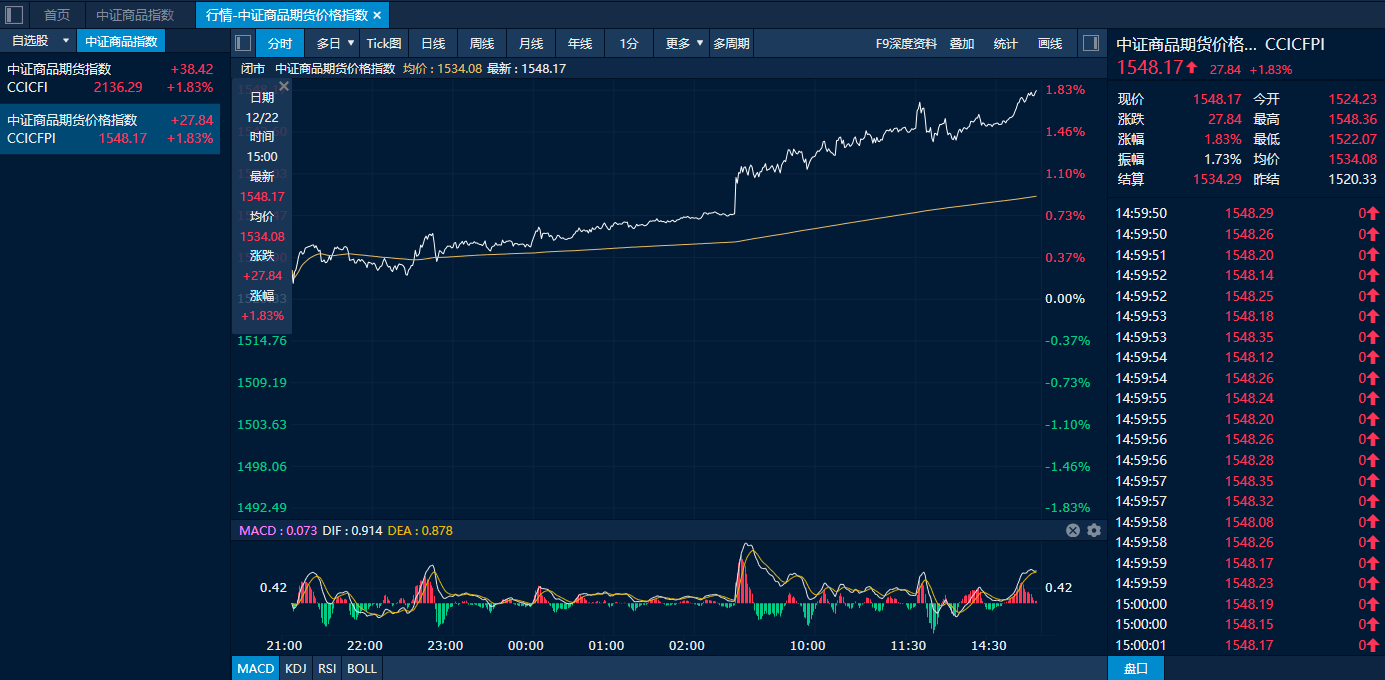
Group 1 - The domestic commodity futures market saw a majority of gains on December 22, with the shipping index (European line) leading the rise with an increase of over 8% [1][2] - Precious metals such as palladium and platinum reached their daily limit with increases of 7.00% and 6.99% respectively, while silver rose over 6% [1][3] - The shipping index's strong performance was supported by market expectations for the upcoming peak season, despite uncertainties regarding shipping routes in the Red Sea and Suez Canal [2][3] Group 2 - The silver, platinum, and palladium markets have shown remarkable performance, with silver prices hitting historical highs and the three metals collectively surging on December 22 [3] - Supply constraints and macroeconomic easing policies are significant factors supporting the continued strength of precious metals [3] - The polyester chain commodities also experienced significant gains, with PTA rising over 4.5% and other related products increasing by more than 3% [4] Group 3 - In contrast, the plastic market faced its fifth consecutive day of decline, driven by a supply-demand imbalance and decreasing downstream operating rates [5] - The main contract for polysilicon also saw a drop of over 2%, attributed to weak terminal demand and high inventory levels [5]