外汇市场干预

Search documents
高市早苗胜选后,日本外汇主管警告“正密切关注日元走势”
Hua Er Jie Jian Wen· 2026-02-09 03:32
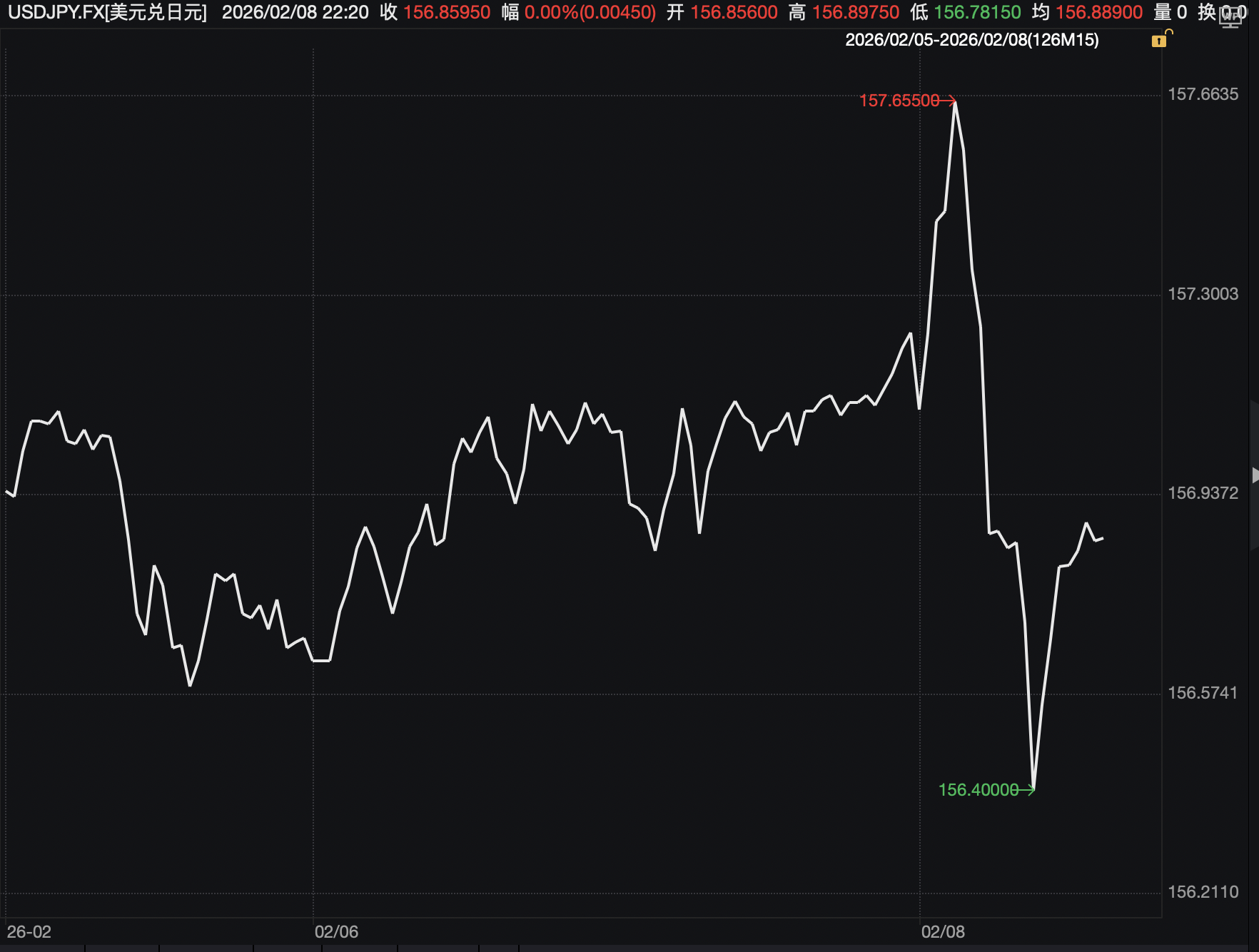
Core Viewpoint - The recent election victory of Prime Minister Sanna Takashi has led to increased pressure on the Japanese yen, prompting the Ministry of Finance to signal heightened vigilance to stabilize market expectations regarding fiscal expansion [1][2]. Group 1: Election Impact and Market Reaction - The direct trigger for the yen's depreciation was the policy expectation shift following Takashi's clear electoral victory, which is anticipated to lead to more aggressive fiscal spending [2]. - The ruling Liberal Democratic Party, led by Takashi, secured 316 out of 465 seats in the House of Representatives, marking the largest victory for a single party in post-war Japan [2]. - Takashi's post-election comments about potentially suspending the food sales tax for two years have raised concerns about fiscal health, further pressuring the yen and Japanese government bonds [2]. Group 2: Official Statements and Market Communication - Atsushi Mimura emphasized the government's ongoing commitment to monitor market movements with urgency and maintain open communication with the market [3]. - Satsuki Katayama's remarks included a warning about the potential for decisive measures, including intervention, in response to rapid fluctuations in the yen's value [3]. Group 3: US-Japan Coordination and Intervention Strategies - Katayama highlighted the importance of coordination with U.S. Treasury Secretary Janet Yellen, framing the responsibility for stabilizing the USD/JPY exchange rate as a shared obligation [4]. - Previous volatility in the yen was initially perceived as a potential intervention by Tokyo, but was later attributed to U.S. interest rate checks, indicating a complex interplay between U.S. and Japanese monetary policies [4]. Group 4: Market Dynamics and Fiscal Sustainability - As the yen weakened, Japanese stock markets and benchmark government bond yields rose, indicating a rapid reassessment of growth, inflation, and fiscal expansion expectations [5]. - Katayama reassured that the Takashi administration is focused on fiscal sustainability and will carefully monitor financial markets, with investors keenly observing the implementation of fiscal stimulus commitments and tax policy discussions [5].

特朗普“称赞美元贬值”引发抛售后,贝森特出面救火
Feng Huang Wang· 2026-01-28 23:15
Core Viewpoint - The U.S. Treasury Secretary emphasized the commitment to a "strong dollar policy," denying any plans for market intervention to support the yen, following a significant drop in the dollar index [1][3][4]. Group 1: Dollar Index and Market Reactions - The dollar index attempted to stabilize after a significant drop, which was the largest single-day decline since April of the previous year, reaching a nearly four-year low [1]. - Since President Trump's inauguration, the dollar index has seen a cumulative decline of nearly 10% [1]. Group 2: Treasury Secretary's Statements - Treasury Secretary Yellen stated that a strong dollar policy involves solidifying economic fundamentals, which should naturally strengthen the dollar over time as trade deficits are reduced [3]. - Yellen categorically denied rumors of market intervention regarding the dollar-yen exchange rate, which had been speculated following a review by the New York Fed [4]. Group 3: Market Implications and Expert Opinions - The clarification from Yellen alleviated market concerns about a potential large-scale plan to weaken the dollar, reinforcing the belief that market forces will dictate currency strength [7]. - Experts noted that while a weaker dollar could benefit exports, the long-term risks associated with a declining dollar are significant, especially given the U.S. debt level approaching $40 trillion [7].
美元指数跌至近4年来低点
Sou Hu Cai Jing· 2026-01-28 01:47
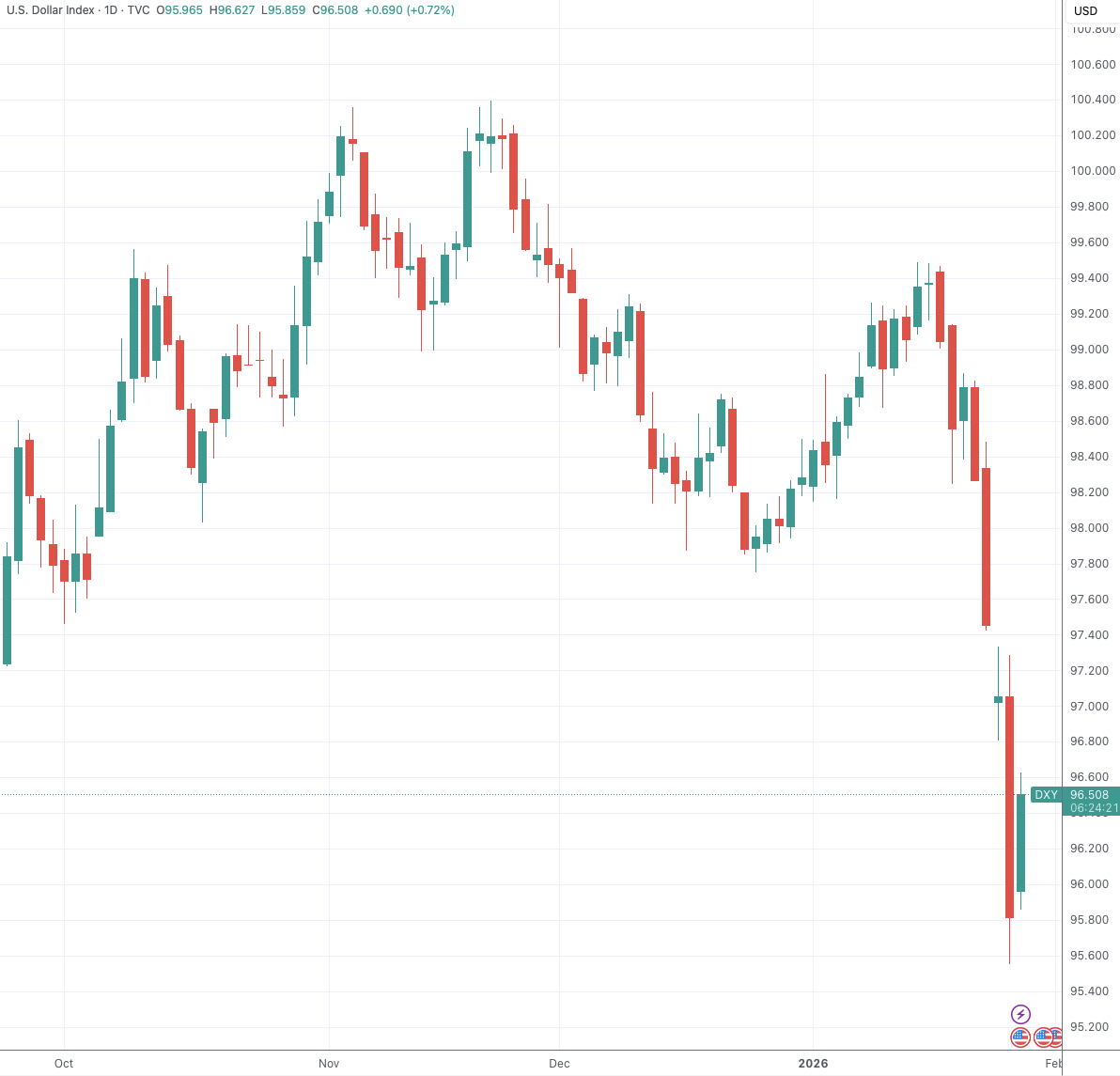
Core Viewpoint - The US dollar index has been declining significantly due to multiple investor expectations, reaching a near four-year low, with a notable drop on January 27 [1] Group 1: Dollar Index Performance - On January 27, the dollar index fell by 0.84%, closing at 96.219, and subsequently dropped to 95.55, marking the lowest level since mid-February 2022 [1] - The euro to dollar exchange rate surpassed the 1.20 mark for the first time since 2021, indicating a strong performance of the euro against the dollar [1] Group 2: Market Reactions and Speculations - President Trump expressed confidence in the current performance of the dollar, stating he does not believe it has fallen excessively, which contributed to the rapid decline of the dollar index [1] - There are speculations that the US and Japan may collaborate on foreign exchange market interventions, which has led to a significant strengthening of the yen against the dollar [1] Group 3: Economic Policy Uncertainty - The chief market economist at Capital Economics noted that while there are several factors contributing to the dollar's decline, the primary driver is market expectations regarding potential interventions by the US Treasury in the foreign exchange market [1] - The chief market strategist at Cambridge Global Payments indicated that the US government's lack of regret over tariff policies and the potential for another government shutdown have heightened economic policy uncertainty, leading to increased "sell America" trades [1]
市场分析:日元因可能出现技术性回调而小幅走软
Sou Hu Cai Jing· 2026-01-28 00:25
Core Viewpoint - The Japanese yen is experiencing a slight depreciation against most G10 and Asian currencies, potentially indicating a technical correction following its recent gains [1] Group 1: Currency Movements - The USD/JPY pair has seen a minor increase of 0.2%, reaching 152.49 yen [1] - The yen had appreciated overnight after Japan's Finance Minister, Shunichi Suzuki, indicated that authorities would take appropriate action in the foreign exchange market if necessary [1] Group 2: Government Communication - Following a meeting with G7 finance ministers, Japan emphasized the importance of maintaining close communication with the United States regarding currency market issues [1] Group 3: Economic Analysis - Carol Kong from the Commonwealth Bank noted that the prospect of coordinated intervention by US and Japanese authorities may temporarily limit the upside potential for both AUD/JPY and USD/JPY [1] - Kong also mentioned that without a clear macroeconomic policy shift from Japan, the yen is likely to continue its weakening trend in the long run [1]
美元指数急跌至近4年低位,仅凭特朗普一句话?
Sou Hu Cai Jing· 2026-01-28 00:25
Core Viewpoint - The US dollar index has fallen over 1%, reaching its lowest level since April 2022, driven by market expectations and comments from former President Trump [1] Group 1: Dollar Weakness - The trend of a weakening dollar has been ongoing, with a significant acceleration noted recently [1] - Trump's comments regarding the dollar's decline have intensified expectations for further depreciation [1] - Speculation about coordinated intervention by Japan and the US to support the yen has contributed to the dollar's significant depreciation against the yen [1] Group 2: Federal Reserve Outlook - The Federal Reserve is expected to maintain interest rates at its upcoming meeting, with the current chair, Jerome Powell, set to conclude his term in May [1] - Trump has indicated that he will soon announce a successor to Powell, who will preside over the next two meetings in March and April [1]
ATFX:日本发出干预最强音 提前大选增添日元波动变数
Xin Lang Cai Jing· 2026-01-27 12:12
Core Viewpoint - The article discusses the recent fluctuations in the USD/JPY exchange rate, highlighting a significant drop in the dollar and a rise in the yen, amid speculation of potential joint intervention by the US and Japan to stabilize the currency market [1][6]. Group 1: Currency Movements - The USD/JPY exchange rate has dropped nearly 3% over the past two trading days, marking the largest decline since April 2022 [1][6]. - The yen is currently hovering near its highest level since November of the previous year, after having reached its lowest point in July 2024 earlier this year [1][6]. - The Japanese government has issued warnings about potential market interventions to prevent "highly abnormal" fluctuations in the currency [1][6]. Group 2: Government Actions and Speculations - Japan plans to coordinate closely with the US and act according to an agreement made by the finance ministers of both countries in September of the previous year [4][9]. - The Japanese government is set to spend nearly $100 billion in 2024 to purchase yen to support its exchange rate, with a reference point around 160 yen per dollar for future interventions [4][9]. - The recent strengthening of the yen is seen as a measure to curb import inflation, particularly concerning rising food and energy prices [4][9]. Group 3: Political Context and Market Reactions - As Japan approaches early elections, investors are preparing for increased volatility in the bond market and potential government interventions in the currency market [4][10]. - Despite a recent decline in support for Prime Minister Kishi, his approval ratings remain above 60% in most polls, indicating a potential continuity of policies [4][10]. - The promise to reduce food taxes by Kishi has caused significant fluctuations in the Japanese debt market [10].
美元经历糟糕一周,日韩等亚洲货币反攻
Sou Hu Cai Jing· 2026-01-26 06:57
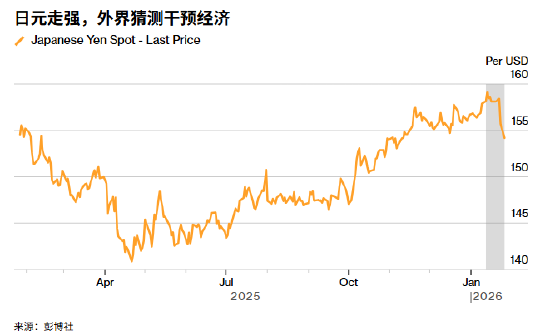
Group 1 - The US dollar experienced its worst week in nearly eight months, declining 1.7% against a basket of major currencies due to domestic and international policy uncertainties [1] - The Japanese yen strengthened against the US dollar, rising nearly 1%, while the South Korean won increased by 1.4%, marking its largest gain in over a month [1] - The Malaysian ringgit reached its highest level since 2018, driven by optimism surrounding artificial intelligence and domestic economic growth [1] Group 2 - Since Prime Minister Fumio Kishida took office, the yen has depreciated over 5% against the dollar, raising concerns about Japan's fiscal health and debt sustainability [2] - Kishida announced plans for tax cuts and increased spending, which have intensified market fears regarding Japan's financial situation [2] - Japanese officials have indicated they are closely monitoring exchange rate fluctuations and may intervene in the currency market if necessary [2][3]
日元延续涨势!高市早苗强化汇市干预信号,执政联盟若失议会多数将辞职
Sou Hu Cai Jing· 2026-01-26 06:40
Core Viewpoint - Japanese Prime Minister Sanae Takaichi warns of market volatility and commits to monitoring speculative trends, indicating potential actions if necessary, following her previous statement to take "all necessary measures" against abnormal fluctuations [1][4]. Group 1: Market Response - The Japanese yen continues to strengthen, with the USD/JPY exchange rate dropping over 1% to 154.01, following a significant decline of approximately 1.75% last Friday, marking the largest single-day increase for the yen in five months [1]. - The New York Federal Reserve's rare "rate check" action is speculated to be a catalyst for this market reversal [1]. Group 2: Government Actions and Statements - Takaichi emphasizes the importance of fiscal sustainability, noting that Japan's basic budget surplus has reached a level not seen in 28 years [1]. - Finance Minister Shunichi Suzuki has indicated that Japan possesses the "discretionary power" to intervene in the market if necessary, suggesting a potential for coordinated action with the U.S. Treasury [4]. Group 3: Speculative Pressure and Market Dynamics - The yen's short positions have reached their highest level in over a decade, and the current rebound may lead to significant short covering [7]. - The volatility in the foreign exchange market is accompanied by dramatic fluctuations in the Japanese government bond market, with the 10-year bond yield recently dropping 3 basis points to 2.225% [7]. Group 4: Upcoming Events and Implications - The latest developments occur as Japan prepares for a sudden election on February 8, with Takaichi expressing intentions to submit a bill to delay the food tax in the fiscal year 2026 [11]. - The Japanese government plans to spend nearly $100 billion in 2024 to support the yen, with previous interventions occurring around the 160 JPY/USD mark [12].
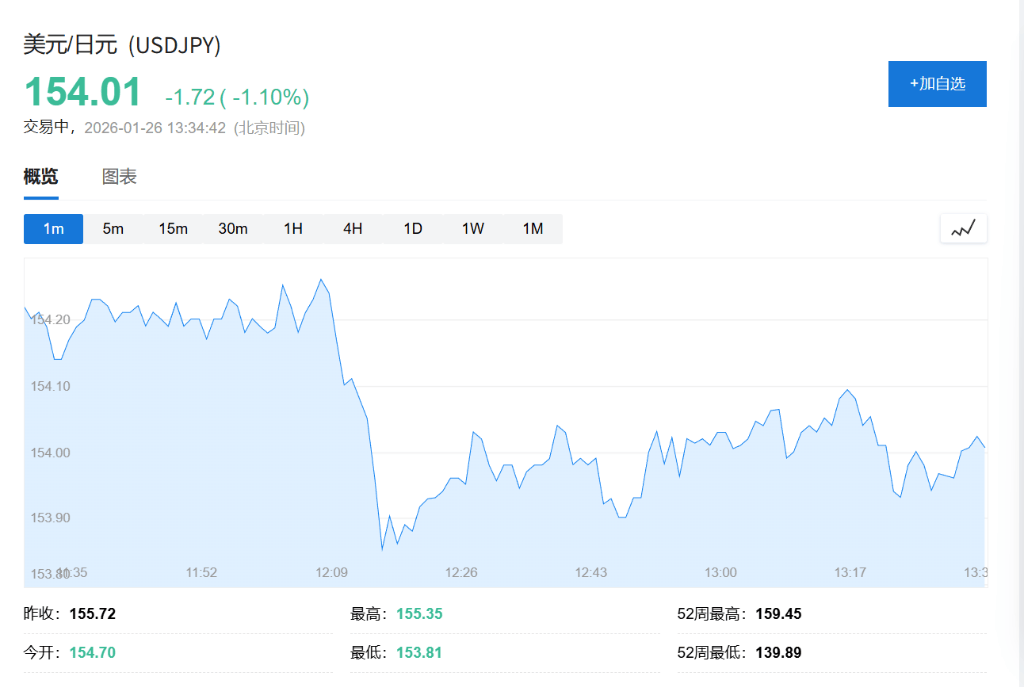
道明证券:美日联合干预可能性已无法排除,日元空头单向押注风险加剧
Jin Rong Jie· 2026-01-26 04:35
Group 1 - The core viewpoint is that Japan's Prime Minister, Fumio Kishida, has verbally intervened in the currency market, indicating potential joint intervention with the U.S. Treasury [1] - The Japanese top foreign exchange official, Jun Miura, has confirmed that the Ministry of Finance is in close contact with the U.S. Treasury, suggesting that coordinated action is possible [1] - The market sentiment is leaning towards shorting the yen, but the possibility of joint intervention means that this is no longer a one-sided bet [1]
新加坡元兑美元汇率升至逾11年来最高水平
Xin Lang Cai Jing· 2026-01-26 02:41
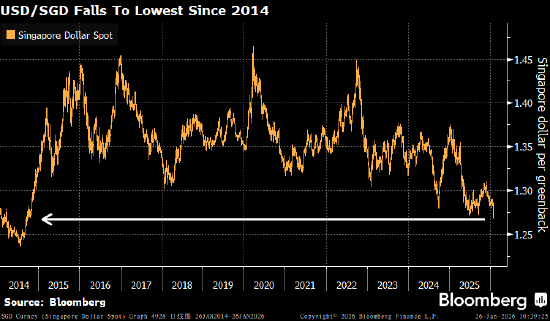
Group 1 - The Singapore dollar has risen to its highest level against the US dollar since October 2014, driven by safe-haven inflows [1][3] - The Singapore dollar increased by over 0.4% to 1.2680, as market speculation suggests potential US intervention in the Japanese foreign exchange market, putting pressure on the dollar [1][3] - The Monetary Authority of Singapore (MAS) is expected to maintain its policy unchanged during the upcoming meeting, as core inflation remains stable [1][3] Group 2 - MAS focuses on the nominal effective exchange rate (S$NEER) rather than interest rates as its primary policy tool, allowing it to fluctuate within a policy band [1][3] - Singapore has attracted numerous investors due to its high-dividend stock market, AAA-rated bonds, and relatively stable government policies [1][3] - The Straits Times Index is currently at a historical high, and the Singapore dollar has appreciated approximately 6% over the past 12 months [1][3]