棉价上涨

Search documents
天虹国际集团:25年纱线毛利率改善2.5pct,偿债带动财务费用显著减少-20260330
GUOTAI HAITONG SECURITIES· 2026-03-30 08:50
Investment Rating - The report maintains a "Buy" rating for Tianhong International Group (2678) [2][3] Core Insights - In 2025, the gross margin for the yarn business improved by 2.5 percentage points to 14.2%. The reduction in financial expenses due to debt repayment significantly contributed to this improvement. For 2026, yarn sales are expected to grow by 1.4%, benefiting from rising cotton prices, thus justifying the "Buy" rating [3][6]. Financial Summary - Total revenue projections (in million RMB) for the years 2024A to 2028E are as follows: - 2024A: 23,029 - 2025A: 22,716 (down 1.4% YoY) - 2026E: 23,965 (up 5.5% YoY) - 2027E: 24,805 (up 3.5% YoY) - 2028E: 25,437 (up 2.5% YoY) [5] - Gross profit and net profit attributable to the parent company are projected as follows: - 2024A: Gross profit 2,863, Net profit 554 - 2025A: Gross profit 3,138, Net profit 913 (up 64.9% YoY) - 2026E: Gross profit 3,387, Net profit 1,088 (up 19.1% YoY) - 2027E: Gross profit 3,547, Net profit 1,192 (up 9.6% YoY) - 2028E: Gross profit 3,677, Net profit 1,284 (up 7.7% YoY) [5] Business Performance - In 2025, the yarn segment generated revenue of 181.1 billion RMB, a 1.1% increase YoY, with sales volume up 6.3% and price down 4.9%. The company sold 433,000 tons in the second half of 2025, exceeding the target of 400,000 tons. The overall gross margin for the year was 14.2%, attributed to improved capacity utilization, especially in overseas factories, flexible raw material procurement, and automation upgrades [6][8]. Future Outlook - For 2026, the company plans to sell 830,000 tons of yarn, a 1.4% increase YoY, while maintaining the woven fabric sales at 100 million meters. The company aims to increase yarn production capacity in Vietnam by 100,000 spindles, raising total capacity to 4.35 million spindles, a 2.4% increase YoY. Additionally, a 20MW solar power station is planned [6][8]. Valuation Metrics - The report projects a PE ratio of 8X for 2026, with a target price of 10.77 HKD, based on a conversion rate of 1 HKD = 0.88 RMB [6].
棉价进入重要窗口期,1-2月中国纺服出口增长17.6%
GUOTAI HAITONG SECURITIES· 2026-03-15 06:07
Investment Rating - The report assigns an "Accumulate" rating for the textile and apparel industry [4]. Core Insights - Cotton prices have entered a critical window, with a recommendation to continue supporting Bailong Oriental and Rainbow International Group. The reduction trend in cotton production from Brazil and the U.S. has been confirmed, indicating a clear upward channel for U.S. cotton prices [2][3]. - In January-February 2026, China's textile and apparel exports grew by 17.6% year-on-year, driven by a later Spring Festival and a low base from the previous year [2][18]. Summary by Sections Market Review - The textile and apparel sector in the A-share market fell by 0.57%, underperforming the CSI 300 by 0.75 percentage points, ranking 15th among 31 sectors. The textile manufacturing sector decreased by 0.45%, while the apparel and home textile sector increased by 0.36% [7]. - The current PE valuation for the textile and apparel sector is 20.64 times, below the historical average of 24.48 times [10]. Industry Data Tracking - In January-February 2026, China's textile and apparel exports totaled approximately $50.446 billion, a year-on-year increase of 17.63%. Textile exports were $25.574 billion (up 20.50%), and apparel exports were $24.871 billion (up 14.80%) [18]. - The retail sales of clothing in China increased by 1.2% year-on-year in December 2025, with a notable increase in the retail sales of clothing, shoes, and textiles [16]. Raw Material Price Tracking - Cotton prices have shown an upward trend, with the 3128B cotton price reported at 16,877 yuan/ton, up 1.2% week-on-week. The ICE No. 2 cotton price closed at 65.80 cents/pound, up 2.5% [5][20]. - Polyester prices also increased, with POY index rising by 20.92% to 9,250 yuan/ton [20]. Key Announcements and News - Bailong Oriental and Rainbow International Group are highlighted as key investment recommendations due to their strong performance and market positioning [2][3]. - Recent financial reports from companies in the sector indicate varied performance, with some companies showing revenue growth while others reported losses [32].

棉花:耐心等待回调做多机会
Wu Kuang Qi Huo· 2026-01-21 01:43
Report Summary 1. Report Industry Investment Rating No information provided. 2. Core Viewpoint The expectation of a reduction in Xinjiang's cotton planting area in the next year and the increase in the downstream industry's operating rate since November 2025 have driven up cotton prices. In the medium to long term, with the reduction in planting area and positive macro - expectations, cotton prices still have room to rise. However, due to the large short - term increase, it is necessary to wait for a correction before making long positions [2][21]. 3. Summary of Relevant Contents Driving Factors for Cotton Price Increase - The expectation of a reduction in Xinjiang's cotton planting area is the main driving factor for the rise of Zhengzhou cotton futures since December last year. The cotton planting subsidy policy in Xinjiang will expire in the 2025/26 season, and the new policy is expected to reduce the subsidized planting area by about 10% compared to 2025 [2][5]. - Since November 2025, the increase in the downstream industry's operating rate is also a driving factor for the rise in cotton prices. As of the week of January 16, the spinning mill operating rate was 64.6%, an increase of 8.6 percentage points year - on - year; the weaving mill operating rate was 35.2%, an increase of 10.2 percentage points year - on - year. The increase may be related to the late Spring Festival in 2026. Although domestic cotton production has increased significantly this year, the national cotton sales progress has also increased significantly year - on - year, indicating good downstream demand [6]. International Cotton Market and Import Situation - According to USDA data, the global cotton production forecast for the 2025/26 season in January is 26 million tons, a decrease of 80,000 tons from the December forecast and an increase of 200,000 tons from the previous year. The inventory - to - consumption ratio is 62.63%, a decrease of 1.42 percentage points from the December forecast and an increase of 0.62 percentage points from the previous year. The US production forecast in January is 3.03 million tons, a decrease of 76,000 tons from the December forecast. Brazil's production forecast remains at 4.08 million tons, India's production is adjusted down by 110,000 tons to 5.12 million tons, and China's production is adjusted up by 220,000 tons to 7.51 million tons [15]. - In December 2025, China imported 180,000 tons of cotton, an increase of 40,000 tons year - on - year. In 2025, China's cumulative cotton imports were 1.08 million tons, a decrease of 1.56 million tons year - on - year. Brazil's cotton exports in December were 450,000 tons, an increase of 100,000 tons year - on - year. Exports to China in December were 146,000 tons, an increase of 60,000 tons year - on - year. As of the week of January 8, the US current - year cotton export sales were 80,600 tons, and the cumulative export sales were 1.6231 million tons, a decrease of 191,000 tons year - on - year. Exports to China were 13,600 tons that week, and the cumulative exports were 85,300 tons, a decrease of 71,200 tons year - on - year. It is expected that China's cotton imports in January will increase month - on - month, but the increase may be small [16].
国内棉价持续上涨 内外价差显著扩大
Xin Lang Cai Jing· 2026-01-14 14:52
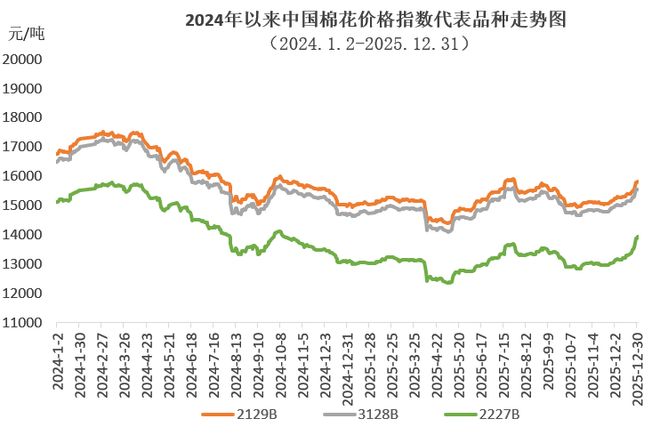
Core Viewpoint - The domestic cotton price in China is expected to experience fluctuations in 2025, showing a trend of "stability followed by decline, then recovery" due to various factors including U.S. tariffs and domestic consumption policies [1] Group 1: Domestic Cotton Price Trends - In 2025, the overall domestic cotton price index is projected to fluctuate, with a minimum drop to 14,100 CNY/ton and a maximum rise to 15,609 CNY/ton during the year [1] - The average annual price for the cotton price index is expected to be 14,903 CNY/ton, reflecting a year-on-year decrease of 6.7% [1] - By December, domestic cotton prices continued to rise, supported by favorable macro policies and a strong textile market, reaching a peak of 15,556 CNY/ton [2] Group 2: Futures Market Dynamics - The futures market showed a bullish trend with increased participation, as the main contract CF2605 rose from 13,760 CNY/ton at the beginning of the month to 14,550 CNY/ton by the end [4][5] - The average settlement price for the main Zheng cotton contract was 14,009 CNY/ton, marking a month-on-month increase of 467 CNY [5] Group 3: Long Staple Cotton Demand and Pricing - Demand for long staple cotton was weak, leading to a slight price decline, with the price for 137-grade long staple cotton at 24,960 CNY/ton, down 40 CNY from the previous month [7] - The average transaction price for 137-grade long staple cotton was 24,896 CNY/ton, reflecting a month-on-month decrease of 104 CNY [7] Group 4: International Market Conditions - The international cotton market faced challenges, with prices initially declining before a slight rebound, resulting in a widening price gap between domestic and international markets [7] - The average price for imported cotton was 73.62 cents/pound, down 0.7% month-on-month, with a significant price gap of 673 CNY compared to the domestic cotton price index [7][10] Group 5: Cotton Yarn Pricing and Inventory Management - Cotton yarn prices increased in line with rising cotton prices, with the average price for 32-count pure cotton yarn at 20,901 CNY/ton, up 337 CNY month-on-month [10] - Due to limited new orders and year-end cash flow pressures, some spinning mills increased their inventory management efforts [10]