流动性变化

Search documents
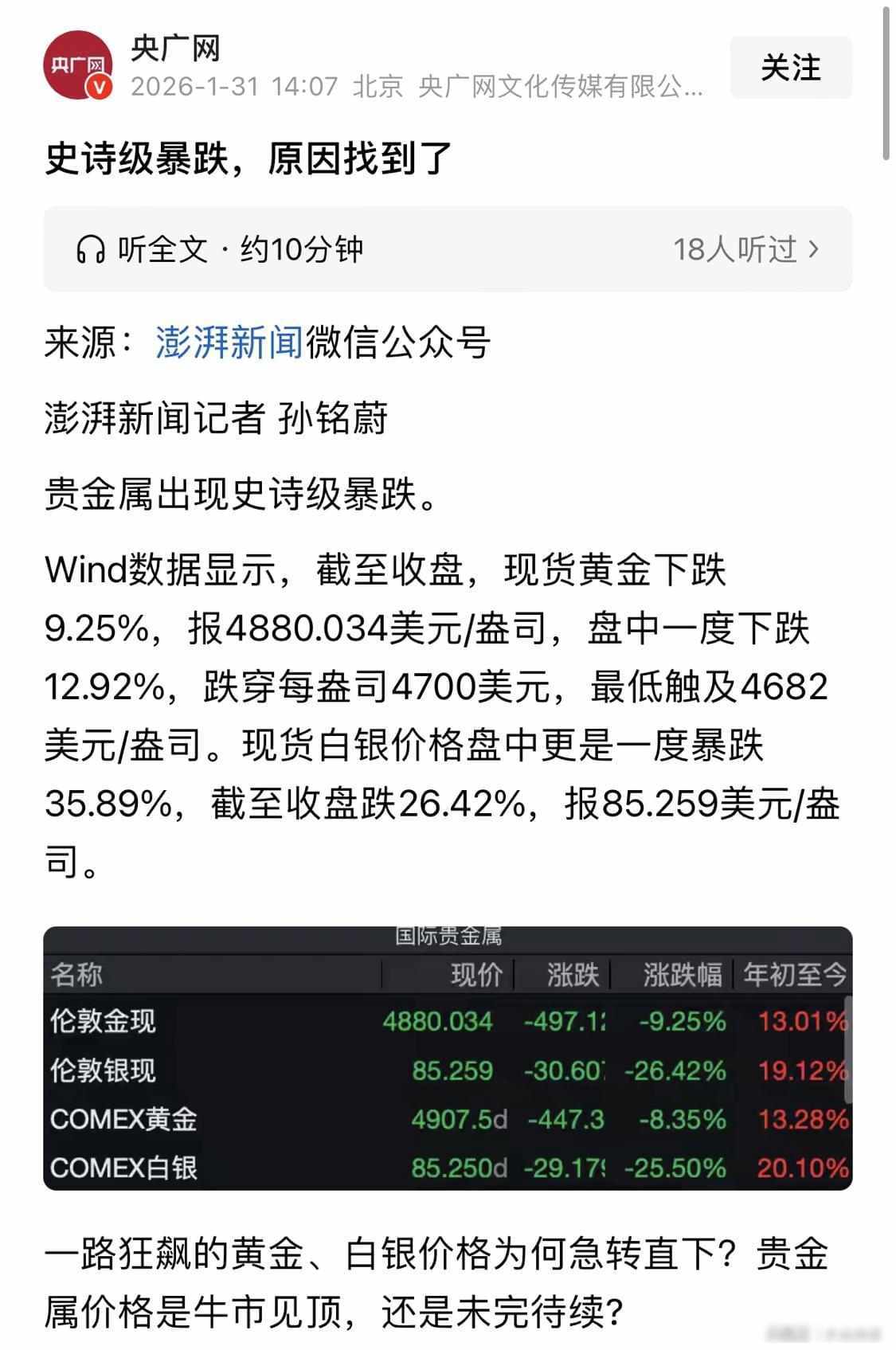
一夜回到解放前!有投资客称忙活一年赚了133万,这两天就亏109万
Sou Hu Cai Jing· 2026-02-01 18:34
Core Viewpoint - The recent surge in gold and silver prices reached historical highs, but a sudden market downturn led to significant losses for many investors who had increased their positions and leveraged their investments [1][6]. Group 1: Market Performance - On January 29, gold prices peaked at $5,598.75 per ounce, while silver reached $121.654, both marking all-time highs [1]. - By January 31, a large volume of sell orders flooded the market, causing prices to plummet rapidly [1]. - Year-to-date performance shows London gold down 9.25% and London silver down 26.42% [3]. Group 2: Investor Behavior - An individual reported a loss of $1.09 million on an $8 million investment in gold short-term trading, highlighting the risks of high-frequency trading and the mismatch between investment scale and returns [4]. - Many retail investors used high leverage to chase rising prices, leading to widespread panic and fears of significant losses when prices began to fall [6]. Group 3: Market Dynamics - The recent price increase was driven by geopolitical tensions and risk aversion, but lacked fundamental support such as actual inflation or central bank purchases [7]. - The COMEX futures market showed excessive open interest, which contributed to the price drop as margin calls triggered a wave of liquidations [7]. - Broader commodity markets, including copper and tin, also experienced declines, indicating a systemic response to liquidity changes and potential demand weakness [9].

【UNforex财经事件】黄金站稳强势区间 投资者重新评估降息节奏与短端流动性改善
Sou Hu Cai Jing· 2025-12-12 03:37
Group 1 - Gold prices are hovering around the high range, approaching $4,275 per ounce, supported by the Federal Reserve's interest rate cut and a weaker dollar [1] - The Fed's decision to cut rates by 25 basis points to a range of 3.50% to 3.75% is the lowest in nearly three years, leading to a decline in the dollar and a corresponding drop in gold holding costs [1] - The market's expectation for maintaining interest rates next month has risen to nearly 80%, indicating a cautious outlook on future monetary policy [1][2] Group 2 - The Fed announced a monthly purchase operation of $40 billion in reserves and plans to increase agency debt reinvestment in December, exceeding previous expectations [2] - Major investment banks have revised their forecasts for U.S. Treasury futures supply, with Barclays predicting a purchase scale of nearly $525 billion in 2026, up from $345 billion [2] - The geopolitical situation in Ukraine is affecting safe-haven demand for gold, as discussions on a revised peace framework may reduce gold's attractiveness as a safe asset [2] Group 3 - Gold remains in an upward structure, with key resistance at $4,245 to $4,250 and support at $4,200 [3] - The upward movement in gold prices is primarily driven by the Fed's rate cut, weak employment data, and a soft dollar, with additional support from the Fed's measures to enhance short-term liquidity [3] - The overall trend for gold is upward, but further momentum will depend on new event-driven factors [3]
美联储缩表拐点临近,流动性变化对市场影响几何?| 市场罗盘
Jin Shi Shu Ju· 2025-10-29 10:06
Core Viewpoint - The Federal Reserve is expected to announce the end of its balance sheet reduction (QT) during the upcoming meeting, which has led to a decline in the 10-year U.S. Treasury yield below 4.0% for the first time in a year [2]. Summary by Sections Federal Reserve's Balance Sheet Changes - Since March 2020, the Federal Reserve's balance sheet expanded from $4.31 trillion to nearly $9 trillion by April 2022, effectively doubling in size [4]. - The Fed initiated asset purchases in March 2020, announcing a $500 billion increase in Treasury securities [4]. - In December 2020, the Fed committed to purchasing at least $800 billion in Treasury securities and $400 billion in mortgage-backed securities (MBS) monthly [5]. - The tapering of asset purchases began in July 2021, with a gradual reduction in the pace of buying [5]. - The balance sheet reduction started in June 2022, with monthly reductions of $30 billion in Treasuries and $17.5 billion in MBS, increasing to $60 billion and $35 billion respectively by September 2022 [5]. - By March 2025, the reduction pace for Treasuries is expected to slow to $5 billion per month [5]. Reasons for Ending QT - The need to avoid increased market financing costs and tightening liquidity in the overnight money market [7]. - Core inflation has been affected by tariffs and wages, and aggressive rate cuts could exacerbate inflation [7]. - To prevent long-term Treasury yields from rising due to a new round of fiscal expansion [7]. - The U.S. housing market is closely linked to MBS and long-term rates, necessitating a careful approach to avoid destabilizing the housing market [7]. Market Impact of Ending QT - Gold prices are likely to rise due to improved liquidity, alongside declining real interest rates and a weaker dollar [8]. - U.S. Treasury yields are expected to trend downward in the medium to long term, influenced by rate cut expectations [8]. - Overall, the end of QT could support equity valuations due to improved liquidity and lower yield expectations, although it may also lead to increased volatility if interpreted as a reactive policy change [8].