海外发展

Search documents
【辉煌“十四五”】我国特钢行业“十四五”成就一览
Xin Lang Cai Jing· 2025-12-12 14:14
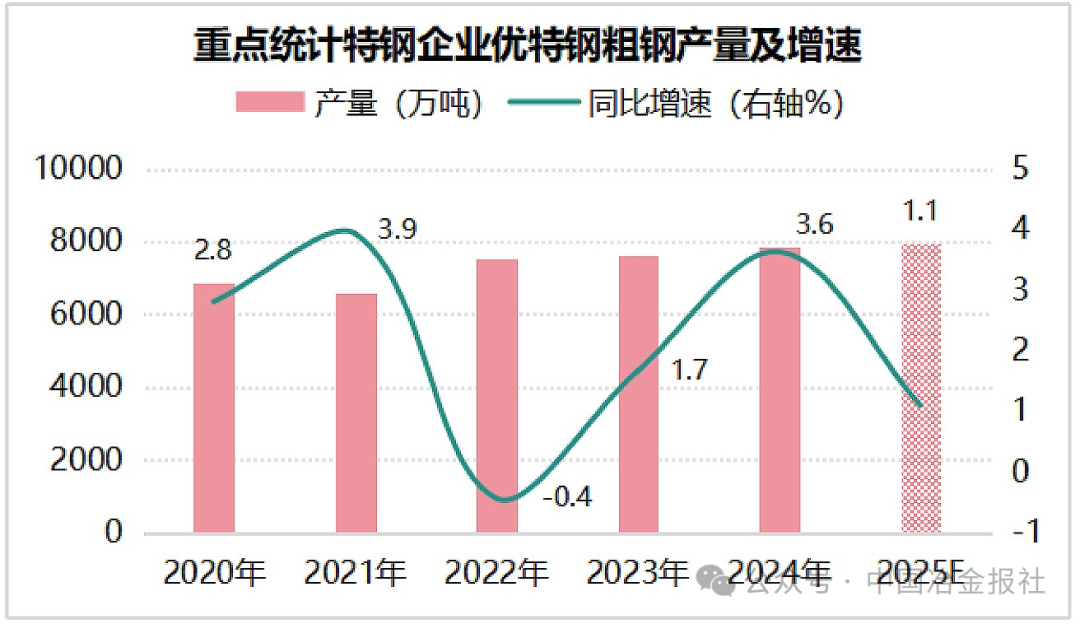
Core Viewpoint - The Chinese special steel industry is experiencing steady growth in production and significant advancements in technology and sustainability, with a focus on high-value products and international competitiveness [1][3][21]. Production Growth - In 2024, the crude steel production of special steel by key member enterprises of the China Special Steel Enterprises Association (CSESA) is projected to reach 78.69 million tons, a 19.3% increase from 2021 and a 14.5% increase from the end of the 13th Five-Year Plan. The forecast for 2025 is 79.74 million tons, representing a 20.9% increase from 2021 and a 16.0% increase from the end of the 13th Five-Year Plan [1][49]. - The production of bearing steel in 2024 is expected to be 4.97 million tons, a 12.2% increase from 2021 and a 25.2% increase from the end of the 13th Five-Year Plan. The 2025 forecast is 4.88 million tons, a 10.2% increase from 2021 and a 22.9% increase from the end of the 13th Five-Year Plan [3][51]. - Gear steel production is projected to reach 5.02 million tons in 2024, a 39.1% increase from 2021 and a 35.7% increase from the end of the 13th Five-Year Plan, with a forecast of 5.60 million tons in 2025, a 55.1% increase from 2021 and a 51.4% increase from the end of the 13th Five-Year Plan [5][53]. - Tool steel production is expected to be 850,000 tons in 2024, a 44.1% increase from 2021 and a 2.4% increase from the end of the 13th Five-Year Plan, with a forecast of 870,000 tons in 2025, a 47.5% increase from 2021 and a 4.8% increase from the end of the 13th Five-Year Plan [7][55]. R&D Investment - R&D expenses for 2024 are projected to be 22.6 billion yuan, a 29.9% increase from 2021 and a 61.4% increase from the end of the 13th Five-Year Plan. The forecast for 2025 is 21.1 billion yuan, a 21.3% increase from 2021 and a 50.7% increase from the end of the 13th Five-Year Plan [9][57]. - The R&D investment intensity is expected to be 3.3% in 2024, an increase of 1 percentage point from 2021 and 2.2 percentage points from the end of the 13th Five-Year Plan, with the same level expected to be maintained in 2025 [11][59]. Industry Consolidation - Since the 14th Five-Year Plan, the special steel industry has seen steady progress in mergers and acquisitions, leading to a dual structure of "super-large groups" and "specialized leaders" [13][61]. - Numerous specialized production enterprises have emerged, forming industrial clusters that cover various specialized production lines, creating a comprehensive structure and advanced production processes [15][63]. Breakthroughs in Key Materials - Significant breakthroughs have been achieved in key material fields during the 14th Five-Year Plan, supporting developments in infrastructure, wind power equipment, aerospace, and marine engineering [15][64]. Green and Low-Carbon Development - The special steel industry has made substantial progress in green and low-carbon development through process reforms, energy-saving technologies, and intelligent upgrades, with 70% of member units completing or partially completing ultra-low emission transformations by February 2025 [21][69]. - Various companies have implemented innovative technologies to reduce emissions and energy consumption, such as low-carbon heating furnaces and intelligent combustion technologies [22][70]. Intelligent Manufacturing - The industry has undergone a profound transformation towards intelligent manufacturing, significantly improving production efficiency and product quality [27][75]. - Companies like Xingcheng Special Steel have been recognized as "lighthouse factories" for their advanced use of AI and digital twin technologies [27][75]. Diversified Overseas Development - The industry has shifted from simple product exports to a collaborative approach involving products, technology, brand, and capital, enhancing resilience in a complex global environment [29][77]. - Special steel enterprises are actively planning overseas production bases and local service enhancements to build a more resilient global supply chain [30][78]. International Standards and Brand Influence - The industry has made significant strides in standard-setting, moving from following to leading in international standards, particularly in green and low-carbon areas [31][79]. - Chinese companies have taken the lead in formulating international standards, enhancing their influence in the global market [31][80]. Expansion of New Application Scenarios - The industry has expanded into high-value new application scenarios, closely aligning with national major projects and emerging industries [34][82]. - Innovations in materials for renewable energy, high-end equipment, and aerospace have been developed to meet the demands of modern engineering [34][82].

建筑建材行业内需之重下稳中求进 | 投研报告
Zhong Guo Neng Yuan Wang· 2025-12-04 02:03
Investment Summary - The construction and building materials industry is expected to face demand challenges in 2025 due to declining infrastructure and manufacturing investment, alongside a significant drop in real estate investment [1] - Local governments are stabilizing debt management and maintaining high growth in refinancing special bonds, with infrastructure investment (excluding electricity) expected to see a negative year-on-year growth rate [1] - The real estate sector has experienced a continuous decline in fixed asset investment for 40 months, with the drop in new construction, construction, and completion areas showing signs of narrowing [1][2] Economic Impact - The negative cycle of the real estate sector continues to impact overall economic demand, although the intensity of this impact is weakening [2] - The new commodity housing price index has decreased by 11.77% from its peak in September 2021 to October 2025, while the second-hand housing price index has dropped by 20.31% in the same period [2] - Government revenue from land sales has seen a significant reduction, but general revenue has turned positive year-on-year [2] Policy Direction - The focus for 2026 will be on expanding domestic demand to counteract the negative effects of the real estate sector, with policies aimed at stabilizing the housing market and improving housing demand [3][4] - Infrastructure projects will prioritize modern infrastructure systems and effective project implementation through special bonds and long-term national bonds [3] - The government aims to enhance consumer spending and promote new consumption patterns, including the expansion of service consumption and the removal of unreasonable consumption restrictions [3] Investment Strategy - Companies in the building materials sector are expected to see improvements in profitability due to the "anti-involution" policy, which is set to optimize supply and stabilize product prices [4] - There is a growing opportunity for traditional industries to expand internationally, leveraging China's competitive advantages and the favorable conditions for overseas development [4][5] - The release of new demands driven by technological advancements and the maturation of the industrial system is anticipated to create opportunities in new materials [5]
北新建材(000786):优化夯实发展基础
Xin Lang Cai Jing· 2025-10-29 10:32
Core Viewpoint - The company reported a decline in revenue and profit for the first three quarters of 2025, primarily due to the ongoing downturn in the real estate sector, which has negatively impacted industry demand and financial performance [1][2]. Financial Performance - The company achieved a revenue of 19.905 billion yuan, a year-on-year decrease of 2.25% [1]. - The net profit attributable to shareholders was 2.586 billion yuan, down 17.77% year-on-year [1]. - The net profit after deducting non-recurring items was 2.531 billion yuan, a decline of 17.52% year-on-year [1]. - Basic earnings per share (EPS) stood at 1.53 yuan [1]. - The comprehensive gross profit margin was 29.53%, down 1.12 percentage points year-on-year [2]. - The net profit margin was 13.34%, a decrease of 2.36 percentage points year-on-year [2]. - The return on equity (ROE) after deducting non-recurring items was 9.64%, down 3.01 percentage points year-on-year [2]. Cost Structure - The sales expense ratio increased to 5.57%, up 0.61 percentage points year-on-year [2]. - The management expense ratio rose to 4.48%, an increase of 0.42 percentage points year-on-year [2]. Debt and Product Structure Optimization - The company reduced its interest-bearing debt ratio to 0.80%, a significant decrease of 8.51 percentage points year-on-year [3]. - The company optimized its debt structure by reducing bank loans and increasing the issuance of short-term financing bonds, with two issuances of 1 billion yuan each at interest rates of 1.78% and 1.66% [3]. - The financial expense ratio was 0.13%, down 0.18 percentage points year-on-year [3]. - The company increased investment in gypsum fiberboard and is actively developing production lines in Thailand and Bosnia to enhance product structure and expand overseas [3]. Future Outlook - The company is positioned as an industry leader with strong risk resistance capabilities, ensuring stable operations even in a challenging environment [3]. - The company is expected to benefit significantly from any improvement in supply and demand dynamics, leading to greater earnings elasticity [3]. - Profit forecasts for 2025-2027 are 3.278 billion, 3.610 billion, and 4.141 billion yuan, with corresponding EPS of 1.93, 2.12, and 2.44 yuan [4]. - The current stock price corresponds to PE ratios of 12.15, 11.03, and 9.62 for 2025-2027 [4]. - The company maintains a "strongly recommended" rating due to its resilience and ongoing optimization efforts [4].

海螺水泥(600585):行业持续低迷,内生外延和海外拓展新空间
Dongxing Securities· 2025-05-03 14:17
Investment Rating - The report maintains a "Strong Buy" investment rating for Conch Cement [2][11]. Core Views - The cement industry is experiencing continued weakness, but Conch Cement is leveraging both organic growth and overseas expansion to create new opportunities [5][11]. - In 2024, Conch Cement's revenue is projected to be 91.03 billion yuan, a year-on-year decline of 35.44%, with a net profit attributable to shareholders of 7.70 billion yuan, down 26.21% [3][12]. - The company has seen a decrease in sales volume due to weak industry demand, but prices have rebounded since the third quarter of 2024, positively impacting profit margins [3][4]. Summary by Sections Financial Performance - In 2024, Conch Cement's self-produced cement sales volume was 26.8 million tons, a decrease of 5.96% year-on-year [3]. - The average selling price of cement in 2024 was 214.17 yuan/ton, down 21.68% year-on-year [3]. - The comprehensive gross margin for Q1 2025 improved to 22.88%, up 5.13 percentage points year-on-year, offsetting the impact of declining sales volume [4]. Market Position - Conch Cement has maintained a market share increase despite a 9.50% decline in national cement production in 2024, showcasing its cost advantages [4]. - The company is positioned as a leading national cement producer, benefiting from its scale and cost efficiency [4]. Growth Opportunities - The current industry downturn has accelerated Conch Cement's market share growth and provided opportunities for external expansion [5]. - The company is actively pursuing regional capacity consolidation and has established offices in Africa and South America, with production lines in Uzbekistan and Cambodia expected to commence operations in early 2025 [5]. Profit Forecast - The forecasted net profits for Conch Cement from 2025 to 2027 are 9.36 billion yuan, 10.40 billion yuan, and 11.64 billion yuan, respectively, with corresponding EPS of 1.77 yuan, 1.96 yuan, and 2.20 yuan [5][12].