
煤价上涨预期

Search documents
A股异动丨煤炭股继续走强,陕西黑猫涨超8%,中煤能源涨超6%
Ge Long Hui· 2026-03-03 03:35
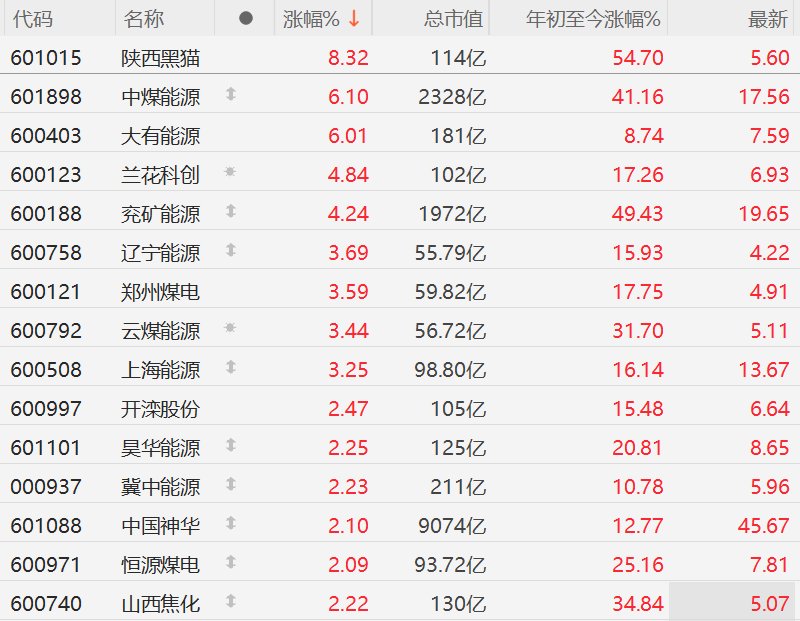
Core Viewpoint - The A-share coal stocks continue to rise, driven by geopolitical tensions in the Middle East and potential increases in coal prices due to disruptions in coal exports from Indonesia and impacts on chemical product logistics [1] Group 1: Market Performance - Shaanxi Black Cat saw an increase of over 8%, while China Coal Energy and Dayou Energy rose by over 6% [1] - Other notable performers include Lanhua Science and Technology and Yanzhou Coal Mining, both up over 4%, and several companies including Liaoning Energy and Zhengzhou Coal Electricity, which increased by over 3% [1] - The total market capitalization for Shaanxi Black Cat is 11.4 billion, with a year-to-date increase of 54.70% [2] - China Coal Energy has a market cap of 232.8 billion, with a year-to-date increase of 41.16% [2] Group 2: Industry Insights - CITIC Securities suggests that rising oil prices due to geopolitical conflicts may positively impact coal prices [1] - Increased demand for coal in domestic coal chemical industries is anticipated if logistics for methanol and other chemical products are affected [1] - The expectation for domestic coal prices to remain favorable is supported by the reduction in coal exports from Indonesia [1]






煤炭股继续走强,中煤能源逼近涨停,恒源煤电涨超5%
Ge Long Hui· 2026-03-02 05:36
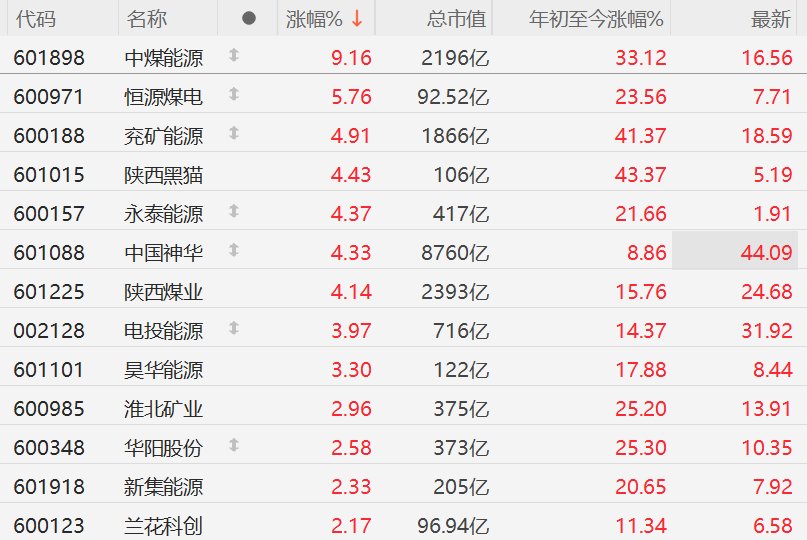
Core Viewpoint - The A-share market for coal stocks continues to strengthen, driven by geopolitical tensions in the Middle East and potential increases in coal prices due to disruptions in coal trade logistics and reduced coal exports from Indonesia [1] Group 1: Market Performance - Coal stocks such as China Coal Energy approached the daily limit, while Huaneng Power surged over 5%, and other companies like Yanzhou Coal Mining, Shaanxi Black Cat, Yongtai Energy, China Shenhua, and Shaanxi Coal & Chemical all saw increases exceeding 4% [1] - Specific stock performance includes: - China Coal Energy: 9.16% increase, market cap of 219.6 billion, year-to-date increase of 33.12% [2] - Huaneng Power: 5.76% increase, market cap of 9.252 billion, year-to-date increase of 23.56% [2] - Yanzhou Coal Mining: 4.91% increase, market cap of 186.6 billion, year-to-date increase of 41.37% [2] - Shaanxi Black Cat: 4.43% increase, market cap of 10.6 billion, year-to-date increase of 43.37% [2] - China Shenhua: 4.33% increase, market cap of 876 billion, year-to-date increase of 8.86% [2] Group 2: Industry Insights - CITIC Securities suggests that escalating geopolitical conflicts in the Middle East could lead to rising oil prices, which may positively impact coal prices [1] - The potential impact on methanol and chemical trade logistics could increase domestic coal consumption in coal chemical industries, further supporting coal price expectations [1] - The combination of reduced coal exports from Indonesia is expected to create a favorable outlook for domestic coal prices [1]


A股煤炭股继续走强,中煤能源逼近涨停,恒源煤电涨超5%
Ge Long Hui· 2026-03-02 05:30
Group 1 - The core viewpoint of the article highlights the strong performance of coal stocks in the A-share market, with companies like China Coal Energy nearing the daily limit increase and others like Hengyuan Coal Power and Yanzhou Coal Mining also showing significant gains [1] - CITIC Securities suggests that escalating geopolitical conflicts in the Middle East could lead to rising oil prices, which may positively impact coal prices [1] - The article notes that disruptions in the export of Indonesian coal, combined with increased domestic demand for coal in chemical production due to potential impacts on methanol and other chemical logistics, are expected to support a favorable outlook for domestic coal prices [1]
港股异动 | 煤炭股集体走高 海外煤炭涨价性价比优势消失 进口约束预期支撑国内煤价
智通财经网· 2026-02-27 06:41
Group 1 - Coal stocks collectively rose, with China Qinfa (00866) up 7.51% to HKD 3.72, China Coal Energy (01898) up 6.08% to HKD 12.91, Yancoal Australia (03668) up 4.46% to HKD 33.28, and Yanzhou Coal Mining (01171) up 3.94% to HKD 13.98 [1] - Indonesian coal companies are pausing coal spot exports due to production quota reductions, which has garnered market attention as policies are expected to be announced from late 2025 to early 2026 [1] - Guohai Securities reported that due to rising overseas coal prices, the cost-effectiveness of imported coal has diminished, and expectations of import restrictions are providing favorable support for domestic coal prices [1] Group 2 - Huayuan Securities noted that in early January 2026, coastal provinces are expected to experience lower temperatures due to cold waves, maintaining high daily coal consumption at power plants, indicating strong overall demand for coal [1] - Although power plants are maintaining a low intensity of fuel coal procurement according to past strategies, the approach of the Spring Festival has led to limited supply and demand easing, prompting power plants to begin stockpiling [1] - Shipping rates have shown early signs of increase, which may indicate stronger support for coal prices post-Spring Festival compared to previous years [1]
东方证券:印尼矿商暂停煤炭出口 煤价上行预期明显加强
智通财经网· 2026-02-05 03:12
Core Viewpoint - The report from Dongfang Securities indicates that domestic coal supply and demand will stabilize by 2026, with overseas disruptions, particularly from Indonesia, likely to drive coal price changes. The potential for rising coal prices is noted, supported by increasing global coal trade costs over the long term. The valuation of high-quality coal companies currently reflects only "debt-like" value, but as the likelihood of rising coal prices increases, this may evolve into a combination of "debt" and "coal price call options," which the market has not yet fully recognized [1]. Group 1: Immediate Impact of Indonesian Export Suspension - Indonesian miners have suspended spot coal exports due to a significant production cut plan announced by the government, which has reduced production quotas by 40% to 70% compared to 2025 levels as part of a strategy to boost coal prices [1]. - The upstream sector is adopting a defensive strategy by halting spot contracts in response to the uncertainty surrounding future export quotas, waiting for policy clarity before resuming spot pricing [2]. - The downstream sector, previously pessimistic about coal prices, is likely to increase inventory levels due to the uncertainty of spot supply driven by this event [2]. Group 2: Medium-Term Uncertainties - The last submission of the Indonesian coal production plan (RKAB) was at the end of 2022, but companies were allowed to submit changes until July 31, 2023, indicating potential for future adjustments [3]. - The effective period of RKAB has changed from one year to three years, with expectations of further changes as the approval period for the 2026 RKAB is currently underway [3]. - Historically, Indonesia's actual coal production has often exceeded the RKAB quotas or government targets since 2016, suggesting potential for higher output than planned [3]. Group 3: Long-Term Price Support Factors - The International Energy Agency (IEA) reports that while the cost levels of low-cost Indonesian coal mines will remain stable into 2025, high-cost mines are experiencing significant cost increases, leading to profitability pressures for smaller coal mines [4]. - As coal is Indonesia's primary source of export revenue, the government has a strong incentive to boost coal prices, with plans to impose an export tax starting in 2026, adjusted according to global prices [4]. - The long-term trend indicates a clear upward trajectory in the cost of Indonesian coal exports, suggesting that the cost of imported Indonesian coal for China will continue to rise [4]. Group 4: Investment Recommendations - Investment recommendations include companies such as China Shenhua, China Coal Energy, Shaanxi Coal and Chemical Industry, and Jinneng Holding Group [5].

煤与镍-印尼减少配额的逻辑与进展
2026-02-05 02:21
Summary of Conference Call on Coal and Nickel Industry in Indonesia Industry Overview - The conference call discusses the coal and nickel industries in Indonesia, focusing on recent changes in export quotas and their implications for the market and investors [1][8]. Key Points on Coal Industry - Indonesia has significantly reduced its coal export quota to 600 million tons, which is lower than the market's expectation of 700-800 million tons, raising concerns about coal supply shortages, particularly affecting southern power plants in China [1][2]. - The Indonesian government aims to increase fiscal revenue by reducing export quotas and imposing an export tax of 5-8%, intending to raise coal prices to ensure profitability despite current prices nearing mining cost limits [1][3]. - In January, Indonesian coal production and export volumes saw a significant decline as companies responded to the reduced quota policy, with some halting spot exports and facing difficulties in signing long-term contracts for the second quarter [1][6]. - The reduction in coal supply has made it increasingly difficult for Chinese power companies to secure imported coal, with spot procurement channels nearly cut off in the first quarter and long-term contracts hard to finalize in the second quarter, adding uncertainty to supply guarantees ahead of peak summer demand [1][7]. - The market had previously expected a reduction in coal export quotas but anticipated a final figure between 600-700 million tons. However, recent findings revealed an average reduction of 34% in quotas, exceeding market expectations and causing panic [1][5]. Key Points on Nickel Industry - The tightening of nickel quotas by the Indonesian government may shift the supply-demand balance from surplus to shortage, potentially increasing nickel prices and indicating the government's strong commitment to enforcing resource quota policies beyond market expectations [1][8]. - If nickel quotas are reduced from 38 million tons to 25-26 million tons, it will further tighten the market, reinforcing the expectation of rising prices [1][8]. Investment Recommendations - Investors are advised to focus on opportunities within the coal sector, particularly in companies with significant overseas operations such as Yanzhou Coal Mining Company and high-quality coking and thermal coal companies like China Coal and Shaanxi Coal and Chemical Industry [1][9][10]. - For nickel, the recommendation is to monitor its performance closely, as the Indonesian government's control over nickel pricing is stronger than that of coal, suggesting a smoother path for price increases through supply contraction [1][10]. - The final coal quota is expected to be announced by the end of March, while nickel quotas will follow about a month later, allowing for early positioning based on current stringent measures [1][10]. Additional Insights - The overall sentiment in the market has shifted regarding the reliability of the Indonesian government's commitment to quota policies, with a clearer indication of their determination to enforce reductions [1][8]. - The anticipated rise in coal prices due to reduced supply is compounded by external factors such as adverse weather affecting Australian coal exports and increased domestic electricity demand in the U.S., which further complicates the supply landscape [1][3][8].
三重利好共振,煤炭板块的短期行情要飞?
3 6 Ke· 2026-02-04 12:05
Core Viewpoint - The A-share coal sector has experienced a significant rally due to the suspension of spot coal exports from Indonesia, which is a major global coal supplier, alongside domestic price increases in coke and seasonal production halts for the upcoming Spring Festival [2][3][6]. Group 1: Market Dynamics - Indonesia's government has implemented a substantial reduction plan for coal production, leading to major miners halting spot coal exports, with a target production of 600 million tons by 2026, a 24% decrease from 2025's actual output of 790 million tons [3][4]. - Indonesia accounts for approximately 43% of global coal trade, with annual exports reaching 1.3 billion tons, primarily to major Asian economies such as China, India, Japan, and South Korea [4]. - The suspension of Indonesian coal exports is expected to create a supply gap of nearly 25% in the global spot market for thermal coal, potentially driving international coal prices higher [4][5]. Group 2: Domestic Factors - The domestic coke market has seen its first price increase of 50-55 yuan per ton in 2026, supported by low operating rates in coke enterprises and a gradual release of demand from downstream steel mills [6][7]. - The approach of the Spring Festival has led to a significant number of coal mines in key production areas, such as Shanxi and Shaanxi, entering a production halt, with 388 out of 395 surveyed mines planning to stop production during the holiday, affecting an estimated 1.868 million tons of raw coal output [6][7]. Group 3: Company Focus - Key companies in the coal sector include China Shenhua, which has over 40 billion tons of coal reserves and a strong focus on low-sulfur, high-calorific coal, with a revenue of approximately 213.2 billion yuan and a net profit exceeding 45 billion yuan in the first three quarters of 2025 [8][9]. - China Coal Energy, with significant reserves and a production capacity exceeding 300 million tons per year, reported revenues of 110.6 billion yuan and a net profit of over 12 billion yuan in the same period [8]. - Lu'an Environmental Energy, a leader in the spray coal market with over 20% market share, maintains a stable gross margin above 30%, benefiting from the recovery in the steel industry and the transition to renewable energy [8].

煤炭板块走强,个股掀涨停潮
第一财经· 2026-02-04 05:34
Core Viewpoint - The coal sector is experiencing a significant rally, driven by expectations of price stabilization and potential supply reductions from Indonesia, the world's largest coal exporter [2][3][4]. Group 1: Market Performance - The coal index rose by 6.82%, the central enterprise coal index by 6.23%, and the coal mining index by 5.93% as of the midday close on February 4 [2]. - Individual stocks such as Yanzhou Coal Mining (600188.SH), Meijin Energy (000723.SZ), and Shanxi Coking Coal (000983.SZ) reached their daily limit up [2]. Group 2: Indonesian Coal Production Cuts - Indonesia's Ministry of Energy and Mineral Resources announced a potential reduction in coal production quotas to approximately 600 million tons by 2026, a significant decrease from the projected 790 million tons for 2025, with some miners facing cuts of 40%-70% [3][4]. - The Indonesian Mining Association warned that these cuts could lead to mine closures, exacerbating challenges in the coal industry [4]. Group 3: Global Coal Market Impact - Indonesia's coal production is projected to reach 836 million tons in 2024, with exports accounting for 55.5 million tons, representing 33%-35% of global coal trade [4]. - The anticipated production cuts are expected to reduce global coal supply, potentially driving international coal prices higher [4]. Group 4: Domestic Market Outlook - Analysts are optimistic about coal prices stabilizing and rebounding post-Chinese New Year, supported by terminal restocking demand and supply contraction [5]. - Dazhong Securities predicts a tight supply-demand balance in the thermal coal market, with upward price potential in the medium to long term [5]. - GF Securities forecasts a significant improvement in coal industry profitability by 2026, with a projected 42% decline in industry profits for 2025, but stable production and sales in Q4 [5].



煤炭板块走强,个股掀涨停潮
Di Yi Cai Jing· 2026-02-04 05:16
Group 1 - The coal sector has shown strong performance, with coal indices rising significantly: coal index up 6.82%, central enterprise coal index up 6.23%, and coal mining index up 5.93% as of midday on February 4 [1] - Individual stocks such as Yanzhou Coal Mining (600188.SH), Meijin Energy (000723.SZ), and Shanxi Coking Coal (000983.SZ) have reached their daily limit up, indicating strong market sentiment [1] Group 2 - The coal ETF has surged over 7%, with a cumulative increase of 11.58% since the beginning of the year, and has seen net inflows for four consecutive days [2] - Indonesia's Ministry of Energy and Mineral Resources announced a potential reduction in coal production quotas for 2026 to approximately 600 million tons, a significant decrease from the expected 790 million tons in 2025, with some miners facing cuts of 40%-70% [2] - The Indonesian Mining Association warns that these cuts could lead to mine closures, exacerbating challenges in the coal industry, although market consensus suggests that such large-scale reductions may not be fully realized [2] Group 3 - International thermal coal prices have risen significantly due to multiple short-term factors, with Newcastle coal futures reaching a one-year high [3] - Domestic analysts expect coal prices to stabilize and rebound post-Chinese New Year, supported by terminal replenishment demand and supply contraction [3] - Guangfa Securities predicts a significant improvement in coal industry profitability by 2026, with supply growth slowing and demand recovery potential, despite a projected 42% year-on-year decline in industry profits for 2025 [3]
煤炭行业的边际利多因素正在逐渐累积
2026-02-02 02:22
Summary of Coal Industry Conference Call Industry Overview - The coal sector's valuation logic is shifting from a dividend-like bond model to one that includes the value of call options, indicating market expectations of potential price increases [1] - The government has set a reasonable coal price range of 570-770 RMB/ton, which is recognized by the market; however, rising import coal prices and international tensions may reduce maritime trade volumes, impacting domestic supply and demand [1][3] Key Points and Arguments - Daily coal consumption in coastal eight provinces and inland seventeen provinces has surged to a record high, exceeding historical levels by 8%, driven by extreme weather conditions that have weakened renewable energy output, thus increasing coal demand [1][3] - Port inventories have decreased from high levels to low, and overall industry inventories are low; rising resource prices may trigger panic buying among downstream companies, exacerbating supply-demand tensions [1][4] - The primary drivers for mid-term coal price increases are expected to come from overseas markets; significant increases in overseas oil and natural gas prices could lead to higher coal prices abroad, reducing domestic import volumes, similar to the situation during the 2022 Russia-Ukraine conflict [1][5] Market Dynamics - The government's price cap of 770 RMB has limited effectiveness, while the lower limit can be managed more easily through controlling production rates and prioritizing domestic resource procurement [5] - The market sentiment regarding future profitability levels is optimistic, with expectations that if coal prices remain above 770 RMB, the value of call options will provide substantial returns, with some companies potentially offering dividend yields exceeding 6.5% or even 20% [1][7] Investment Recommendations - Current conditions present an excellent opportunity for investors to allocate funds into coal stocks, as the previous adjustments have led to a consensus on the basic pressures for the first half of the year, which are gradually improving [6] - The overall sector valuation is transitioning from a dividend-based model to one that includes the value of call options, reflecting increased market expectations for potential price increases [6][7] - Investors are advised to monitor and strategically allocate to relevant stocks to capitalize on potential returns, especially if future average prices can be maintained above 770 RMB [7]