
用户生命周期管理

Search documents
私域的八大挑战:困境,还是下一轮机遇?
3 6 Ke· 2026-01-04 05:19
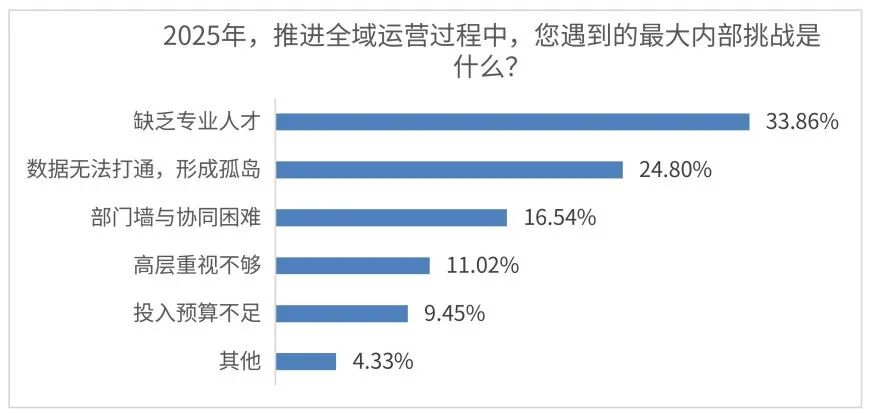
Core Insights - The report highlights that the challenges faced in private domain and full domain operations have intensified, particularly due to user fatigue, talent shortages, and data integration issues [1][2] - The report aims to systematically address whether the complexity of private domain operations is increasing or if expectations are simply rising [1] Group 1: Internal Challenges - The primary internal challenge for companies is the lack of professional talent, cited by 33.86% of respondents, followed by data silos at 24.80% and difficulties in departmental collaboration at 16.54% [4] - The talent gap in private and full domain operations has been consistently emphasized in previous reports, indicating a persistent need for skilled professionals [5] - High-level support is crucial for overcoming internal challenges, with many teams expanding and increasing the importance of leadership involvement [5] Group 2: External Challenges - User fatigue or resistance to private domain interactions is the most significant external challenge, reported by 41.73% of respondents [7] - The high cost of customer acquisition, particularly in transitioning users to private domains, is another major concern at 25.2% [8] - Changes in platform rules, such as restrictions on outbound calls and link blocking, are also impacting businesses, with 24.02% of respondents highlighting this issue [9] Group 3: User Engagement and Lifecycle Management - Only 21.26% of companies have fully established user lifecycle management systems, while 42.52% have partially implemented them, indicating a need for improvement in this area [14] - The report shows a mixed perception of user engagement, with 40.55% of teams noting an increase in user acceptance of private domain interactions, while 36.62% observed a decline [11][13] Group 4: Data Integration and Platform Policies - Achieving complete cross-platform user data integration remains a challenge, with only 8.66% of brands reporting full integration and 48.43% achieving partial integration [16][17] - The impact of platform policy changes on business operations is significant, with 30.71% of brands indicating a need for frequent strategy adjustments due to these changes [20] Group 5: New Growth Channels and Supply Chain Impact - The contribution of live streaming and short video platforms to private domain growth is still perceived as needing improvement, with brands viewing these as auxiliary channels more than core ones [21] - Private domain operations are driving changes in supply chains and business models, with 57.14% of service providers noting significant impacts on organizational structure and business model upgrades [25] Group 6: International Expansion - There is a growing interest in overseas private domain operations, with 7.48% of companies already engaged and 22.83% planning to do so, reflecting the momentum of globalization [28]

避免内容同质化的母婴平台,用户信任度更高
Sou Hu Cai Jing· 2025-12-22 09:12
Core Insights - The maternal and infant vertical platforms exhibit differences in user coverage, business models, and content ecosystems [2] - User lifecycle management capabilities vary, impacting the ability to serve users from pre-pregnancy to parenting stages [17] Platform Comparison - **Mama Network**: Focuses on new mothers, providing comprehensive services from pre-pregnancy to age six [2] - **Qin Baby**: Emphasizes multi-role family participation with features for private growth records and family interaction [4] - **Baby Tree**: Previously a comprehensive maternal and infant community, now facing user loss due to a single business model and content homogenization [6] - **Other Platforms**: - **Yuer Network**: Specializes in pregnancy knowledge and tools with high professional standards [7] - **You Baby**: Features an AI parenting assistant with quick response times [8] - **Meiyou Parenting**: Extends from women's health to maternal and infant areas with diverse community topics [8] - **Beibei Parenting**: Driven by e-commerce with a wide range of products [9] - **Mama Help**: Regional community with rich localized activities [10] User Trust and Content Quality - Trust in maternal and infant platforms is enhanced by professional reviews and authoritative endorsements [10] - Users may prefer platforms with comprehensive tools if they prioritize professional knowledge, while multi-generational families may focus on interaction features [11] Industry Trends - The application of AI technology and personalized services is becoming increasingly prevalent in the industry [18] - The diversity of business models affects the sustainability of platforms, with light asset and heavy asset models each having distinct characteristics [16]

首个"快消行业新锐品牌榜单"出炉,至本、BeBeBus、Off&Relax、绽家等表现亮眼
Ge Long Hui· 2025-08-21 03:55
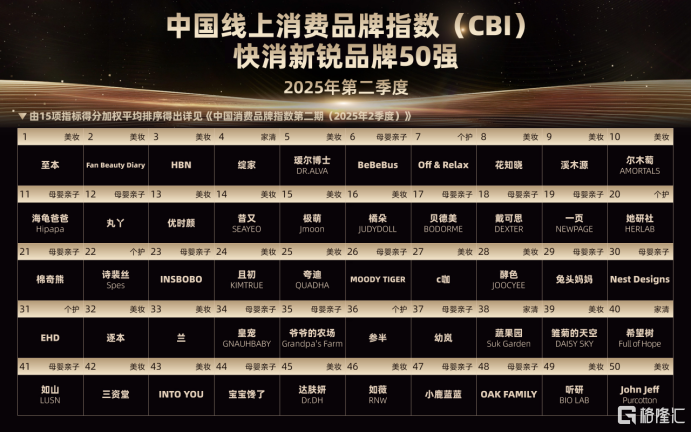
Core Insights - The report released on August 20, 2023, focuses on the "China Online Consumption Brand Index" (CBI) and the "Global Brand China Online 500 Strong List" (CBI500), highlighting emerging brands in the fast-moving consumer goods (FMCG) sector [1] - A new ranking for emerging brands in the FMCG sector was introduced, emphasizing innovation and the establishment of a comprehensive evaluation system for new brands [1][2] - The beauty industry had the highest number of new brands on the list, with brands like Zhi Ben, Fan Beauty Diary, and HBN leading the rankings [1][2] Evaluation Dimensions - The new FMCG emerging brand ranking is based on five evaluation dimensions: market opportunity, newness, brand awareness, reputation, and customer loyalty [2] - Market opportunity, a newly added dimension, accounts for 20% of the evaluation, utilizing Taobao and Tmall consumption data to assess market potential [2] - High-value consumer recognition is crucial for establishing a brand's quality image and gaining external validation [2] Brand Strategies - Emerging brands are focusing on both functional and emotional value, balancing practical benefits with emotional experiences [3] - Brands like Zhi Ben and HBN emphasize product efficacy, while others like Zhi Jia and Off & Relax focus on sensory experiences [3] - Market segmentation is a key strategy, with brands targeting specific niches within the mother and child sector, such as BeBeBus for strollers and Hai Gui Ba Ba for sun protection [3] Market Trends - The majority of the 50 brands listed are domestic, indicating a strong trend of entrepreneurship and innovation in China's FMCG sector [4] - The report highlights the increasing market attention on high-quality consumer brands, with companies like Lao Pu Huang Jin and Pop Mart seeing stock price surges [5] - Tmall serves as a significant digital platform for emerging brands, providing comprehensive support from traffic acquisition to user operations [5]
卑微如我,才是游戏公司今天最重要的人|深氪
36氪未来消费· 2025-06-05 11:57
Core Viewpoint - The article emphasizes the importance of game operation in the current market, highlighting that success or failure often hinges on effective player engagement and retention strategies in a saturated gaming environment [6][18][56]. Group 1: Game Operation and Player Engagement - The recent incident in "Battlefield 2" illustrates how crucial game operation is, as player dissatisfaction arose from perceived operational flaws despite the game's initial success [3][5]. - Tencent's strategic officer noted that stagnation in a game often points to issues within the operational team rather than the game itself, stressing the need for the right personnel to manage player engagement [15]. - The gaming industry is transitioning from a phase of rapid growth to one focused on retaining existing players, making player operation more critical than ever [17][18][19]. Group 2: Challenges in Player Retention - In 2024, China's gaming user growth was only 0.94%, indicating a shift towards a more competitive landscape where retaining existing players is paramount [17]. - Companies are now tasked with keeping older games engaging for long-term players, which presents unprecedented challenges for player operation roles [19][30]. - Effective player operation involves monitoring user behavior and intervening before players decide to leave, utilizing data-driven strategies to enhance user experience [28][30]. Group 3: Evolution of Game Operation - The evolution of player operation has been significant, moving from basic customer service to a comprehensive lifecycle management approach that addresses user needs at every stage [49][52]. - The cost of acquiring new players has increased dramatically, necessitating a focus on retaining existing users to justify the investment made in acquiring them [55][56]. - Companies are learning from successful long-standing games, implementing strategies to extend their lifecycle and maintain player interest [57][58]. Group 4: The Role of Player Operation Teams - Player operation teams are now expected to provide "exceeding expectations" services, creating emotional connections with players to enhance retention [43][48]. - Successful player operation involves not just addressing complaints but also proactively engaging with players through personalized interactions and community-building activities [43][44][67]. - The emotional aspect of player operation is highlighted, as operators often form bonds with players, which can lead to increased loyalty and reduced churn [66][72].



这个有30多年工作经验的新任CEO,能否让雪铁龙实现新的突围?
Zhong Guo Qi Che Bao Wang· 2025-05-22 07:27
Core Viewpoint - Stellantis Group's Citroën brand has appointed Xavier Chardon as the new CEO, effective June 2, 2025, raising industry expectations for new opportunities under his leadership [2][8]. Background of Xavier Chardon - Xavier Chardon graduated from the prestigious Nancy Business School in France, focusing on marketing and corporate strategy, which laid a solid theoretical foundation for his management in the automotive industry [3]. - He joined PSA Group in 1994 as a marketing specialist, successfully increasing market share in Southern Europe [3]. - Chardon became the global marketing and communications director for Citroën in 2007, enhancing the brand's image and positioning [3]. - He held various roles at Volkswagen, including European market sales director and global marketing director, where he implemented strategies that significantly improved market share and brand perception [4]. Responsibilities and Strategic Focus - Chardon will report to Jean-Philippe Imparato, COO of Stellantis Group for Europe, and aims to continue the "comfort technology" differentiation strategy while accelerating the development of electric vehicles [5][6]. - He plans to launch three new electric models in the next three years, targeting 100% electric sales in Europe by 2030 [6]. - Chardon emphasizes a "global vision, local execution" strategy, focusing on French design aesthetics and environmental principles in Europe while customizing offerings for the Asia-Pacific market [6]. Brand Transformation and Market Positioning - Chardon aims to leverage Stellantis Group's STLA electric platform to enhance battery performance and reduce production costs by 20% [7]. - He proposes a dual strategy of high-end and youth-oriented branding in China, integrating AI-driven driving assistance systems while maintaining classic technologies [7]. - The introduction of a "Vehicle as a Service" (VaaS) model in Europe is planned, offering comprehensive subscription services for electric vehicles [7]. - Chardon will also push for Citroën's participation in Stellantis Group's battery recycling network, aligning with global carbon neutrality goals [7]. Industry Context and Expectations - Chardon's appointment comes at a critical time for the global automotive industry, facing challenges in electric and intelligent transformation [8]. - His extensive experience across two major automotive groups is seen as a potential catalyst for Citroën to navigate the industry's transformative period [8]. - The industry is keenly observing whether Chardon can lead Citroën to strengthen its market position and explore new opportunities [8].
