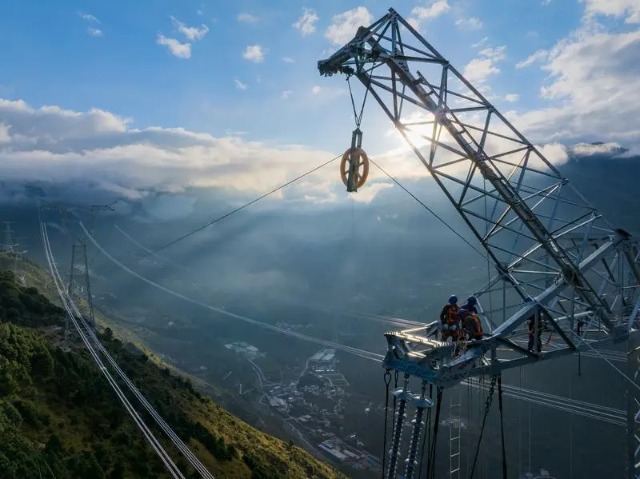
电力自由

Search documents
超级电力帝国崛起,从一块光伏板开始
3 6 Ke· 2026-01-22 05:05
Group 1 - The core point of the article highlights that China's electricity consumption is projected to exceed 10 trillion kilowatt-hours by 2025, marking a significant milestone in energy consumption and positioning China as a potential energy empire [1][3] - This electricity consumption is equivalent to more than double that of the United States and surpasses the total consumption of the EU, Russia, Japan, and India combined [1][3] - The rapid expansion of China's energy infrastructure is evidenced by the National Grid's announcement of a 40% increase in fixed asset investment during the 14th Five-Year Plan period, reaching 4 trillion yuan [1] Group 2 - The article emphasizes the strategic importance of electricity in the 21st century, suggesting that control over electricity and its pricing will determine global dominance [3][6] - Historical context is provided, detailing significant developments in China's electricity infrastructure, including the construction of high-voltage power lines, large hydropower stations, and nuclear power plants [5][6] - The article notes that while solar power currently accounts for only 5.95% of China's electricity generation, it is viewed as a sector with immense growth potential due to its adaptability and lower entry barriers compared to other energy sources [8][9] Group 3 - The solar power industry has seen rapid growth, with major companies like Longi Green Energy and Tongwei experiencing significant stock price increases following the end of European anti-dumping investigations [12][13] - However, the industry faces challenges, including overproduction and significant financial losses, with major companies forecasting losses in the billions due to aggressive market competition and capacity expansion [15][16] - The article suggests that despite these challenges, companies are reluctant to cut production, aiming to achieve economies of scale and maintain competitive advantages in the long term [18]



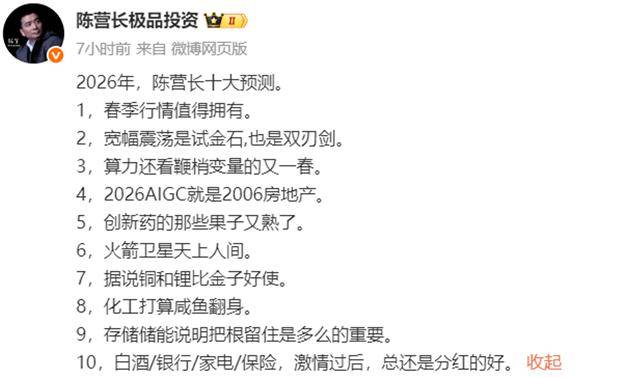
22.09万亿,私募规模狂创新高!31家外资私募名单明细;淡水泉、重阳最新观点;神农投资陈宇2026年十大预测|私募透视镜
Sou Hu Cai Jing· 2025-12-27 04:26
热点聚焦 22.09万亿,私募规模狂创新高! 重阳投资:本轮行情的韧性可能会超出大家的预期 12月25日,重阳投资2026年策略报告显示,在全球经济结构重塑与科技革命加速的背景下,中国正步入以创新驱动和产业 升级为核心的新周期。与此同时,今年股市的增量资金源于低利率环境下居民和金融机构资产的再配置,因此,本轮行情 的韧性可能会超出大家的预期。提到AI,重阳投资报告中指出,拉长时间看,目前仍处于AI产业发展的早期,无论是多模 态大模型的应用爆发,还是人形机器人的落地普及,都需要远超当前规模的算力投入。但AI的"星辰大海"如何夯实经济可 行性的微观基础,弥合潜在需求和有效需求之间的鸿沟,可能是2026年产业发展无法回避的问题。 展望2026 洪灏:美股、A股、AI与人民币何去何从? 据中国证券投资基金业协会最新数据显示,截至2025年11月末,存续私募基金管理人19314家,管理基金数量138055只,管 理基金规模22.09万亿元,再创历史新高。其中,存续私募证券投资基金80242只,存续规模7.04万亿元;存续私募股权投资 基金29971只,存续规模11.18万亿元;存续创业投资基金27064只,存续规模3. ...
“电力自由”如何赋能中国制造
淡水泉投资· 2025-12-24 09:10
Core Viewpoint - The article emphasizes the growing importance of electricity as a competitive factor in global industries, highlighting China's achievement of "electricity freedom" as a significant competitive advantage amidst global energy challenges [1][16]. Group 1: Electricity Market Trends - Since 2019, global average electricity prices have been rising and becoming more volatile, indicating an unstable electricity market due to insufficient investment in energy sources and aging grid infrastructure [1][3]. - In contrast, China has not experienced similar price increases, attributed to decades of strategic energy planning and infrastructure investment, resulting in China's electricity generation surpassing that of the U.S. by 2024, reaching 2.3 times the U.S. output [3][5]. Group 2: Stability and Cost Advantages - China's electricity supply stability is bolstered by advanced ultra-high voltage transmission technology and a unified national power market, leading to competitive electricity prices for industrial users, approximately $0.1 per kWh, significantly lower than the U.S. at $0.15 per kWh and even lower than European countries [5][8]. - The low and stable electricity supply is crucial for high-energy, asset-heavy industries, where energy costs can account for 40%-50% of total production costs, making them sensitive to energy price fluctuations [8][10]. Group 3: Competitive Edge in Industries - China's leading position in the global battery market, with a 56% share in 2024, exemplifies the competitive advantage derived from low energy costs and technological superiority, particularly in high-energy sectors [10][12]. - The chemical industry is witnessing a shift towards "overseas contraction and Chinese expansion," with China becoming a net exporter of chemical products due to its energy and cost advantages, while traditional chemical powerhouses in Europe face declining global market shares [13][16]. Group 4: Impact on Manufacturing Competitiveness - Electricity is reshaping the competitiveness of Chinese manufacturing, contributing to an increase in China's global export share and a trade surplus exceeding $1 trillion, supported by a stable energy system [16][17].
2025年经济热词盘点!你的生活因它们而变了吗?
Sou Hu Cai Jing· 2025-12-09 02:55
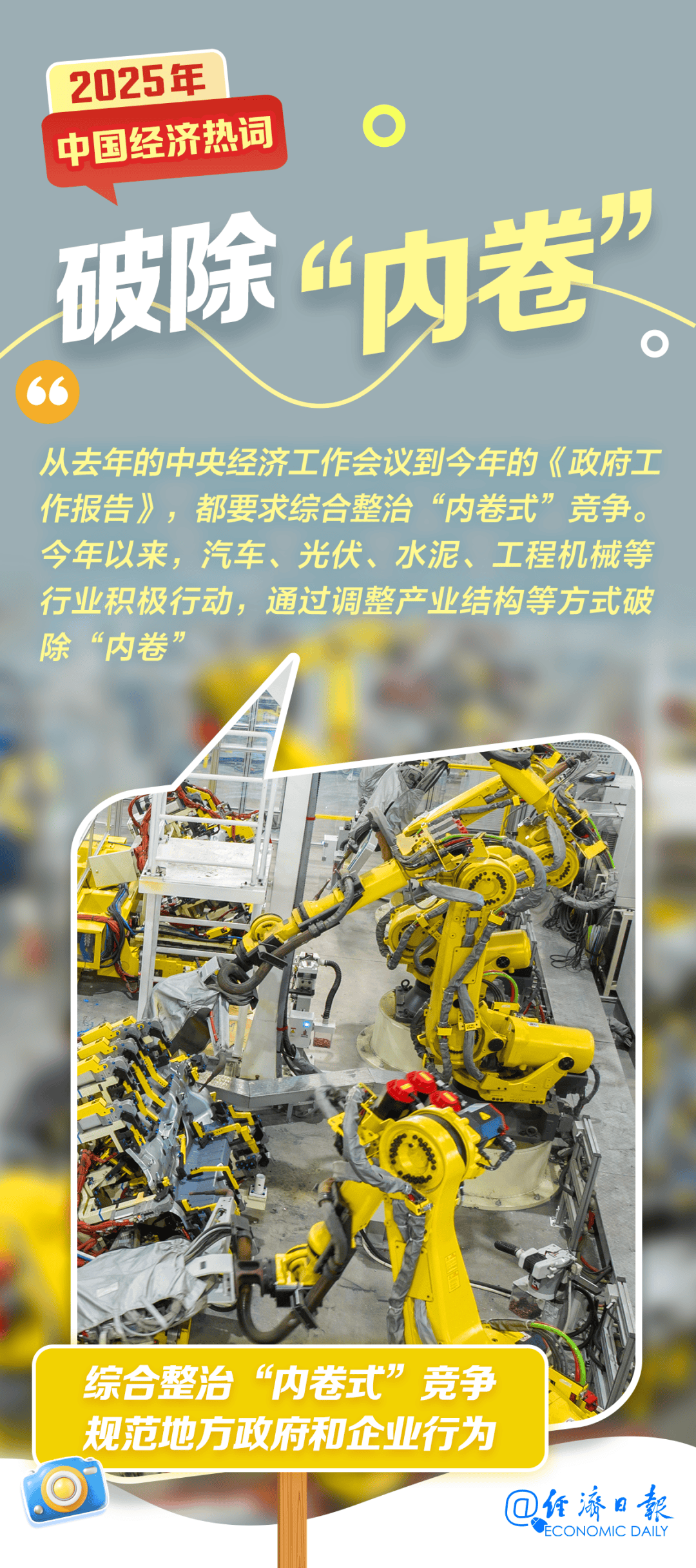
综合整治"内巷式"竞争 规范地方政府和企业行为 OK 海日報 ECONOMIC DAILY 2025年 中国经济热词 智能 今年是中国式现代化进程中具有重要意义的一年,我国经济运行总体平稳、稳中有进,新质生产力稳步发展,改革开放迈出新步伐,重点领域风险化解取 得积极进展,民生保障更加有力,社会大局保持稳定。回眸2025年,一起来盘点中国经济热词↓ 继"互联网+"之后,我国对数字经济进行又 一次战略部署。今年8月,国务院印发《关于 深入实施"人工智能+"行动的意见》,以六 大行动八大支撑赋能新质生产力发展, 为人工 智能发展按下"加速键" 人工智能领域 要占领先机、赢得优势 促进民营经济健康发展、 高质量发展 0 14 濟 取 2025年 中国经济热词 IF 2 5 IFF 上開封天 66 0.99 深日報 CONOMIC DAILY 2025年 中国经济热词 . "印尼 66 今年以来,"国补"资金按计划陆续下达、 个人消费贷款迎来财政贴息 …… 一系列真金 白银的政策加力提振消费,让消费者得到更 多实惠、市场获得更强动能 惠民生、促消费、增后劲 OF 海 海 取 2025年 0 中国经济热词 s经济促进法 ...
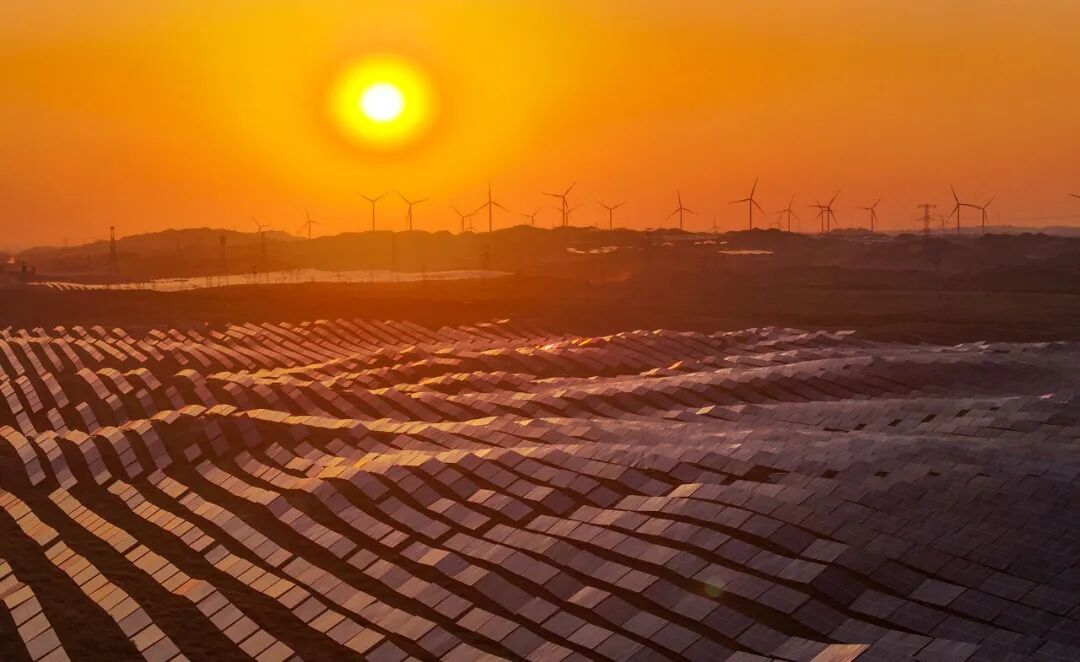
中国手中又有了一张“王牌”!
Jing Ji Ri Bao· 2025-09-25 06:43
Group 1 - The core viewpoint of the article emphasizes that "electricity freedom" is a significant competitive advantage for China, ensuring stable and high-quality electricity supply which supports economic and industrial development [1][4][6] - China's electricity load has reached historical highs, with electricity consumption exceeding one trillion kilowatt-hours in July and August, marking a global first [1] - The stability of China's electricity supply has been crucial for maintaining the operational needs of a vast industrial system and a population of over 1.4 billion [1][3] Group 2 - "Electricity freedom" signifies stable supply, which is essential for industrial transformation and upgrading, particularly in high-tech sectors like semiconductors that require consistent power [3][4] - The World Bank highlights the importance of upgrading electricity infrastructure for transitioning to high-value-added manufacturing [3] - Continuous improvements in electricity infrastructure and smart grid technology are necessary to enhance reliability and responsiveness of the power system [3][4] Group 3 - "Electricity freedom" also represents green supply, with renewable energy generation surpassing thermal power, thus reducing production costs and carbon emissions while enhancing competitiveness [4][6] - The increasing demand for green electricity necessitates the expansion of renewable energy capacity and improvements in its stability [4] - Low-cost electricity supply is critical for manufacturing, particularly for energy-intensive industries, and China's average electricity prices remain competitive globally [4][6] Group 4 - The manufacturing sector must adapt to the characteristics of renewable energy, with large electricity consumers upgrading systems for flexible production based on electricity price changes [6] - Historical energy revolutions have redefined national competitiveness, and "electricity freedom" is emerging as a new focal point in this context [6] - China's advancements in stable supply, green transition, and cost control reflect innovations in energy technology and infrastructure, contributing to sustainable economic development [6]
“电力自由”意味什么
Jing Ji Ri Bao· 2025-09-24 22:49
Core Insights - The article emphasizes that "electricity freedom" is becoming a competitive advantage for China in the global market, particularly in ensuring stable and high-quality electricity supply for economic development [1][4] - China's electricity consumption has reached unprecedented levels, with over 1 trillion kilowatt-hours in July and August, showcasing the country's robust power supply system [1] - The stability of China's electricity supply is crucial for the transformation and upgrading of industries, especially in high-tech sectors like semiconductors [1][2] Group 1: Stability of Electricity Supply - "Electricity freedom" signifies stable supply, which is essential for industrial transformation and upgrading [1][2] - The stability of the electricity system supports the needs of over 1.4 billion people and a vast industrial framework, ensuring uninterrupted power for manufacturing [1][4] - Upgrading electricity infrastructure is vital for transitioning to high-value-added manufacturing, with a focus on enhancing grid reliability and flexibility [2] Group 2: Green Energy Supply - "Electricity freedom" also represents a shift towards green energy, with renewable energy generation surpassing thermal power for the first time [2] - The increasing application of green electricity in manufacturing helps reduce production costs and carbon emissions, promoting a greener industrial development [2] - There is a need to enhance the stability of renewable energy sources and encourage distributed renewable energy facilities to minimize transmission losses [2] Group 3: Cost-Effective Electricity Supply - Low-cost electricity is crucial for manufacturing, directly impacting overall production costs and competitiveness [3] - China's average electricity prices remain low due to diverse energy sources and economies of scale, enhancing international competitiveness for manufacturers [3] - The establishment of a unified national electricity market will further optimize resource allocation and improve service efficiency for the manufacturing sector [3] Group 4: Historical Context and Future Implications - Historical energy revolutions have redefined national competitiveness, and "electricity freedom" is emerging as a new focal point in this context [4] - China's advancements in stable supply, green transition, and cost control reflect innovations in energy technology and infrastructure, contributing to sustainable economic development [4]
有一种奢侈叫“电力自由”
Ren Min Wang· 2025-08-26 03:38
国家能源局近日发布了一个具有历史意义的数字:10226亿千瓦时。这个数字,是中国7月份的全社会用 电量,相当于东盟国家一年的用电总和。这是我国月度全社会用电量规模首次突破万亿千瓦时大关。 事实上,电力不仅关乎生产的连续性,更直接影响着经济的成本。从西部的风光大基地,到沿海的核电 集群,再到深入全国的特高压输电网络,一个庞大、高效、多元的能源体系,构成了电价稳定的"压舱 石"。一个稳定且相对低廉的电价体系,能够有效降低实体经济,特别是制造业的运行成本。这种成本 优势的影响是深远的。它能让高耗能产业,如有色金属、化工、建材等,在全球竞争中保持了成本优 势,稳固了产业链中上游的地位。 更重要的是,它惠及了千千万万的中小企业。对于这些利润空间本就有限的企业而言,稳定的能源成本 是其生存和发展的生命线。当海外竞争对手还在为飙升的电费头疼时,中国企业却能将节省下来的成本 投入到研发升级中,这种系统性的成本优势,如同一股"引力波",持续吸引着全球资本和高端制造业向 中国集聚。 充沛的电力是数字经济和未来产业的"点火器"。以人工智能为例,大模型的训练和推理需要消耗惊人的 算力,而算力的背后就是巨大的电力消耗。一个超大型智算中 ...