精准深耕

Search documents
视点 | 第一份2025年度书业市场报告来了!
Xin Lang Cai Jing· 2026-01-22 10:09
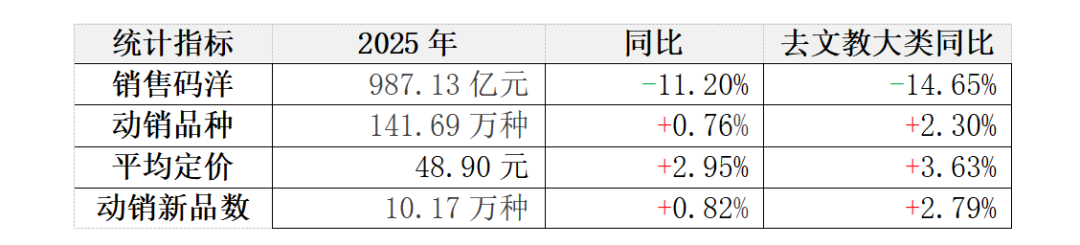
Core Insights - The 2025 book market is projected to have a total sales value of 98.713 billion yuan, representing a year-on-year decline of 11.20%, with a further widening of the decline [1][29] - Excluding the essential educational category, other major book categories are expected to see a decline of 14.65% in sales value [1][29] - The average price of books is expected to rise to 48.90 yuan, an increase of 2.95% compared to the previous year [9][37] Market Trends - The number of active book titles is projected to increase by 0.76% to 1.4169 million, while the number of new titles is expected to rise by 0.82% to 101,700 [1][29] - Political books have regained the top share in new book sales, with a significant increase of 59.97%, driving overall new book market performance [2][32] - The decline in various book categories, except for educational and literary genres, has narrowed compared to the previous three quarters [5][34] Sales Channels - Traditional e-commerce and short video e-commerce channels are expected to dominate the market, with a near 1:1 share [12][40] - Traditional e-commerce channels are under pressure, with a significant market share reduction, while short video e-commerce is transitioning from rapid growth to stable increases [14][43] - The market share of physical retail channels has shrunk to around 3%, with a year-on-year decline of 25% [14][43] Consumer Behavior - The demand for classic and functional children's books is increasing, with trends showing a preference for "manga+" formats [21][52] - Celebrity authors and social media influencers are becoming a new trend, leveraging their popularity to drive book sales [22][52] - The industry is facing challenges in maintaining long-term sales momentum, as many bestsellers experience rapid declines in sales after initial success [6][35] Industry Challenges - The book industry is in a state of turbulence, with structural challenges and transformation pains coexisting [58] - The focus is shifting from broad market expansion to precise marketing and meeting consumer needs [51][58] - The industry must adapt to changing market dynamics and consumer preferences to create sustainable value [58]

同时关闭7家商场!宜家中国转型遇挫?
3 6 Ke· 2026-01-14 10:51
Core Viewpoint - IKEA China is undergoing a strategic adjustment, announcing the closure of seven offline stores starting February 2, reflecting challenges in the retail sector and changing consumer behavior [1][3]. Group 1: Store Closures and Operations - IKEA China will stop operations at seven stores, including locations in Shanghai, Guangzhou, and Tianjin, effective February 2 [1]. - The announcement follows prior temporary closures in Xuzhou and Ningbo, with a clearance sale expected to take place before the final closure [2]. - After the closures, IKEA will have only one store remaining in Guangzhou and Tianjin, and no stores in Heilongjiang, while Jiangsu will reduce from five to three stores [2]. Group 2: Financial Performance - IKEA's parent company, Ingka Group, reported a 5.5% decline in revenue and a 46.5% drop in net profit for the 2024 fiscal year [3]. - In China, despite opening four new stores, IKEA's revenue decreased from €1.58 billion to €1.46 billion, indicating a significant decline in single-store performance [3]. Group 3: Market Trends and Consumer Behavior - The middle class in China is moving away from IKEA, perceiving its offerings as less upscale, leading to a demographic shift where older consumers frequent the stores more than younger ones [3]. - Online sales for IKEA in China accounted for 25.7% of total revenue in the 2025 fiscal year, but the brand lags behind competitors in online presence [4]. Group 4: Strategic Adjustments and Future Plans - IKEA China is focusing on transformation, emphasizing a multi-channel strategy and plans to open over ten smaller stores in key markets like Beijing and Shenzhen by 2026 [4]. - The company aims to enhance its online presence, recently launching a flagship store on JD.com, as part of its strategy to adapt to market changes [4][5].
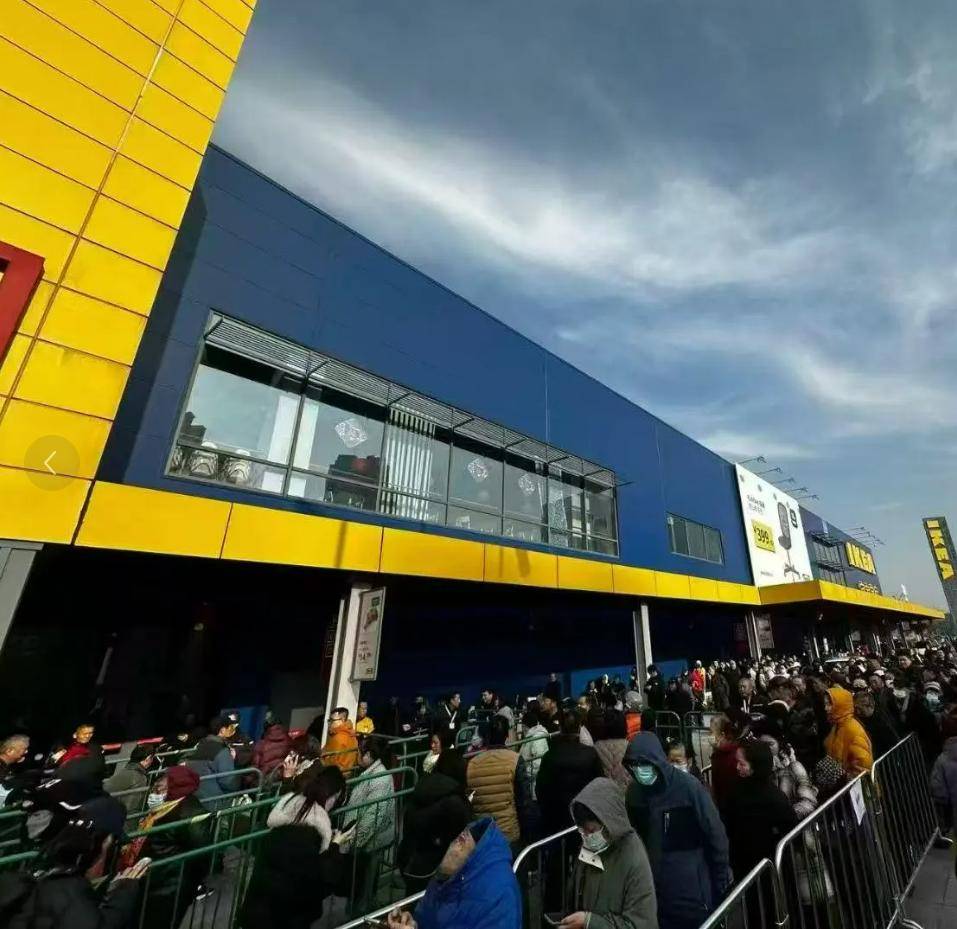
宣布闭店后的宜家人满为患 但打折活动15日才开启
Sou Hu Cai Jing· 2026-01-10 13:22
Core Viewpoint - IKEA is undergoing a significant strategic transformation in response to declining sales and changing consumer behaviors, moving away from large-scale expansion to focus on community-based smaller stores and online retail [1][19]. Group 1: Store Closures and Consumer Reactions - IKEA announced the closure of seven stores in China, including locations in Shanghai, Guangzhou, and Ningbo, effective February 2 [4][8]. - Following the announcement, there was a surge in customer traffic at the remaining stores, with long queues and crowded aisles as consumers rushed to take advantage of clearance sales starting January 15 [5][6]. - Many customers expressed nostalgia and shared memories associated with IKEA, highlighting its role as a significant part of their lives beyond just a shopping destination [5][10]. Group 2: Financial Performance and Market Challenges - IKEA's global revenue declined by 5.5% to €41.864 billion in 2024, while IKEA China's sales dropped from a peak of ¥15.77 billion in 2019 to approximately ¥11.15 billion in 2024, a nearly 30% decrease [19][20]. - The traditional drivers of the home goods market, such as new housing deliveries and large-scale renovations, are diminishing, impacting sales [20]. - The rise of local brands offering competitive pricing and tailored designs has intensified competition, with IKEA falling to seventh place in the Tmall furniture sales rankings during the 2024 Double Eleven shopping festival [20][21]. Group 3: Strategic Shift and Future Plans - IKEA is shifting its strategy to focus on smaller, community-oriented stores and enhancing its online presence, with plans to open over ten small stores in key cities like Beijing and Shenzhen in the next two years [21]. - The company aims to adapt to the evolving market by optimizing costs and improving efficiency, indicating a proactive approach to its transformation rather than a reaction to financial distress [19][21]. - The transition reflects broader trends in retail, where large-format stores are being replaced by smaller, more accessible formats to meet changing consumer preferences [21].

宣布闭店后的宜家人满为患
Sou Hu Cai Jing· 2026-01-10 00:55
Core Viewpoint - IKEA is undergoing a significant strategic transformation in China, moving away from large-scale expansion to focus on community-based small stores and online instant retail, prompted by declining sales and changing consumer habits [6][8][10]. Group 1: Store Closures and Consumer Response - IKEA announced the closure of seven stores in China, including locations in Shanghai, Guangzhou, and Ningbo, effective February 2 [4]. - Following the announcement, there was a surge in customer traffic at the remaining stores, with long queues and crowded aisles as consumers rushed to take advantage of the clearance sales starting January 15 [5][6]. - The closures have sparked nostalgia among consumers, who associate IKEA with personal memories and experiences, highlighting its role as a community space beyond just a furniture retailer [4][5]. Group 2: Financial Performance and Market Dynamics - IKEA's parent company, Ingka Group, reported a 5.5% decline in global revenue to €41.864 billion for the fiscal year ending August 2024, while IKEA China's sales dropped nearly 30% from a peak of ¥15.77 billion in 2019 to approximately ¥11.15 billion in 2024 [6][8]. - The traditional drivers of the home furnishings market, such as new housing deliveries and large-scale renovations, are diminishing, impacting sales [7]. - Changing consumer behavior, particularly among younger generations who prefer online shopping and efficient purchasing, has challenged IKEA's traditional large store model [7][8]. Group 3: Competitive Landscape and Strategic Shift - Local brands in China are gaining market share, with IKEA ranking seventh in sales during the 2024 Double Eleven shopping festival, behind brands like Yuan Shi Mu Yu and Lin Shi Home [8]. - These local competitors offer more flexible supply chains, designs that resonate with local aesthetics, and competitive pricing, making IKEA's traditional self-service model less appealing [8]. - In response, IKEA plans to open over ten small-format stores in key cities like Beijing and Shenzhen over the next two years, marking a shift towards a "small but beautiful" community store model [8][10].
宜家中国:2月2日起停止运营7家门店
Xin Lang Cai Jing· 2026-01-07 07:30
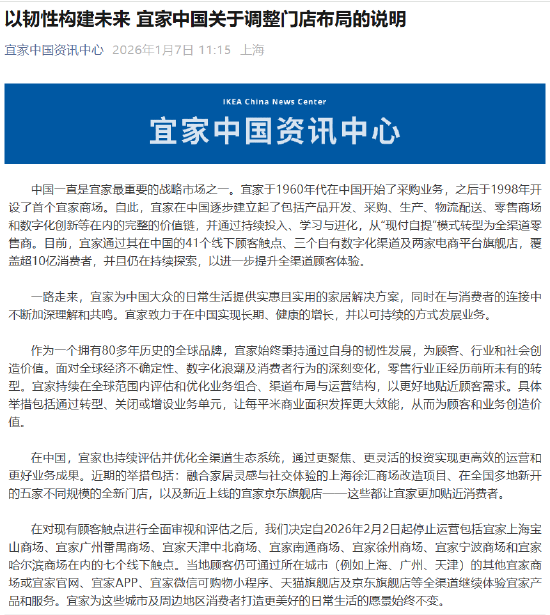
Core Insights - IKEA China announced the closure of seven offline locations starting February 2, 2026, including stores in Shanghai, Guangzhou, Tianjin, Nantong, Xuzhou, Ningbo, and Harbin [1][3] - Customers can continue to access IKEA products and services through other local stores, the IKEA website, app, WeChat mini-program, and flagship stores on Tmall and JD [1][3] - The company plans to shift from expansion to focused development, prioritizing Beijing and Shenzhen as key markets, with plans to open over ten small stores in the next two years [1][3] - New store openings include the Dongguan store in February 2026 and the Tongzhou store in Beijing in April 2026 [1][3] - IKEA will also enhance its online presence and invest in existing stores [1][3]
突然宣布,关闭7家门店!
Zhong Guo Ji Jin Bao· 2026-01-07 07:26
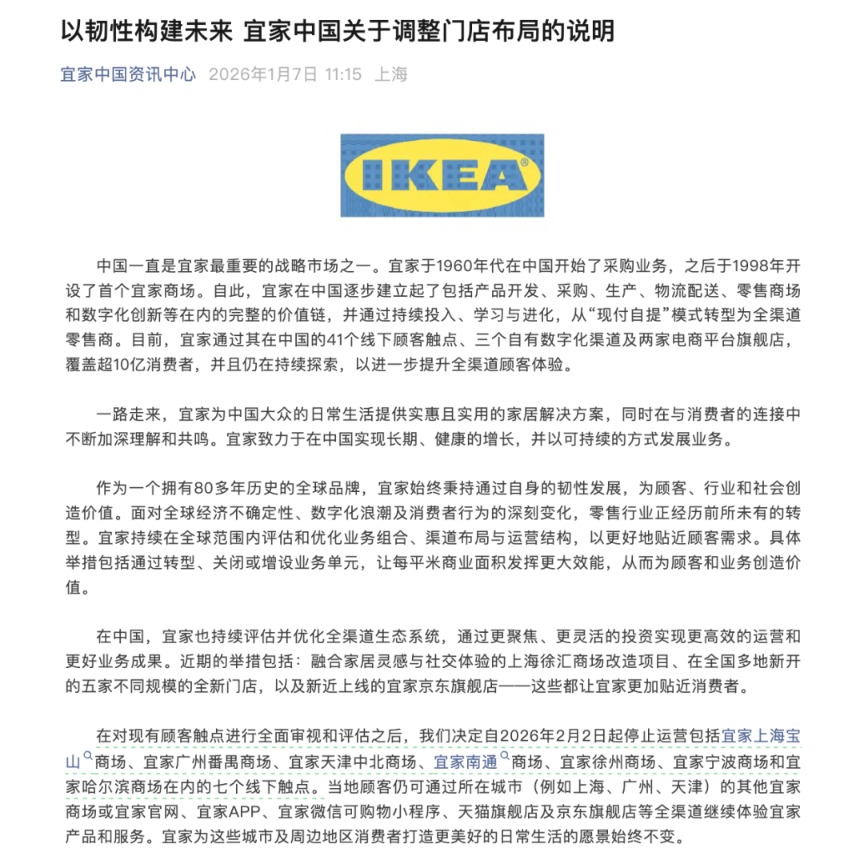
Core Viewpoint - IKEA China announced the closure of seven stores as part of its strategic transformation to build a more resilient foundation for future business growth [4]. Group 1: Store Closures - IKEA China will cease operations at seven locations, including stores in Shanghai, Guangzhou, Tianjin, Nantong, Xuzhou, Ningbo, and Harbin, starting February 2, 2026 [1]. - Customers in these cities can continue to access IKEA products and services through other nearby stores and various online platforms [3]. Group 2: Strategic Transformation - The decision to close stores is part of IKEA's ongoing evaluation and optimization of its business portfolio, channel layout, and operational structure globally [4]. - IKEA aims to enhance customer experience by maximizing the efficiency of each square meter of commercial space through transformation, closures, or the addition of business units [4]. Group 3: Market Focus - China remains a key strategic market for IKEA, with the company planning to shift from scale expansion to targeted development [5]. - IKEA will focus on Beijing and Shenzhen as key markets, with plans to open over ten small stores in the next two years, including new locations in Dongguan and Tongzhou [6]. - The company will continue to strengthen its online presence and invest in existing stores to improve the shopping experience for customers and the working environment for employees [6].
速看,11月起房地产调控换道,三大影响让购房者连夜算账
Sou Hu Cai Jing· 2025-11-08 11:42
Core Insights - The real estate market is experiencing a paradox where despite historically low interest rates and down payments, new home sales in 100 cities have declined by 6% year-on-year as of September 2025 [1][3] - The optimization of purchase restrictions in major cities like Beijing, Shanghai, and Shenzhen marks the beginning of a "non-restriction period" in the real estate sector, following nearly 3,000 policy adjustments since 2022 [3][5] - The market is undergoing structural changes, with a shift from "just having a home" to "having a good home," indicating a focus on quality and location over mere affordability [5][9] Policy Changes - By May 2024, the down payment for first-time homebuyers was reduced to 15%, and the lower limit for mortgage rates was removed, resulting in a current mortgage rate of 3.5%, the lowest in history [3][5] - Various supportive policies, including tax rebates for home purchases and increased public housing supply, are being implemented to further lower the barriers to homeownership [10][12] Market Dynamics - The inventory of unsold residential properties remains high at 310 million square meters, with a clearance period of approximately 19.9 months, particularly pronounced in third- and fourth-tier cities [5][7] - The land market shows a stark contrast between first-tier cities, where land transfer fees increased by 24.5%, and third- and fourth-tier cities, which saw a decline [7][12] Buyer Behavior - There is a noticeable shift in buyer preferences towards larger homes, with properties between 120-144 square meters accounting for over 30% of new home sales in key cities [7][9] - First-time buyers are advised to focus on cities with stable population inflows and solid industrial bases, while upgrade buyers can benefit from policies like "old for new" [9][10] Investment Strategies - Real estate companies are shifting their focus from scale expansion to quality aspects such as design, green building, and community services [9][10] - Investors are encouraged to adopt a long-term perspective, prioritizing quality residential and commercial properties in core cities, rather than seeking short-term gains [10][14]