经济碎片化

Search documents
联合国贸发会议报告指出:全球投资总量回升但分布失衡
Jing Ji Ri Bao· 2026-01-28 08:49
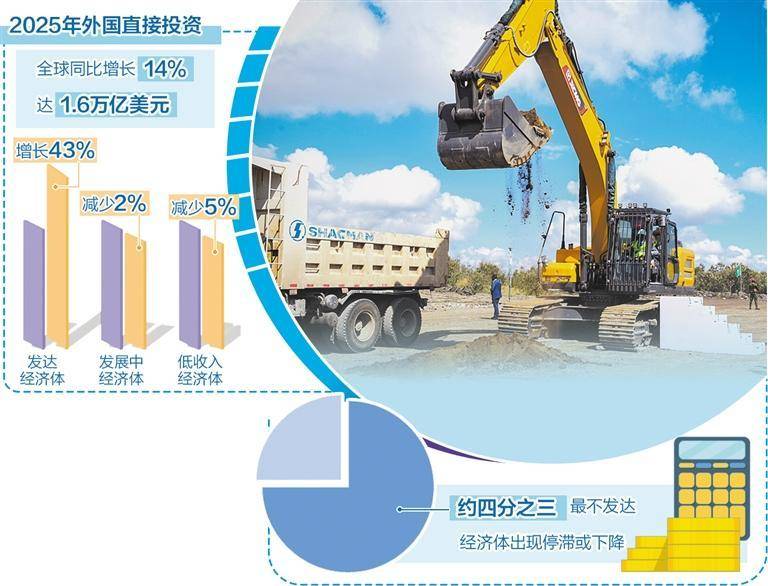
Group 1 - The core viewpoint of the report is that while global foreign direct investment (FDI) is projected to grow by 14% to $1.6 trillion by 2025, this increase is primarily due to a technical rebound rather than a comprehensive recovery in real investment [1] - Over $140 billion of the FDI increase is attributed to financial hubs like the UK, Luxembourg, Switzerland, and Ireland, indicating that the real growth, excluding such channel FDI, is only about 5% [1] - There is a stark disparity in global investment distribution, with developed economies experiencing a 43% increase in FDI to $728 billion, while developing economies saw a 2% decrease to $877 billion, and low-income economies faced a 5% decline [1] Group 2 - International project financing in sectors like infrastructure has declined for the fourth consecutive year, with a significant drop of 16%, and the number of new greenfield projects also decreased by 16% [2] - Companies are showing reluctance to make long-term capital commitments due to structural reasons, with increasing uncertainty in trade, industry, and investment policies leading to a preference for capital reallocation rather than physical investments [2] - Global FDI is increasingly concentrated in data centers and semiconductors, with data centers accounting for about 20% of global greenfield investment, while traditional manufacturing and renewable energy sectors are experiencing a notable decline [2] Group 3 - The report anticipates a moderate recovery in FDI in 2026, but highlights significant downside risks and an unstable recovery foundation [3] - Favorable factors include expected declines in inflation and financing costs, as well as a potential rebound in merger and acquisition activities [3] - Adverse factors consist of escalating geopolitical conflicts, increased policy uncertainty, and a worsening fragmentation of the economy, which may lead to capital spending concentrating further in a few countries and strategic industries [3]
全球投资总量回升但分布失衡
Sou Hu Cai Jing· 2026-01-28 01:11
Group 1 - The core viewpoint of the report indicates that global foreign direct investment (FDI) is expected to grow by 14% in 2025, reaching $1.6 trillion, primarily due to a technical rebound rather than a comprehensive recovery in physical investments [2] - The report highlights that over $140 billion of the FDI increase in 2025 will come from financial hubs like the UK, Luxembourg, Switzerland, and Ireland, but when excluding this type of FDI, the real growth is only about 5% [2] - There is a significant disparity in global investment distribution, with developed economies experiencing a 43% increase in FDI to $728 billion, while developing economies saw a 2% decrease to $877 billion, and low-income economies faced a 5% decline [2] Group 2 - International project financing in infrastructure and other sectors has declined for the fourth consecutive year, with a drop of 16%, and the number of new greenfield projects has also decreased by 16% [3] - The report attributes the weakening of corporate investment intentions to structural reasons, as companies are more inclined to manage funds rather than commit to physical investments due to increased uncertainty in trade, industry, and investment policies [3] - Global FDI is increasingly concentrated in data centers and semiconductors, with data centers accounting for about 20% of global greenfield investment, while traditional manufacturing and renewable energy sectors are experiencing a notable decline [4] Group 3 - The report anticipates a modest recovery in FDI in 2026, but the risks of decline are significant, with unstable recovery foundations [4] - Favorable factors for potential recovery include expected decreases in inflation and financing costs, as well as a possible rebound in merger and acquisition activities [4] - Adverse factors include escalating geopolitical conflicts, increased policy uncertainty, and heightened economic fragmentation, which may lead to capital expenditures concentrating further in a few countries and strategic industries [4]

美联储柯林斯:全球经济一体化的退潮可能会推高通胀
Sou Hu Cai Jing· 2025-11-21 16:03
Core Viewpoint - The potential retreat from global economic integration may complicate the Federal Reserve's efforts and increase price pressures [1] Group 1 - The shift towards "economic fragmentation" could lead to a transitional period of inflationary pressure [1] - This environment may result in a reduced level of financial integration, which could raise domestic borrowing costs and broadly impact financial conditions [1] - A more turbulent and fragmented global environment may exacerbate business cycle and inflation volatility [1] Group 2 - The complexities of maintaining price stability and maximum employment may increase for the Federal Reserve, especially if supply-side shocks become more significant in this new environment [1] - Rising global risks and fragmentation are likely to suppress short-term economic activity while lowering long-term growth [1] - These factors may become significant, transformative, and interwoven forces shaping the economic landscape in the coming years [1]
欧盟委员会执行副主席东布罗夫斯基斯:七国集团的贸易讨论主要关注关税的经济影响以及经济碎片化问题。
news flash· 2025-05-22 15:48
Core Points - The trade discussions among the G7 countries primarily focus on the economic impact of tariffs and economic fragmentation [1] Group 1 - The discussions emphasize the economic implications of tariffs [1] - There is a concern regarding economic fragmentation among nations [1]
关于关税战、贸易战,蓝佛安、潘功胜重磅发声!|宏观经济
清华金融评论· 2025-04-25 10:30
20 25年4月23日至24日,二十国集团(G2 0)主席国南非在美国华盛顿举 行今年第二次G2 0财长和央行行长会议。会议讨论了全球经济展望、完善 国际金融架构、应对非洲发展和增长困境等议题。财政部部长蓝佛安,中 国人民银行行长潘功胜出席会议并发言。 蓝佛安:关税战、贸易战进一步影响经济金融稳定 2025年4月23日至24日,二十国集团(G20)主席国南非在美国华盛顿举行今年第二次G20财长和央行行长会议。会议主要就全球宏观经济形势和金融稳 定、国际金融架构以及促进非洲增长和发展等议题进行了讨论。财政部部长蓝佛安出席会议并发言,副部长廖岷陪同参会。 来源 | 财政部、中国人民银行 编辑丨丁开艳 责编丨兰银帆 往期回顾 Review of Past Articles - 蓝佛安表示,当前世界经济增长动能不足,关税战、贸易战进一步影响经济金融稳定。中方坚定维护以世界贸易组织为核心的多边贸易体制,主张通过平 等对话协商解决贸易和关税争议,也将坚定维护自身正当权益。各方应通过加强多边合作进一步完善国际经济金融体系,积极推动多边开发银行改革,有 效推进国际复兴开发银行股权审议,务实完善《缓债倡议后续债务处理共同框架》 ...
蓝佛安、潘功胜,在美最新发声!
证券时报· 2025-04-25 01:42
Core Viewpoint - The G20 meeting highlighted the need for enhanced multilateral cooperation to address global economic challenges, including trade tensions and financial stability, while emphasizing support for Africa's development and the importance of a stable international financial architecture [1][6]. Group 1: G20 Meeting Overview - The G20 finance ministers and central bank governors meeting took place in Washington, D.C. on April 23-24, 2025, focusing on global macroeconomic conditions, financial stability, and development in Africa [1][6]. - The meeting underscored the insufficient momentum in global economic growth, exacerbated by trade and tariff wars, which threaten economic and financial stability [1][6]. Group 2: China's Position and Contributions - China's Finance Minister, Liu He, emphasized the importance of maintaining a multilateral trade system centered around the WTO and resolving trade disputes through dialogue [1]. - The Chinese government is committed to supporting Africa's development by mobilizing resources and enhancing institutional capacity, leveraging digital and green transitions to stimulate economic growth [1]. Group 3: Bilateral Meetings - During the G20 meeting, Liu He held discussions with finance ministers from various countries, including South Africa, the EU, Pakistan, Germany, South Korea, Indonesia, the UK, Japan, and the World Bank, focusing on macroeconomic conditions and bilateral cooperation [2].

潘功胜:央行将实施好适度宽松的货币政策
第一财经· 2025-04-25 01:29
潘功胜强调,经济碎片化与贸易紧张局势持续扰乱产业链供应链、削弱全球经济增长动能,贸易战、 关税战没有赢家,主要经济体应加强参与国际宏观经济金融政策协调,采取实质行动推动国际合作, 维护全球经济和金融稳定。当前中国经济开局良好,延续回升向好态势,金融市场运行平稳。中国人 民银行将实施好适度宽松的货币政策,推动中国经济高质量发展。 据央行网站,2025年4月23日-24日,二十国集团(G20)在美国华盛顿召开今年第二次G20财长和央行 行长会。会议讨论了全球经济展望、完善国际金融架构、应对非洲发展和增长困境等议题。中国人民 银行行长潘功胜出席会议并发言,中国人民银行副行长宣昌能参加会议。 与会各方表示,全球经济持续复苏,但下行风险显著上升,贸易紧张局势、融资条件收紧、长期结构 性挑战交织叠加。各方对贸易摩擦升级的负面影响表示担忧,呼吁加强对话和政策协调,完善多边贸 易体系,寻求符合各方利益的解决方案。各方支持构建更稳定、更高效、更有韧性的国际金融架构, 强化多边开发银行融资能力,继续提供发展融资。 ...
央行行长潘功胜,在美发声
新京报· 2025-04-24 07:12
Group 1 - The core viewpoint emphasizes the current global economic uncertainty, highlighting issues such as economic fragmentation and escalating trade tensions that disrupt global supply chains and financial markets, ultimately weakening global economic growth momentum [1] - The article stresses the importance of international cooperation to avoid a trajectory of "high friction, low trust" in the global economy, indicating that trade wars and unilateralism do not benefit any party involved [1] - China reaffirms its commitment to openness, support for free trade rules, and a multilateral trading system, aiming to promote inclusive economic globalization and maintain global economic and financial stability [1]
央行行长,在美发声!
券商中国· 2025-04-24 06:02
Core Viewpoint - The global economy is currently facing significant uncertainty, characterized by fragmentation and escalating trade tensions, which disrupts global supply chains and financial markets, ultimately weakening economic growth momentum [1] Group 1: Global Economic Situation - The global economy is experiencing increased fragmentation and trade tensions, leading to disruptions in supply chains and financial market volatility [1] - There is a call for enhanced cooperation among nations to prevent the global economy from descending into a state of "high friction, low trust" [1] Group 2: Trade and Economic Policy - Trade wars and tariff conflicts yield no winners, and unilateralism and protectionism are deemed ineffective and contrary to the interests of all parties involved [1] - China reaffirms its commitment to openness, supporting free trade rules and a multilateral trading system, while promoting inclusive economic globalization [1]
潘功胜,重磅发声!
21世纪经济报道· 2025-04-24 05:44
Group 1 - The global economy is currently filled with uncertainties, with increasing economic fragmentation and trade tensions disrupting global supply chains and financial markets, weakening global economic growth momentum [1] - There are no winners in trade wars and tariff conflicts; unilateralism and protectionism do not serve the interests of any party [1] - China will continue to uphold openness, firmly support free trade rules and multilateral trade systems, and promote inclusive economic globalization to maintain global economic and financial stability [1] Group 2 - The central bank has released several positive signals, indicating a stable monetary policy [2] - Key data has been announced by the central bank, which is expected to have favorable implications for the market [2]