
综合整治内卷式竞争

Search documents
多项制度性建设成果发布 全链条发力破解“内卷”困局
Jing Ji Ri Bao· 2026-01-14 23:50
Core Viewpoint - The article emphasizes the need to address "involutionary" competition, which is characterized by low prices, low quality, and low standards, disrupting market signals and hindering long-term competitiveness and high-quality development [1] Group 1: Key Areas of Governance - The emergence of "involutionary" competition often stems from unclear competition rules in specific sectors and a lack of unified technical guidance for industry development [2] - The revised Anti-Unfair Competition Law, implemented in June last year, targets issues like fake reviews and forced lowest prices, establishing a solid legal foundation for comprehensive governance against "involutionary" competition [2] - The introduction of 167 national standard projects for emerging advantageous industries aims to set clear quality benchmarks and guide technological direction, compelling companies to upgrade their technology and improve product quality [2] Group 2: Market Exit Mechanism - A significant issue contributing to persistent "involutionary" competition is the lack of a smooth market exit mechanism, with many "zombie companies" distorting market signals and disrupting competition [3] - The implementation of the "Mandatory Company Deregistration System" since October last year has effectively streamlined the market exit process, with 294,900 companies undergoing forced deregistration by the end of December [3] - This system ensures that the cleanup process is both rigorous and considerate, preventing dishonest entities from evading responsibilities while promoting a healthy competitive environment [4] Group 3: Collaborative Governance - Addressing "involutionary" competition requires a comprehensive and long-term approach, with various regulations being introduced to create a full-chain governance system [5] - The governance strategy includes preventive measures, regulatory actions during operations, and post-incident cleanups, aiming to shift the focus from quantity to quality in market competition [6] - Different sectors require tailored governance strategies, with a focus on rigid constraints in safety-critical areas and compliance guidance in innovative sectors, allowing for a balance between regulatory order and business vitality [6] Group 4: Future Directions - The market regulatory authority plans to intensify efforts to ensure the effective implementation of newly introduced regulations, aiming to transform these "good laws" into effective governance for high-quality development [7]
综合整治“内卷式”竞争政策引导市场理性
Zheng Quan Shi Bao· 2025-12-30 01:38
Group 1 - The core viewpoint of the article emphasizes the ongoing efforts to address "involution" competition in various industries, particularly highlighted by the central economic work conference in 2024 and its implications for 2025 [1] - A series of policies aimed at rationalizing the market have been implemented, ranging from legal revisions to industry self-regulation, indicating a comprehensive approach to tackle "involution" competition [1] - In the photovoltaic industry, the price of the main continuous contract for polysilicon futures has increased significantly from slightly above 30,000 yuan/ton in June 2025 to over 58,000 yuan/ton currently, reflecting market adjustments [1]
综合整治“内卷式”竞争 政策引导市场理性
Zheng Quan Shi Bao· 2025-12-29 19:27
Core Viewpoint - The central economic work conference in 2024 emphasized the need to comprehensively address "involutionary" competition, with a focus on guiding the market towards rationality through a series of policies implemented from the central to local levels [1] Group 1: Policy Implementation - A series of policy measures, described as a "combination punch," have been rolled out to regulate "involutionary" competition, including legal revisions and industry self-discipline [1] - The focus on "anti-involution" will continue throughout 2025, indicating a sustained effort to reshape competitive practices in various industries [1] Group 2: Industry Impact - In the photovoltaic industry, the price of the main contract for polysilicon futures has seen a significant increase, rising from slightly above 30,000 yuan per ton in June 2025 to over 58,000 yuan per ton currently [1]
锐财经|物价水平保持企稳态势
Ren Min Ri Bao Hai Wai Ban· 2025-12-12 01:52
Group 1 - The Consumer Price Index (CPI) increased by 0.7% year-on-year in November, the highest since March 2024, driven primarily by a reversal in food prices from a decline to an increase [2][4] - Core CPI, excluding food and energy, rose by 1.2% year-on-year, maintaining above 1% for three consecutive months [2][4] - The Producer Price Index (PPI) saw a month-on-month increase of 0.1% but a year-on-year decline of 2.2%, indicating a mixed price environment influenced by seasonal demand and macroeconomic policies [4][5] Group 2 - Food prices shifted from a 2.9% decline to a 0.2% increase, with fresh vegetable prices rising by 14.5% after nine months of decline, significantly impacting the CPI [2][3] - Service prices and industrial consumer goods prices increased by 0.7% and 2.1% respectively, contributing positively to the CPI [2][4] - The demand for coal and gas increased seasonally, leading to price rises in related industries, with coal mining prices up by 4.1% [4][5] Group 3 - Emerging industries such as new materials and intelligent technology are driving price increases in related sectors, with prices for external storage devices rising by 13.9% year-on-year [5][6] - Consumer demand is being revitalized through targeted actions, with prices in sectors like arts and crafts rising by 20.6% [5][6] - The government plans to enhance domestic demand and consumption through various initiatives, especially as the year-end approaches, which is traditionally a peak consumption period [7]
中央经济工作会议如何指引A股?机构研判来了
Sou Hu Cai Jing· 2025-12-11 15:30
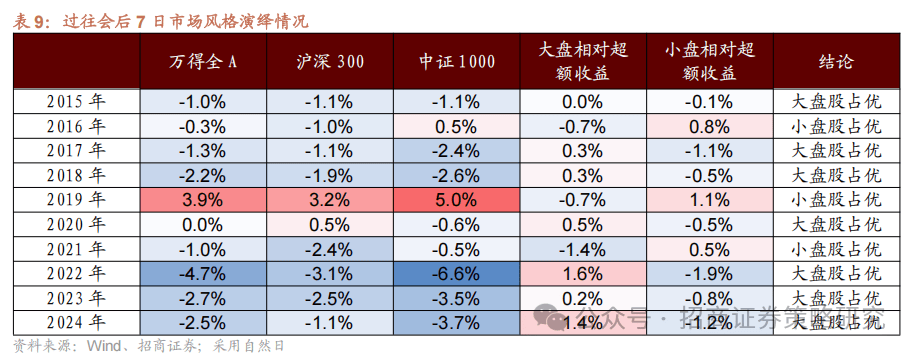
Group 1 - The central economic work conference indicates a relatively positive policy tone for the capital market in 2024, with a fiscal deficit rate potentially maintained at 4% and a focus on promoting economic stability and reasonable price recovery in monetary policy [1][2] - The conference emphasizes the need to address the decline in investment growth, with major projects expected to be a key focus for investment in 2024, particularly as it marks the beginning of the 14th Five-Year Plan [1][2] - The conference highlights the importance of consumer demand, with plans to implement a rural resident income increase plan, although there may be limited expansion in funding support for new policies [1][2] Group 2 - Historical market performance shows that large-cap stocks tend to outperform in the week following the conference, with a consistent trend observed over the past five years [3][4] - Specific industries such as oil and petrochemicals, telecommunications, and electronics have a higher probability of rising in the week after the conference, while sectors like social services, public utilities, coal, and media have shown higher average excess returns over the past five years [6][11] - The focus on key industries mentioned in the conference often translates into increased policy support in the following year, with past examples including the emphasis on low-altitude economy in 2023 leading to significant policy developments in 2024 [11][12]

建筑建材行业周报:高质量发展、扩大内需、反内卷仍是十五五关键词-20251026
Western Securities· 2025-10-26 12:39
Investment Rating - The report does not explicitly state an investment rating for the construction and decoration industry. Core Insights - High-quality development, expanding domestic demand, and comprehensive rectification of "involution" competition are key themes for the 14th Five-Year Plan. The report emphasizes the importance of a strong domestic market as a strategic support for modernization in China. It suggests that construction companies will adopt a mindset focused on cash flow and profitability rather than just revenue growth [1][2]. - As of September 2025, fixed asset investment decreased by 0.5% year-on-year, while infrastructure investment (excluding electricity) increased by 1.1%. Real estate investment saw a significant decline of 13.9% year-on-year, and manufacturing investment grew by 4.0% [1][2]. - The report indicates that infrastructure investment is expected to remain stable during the 14th Five-Year Plan period despite current challenges [2]. Market Performance - During the week of October 20-24, 2025, the construction index rose by 2.91%, and the building materials index increased by 1.60%, while the Shanghai Composite Index rose by 2.88%. Year-to-date, the construction index has increased by 9.76%, ranking 19th out of 30 industries, and the building materials index has risen by 18.69%, ranking 12th [3][8]. - The report highlights that the market is becoming more active, particularly for low-growth, low-valuation, and low-holding construction and building materials sectors, especially heavyweight stocks [3][8]. Special Bonds and Funding Status - As of October 24, 2025, a total of 1,123.61 billion yuan in new local government special bonds were issued during the week, a week-on-week increase of 459.27%. The cumulative issuance for the year reached 38,096.76 billion yuan, a year-on-year increase of 0.22% [2][19]. - The report notes that the funding availability rate for construction sites was 59.62%, with non-residential projects at 61.06% and residential projects at 52.76% [24]. Cement Industry Data - The national average cement price as of October 23, 2025, was 263.5 yuan per ton, reflecting a week-on-week increase of 0.8% but a year-on-year decrease of 17.8%. The report anticipates that cement prices will continue to fluctuate [35][39]. - Cement production from January to September 2025 totaled 1.259 billion tons, a year-on-year decrease of 5.2%, with September's production down 8.6% compared to the previous year [49][55]. Key Company Orders and Valuation - The report suggests focusing on major construction blue-chip stocks such as China Railway, China Communications Construction, and China State Construction, as well as companies involved in overseas projects and those benefiting from domestic demand [3][8]. - The current price-to-earnings ratios for the construction and building materials sectors are 9.46 and 21.72, respectively, indicating that the construction sector is at a historically low valuation level [3][14].