
绿色工业化

Search documents
2025印度工业发展探索:从服务业路径依赖转向路径重塑研究报告
Sou Hu Cai Jing· 2026-02-12 05:51
Core Insights - The report focuses on India's industrial development transition from a service-oriented path dependency to a path reconfiguration, analyzing the causes of deviation from traditional industrialization, the effectiveness and constraints of industrial development, and proposing policy recommendations for industrialization opportunities [1][6]. Group 1: Historical Context of India's Industrialization - India's industrialization has undergone two major phases: the state-led phase (1948-1991) and the market economy phase (1991-present), influenced by global dynamics and domestic strategic shifts [14][23]. - During the state-led phase, India adopted a planned economy model, focusing on heavy industry, which led to an initial industrial growth peak with an average GDP growth rate of 3.6% from 1960-1967 [15]. - The liberalization period starting in 1991 marked a shift towards a more market-oriented economy, with significant reforms in finance, infrastructure, and information technology, resulting in a rise in service sector GDP share from 32% to 42% [22]. Group 2: Drivers of Service-Oriented Path Dependency - The service-oriented growth path in India is driven by institutional, technological, and weak inter-industry linkages [24]. - Institutional factors include a risk-averse regulatory environment and low efficiency in governance, which have constrained industrialization while allowing the service sector to thrive due to lower dependency on traditional institutions [25]. - Technological dependency is characterized by low R&D investment in manufacturing, leading to a reliance on external resources for complex technologies, while the IT sector attracts skilled labor due to higher wages [26]. Group 3: Achievements and Constraints in Industrial Development - India has made progress in manufacturing, becoming the fifth-largest manufacturing economy globally, with a shift from labor-intensive to knowledge-intensive industries, particularly in pharmaceuticals and automotive sectors [2][29]. - Despite these advancements, significant gaps remain compared to leading countries, with manufacturing's GDP contribution stagnating around 15% and foreign investment levels being relatively low [30]. - The manufacturing sector faces challenges such as informal employment issues and limited job creation, with existing competitive advantages in pharmaceuticals and automotive industries hindered by insufficient R&D and a narrow export structure [2][29]. Group 4: Opportunities and Policy Recommendations for Industrialization - Current opportunities for India's industrialization include leveraging digital advancements and diversifying the industrial base to enhance manufacturing growth [7]. - The report suggests six key areas for path reconfiguration: advancing existing competitive industries, fostering high-value emerging sectors like semiconductors and green technologies, empowering manufacturing through digital technologies, restructuring the industrial base for sustainable growth, expanding domestic demand through government procurement and rural infrastructure, and enhancing international cooperation [7][10].


加纳加快发展太阳能发电
Shang Wu Bu Wang Zhan· 2025-12-05 16:15
Core Insights - Ghana is making symbolic progress in clean energy production, with an expected addition of approximately 111 GWh of solar power capacity by 2026, as reported by the African Development Bank [1][2] - The initiative aims to diversify the energy supply in Ghana, which currently relies heavily on hydropower and thermal generation, with renewable energy accounting for less than 1% of the power generation mix [2] - The project includes the installation of 67.8 MW of new solar capacity through 35 microgrids and 12,000 rooftop solar systems for households and small businesses [2][3] Group 1 - The African Development Bank's $85 million project aims to improve rural electrification in Ghana and reduce dependence on hydropower and thermal power [1] - Ghana's electricity demand is growing over 4% annually, making energy diversification crucial to meet the government's commitment to universal electricity access by 2030 [2] - The project has faced delays due to slow approval of tax exemptions and delays in government funding, with only 12.6% of project funds disbursed by the end of 2025 [2] Group 2 - The German Development Bank (KfW) plans to establish a solar panel assembly plant in Kumasi with an annual capacity of 75 MW, which would be the first of its kind in West Africa [3] - This plant is expected to reduce reliance on Asian imports and position Ghana as a potential supplier in the Economic Community of West African States (ECOWAS) market [3] - Ghana's project pipeline is increasing, including the Norbert Anku solar power park with a capacity of 200 MW, which is expected to expand to 1 GW by 2032 [3] Group 3 - The trend of expanding solar energy projects is evident across Africa, with Nigeria, Kenya, Angola, and Morocco also advancing their clean energy initiatives [3] - If financing remains stable, Africa's solar installed capacity could exceed 100 GWh by 2030, up from the current approximately 10 GWh [3]

工信部征集14类典型案例,工业绿色低碳典型等由多部门联合开展
Huan Qiu Wang· 2025-11-25 01:08
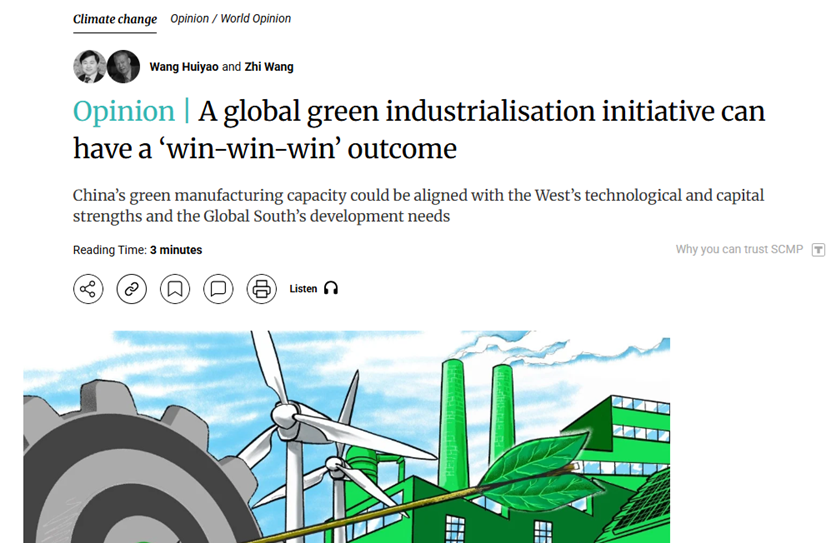
Group 1 - The Ministry of Industry and Information Technology of China has initiated a collection of typical case studies, covering 14 categories including artificial intelligence and digital transformation [1] - Three categories, including industrial green low-carbon typical cases, will be jointly organized by multiple departments, with specific application requirements to be clarified in future joint announcements [1] - The global green industrialization initiative aims to address the challenges between climate crisis, geopolitical issues, and industrial development needs, combining China's green manufacturing with Western technology and capital advantages [1] Group 2 - The initiative is driven by the development needs of the Global South, promoting capital flow through technology transfer, joint ventures (such as electric vehicles), and green financial mechanisms like RMB loans and localized financing [1] - The goals include not only promoting green industry exports but also facilitating knowledge transfer and capacity building to support the development, emission reduction, and job creation in Global South countries [1]
李成钢国际贸易谈判代表兼副部长出席二十国集团贸易投资部长会议
Shang Wu Bu Wang Zhan· 2025-10-11 00:29
Core Points - The G20 Trade and Investment Ministers' Meeting took place in Gqeberha, South Africa, focusing on trade, inclusive growth, and global challenges [1] - Key discussions included promoting green industrialization, sustainable trade investment frameworks, and WTO reforms [1] - The meeting resulted in the G20 Trade and Investment Ministers' Declaration and Chair's Summary, preparing for the upcoming G20 Leaders' Summit in November [1] Group 1 - China firmly supports multilateralism and announced it will not seek new special and differential treatment in current and future WTO negotiations, demonstrating its commitment as a responsible developing country [1] - The G20 is recognized for its significant contributions to global trade and investment development, emphasizing the need for better utilization of the G20 trade investment mechanism to address global challenges through open cooperation [1] - China aims to contribute to global economic growth while promoting its own development, urging support for the multilateral trading system and free trade to counter unilateralism and protectionism [1] Group 2 - During the meeting, discussions were held between Li Chenggang and various heads of delegations, including the Director-General of the WTO and leaders of international organizations [2]
这个事关中国的报告,火了!
Huan Qiu Shi Bao· 2025-09-11 13:59
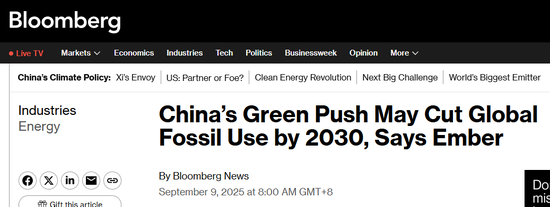
Core Insights - A report from the UK think tank Ember suggests that within five years, China could significantly impact global energy dynamics, potentially leading to a decline in fossil fuel usage by 2030, which would be a landmark achievement in combating climate change [1][4] Group 1: China's Clean Energy Transition - China's clean energy transition is characterized by its large scale and rapid pace, with nearly 25% of developing countries making significant progress in economic electrification thanks to affordable Chinese clean energy products [1][4] - Countries such as Brazil, Chile, El Salvador, Kenya, Morocco, and Namibia have surpassed the United States in the share of solar and wind energy generation [1] Group 2: Global Impact and Market Dynamics - The report indicates that China's growth in renewable energy and economic electrification is reshaping energy choices globally and creating conditions for a structural decline in fossil fuel demand by 2030 [4] - The affordability of Chinese solar panels and wind turbines is enabling people in sub-Saharan Africa to access clean energy solutions that are cheaper than traditional diesel generators [4] Group 3: International Perspectives - Despite some Western media's negative narratives about China's renewable energy sector, the tangible benefits of China's production capacity in providing clean energy to developing countries are becoming increasingly recognized [4] - Experts highlight that Africa is focused on obtaining affordable green energy without being hindered by geopolitical conflicts, emphasizing the importance of China's clean energy products in supporting Africa's green industrialization [5] Group 4: Challenges from the U.S. - The report notes that while China is advancing global clean energy transitions, the U.S. is perceived as hindering these efforts through inaction and resistance, creating uncertainty in global carbon reduction initiatives [6]
中国在世贸组织分享绿色技术合作经验
Shang Wu Bu Wang Zhan· 2025-07-04 15:50
Group 1 - The World Trade Organization (WTO) held its first annual meeting of the Trade and Environment Committee in Geneva, focusing on "Technical Cooperation, Trade, and Green Industry Strategies" [1] - China shared its successful experiences in promoting green technology cooperation, highlighting three key aspects: the importance of planning and cooperation, adaptability and flexibility, and capacity building and knowledge sharing [1] - Experts discussed the need to balance intellectual property protection and technology transfer in technical cooperation, suggesting multilateral cooperation and flexible licensing arrangements as potential solutions [1] Group 2 - The UNESCO Science and Technology Innovation Center emphasized the challenges faced by African countries in technical cooperation, including policy coordination difficulties and the lack of a unified policy framework and technical standards [2] - The importance of enhancing policy flexibility and adaptability in addressing these challenges was highlighted [2]