美元石油体系

Search documents
贵金属日报-20260302
Guo Tou Qi Huo· 2026-03-02 11:54
1. Report Industry Investment Rating - Gold: ★☆☆, indicating a bullish bias but with limited trading operability [1] - Silver: ★☆★, with unclear short - term trend and low trading operability [1] - Platinum: Suggest to lay out long positions at low levels with high safety margins [2] - Palladium: Participate by buying at low prices [2] 2. Core View of the Report - Short - term gold market fluctuations are mainly due to emotional swings after the start of the US - Iran war. It is recommended to take profits for long positions after the price rises. The medium - term impact will be determined by the war's development [1] - If the US and Israel achieve an overwhelming victory and regime change in Iran, gold may face a downward risk. If Iran conducts a strong retaliation and the war expands, gold prices will remain high but with more frequent fluctuations [1] - In the long run, factors such as the economic outlook after the oil price increase, Fed policies, Russia - Ukraine cease - fire negotiations, global trade situation, and US mid - term elections need to be concerned [1] - This week, attention should be paid to the war progress and the impact of important data such as US non - farm payrolls on Fed policy expectations [1] - Platinum has rebounded after the festival, and the platinum - palladium price difference has widened, but the further widening space is limited. The financial premium space of platinum and palladium may narrow, and it is recommended to lay out long positions at low levels [2] - Palladium's supply - side narrative is strengthening, its demand expectation is still weak, and the fundamentals are improving. It is advisable to buy at low prices [2] 3. Summary by Related Catalogs Iran Situation - Trump said that the new Iranian leadership hopes to resume negotiations, and he has agreed to dialogue [3] - Trump claimed to have killed 48 Iranian leaders and basically destroyed the Iranian naval headquarters, and the US military said it destroyed the Revolutionary Guard headquarters [3] - An Iranian interim leadership committee has been established, with the Iranian president as one of the main members [3] - The Iranian foreign minister said Iran is open to efforts to ease tensions, and new leader elections may be seen in the next few days [3] - The Israeli prime minister said the strike on Iran will be strengthened in the next few days [3] - Trump said the military action against Iran may last for 4 weeks [3] Middle - East Shipping Throat - There are a large number of oil tankers stranded outside the Strait of Hormuz [3] - Many shipping companies may detour around the Cape of Good Hope, and shipping costs may rise [3]
从百年趋势中,看懂黄金涨跌的核心逻辑!
Sou Hu Cai Jing· 2026-02-04 09:21
Core Viewpoint - The article discusses the historical significance and evolving role of gold as a monetary asset, highlighting its resurgence in times of economic uncertainty and its potential future price trajectory as a reflection of global macroeconomic conditions [1][10]. Historical Context - The establishment of the gold standard in 1821 by the UK marked the beginning of a unified global monetary system, where currencies were pegged to gold, ensuring stable exchange rates and facilitating free convertibility [3]. - The limitations of gold mining and the economic acceleration led to the eventual abandonment of the gold standard during the Great Depression in 1929, as countries sought to revive their economies by severing the gold anchor [3][4]. Economic Crises and Gold's Resurgence - The oil crises of 1973 and 1979 caused a dramatic increase in oil prices, leading to global stagflation and highlighting gold's role as a zero-interest, universally accepted asset for hedging systemic risks [4][5]. - Between 1971 and 1980, gold prices surged from $35 to $850, marking a 2328.6% increase, as investors recognized gold's core value in inflation hedging and risk aversion [7]. Recent Developments - The bursting of the internet bubble in 2001 and the 9/11 attacks increased market uncertainty, driving demand for gold as a safe-haven asset, while the introduction of the euro challenged the dollar's dominance [9]. - The 2008 financial crisis further solidified gold's status as a protective asset, with prices reaching a historical high of $1920.8 in September 2011 due to heightened inflation expectations and global economic instability [9]. Current Market Dynamics - As of 2020, gold has entered a new upward trend, reflecting similar patterns observed in the 1970s, with current global economic challenges such as high debt, low growth, and structural inflation echoing past crises [10]. - Gold's historical narrative serves as a microcosm of monetary credit evolution, with its future price movements likely to be influenced by the trajectory of global macroeconomic order [10].

张尧浠:金价如期受阻趋势线压力、关注再度调整和入场机会
Sou Hu Cai Jing· 2025-10-20 01:38
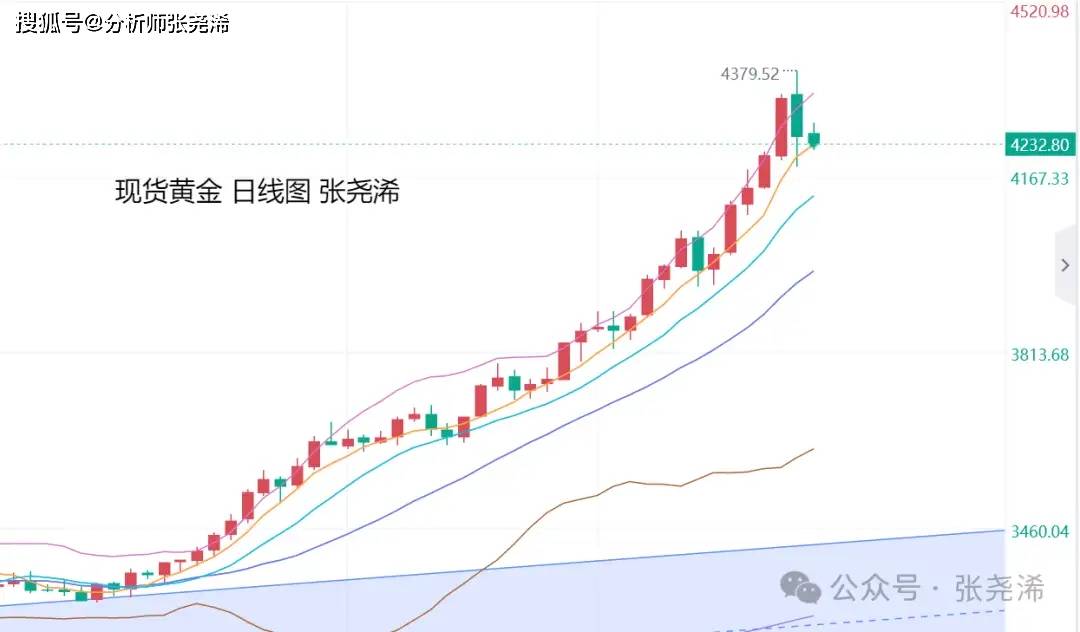
Core Viewpoint - The international gold market has shown a strong rebound, reaching historical highs and closing positively for the ninth consecutive week, with future movements dependent on the trend line resistance level [1][3]. Market Performance - Gold prices opened the week at $4004.70, hitting a low of $4003.62 before rebounding to a high of $4378.91, ultimately closing at $4246.89, marking a weekly increase of $234.26 or 5.83% from the previous week's close of $4012.63 [1][3]. Influencing Factors - Concerns over a potential U.S. government shutdown, dovish comments from Federal Reserve officials, and rising geopolitical tensions have contributed to increased demand for gold as a safe-haven asset [3][5]. - The recent surge in gold prices has also been influenced by significant sell-offs as prices approached key resistance levels, alongside a rebound in the U.S. dollar index and Treasury yields [3][5]. Future Outlook - The market is expected to experience volatility, with potential adjustments to $4000 or $3800 if resistance is encountered. Key events to watch include the meeting between Trump and Chinese leaders and the upcoming Federal Reserve meeting at the end of October [3][5]. - Long-term bullish sentiment remains, supported by central bank gold purchases and ongoing geopolitical risks, despite short-term concerns about market corrections [5][6]. Technical Analysis - Monthly charts indicate that gold prices are encountering resistance at the upper trend channel, with a potential for further upward movement if the resistance is broken. However, a significant adjustment may be on the horizon, as historical data suggests that gold has never achieved ten consecutive weeks of gains [8][10]. - Daily charts show a bearish reversal pattern, indicating a possible short-term decline unless prices recover from recent losses [10]. Support and Resistance Levels - Key support levels for gold are identified at $4215 and $4160, while resistance levels are at $4285 and $4333. For silver, support is at $51.20 and $49.85, with resistance at $52.35 and $53.00 [10].

中俄美上半年石油产量出炉,美国3.3亿吨,俄罗斯2.5亿吨,那中国呢?
Sou Hu Cai Jing· 2025-09-06 02:15
Group 1: Global Oil Production Trends - The U.S. daily oil production reached a historic high of 13.58 million barrels, with Texas contributing 5.72 million barrels, accounting for nearly 40% of total U.S. production [2] - Russia maintained an oil production level of 250 million tons in the first half of 2025, with a daily output of 9.5 million barrels, despite a 3.5% decline compared to the previous year [3] - China's domestic crude oil production was approximately 10.847 million tons in the first half of 2025, showing a year-on-year growth of 1.3% [4] Group 2: Key Players in the Oil Industry - The three major Chinese state-owned enterprises—PetroChina, Sinopec, and CNOOC—dominate domestic oil extraction, with PetroChina producing 395.2 million barrels and Sinopec achieving a total oil and gas output of 126 million barrels in the first half of 2025 [8] - Rosneft, the largest oil company in Russia, reported a liquid hydrocarbon production of 89.3 million tons in the first half of 2025 [3] Group 3: Geopolitical Dynamics and Market Implications - The global oil market is characterized by "supply looseness and weak demand," with predictions of an average daily change in global crude oil inventory of 301,600 barrels in 2025 [6] - China’s oil imports reached 280 million tons in the first half of 2025, with a high dependency rate of 72.1% on foreign oil [6] - The geopolitical landscape is shifting, with 47% of Russia's crude oil exports directed to China, and energy trade between China and Russia expected to exceed $300 billion by 2025 [9]