能源技术

Search documents
能源强国建设“大家谈”︱统筹兼顾建设能源强国
Jing Ji Ri Bao· 2026-02-06 09:36
Core Viewpoint - The concept of an "energy power" is introduced in the 14th Five-Year Plan, emphasizing the need for comprehensive enhancement of energy technology, industrial chains, and system capabilities to support the construction of a modern socialist country [1] Group 1: Strengths of an Energy Power - The strength of an energy power lies in its hard power of security assurance, ensuring stable domestic energy supply and resilience against external shocks [1] - The strength also manifests in green, low-carbon, and high-quality development, focusing on optimizing energy utilization rather than merely increasing consumption [1] - Technological self-reliance is crucial, with key technologies in the energy sector needing to be controlled domestically to avoid dependency [2] Group 2: Goals for Strengthening - Strengthening the supply chain involves creating a diversified and resilient supply system, emphasizing the importance of not relying on a single source [2] - Strengthening the technology chain focuses on overcoming core technologies across the entire energy production process, transitioning from a major energy producer to a technology powerhouse [2] - Strengthening the industrial chain aims to cultivate globally competitive industrial clusters, integrating resources from research and development to operation services [3] Group 3: Institutional Strengthening - Establishing a modern governance system and market mechanism is essential for adapting to the energy revolution, requiring reforms to break monopolies and enhance market roles [4] - The construction of an energy power is a systematic project that necessitates coordinated advancement across various dimensions [4] Group 4: Pathways to Strengthening - A dual approach of traditional and emerging energy sources is necessary, promoting clean and efficient development of traditional energy while increasing the share of renewables [4] - Emphasizing technological breakthroughs alongside institutional reforms is critical, with increased R&D investment and unified electricity market construction [4] - Promoting both domestic and international cooperation is vital, ensuring energy security while contributing to global energy transition [5]
马斯克:为退休存钱毫无意义
财富FORTUNE· 2026-01-18 13:08
Core Viewpoint - Elon Musk predicts a future of extreme material abundance due to advancements in artificial intelligence and robotics, challenging traditional financial advice about saving for retirement [1][2]. Group 1: Predictions on AI and Robotics - Musk forecasts that by 2030, AI intelligence will surpass the total intelligence of all humans combined, leading to a significant increase in the number of humanoid robots [3]. - He believes that AI could already perform over half of the tasks associated with many jobs, particularly white-collar positions, which will be increasingly replaced by technology [4]. Group 2: Economic Implications - Musk argues that the technological advancements will drastically enhance productivity, resulting in a level of abundance that surpasses current human imagination, where the relationship between personal income, savings, and living standards will become irrelevant [4]. - He envisions a future where individuals can access what they need without the necessity of traditional employment, likening work to leisure activities such as gardening or gaming [6]. Group 3: Societal Concerns - While Musk presents an optimistic outlook, he acknowledges potential societal issues, such as a crisis of meaning for individuals who may find their work devalued in a world of abundance [7][8]. - He highlights the current financial struggles of many Americans, with only 55% having sufficient savings to cover three months of expenses, contrasting this with his vision of a future without financial worries [7].


马斯克称10到20年内退休储蓄可能变得毫无意义
Xin Lang Cai Jing· 2026-01-11 23:48
Core Viewpoint - Elon Musk suggests that retirement savings may soon become meaningless due to advancements in AI, energy, and robotics that will significantly increase productivity and create abundant resources, leading to universal high incomes [1][3][4] Group 1: Future Predictions - Musk envisions a future where everyone can have anything they want, including better healthcare available to all within five years, and where goods and services are no longer scarce [1][3] - He warns that the transition to this utopian world will be bumpy, marked by significant changes and social upheaval [1][3] Group 2: Current Economic Context - Despite Musk's optimistic predictions, many Americans face a reality of persistent inflation, high interest rates, and stagnant wage growth, leading to a crisis of affordability [2][4] - Millions of people find the costs of obtaining a college degree, quality healthcare, housing, or starting a family to be prohibitively high, making a comfortable retirement seem out of reach [2][4] Group 3: Potential Risks of Musk's Advice - Musk's suggestion to not worry about saving for retirement may be seen as naive or even dangerous, as it could lead individuals to stop saving while the anticipated changes do not materialize, resulting in insufficient savings for retirement [2][4]

2026年美国消费电子展开幕 聚焦AI、机器人等科技趋势
Zhong Guo Xin Wen Wang· 2026-01-07 11:29
Group 1 - The 2026 Consumer Electronics Show (CES) opened in Las Vegas, focusing on six key technology trends: artificial intelligence (AI), digital health, energy technology, enterprise technology, mobile technology, and robotics [2][3] - The CES exhibition covers over 2.6 million square feet and attracts more than 4,100 exhibitors from over 150 countries, including major companies like NVIDIA, Qualcomm, Amazon, Lenovo, TCL, BOE, and Hisense, as well as numerous innovative startups [3] - The event features hundreds of activities, including forums and seminars, with industry leaders such as AMD's CEO Lisa Su and Lenovo's CEO Yang Yuanqing discussing new trends in the consumer electronics industry [3] Group 2 - BOE showcased over 60 cutting-edge display technologies and IoT solutions, including the global debut of the "HERO2.0 smart cockpit," highlighting its innovations in AI and green low-carbon technology [3] - The robotics AI software company MARI, founded by Chinese scientists, made its debut at CES, winning the CES Innovation Award for its mobile autonomous intelligent robot system, and plans to collaborate with leading robotics manufacturers to promote the application of robotics technology in complex industrial scenarios [4] - The CES is recognized as a platform for innovators, with the Consumer Technology Association's CEO Gary Shapiro emphasizing the importance of global innovators in shaping future technological breakthroughs [5]


新方法可提升超薄二维材料金属烯稳定性
Xin Hua She· 2025-12-12 02:05
Core Viewpoint - Researchers at the University of Vaasa in Finland have discovered a new method to enhance the stability of emerging two-dimensional materials known as metalene, which could lead to advancements in next-generation nanoelectronics, energy technologies, and biomedical materials [1] Group 1 - The breakthrough in stabilizing metalene materials is expected to provide new insights for the development of various applications [1] - The research highlights the potential of two-dimensional materials in innovative technological fields [1]
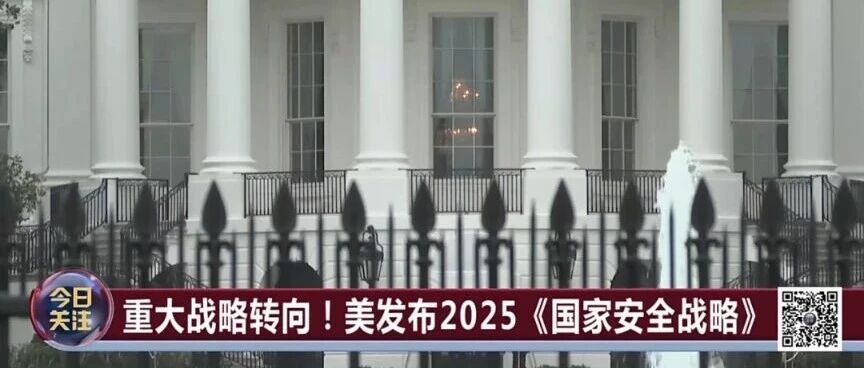
美国发布最新《国家安全战略》:放弃全球霸权 承认中美“近乎对等”
天天基金网· 2025-12-07 08:35
Core Viewpoint - The new National Security Strategy under the Trump administration marks a significant shift from pursuing global hegemony to prioritizing U.S. interests, particularly in Latin America, while criticizing European allies for their declining economic influence and potential demographic changes [2][6][11]. Summary by Sections U.S. Foreign Policy Shift - The document emphasizes "America First" as the guiding principle, abandoning the decades-long pursuit of global dominance, which is deemed destined to fail [6][7]. - It states that the era of the U.S. supporting the global order is over, and the focus will be on preventing other major powers from gaining dominance without extensive military engagement [6][7]. Focus on Latin America - The strategy aims to restore U.S. hegemony in the Western Hemisphere, addressing issues like immigration and drug trafficking, and reasserting the Monroe Doctrine [7][9]. - The U.S. will adjust its military presence globally, withdrawing from regions deemed less critical to national security, while increasing the Coast Guard and Navy's deployment in the Western Hemisphere [7][9]. Critique of Europe - The strategy presents an unprecedented confrontational stance towards Europe, highlighting a decline in Europe's share of global GDP from 25% in 1990 to 14% today, and warns of a potential "civilizational extinction" [11][12]. - It raises concerns about the demographic shifts in NATO countries and questions the future of U.S.-European alliances [11][12]. Response to Ukraine Conflict - The document states that the U.S. core interest is to quickly end hostilities in Ukraine and rebuild strategic stability with Russia, while criticizing European officials for obstructing U.S. efforts to resolve the conflict [12][12]. Military and Economic Strategy - The strategy calls for increased R&D investment to maintain U.S. superiority in advanced military technologies, focusing on areas like underwater, space, nuclear technology, artificial intelligence, and quantum computing [14][15]. - It indicates a shift in U.S.-China relations towards a more reciprocal economic relationship, while deemphasizing the Middle East in U.S. foreign policy priorities due to the U.S. becoming an energy net exporter [15][15]. Comparison with Previous Strategies - The new strategy represents a significant departure from the Biden administration's 2022 National Security Strategy, which focused on strategic competition with China and Russia, domestic industrial policy, and climate change as a national security challenge [17][17].
“十五五”将至,中国经济又有怎样的新机遇?专家解读→
Yang Shi Wang· 2025-10-25 03:16
Group 1 - The core message of the 20th Central Committee's Fourth Plenary Session emphasizes the importance of prioritizing economic development, which is seen as a fundamental national policy since the reform and opening up, crucial for China's significant achievements over the past 40 years [1][4] - China's per capita GDP has increased over 70 times since the beginning of the reform and opening up, but it still only matches the global average, indicating challenges ahead to reach the level of developed countries by 2035 [4] - The U.S. attempts to suppress China's economic development through trade wars and other means, highlighting the importance of the central government's reaffirmation of economic construction as a guiding principle [4] Group 2 - The 20th Central Committee's Plenary Session calls for seizing the high ground in technological development, recognizing the intensifying competition in technology, especially under geopolitical tensions [5][7] - In the next five years, breakthroughs in core frontier areas of technology are expected, with artificial intelligence being a major focus, where China has made significant advancements and may have surpassed the U.S. in certain applications [7][9] - China is also leading in quantum computing and has made substantial progress in energy technologies, including nuclear fusion and advanced nuclear power, indicating a potential for explosive growth in these sectors during the 14th Five-Year Plan [11] Group 3 - China's approach to foreign trade and investment is evolving into a new phase, characterized by a "China + N" model, where global enterprises will produce in China while diversifying their production locations [13][15] - The new openness strategy includes welcoming high-quality foreign enterprises and supporting Chinese companies in expanding globally, aiming to create a synergistic industrial chain [17] - The focus remains on economic construction, technological advancement, new industrial chains, domestic markets, consumption, and improving people's livelihoods as key battlegrounds during the 14th Five-Year Plan [17]