芯片产业发展

Search documents
美国要慌了?2025年中国出口芯片3500亿个,1.44万亿元,量价齐升
Sou Hu Cai Jing· 2026-01-17 12:28
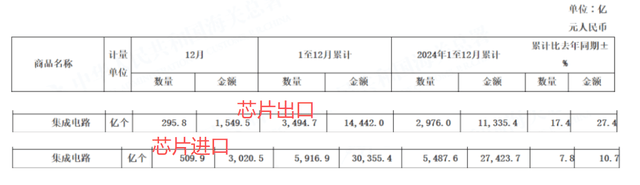
Core Insights - China's chip export volume is projected to reach 349.5 billion units in 2025, marking a year-on-year increase of 17.4%, while the export value is expected to be 1.4442 trillion yuan, up 27.4% [1] - The daily export figures translate to approximately 960 million chips and 3.96 billion yuan in value, both setting historical records [1] - In contrast, China's chip imports are forecasted at 591.7 billion units, a 7.8% increase, with an import value of 3.0355 trillion yuan, reflecting a 10.7% growth [3] Export vs. Import Analysis - The growth rates for both export quantity and value significantly outpace those of imports, indicating a robust expansion of China's chip industry [3] - The increase in export value suggests a notable rise in the average price of exported chips, indicating a shift from low-end to high-end chip production [5] Industry Implications - The rapid development of China's chip industry and its increasing self-sufficiency pose a challenge to the U.S., which has historically dominated the global chip market [7] - As China enhances its production capacity and exports more high-value chips, the competitive landscape may shift, potentially undermining the U.S.'s market position [9] - The combination of lower operational costs, high efficiency, and a well-established supply chain gives China a competitive edge in the global chip market [9]

张汝京回国创办中芯国际获家人支持,母亲坚守成最大动力
Xin Lang Cai Jing· 2025-12-25 16:20
Core Viewpoint - The founder of the semiconductor industry, Zhang Rujing, has returned to China to establish SMIC (Semiconductor Manufacturing International Corporation), motivated by the support from his mother and partner, with his mother's steadfastness being a significant driving force [2] Group 1 - Zhang Rujing's return to China is marked by the establishment of SMIC, highlighting a personal and emotional connection to his roots [2] - The support from family, particularly his mother's daily prayers for China, emphasizes the personal motivations behind the company's founding [2]

从买家到卖家,广东“芯”跳加速何以实现?
2 1 Shi Ji Jing Ji Bao Dao· 2025-12-18 09:56
Group 1 - The semiconductor sector has become a focal point in the market, with industry ETFs showing a net value increase of 55.43% over the past year, indicating strong momentum [1] - Guangdong, as a manufacturing hub, produces the most mobile phones, drones, and home appliances in China, making it a significant buyer in the chip market, historically accounting for about 40% of the national integrated circuit imports [1] - Guangdong is transitioning from being the largest buyer of chips to becoming a key player in the industry through a critical "chip supplementation" initiative aimed at addressing its manufacturing shortfalls [1] Group 2 - The turning point for Guangdong's semiconductor industry began in 2019 with the production of its first batch of chips by Yuexin Semiconductor, marking the start of true autonomous mass production in the region [2] - The industry has seen significant growth, with chip production expected to rise from 36 billion units in 2019 to over 80 billion units by 2024, positioning Guangdong as the second-largest producer in the country [2] - The structure of the industry has evolved, with a stable "iron triangle" formed between design, manufacturing, and testing, and manufacturing revenue experiencing a remarkable increase of 102% [2] Group 3 - In April 2025, Yuexin Semiconductor is set to initiate its A-share listing process, reflecting the growing confidence in Guangdong's semiconductor industry [3] - Several Guangdong chip companies, including Shangdingxin, Chuangzhixinlian, Jiben Semiconductor, and Huada Beidou, are also pursuing listings on the Hong Kong Stock Exchange, showcasing strong market validation for the region's chip industry development [4] - Over five years, Guangdong has successfully transitioned from a passive buyer to an active player in the semiconductor market, with its industry now gaining global recognition [4]
印度正在打造芯片城
半导体芯闻· 2025-12-04 10:09
Group 1 - A planned city is emerging in India, designated as a semiconductor manufacturing hub, attracting businesses and investments [1] - The "Semiconductor City" project is located in the Dholera Special Investment Region, covering an area of 920 square kilometers, larger than Singapore [1] - The first phase of Dholera's development began in 2016, with infrastructure such as roads, water supply, and substations already established [1] Group 2 - Tata Electronics, a subsidiary of Tata Group, will play a central role in the semiconductor city, investing up to ₹910 billion (approximately $10 billion) to build India's first front-end wafer fab [1] - The wafer fab, currently under construction, is expected to have a monthly capacity of 50,000 wafers and create over 20,000 jobs, with production anticipated to start in two to three years [1] - The Indian government has approved the establishment of 10 semiconductor manufacturing plants nationwide, with total public and private investments reaching ₹1.6 trillion [2] Group 3 - Japanese companies are also seizing opportunities in India's semiconductor sector, with Tokyo Electron collaborating with Tata Group for employee training and planning to establish a support center in Dholera [2] - Fujifilm, a Japanese technology group, plans to invest billions of yen to build a chip materials factory in the next fiscal year, focusing on chemicals for impurity removal [2] - The growing Japanese expatriate community in India is leading to increased demand for services, prompting AJU Group to open a Japanese restaurant and plan a hotel in Dholera [2]
易成新能:控股子公司梅山湖对合并报表外单位提供担保总额为1.7亿元
Mei Ri Jing Ji Xin Wen· 2025-11-30 09:03
Group 1 - The core point of the article is that 易成新能 has announced significant guarantees provided to its subsidiaries, amounting to 161,148.9 million yuan, which represents 12.20% of the company's latest audited total assets and 29.93% of its latest audited net assets [1] - The company’s subsidiary, 梅山湖, has provided guarantees totaling 170 million yuan, accounting for 1.29% of the company's latest audited total assets and 3.16% of its latest audited net assets [1] - For the first half of 2025, 易成新能's revenue composition is entirely from the manufacturing sector, with a 100.0% share [1] Group 2 - As of the report, 易成新能 has a market capitalization of 9.6 billion yuan [2]

芯片龙头,三季报发布
第一财经· 2025-11-13 10:28
Core Viewpoint - The company reported strong financial performance in Q3, with significant year-on-year growth in revenue and net profit, indicating a positive trend in its operational efficiency and market position [1][2]. Financial Performance - Q3 revenue reached 17.162 billion RMB, a year-on-year increase of 9.9% [2] - Q3 net profit was 1.517 billion RMB, reflecting a year-on-year growth of 43.1% [2] - For the first three quarters, total revenue was 49.510 billion RMB, up 18.2% year-on-year [2] - Net profit for the first three quarters amounted to 3.818 billion RMB, an increase of 41.1% year-on-year [2] Profitability Metrics - The gross margin for Q3 was 25.5%, up 4.8 percentage points from the previous quarter [1] - Capacity utilization increased to 95.8%, a rise of 3.3 percentage points quarter-on-quarter [1] Earnings Per Share - Basic earnings per share for Q3 were 0.19 RMB, a 46.2% increase compared to the same period last year [2] - Diluted earnings per share also stood at 0.19 RMB, reflecting the same growth rate [2] Research and Development - Total R&D expenditure was 1.447 billion RMB in Q3, a 13.6% increase year-on-year [2] - R&D spending accounted for 8.4% of revenue, an increase of 0.2 percentage points from the previous year [2] Future Guidance - The company expects Q4 revenue to remain flat or grow by 2% quarter-on-quarter, with gross margin projected to be between 18% and 20% [1][2]
传长鑫存储计划最快于2026年一季度在上海进行IPO 计划筹资200亿至400亿元人民币
智通财经网· 2025-10-21 10:54
Core Viewpoint - Changxin Storage, a leading Chinese memory chip manufacturer, plans to conduct its initial public offering (IPO) in Shanghai as early as the first quarter of next year, with a target valuation of up to 300 billion RMB [1] Group 1: IPO Plans - The company aims to raise between 20 billion to 40 billion RMB through the IPO, with a prospectus expected to be disclosed to investors as early as November [1] - The IPO is anticipated to attract strong demand from domestic investors [1] Group 2: Production and Technology - Changxin Storage is constructing an HBM (High Bandwidth Memory) backend packaging plant in Shanghai, with production expected to commence by the end of next year [1] - Initial monthly production of HBM wafers is projected to reach approximately 30,000 pieces, which is slightly less than one-fifth of South Korea's SK Hynix's output [1] - The company aims to start mass production of the fourth generation high bandwidth memory (HBM3) chips by 2026 [1] Group 3: Company Background - Changxin Storage was established in 2016 and is the strategic pioneer for China in the global DRAM (Dynamic Random Access Memory) market, which has been dominated by companies from Japan, South Korea, and the United States [1] - In July of this year, the parent company, Changxin Technology, submitted its IPO guidance report and appointed China International Capital Corporation and CITIC Securities as advisory firms [1]
寒武纪发布半年报
第一财经· 2025-08-26 13:16
Group 1 - The core viewpoint of the article highlights that Cambrian has reported significant financial growth in the first half of the year, with operating revenue reaching 2.881 billion yuan, representing a year-on-year increase of 4347.82% [1] - The net profit attributable to the parent company was 1.038 billion yuan, a turnaround from a net loss of 530 million yuan in the same period last year, indicating a successful recovery [1]

美国再次对我们的芯片开始了围剿,中国芯片的破局之路有多难?
Hu Xiu· 2025-08-18 11:06
Core Viewpoint - The U.S. is intensifying its crackdown on semiconductor companies, with significant implications for firms like Nvidia and AMD, as well as potential tariffs and manufacturing requirements [1] Group 1: U.S. Actions Against Semiconductor Companies - The U.S. government is targeting semiconductor companies, indicating that the crackdown is not limited to Nvidia but also includes other players like Intel [1] - Former President Trump has proposed a 15% reduction in sales revenue for Nvidia and AMD in China, emphasizing that this is based on sales, not profits [1] - Trump has threatened to impose a 100% tariff on chips and semiconductors, pressuring companies to establish manufacturing facilities in the U.S. [1] Group 2: Risks and Challenges for Companies - Companies that do not comply with the manufacturing requirements may face tariffs increased to 300% in the future [1] - The mention of vulnerabilities in Nvidia's H20 chip and Intel's security issues highlights the ongoing risks in the semiconductor industry [1]
稀土恢复供应!中美伦敦谈判结束,美国给了中企想要的!
Sou Hu Cai Jing· 2025-06-11 17:21
Group 1 - The recent negotiations between China and the US in London resulted in a framework agreement, with both sides making minor concessions on urgent issues [1] - The rare earth issue emerged as a focal point, with many US private enterprises halting production due to a lack of rare earth materials, which cannot be stored long-term [3][5] - China has begun to gradually ease restrictions on rare earth exports, prioritizing domestic enterprises while still maintaining a rigorous review process [5][11] Group 2 - The US has agreed to lift restrictions on EDA software, semiconductor equipment, and aircraft engine components for Chinese companies, excluding AI chips [5][9] - The availability of EDA software is crucial for domestic chip manufacturers, enabling them to collaborate with TSMC for chip production [5][9] - The lifting of restrictions on lithography machines is significant for the domestic chip industry, enhancing production capacity and supporting advancements in manufacturing techniques [7][9] Group 3 - The provision of aircraft engine components is vital for the domestic C919 aircraft, allowing for quicker integration and deployment of the aircraft [9] - The negotiation outcomes are seen as beneficial for the US, as they exchanged critical technology for urgently needed rare earth materials [9][11] - The results of the negotiations signal a positive development for global industry, potentially alleviating tensions in the supply chain and promoting economic stability [13]