芯片价格上涨

Search documents
一夜价格翻倍!TI、存储、TDK等热门芯片料号鉴定
芯世相· 2026-03-11 06:07
Core Viewpoint - The article discusses the recent price increases in various semiconductor components, particularly those from Texas Instruments (TI), highlighting the growing demand and market trends in the chip industry [3][4][5]. Group 1: Price Increases in Specific Chips - The MCU TMS320F28335PGFA has seen its price rise from 36 yuan to 120 yuan, with current quotes around 85 yuan, indicating a significant increase in market demand [3][4]. - The TPS5430DDAR, a general-purpose chip, has experienced a price increase from 1 yuan in January to 3 yuan in March, marking a new high for this component [5][6][8]. - The INA139NA/3K has seen its price double from 0.17 USD (approximately 1.2 yuan) to 0.5 USD (approximately 3.4 yuan), driven by increased market activity and demand [9][10][12]. Group 2: Popular Chips and Their Applications - The ICM-42688-P, a 6-axis MEMS motion tracker, has maintained a stable price range of 50-60 yuan, with reports of prices exceeding 60 yuan recently [13][14][16]. - The MT41K256M16TW-107:P, a 4Gb DDR3L SDRAM chip, has seen little price fluctuation, remaining around 30-40 yuan [17]. - The W25Q128JVSIQ, a popular SPI NOR Flash chip, has stabilized at 9-10 yuan after a significant price increase from 6 yuan to 9-10 yuan in January [19][20][22].



又有2家芯片公司,涨价!
芯世相· 2026-02-26 07:06
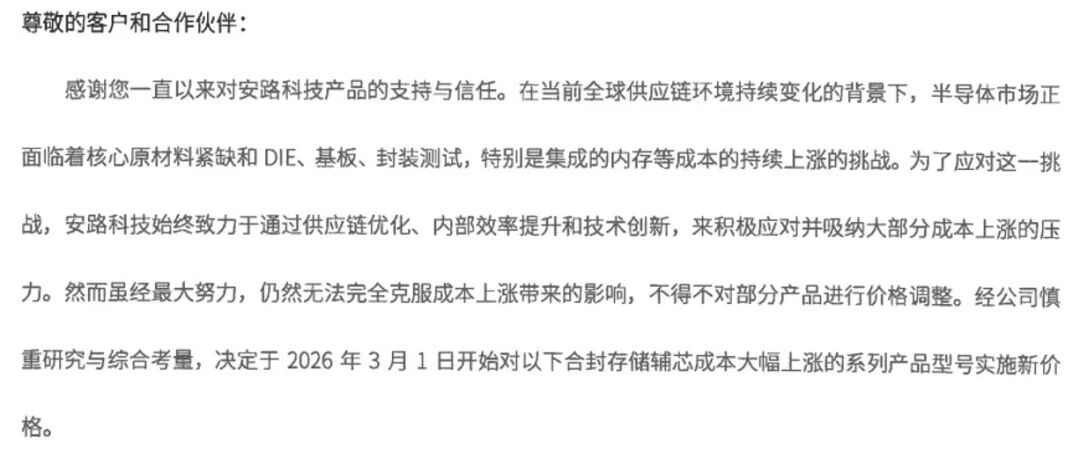
Group 1 - Shanghai Anlu Information Technology Co., Ltd. announced a price increase due to rising costs, effective March 1, 2026, with specific increases of 30% for EG4D20 and EG4S20 series, 40% for PH1P35MDG series, 60% for PH1P35MHG series, and 20% for SF1/SF2 series [3][5] - Vishay, a leading manufacturer of discrete semiconductors and passive electronic components, is also implementing emergency price adjustments for its MOSFET and IC product lines due to significant increases in key raw material costs [5][7] - Anlu Technology, founded in November 2011, specializes in the research, design, and sales of FPGA, FPSoC chips, and dedicated EDA software, and is recognized as a leading FPGA product supplier in China [5][6] Group 2 - The semiconductor industry is experiencing widespread price increases across various product lines, indicating a trend of rising costs and potential supply chain challenges [3][5][7] - The price adjustments from both Anlu Technology and Vishay reflect ongoing pressures in the semiconductor market, particularly in sectors such as automotive, industrial, and consumer electronics [5][7] - The article highlights the importance of monitoring price changes and market dynamics within the semiconductor industry for potential investment opportunities [3][5]
还在涨!存储、TDK、ST等热门芯片料号鉴定
芯世相· 2026-01-30 04:23
Core Viewpoint - The article discusses the rising prices and demand for various semiconductor components in January, highlighting specific products that have seen significant price increases and market interest [3][4][9][12][16][18][21][25]. Group 1: NOR Flash - The prices of NOR Flash products W25Q128JV and W25Q64JV have increased, with W25Q128JV rising from approximately 6 RMB to 8-10 RMB, and W25Q64JV from around 3 RMB to 5-8 RMB [4][6]. - The global second-ranked NOR Flash, GD25Q128ESIGR, has also seen a price increase from nearly 4 RMB to 4-6 RMB, with its applications in industrial control and consumer electronics [21]. Group 2: Motion Sensors - The ICM-42688-P motion tracker has experienced a price surge from about 30 RMB to 50-60 RMB, with some quotes exceeding 70 RMB, while ICM-42670-P has risen from 5-6 RMB to 15-16 RMB [9][11]. - Both sensors are designed for low-power applications in AR/VR, wearables, and IoT devices [11]. Group 3: DDR Memory - The DDR3 memory chip MT41K256M16TW-107:P has seen its price rise from just over 20 RMB to around 30 RMB [12][13]. - The DDR5 chip H5CG48AGBDX018N has experienced a dramatic price increase, reaching approximately 390 RMB, up from around 46 RMB [16]. Group 4: eMMC - The eMMC chip KLM8G1GETF-B041 has increased in price from 70-80 RMB to about 120 RMB, with a significant rise from 28 RMB a year ago [18][19]. Group 5: MEMS Accelerometers - The LIS3DHTR MEMS accelerometer has seen its price fluctuate between 1.7-2.5 RMB, with a notable increase from 2 RMB at the end of last year [25].

存储芯片涨价超50% 手机价格或将上调千元
Xin Lang Cai Jing· 2026-01-08 01:30
Core Insights - Recent news highlights significant price adjustments in mobile phone products due to rising costs of storage chips and main control chips, with expectations of overall price increases of 800 to 1,000 yuan [2][3] Price Trends - Storage chip prices have increased over twofold in the past six months, while the cost of main control chips is projected to rise by over 500 yuan [2][3] - Further price hikes are anticipated by the end of March, with memory chips expected to increase by more than 50% [2][3] - The overall mobile phone price increase is estimated to be between 800 to 1,000 yuan due to these cost changes [2][3] Consumer Recommendations - Industry experts advise consumers to plan their purchasing strategies early, especially for high-capacity storage models, as current flagship model prices may represent the lowest levels for the next one to two years [2][3] Market Adjustments - A market research report indicates that due to anticipated significant increases in storage prices in Q1 2026, industries such as smartphones and laptops are adjusting strategies, with some manufacturers raising end product prices or reducing specifications [2][3] - Market sales forecasts have been revised downward, with industry resources increasingly concentrating on a few leading brands [2][3] Supply Chain Challenges - Supply chain executives have warned of an unprecedented tight supply of memory chips, making it nearly impossible for companies to fully mitigate the impact [2][3] - This shortage is affecting not only the smartphone sector but also extending to televisions, home appliances, and various consumer electronics, posing widespread challenges to the overall industry chain [2][3]
机构:尽管近期股价上涨 三星电子似乎仍有上涨空间
Ge Long Hui A P P· 2025-10-15 00:56
Core Viewpoint - Despite the recent rise in Samsung Electronics' stock price, there appears to be further upside potential driven by multiple factors including rising prices of general chip products, an expanding customer base for its foundry business, and an expected increase in shipments of high-bandwidth memory to Nvidia [1] Group 1: Financial Performance - Samsung Electronics is expected to exceed market expectations for operating profit in the fourth quarter following a third-quarter profit that surpassed expectations [1] - Kiwoom Securities has raised its earnings outlook for Samsung Electronics for 2026, leading to a 14% increase in the target price to 120,000 KRW [1] Group 2: Market Dynamics - The anticipated increase in shipments of high-bandwidth memory to Nvidia is a significant factor contributing to Samsung's expected profit boost [1] - The expansion of Samsung's foundry business customer base is also expected to enhance profitability [1]
高通芯片,太贵了
半导体芯闻· 2025-10-11 10:34
Core Insights - The rising costs of Qualcomm's Snapdragon chips are a significant factor driving up the prices of Android flagship smartphones, with the latest Snapdragon 8 Elite Gen 5 seeing a price increase of 27% compared to last year's model [1][3] - Companies face a dilemma of either absorbing the increased costs to maintain price competitiveness or raising prices, with many analysts predicting that upcoming Android flagship phones will likely see price hikes due to these chip cost increases [3] Pricing Dynamics - The price of Snapdragon 8 Elite Gen 5 has increased from approximately $220 to a range of $240 to $280, primarily due to rising manufacturing costs at TSMC's 3nm process [1][3] - Historical comparisons show that the price of Snapdragon 8 Elite Gen 5 has doubled compared to the Snapdragon 8 Gen 1 from four years ago, indicating a long-term trend of increasing chip prices impacting smartphone pricing [3] Competitive Strategies - Xiaomi's recent launch of the Xiaomi 17 series adopts a "more for the same price" strategy, aiming to compete directly with Apple despite the rising costs in the semiconductor market [3] - Qualcomm is reportedly considering reallocating some orders back to Samsung and evaluating Samsung's 2nm process to strengthen its negotiating position with TSMC [3]


美光涨价,暂停报价!市场有什么反应?
芯世相· 2025-09-15 09:55
Core Viewpoint - Micron Technology is set to increase prices of its storage products, including DDR4, DDR5, LPDDR4, and LPDDR5, by 20%-30% due to supply shortages and market conditions [2][3][17]. Price Increase Announcement - On September 12, it was reported that Micron would raise prices for its storage products by 20%-30% [2]. - Following SanDisk's announcement of a 10% price increase, Micron notified its channels that all DDR4, DDR5, LPDDR4, and LPDDR5 products would stop quoting prices, with all agreements canceled for a week [3][5]. - The price increase is not limited to consumer and industrial storage products; automotive electronics are expected to see a 70% increase [4]. Market Reactions - After the price increase announcement, distributors began to halt quotations, leading to price hikes and a cautious trading environment [9][10]. - Some distributors reported that the price of 16GB industrial-grade DDR4 has risen approximately 30% from around $21 to over $27, while 8GB prices remain stable at around $7 for commercial-grade and $9 for industrial-grade [11]. Historical Context - The price of DDR4 has seen significant fluctuations, with increases of 150%-400% following Micron's previous production halt announcement in June [13]. - Prices for 8GB DDR4 rose from $1.15-$1.25 in late 2022 to over $8 after the production halt announcement [14]. Possible Reasons for Price Increase - The price hike is attributed to supply-demand imbalances, as Micron has shifted production capacity towards higher-margin products, leading to shortages in traditional DRAM [17]. - There are speculations that the price increase may align with Micron's upcoming financial report, which is expected to exceed market expectations due to increased sales and prices of DRAM and NAND products [19][20]. Market Outlook - The market is currently in a state of observation, with questions about whether the price increases are genuine or a strategic move by major storage manufacturers [21].


芯片价格一天暴涨8%!神秘买家大扫货!厂商暴赚!
是说芯语· 2025-06-18 05:29
Core Viewpoint - The DDR4 memory market is experiencing a significant price surge due to major manufacturers exiting the DDR4 market, leading to a buying frenzy among OEM/ODM companies to secure DDR4 supplies. The current prices have exceeded those of DDR5, marking a notable shift in the market dynamics [1][2]. Price Surge - DDR4 spot prices have seen a dramatic increase, with daily price hikes nearing 8%, a level not observed in the past decade. The latest prices for DDR4 8Gb and 16Gb modules have surged significantly, with 8Gb modules reaching an average price of $3.775 and 16Gb modules at $8.2 [2][3]. Historical Price Comparison - Since June, the price of DDR4 8Gb modules has risen from an average of $2.73 to $3.775, marking a 38.27% increase in just half a month. Over the current quarter, prices have increased by approximately 132% from $1.63 [3][4]. Profitability Outlook - Current DDR4 prices are approaching levels seen in the first quarter of 2022, where companies like Nanya Technology and Winbond reported substantial profits, with gross margins of 43.9% and 48.6%, respectively [5][6]. Supply Constraints - Major manufacturers are gradually ceasing DDR4 production, leading to limited supply. This has resulted in a rush to purchase DDR4, particularly for industrial control applications where redesigning is challenging. Nanya Technology and Winbond are positioned to benefit from this price surge, with Nanya's DDR3 and DDR4 products accounting for over 80% of its revenue [7][8]. Future Prospects - Nanya Technology's DDR4 products have received positive feedback from several module manufacturers, and there is an expectation of increased shipments, which could help reduce inventory and potentially turn losses into profits by the fourth quarter [8][9].