
财政冲击

Search documents
The Supreme Court's Tariff Ruling and the New Risk Regime
Etftrends· 2026-02-25 17:32
Core Insights - The Supreme Court ruled that the International Emergency Economic Powers Act (IEEPA) does not allow the president to impose tariffs, impacting trade policy and creating uncertainty in markets and economic activity [1] Group 1: Tariff and Trade Policy Implications - President Trump responded to the ruling with a new blanket tariff, initially set at 10% and later increased to 15%, leading to a spike in the Trade Policy Uncertainty Index to its highest level since April 2025 [1] - The effective trade-weighted tariff rate decreased from 16% before the ruling to 12.7% after, indicating a reduction in near-term tariff-induced inflation pressures [1] Group 2: Federal Reserve and Interest Rate Outlook - The variance of Federal Reserve policy outcomes is expected to widen significantly, complicating communication regarding policy reactions due to uncertainty surrounding tariffs and refunds [1] - Interest rate volatility may increase as markets await clear confirmation of stability, which is likely to be difficult to ascertain in the near term [1] Group 3: Fiscal Implications and Financial Conditions - The Supreme Court ruling may lead to large and complex tariff refunds, resulting in lower federal revenue and potentially higher borrowing needs, which could tighten financial conditions [1] - The balance of market risk has shifted from tariff-induced inflation to fiscal shocks affecting financial conditions, with higher bond issuance exerting upward pressure on rates while lower inflation has the opposite effect [1]


颠覆认知!德银:非经济衰退下快速降息后,往往更可能迎来重新加息
Hua Er Jie Jian Wen· 2025-12-10 06:07
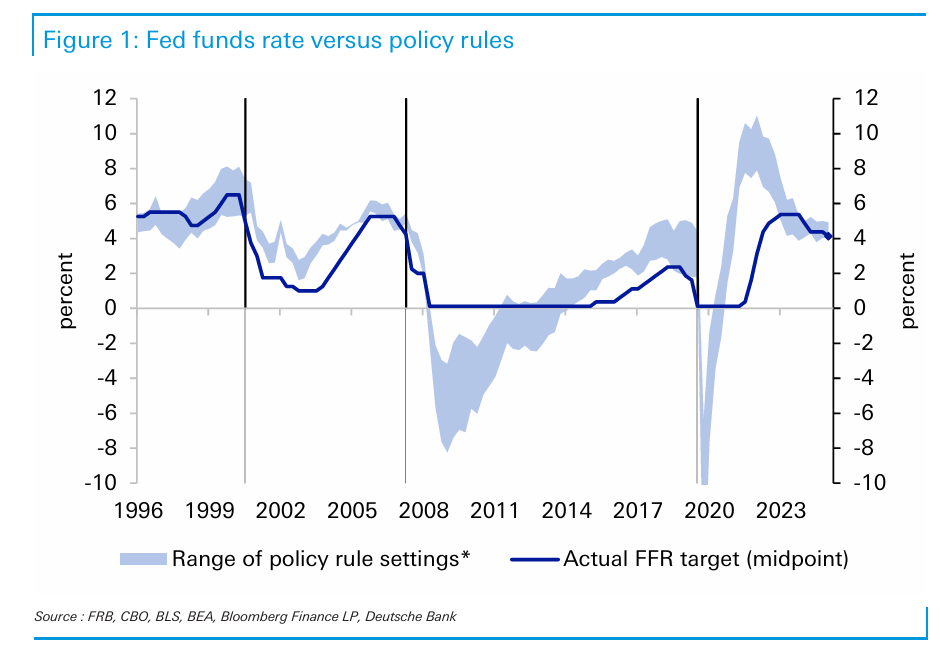
Core Insights - Deutsche Bank warns that despite widespread expectations for the Federal Reserve to maintain a dovish stance, the next likely action in 2026 could be an interest rate hike rather than a cut, contradicting current mainstream consensus [1][2][4] Group 1: Global Economic Trends - Major economies are experiencing a significant reassessment of interest rate expectations, with markets in the Eurozone, Australia, New Zealand, Canada, and Japan indicating a shift towards rate hikes as the next step [1][4] - The rapid reversal in expectations for Canada and Australia within just two weeks serves as a cautionary signal for the U.S. market [4] Group 2: U.S. Market Dynamics - The S&P 500 index recently reached an all-time high, but Deutsche Bank cautions that this optimistic outlook heavily relies on the Fed maintaining a loose monetary policy [2][7] - The sensitivity of the market to Federal Reserve officials' statements highlights the fragility of current policy path expectations [4][5] Group 3: Economic Indicators and Policy Implications - The current pace of interest rate cuts is unprecedented in a non-recessionary context, which historically can lead to economic overheating and inflation rebound, forcing central banks to reverse course [5][7] - The combination of fiscal stimulus from the "Big Beautiful" plan and persistent inflation is likely to alter the current policy narrative, making rate hikes a realistic consideration for 2026 [7] Group 4: Market Projections - Deutsche Bank's stock strategists project a target of 8000 points for the S&P 500 by 2026, implying an annual growth rate of 15-20%, contingent on the Fed's ability to maintain a dovish preference [7] - Any deviation from expected rate cuts towards hikes due to economic data could significantly impact the valuation models for risk assets [7]
每日机构分析:11月6日
Sou Hu Cai Jing· 2025-11-06 12:23
Group 1: US Economic Outlook - UBS suggests that if the US Supreme Court rules Trump's tariff policy illegal, it could force the government to refund approximately $140 billion in taxes, which is 7.9% of the projected federal budget deficit for FY2025. This could lead to a structural low-tariff trade environment, enhancing household purchasing power and easing inflationary pressures, thus providing the Federal Reserve with more room for rate cuts [1] - Barclays indicates that if repo rates remain above the effective federal funds rate target range for several weeks, the Federal Reserve may need to intervene by increasing reserves through more repo lending or direct purchases of Treasury securities [2] - Jefferies maintains a low allocation stance on US Treasuries, highlighting that the Supreme Court's decision on tariffs could significantly impact market volatility and the yield curve [2] Group 2: UK Economic Outlook - Danske Bank anticipates a 25 basis point rate cut by the Bank of England, with a close vote of 5-4. The cooling labor market is noted, but not at a concerning pace. Key votes from the Governor and Deputy Governor will be crucial [3] - Analysts from London Capital Group expect the Bank of England to keep the base rate at 4.0% pending details from the upcoming budget announcement, as uncertainty in new policy measures is suppressing economic activity [4] - Berenberg economists predict that potential tax increases in the UK budget could pave the way for further rate cuts next year, with at least two cuts of 25 basis points to 3.50% anticipated if fiscal tightening is implemented [4] Group 3: Eurozone Economic Data - Eurozone retail sales for September fell short of expectations, primarily due to a 0.2% decline in non-food sales, while food sales remained stable. This lagging data is not expected to influence the European Central Bank's policy outlook [5]
瑞银:特朗普关税若被推翻,美国财政承压之际美联储或迎降息契机
Sou Hu Cai Jing· 2025-11-06 08:24
Core Viewpoint - UBS analysis indicates that if the U.S. Supreme Court rules Trump's tariff policy illegal, it could force the U.S. government to refund approximately $140 billion in taxes to importers, which represents 7.9% of the projected federal budget deficit for FY2025 [1] Group 1: Economic Impact - A ruling against the government could lead to immediate fiscal shocks due to the large tax refunds, potentially resulting in a structurally low-tariff trade environment if trade partners do not retaliate [1] - This low-tariff environment could ultimately benefit the U.S. economy and stock market [1] Group 2: Government Response - UBS estimates that the government is likely to utilize legal tools from the Trade Act of 1974, specifically Sections 201 and 301, to rebuild tariff barriers, although this process may take several quarters and reduce trade policy flexibility [1] Group 3: Market Implications - While refunds may provide unexpected financial benefits to import businesses, the impact on the overall market may be limited as tariff costs have not significantly lowered S&P 500 earnings expectations [1] - The ruling could lower the overall effective tariff rate, enhance household purchasing power, alleviate inflationary pressures, and provide the Federal Reserve with more room for interest rate cuts, which would generally be welcomed by stock market investors, provided trade partners refrain from escalating retaliatory measures [1]

高盛:衡量中国的财政乘数与财政冲击
Goldman Sachs· 2025-06-04 01:53
Investment Rating - The report does not explicitly provide an investment rating for the industry Core Insights - Fiscal easing has been the primary driver of China's cyclical policy in recent years due to weak private demand and muted monetary policy transmission [3][4] - The estimated short-term fiscal multiplier for China ranges from 0.2 to 1.9, with a mean of 0.7 and a median of 0.6 for a one-year horizon [13][16] - The report estimates China's fiscal multiplier to be around 0.5, indicating that a 1 percentage point widening in the augmented fiscal deficit (AFD) would boost real GDP by 0.5 percentage points after four quarters [6][24] - The AFD is projected to widen to 13.0% of GDP in 2025 and 13.5% in 2026, which is expected to increase real GDP growth by 1.1 percentage points in 2025 and 0.6 percentage points in 2026, compared to a 0.5 percentage point drag in 2024 [6][41] Summary by Sections Fiscal Multiplier Estimates - Recent literature suggests a wide range for China's fiscal multiplier, with discrepancies attributed to different sample periods and estimation techniques [13][14] - The report's analysis indicates a cumulative fiscal multiplier of approximately 0.2-0.3 in the first two quarters after a fiscal shock, rising to around 0.5 in the subsequent quarters [28][39] Augmented Fiscal Deficit (AFD) - The AFD has averaged over 11% of GDP in the past three years, while nominal GDP growth has been below 5% [17] - The report highlights a shift towards increasing the official government debt since the onset of COVID-19, enhancing the proportion of on-budget fiscal deficit in the AFD [17][21] Economic Growth Impact - The report anticipates that fiscal policy will significantly support GDP growth in the coming quarters, with a peak incremental fiscal boost expected in Q4 2025 [41][42] - The estimated growth impact of AFD widening is projected to be 1.1 percentage points in 2025 and 0.6 percentage points in 2026, with a quarterly incremental effect diminishing after the fourth quarter [41][44]