
货币增速

Search documents
【银行】春节因素对2月信贷扰动较小——流动性观察第123期(王一峰/赵晨阳)
光大证券研究· 2026-03-04 23:08
Summary of Key Points Core Viewpoint - The financing demand remains to be restored, leading to a relatively mild "opening red" performance in January, with a decrease in loan increments year-on-year. February's credit is constrained by the Spring Festival misalignment and insufficient demand, with an expected loan increment around 1 trillion yuan [6]. Group 1: Loan and Credit Forecasts - It is anticipated that the new RMB loans in February will be around 1 trillion yuan, with a growth rate declining to approximately 6% [6]. - The manufacturing PMI decreased by 0.3 percentage points to 49%, indicating a drop in business activity due to the Spring Festival [6]. - The seasonal decline in loan issuance is expected due to fewer working days in February compared to the previous year, with only 17 days this year versus 19 days last year [6]. Group 2: Social Financing and Monetary Supply - The new social financing in February is projected to be around 2 trillion yuan, with a growth rate dropping to approximately 8.1% [8]. - The estimated increase in on-balance sheet loans is around 600 billion yuan, remaining stable year-on-year [8]. - The direct financing data shows that the net financing scale of government bonds and local bonds is 1.42 trillion yuan, a decrease of 272.9 billion yuan year-on-year [8]. Group 3: Monetary Growth Trends - M1 and M2 growth rates are expected to decline slightly, influenced by the Spring Festival and reduced credit issuance [9]. - M1 growth is projected to fall from 4.9% in January to around 4.6%, while M2 growth may decrease to approximately 8.9% [10]. - The overall monetary growth remains relatively stable despite the seasonal fluctuations [10]. Group 4: Future Funding Conditions - The funding environment in March is expected to remain stable, with attention on the loan issuance at the end of the quarter [11]. - The funding conditions are likely to show a pattern of "loose at the beginning of the month, tightening at the end," influenced by increased loan issuance and government bond issuance [11]. - The focus will be on the recovery of credit demand after the Spring Festival [11].


银行行业月报:货币增速整体改善
Wanlian Securities· 2026-02-25 10:30
Investment Rating - The industry investment rating is "stronger than the market," indicating an expected increase of over 10% in the industry index relative to the market in the next six months [24]. Core Insights - The growth rate of social financing stock in January was 8.2%, with a slight month-on-month decline of 0.1%. The new social financing added was 7.22 trillion yuan, which was 0.17 trillion yuan more year-on-year, primarily affected by new loans [2][10]. - The new RMB loans in January amounted to 4.9 trillion yuan, which was a year-on-year decrease of 0.32 trillion yuan. The net financing scale of government bonds was 0.98 trillion yuan, an increase of 0.28 trillion yuan year-on-year [2][10]. - The M2 money supply grew by 9% year-on-year, with a month-on-month increase of 0.5%. M1 also saw a year-on-year growth of 4.9%, with a month-on-month increase of 1.1% [4][20]. - On January 15, 2026, the central bank announced a 0.25 percentage point reduction in various structural monetary policy tool rates, reflecting a policy approach that maintains moderate easing while emphasizing structural adjustments [21]. Summary by Sections Social Financing - As of the end of January, the total social financing stock was 449.11 trillion yuan, with a year-on-year growth rate of 8.2% [2][10]. - The corporate credit in January saw an increase of 4.71 trillion yuan, which was a year-on-year decrease of 0.42 trillion yuan. The balance of RMB loans from financial institutions was 276.6 trillion yuan, with a year-on-year growth of 6.1% [3][11][16]. Loan Structure - In January, the household sector saw an increase of 456.5 billion yuan in loans, with short-term loans increasing by 109.7 billion yuan and medium to long-term loans increasing by 346.9 billion yuan [3][17]. - The corporate sector had new loans of 4.45 trillion yuan, which was a year-on-year decrease. Short-term loans increased by 2.05 trillion yuan, while medium to long-term loans increased by 3.18 trillion yuan [3][17]. Monetary Supply - The new RMB deposits in January were 8.09 trillion yuan, which was an increase of 3.77 trillion yuan year-on-year, with a year-on-year growth rate of 9.9% [4][20]. Investment Strategy - The report anticipates that the overall revenue and net profit growth rate of listed banks will stabilize in 2025 and 2026, with strong risk compensation capabilities. The current dividend yield in the banking sector remains attractive, suggesting a clear direction for long-term capital allocation towards the banking sector [21].
银行行业月报:货币增速整体改善-20260225
Wanlian Securities· 2026-02-25 07:51
Investment Rating - The industry investment rating is "stronger than the market," indicating an expected relative increase of over 10% in the industry index compared to the broader market within the next six months [24]. Core Insights - In January, the total social financing (社融) stock grew by 8.2% year-on-year, with a slight month-on-month decrease of 0.1%. The new social financing added was 7.22 trillion yuan, which is an increase of 0.17 trillion yuan year-on-year, primarily affected by new loans [2][10]. - The new RMB loans in January amounted to 4.9 trillion yuan, which is a decrease of 0.32 trillion yuan year-on-year. The net financing scale of government bonds was 0.98 trillion yuan, an increase of 0.28 trillion yuan year-on-year [2][10]. - The M2 money supply grew by 9% year-on-year, with a month-on-month increase of 0.5%. M1 also saw a year-on-year growth of 4.9%, with a month-on-month increase of 1.1% [4][20]. - The People's Bank of China announced a 0.25 percentage point reduction in various structural monetary policy tool rates on January 15, 2026, reflecting a focus on maintaining moderate monetary easing while emphasizing structural adjustments [21]. Summary by Sections Social Financing - The total social financing stock reached 449.11 trillion yuan by the end of January, with a year-on-year growth rate of 8.2% and a month-on-month decrease of 0.1% [2][10]. - The new loans to enterprises in January were 4.71 trillion yuan, which is a decrease of 0.42 trillion yuan year-on-year. The total RMB loan balance was 276.6 trillion yuan, with a year-on-year growth of 6.1% [3][16]. Loan Structure - In January, the household sector saw an increase of 456.5 billion yuan in loans, with short-term loans increasing by 109.7 billion yuan and medium to long-term loans increasing by 346.9 billion yuan [3][17]. - The corporate sector had new loans of 4.45 trillion yuan, with short-term loans increasing by 2.05 trillion yuan, while medium to long-term loans increased by 3.18 trillion yuan [3][17]. Monetary Supply - The new RMB deposits in January totaled 8.09 trillion yuan, which is an increase of 3.77 trillion yuan year-on-year, with a year-on-year growth rate of 9.9% [4][20]. - The average interest rate for new corporate loans (in both domestic and foreign currencies) was approximately 3.2%, which is 20 basis points lower than the same period in 2025 but has increased by about 10 basis points month-on-month [3][17].
股市即将变盘的逻辑,财富洗牌的前夜
Sou Hu Cai Jing· 2025-11-27 05:11
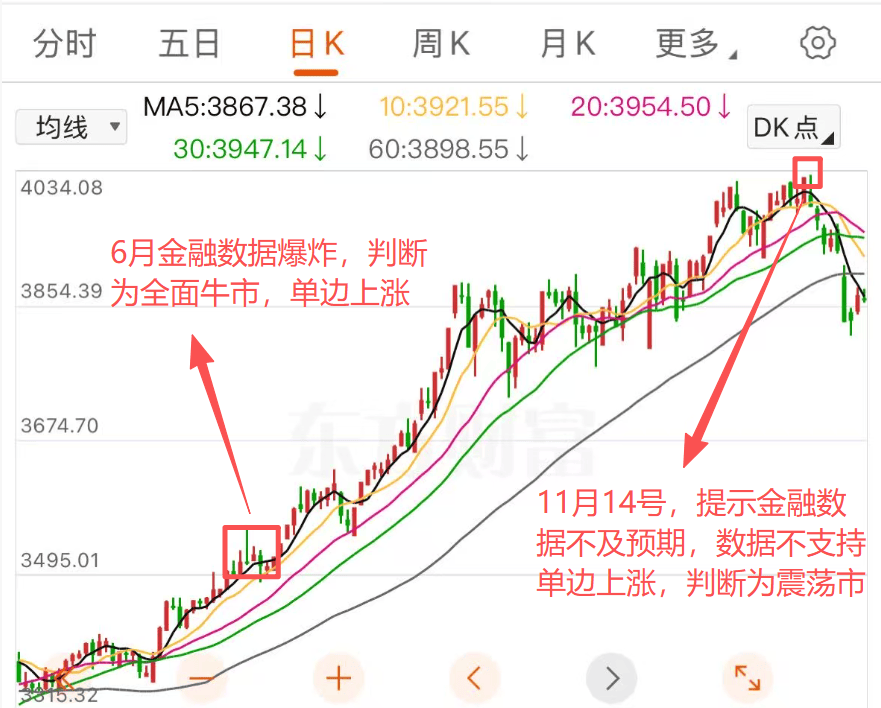
Core Viewpoint - The stock market began a downward trend starting November 14, triggered by the release of disappointing financial data for October on November 13, which did not meet expectations [1][3]. Financial Data Analysis - On July 14, the central bank released June financial data that significantly exceeded expectations, leading to a bullish market trend [3]. - The October financial data released on November 13 was below expectations, resulting in a noticeable decline in the stock market starting November 14 [3][4]. - The primary reason for the explosive data in July was the unexpected increase in money supply driven by bond purchases, while the October data reflected a downturn in bond issuance, impacting money supply growth [5][12]. Monetary Mechanism Explanation - The central bank is the issuer of currency, and the total money supply (M2) is determined by the base currency and the reserve requirement ratio [5][7]. - Commercial banks can create money through asset expansion, which includes buying bonds, but they must first attract deposits [6][9]. - The difference between commercial banks and the central bank in money creation lies in the need for deposits and the type of money created (derived vs. base money) [9][10]. Market Outlook - The recent data indicated a turning point for both M1 and M2, primarily due to a decline in bond issuance [13]. - Despite the downward pressure, the market is expected to stabilize rather than enter a prolonged decline, as the bond market can be adjusted by issuers in response to economic conditions [13]. - The long-term outlook remains optimistic, with confidence in the market's potential for recovery driven by bond issuance mechanisms [13][14]. Sector Focus - Future national development priorities include technology, new productive forces, and industrial upgrades, which may lead to high valuations in tech sectors [15]. - Traditional sectors, while not the focus of future growth, have lower valuations and may present safer investment opportunities [15][16].
流动性观察第118期:10月金融数据前瞻:信贷季节性回落,社融、货币降速
EBSCN· 2025-11-06 14:17
Investment Rating - The industry investment rating is "Buy" (Maintain) [1] Core Viewpoints - In October, credit issuance is expected to seasonally weaken, with new RMB loans projected to be around 200 to 400 billion, a year-on-year decrease of 100 to 300 billion [4][6] - Social financing (社融) is anticipated to be between 600 to 800 billion, with a growth rate declining to approximately 8.4% [12][15] - The government bond remains the main contributor to social financing growth, while the overall financing demand is expected to remain weak in the short term [15][19] Summary by Sections Credit Market - The expected new RMB loans for October are between 2000 to 4000 billion, with a year-on-year decrease of 1000 to 3000 billion, leading to a month-end growth rate of approximately 6.5% to 6.6% [6][16] - Corporate credit is expected to see a seasonal decline, with short-term loans potentially turning negative due to weakened business sentiment [7][8] Social Financing - The forecast for new social financing in October is between 6000 to 8000 billion, with a growth rate around 8.4%, reflecting a year-on-year decrease [12][15] - Government bonds are projected to contribute significantly to social financing, with net financing expected to be 5281 billion, lower than the previous year's figures [13] Monetary Supply - M1 and M2 growth rates are expected to decline due to high base effects, with M1 and M2 increments projected at -526 billion and 2294 billion respectively [19][22] - The seasonal effects of fiscal revenue and the expansion of asset management products are influencing the dynamics between government and general deposits [19]