质量增长

Search documents
福特汽车2025年净亏损超81亿美元,电动化战略全面调整
Ju Chao Zi Xun· 2026-02-12 10:18
Core Insights - Ford reported a total revenue of $187.3 billion for the year 2025, a slight increase of 1.23% year-on-year, marking five consecutive years of revenue growth. However, the company faced a net loss of $8.182 billion for the year, with a significant quarterly net loss of $11.1 billion in Q4 [2] - The primary reasons for the substantial losses were the ongoing challenges in the electrification business and costs associated with strategic adjustments. The electric vehicle division incurred a loss of $4.8 billion in 2025, with cumulative losses exceeding $10 billion. The company also recorded a special project expense of $19.5 billion, primarily accounted for in Q4 [2] - Additional cost pressures arose from a production accident at an aluminum supplier, leading to increased costs for core models, along with $2 billion in extra tariff expenses, further compressing profit margins [2] Business Strategy - In response to the financial challenges, Ford announced the cessation of production for certain all-electric models, reallocating resources towards hybrid and extended-range vehicles, while also developing smaller all-electric products that better meet market demand [2] - The company aims to strengthen its traditional business segments, with the fuel and hybrid business and commercial vehicle sector expected to remain profitable in 2025, serving as crucial support for overall performance. Notably, hybrid vehicle sales increased by over 20% year-on-year, and the commercial vehicle segment achieved a profit margin of 10.3% [2] Future Outlook - Ford's management has emphasized a profit-first strategy moving forward, anticipating that the electric vehicle business will continue to experience short-term losses, but the scale of these losses is expected to gradually narrow. By 2026, adjusted EBIT is projected to rebound to between $8 billion and $10 billion [3] - The company is also exploring new revenue streams in battery storage and is restructuring its existing electric vehicle battery factories to accommodate the storage business, aiming to shift from a focus on scale expansion to quality growth [3]



永辉抄胖东来作业,没抄明白
虎嗅APP· 2026-01-25 14:11
Core Viewpoint - Yonghui Supermarket is facing significant financial challenges, with a projected net loss of 2.14 billion yuan for 2025, marking its fifth consecutive year of losses and a 45.6% year-on-year increase in losses [2][4]. Financial Performance - From 2021 to 2025, Yonghui's net profits were -3.944 billion yuan, -2.763 billion yuan, -1.329 billion yuan, -1.465 billion yuan, and a projected -2.14 billion yuan, totaling over 11.6 billion yuan in losses over five years [4]. - The company's asset-liability ratio reached 88.96% by the end of Q3 2025, with total assets of 31.62 billion yuan and liabilities of 28.129 billion yuan [5]. - Operating cash flow has significantly decreased from 5.864 billion yuan in 2022 to 1.14 billion yuan in Q3 2025, indicating severe cash flow pressure [5]. Strategic Transformation - Yonghui's management attributes the massive losses to "short-term pain" from strategic transformation, including the deep adjustment of 315 stores and the closure of 381 low-efficiency stores, resulting in over 1.2 billion yuan in direct losses [4][5]. - The transformation costs for Yonghui are significantly higher than the industry average, with 81% of supermarket companies achieving performance growth while keeping adjustment costs within 3%-5% of revenue, whereas Yonghui's adjustment costs are projected to consume all profits [5]. Comparison with Competitors - The "Fat Donglai model" has shown positive results, with an average customer flow increase of 80% and 60% of adjusted stores achieving record profits, but Yonghui's adaptation has not translated into overall profitability [7][8]. - Fat Donglai's success is attributed to a unique distribution mechanism, regional supply chain barriers, and a trust-based economy, which are difficult for national chains like Yonghui to replicate [8][9]. Industry Context - The retail industry is experiencing a "diversification intensification," with 50% of companies achieving sales growth and 46% achieving net profit growth, while regional supermarkets are outperforming national chains like Yonghui [11][12]. - The shift from scale-driven growth to efficiency-driven growth is evident, with successful companies focusing on single-store efficiency rather than just increasing customer flow [12]. Future Outlook - Yonghui's future hinges on its ability to effectively utilize funds from a planned 3.1 billion yuan capital increase for store adjustments and supply chain upgrades, with potential cash flow crises looming if the capital increase fails [11][12]. - The company must address two core issues: efficiently investing in profit distribution reform and localizing the supply chain while controlling costs during the transformation process [12][13].


新股前瞻|巴奴火锅再闯港交所:门店翻倍与利润跃升20倍的“双轨实验”
智通财经网· 2025-12-23 01:47
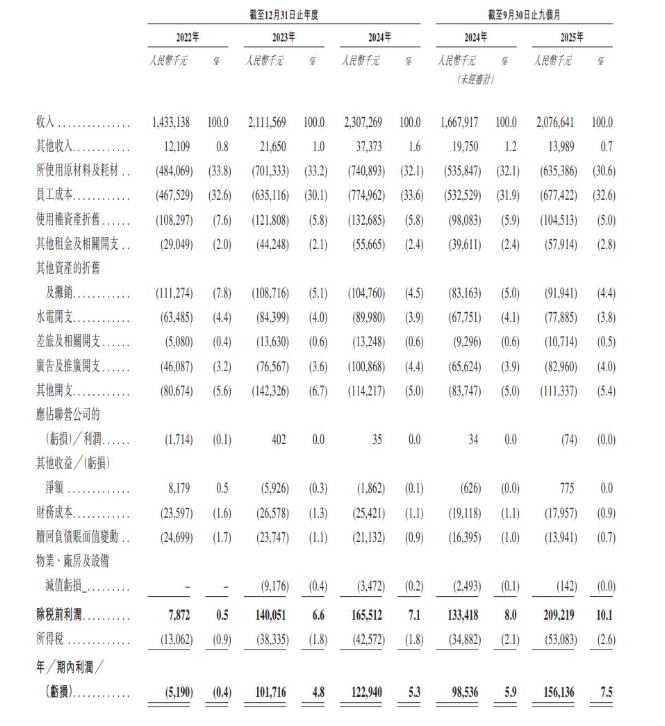
Core Viewpoint - Banu Hotpot is making a second attempt to go public on the Hong Kong Stock Exchange, showcasing strong financial performance despite a projected revenue dip in 2024, with a significant increase in net profit margin from 0.5% in 2022 to a forecasted 10.1% in 2025 [1][3]. Financial Performance - Banu Hotpot's revenue for the years 2022 to 2025 is reported as follows: 1.433 billion RMB in 2022, 2.111 billion RMB in 2023, 2.307 billion RMB in 2024, and 2.077 billion RMB for the first nine months of 2025 [2][4]. - The net profit for the same period shows a turnaround from a loss of 5.19 million RMB in 2022 to a profit of 156.14 million RMB in 2025 [2][4]. Expansion Strategy - The number of Banu Hotpot's direct-operated stores increased from 86 at the end of 2022 to 162 by December 7, 2025, reflecting a growth rate of 95.2% [2]. - As of December 7, 2025, 80.2% of Banu's stores are located in second-tier cities and below, indicating a strategic focus on expanding in less saturated markets [2]. Profitability Improvement - The net profit margin has dramatically increased from 0.5% in 2022 to a projected 10.1% in 2025, attributed to effective cost control and improved supply chain management [3]. - The cost of raw materials as a percentage of revenue decreased from 33.8% in 2022 to 30.6% in 2025, indicating enhanced operational efficiency [3]. Market Position - Banu Hotpot is the largest quality hotpot brand in China, holding a market share of approximately 3.1% in the quality hotpot segment and 0.4% in the overall hotpot market for 2024 [1][2]. - The company has established a strong brand presence through differentiation in quality, which is crucial for maintaining pricing power and profitability [5]. Industry Trends - The restaurant industry is shifting from a focus on traffic-driven growth to a competition based on brand strength and operational efficiency, with Banu positioned to capitalize on this trend [7]. - Consumer demand for quality and experience is rising, while price sensitivity remains, necessitating a balance between premium offerings and cost management [7][8]. Challenges Ahead - The sustainability of Banu's growth model is under scrutiny, particularly regarding whether increased customer traffic from price reductions can offset shrinking profit margins [8][9]. - The ability to maintain quality and service standards while expanding rapidly poses a significant challenge for Banu as it seeks to replicate its successful model across multiple locations [9].
巴奴火锅再闯港交所:门店翻倍与利润跃升20倍的“双轨实验”
Zhi Tong Cai Jing· 2025-12-23 01:43
Core Viewpoint - Banu Hotpot is making a second attempt to go public on the Hong Kong Stock Exchange, showcasing strong financial performance despite a projected revenue dip in 2024, with a significant increase in net profit margin from 0.5% in 2022 to a forecasted 10.1% in 2025 [1][3] Financial Performance - Banu Hotpot's revenue for the years 2022 to 2025 is projected to be RMB 14.33 billion, RMB 21.12 billion, RMB 23.07 billion, and RMB 20.77 billion respectively, with net profits increasing from a loss of RMB 5.19 million in 2022 to a profit of RMB 156.14 million in 2025 [2][4] - The net profit margin is expected to rise approximately 20 times from 0.5% in 2022 to 10.1% in 2025, driven by effective cost control and improved operational efficiency [3][4] Expansion Strategy - Banu Hotpot has expanded its direct-operated stores from 86 in December 2022 to 162 by December 2025, reflecting a growth rate of 95.2% [2] - The company operates 5 integrated central kitchens and 1 specialized base material processing plant, covering 14 provinces and municipalities in China [2] Market Position - Banu Hotpot is the largest quality hotpot brand in China, holding a market share of approximately 3.1% in the quality hotpot segment and 0.4% in the overall hotpot market for 2024 [1][7] - The company has successfully balanced price adjustments with customer volume growth, indicating a strategic approach to maintaining profitability while expanding [8] Industry Trends - The restaurant industry is shifting from a "traffic dividend" era to a phase driven by brand strength and operational efficiency, with a notable increase in consumer demand for quality and experience [7][9] - The competitive landscape in the hotpot sector is intensifying, with a clear divide between high-end brands and those relying solely on marketing without solid profitability models [7][9]
2025淘宝天猫宠物品牌增长白皮书
Sou Hu Cai Jing· 2025-11-23 13:11
Core Insights - The report highlights the structural transformation of China's pet consumption market, indicating a shift from incremental growth to stock competition, entering a quality growth era from 2023 to 2025 [1][2] - The pet market is projected to exceed 300 billion yuan in urban dog and cat consumption by 2024, with the cat economy growing at 10.7%, becoming the main driver of market growth [1][16] - The consumption structure is categorized into four core segments: food, supplies, health, and services, with food accounting for the highest proportion [1][19] Market Trends - The pet market is transitioning to a "quality growth" era, with the urban dog and cat consumption market expected to reach 300 billion yuan in 2024, reflecting a 7.5% year-on-year increase [16] - The dog consumption market is valued at 155.7 billion yuan, growing by 4.6%, while the cat market is valued at 144.5 billion yuan, with a growth rate of 10.7% [16] - The average annual consumption per pet dog is 2,961 yuan, up by 3.0% from 2023, while for cats, it is 2,020 yuan, increasing by 8% [16][27] Consumer Demographics - The pet ownership demographic is becoming younger and more decentralized, with post-90s and post-00s individuals becoming the main pet owners, and the proportion of male pet owners in lower-tier cities significantly increasing [1][27][28] - The proportion of pet owners in first-tier and new first-tier cities has decreased from 47% to 41%, indicating a shift towards lower-tier cities as a major source of new growth [27][28] Consumption Structure - The pet economy has established four core segments: - Food: 52.8% of spending, with staple food as the core [19] - Supplies: Moving towards smart and scenario-based iterations [19] - Health: Medical and health care spending accounts for 28%, driven by pet aging and increased preventive awareness [22] - Services: Grooming and beauty services account for 41% of store revenue, with high-end experience services showing significantly higher repurchase rates [24] Brand Growth Strategies - The platform provides a multi-phase growth strategy for pet brands, including incubation, growth, and maturity stages, focusing on user insights, supply chain upgrades, and innovative marketing [2][10] - Successful case studies from brands like Maifudi and TOPTREES demonstrate effective strategies in food, high-end grain, and pet health sectors, validating the "user-product-marketing" integrated operational logic [2][10] Decision-Making Changes - The purchasing process is evolving from impulsive, single-platform decisions to multi-channel, long-chain decision-making, with price-performance ratio and trust becoming key factors [33][34] - Consumers are increasingly seeking solutions to specific problems rather than just products, indicating a need for brands to align their messaging with consumer queries [39][40] Future Directions - The report suggests that brands should focus on full-link conversion strategies, multi-dimensional user operations, and collaborative layouts across the four core segments to drive growth [48][49]

上半年利润大增超55%,周黑鸭(01458)“质量增长”引领同行
智通财经网· 2025-07-21 02:58
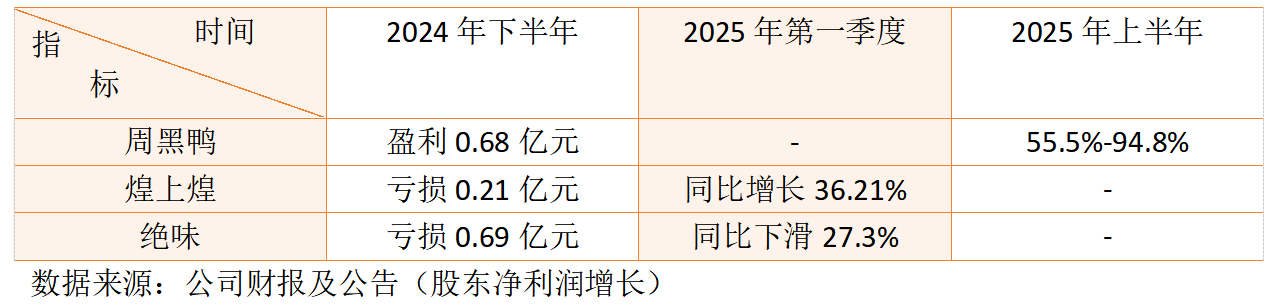
Core Viewpoint - Zhou Hei Ya is leading the industry with significant profit growth amidst a challenging consumer environment, driven by store quality reforms, supply chain optimization, and cost efficiency measures [1][2][6]. Financial Performance - The company expects to achieve a profit of 0.9 billion to 1.13 billion yuan in the first half of 2025, representing a year-on-year growth of 55.2% to 94.8% [1]. - Revenue is projected to be between 12 billion and 12.4 billion yuan during the same period [1]. - The gross profit margin improved by 6 percentage points to 58.3%, while net profit increased by 3.64 times in the previous year [2][5]. Operational Strategies - Zhou Hei Ya is focusing on store quality reforms by optimizing store locations in high-traffic areas and enhancing customer experience through innovative store designs and product offerings [4][6]. - The company has established a dual-driven system of "classic + innovation" to enhance its product matrix and maintain competitive pricing through effective supply chain management [4][7]. Industry Positioning - Zhou Hei Ya has outperformed its peers, such as Huang Shang Huang and Jue Wei, which are facing profit declines [1][3]. - The company is transitioning from scale growth to quality growth, positioning itself as a model for sustainable profitability in the industry [6][7]. Future Outlook - The company anticipates continued profit growth in the second half of 2025, supported by ongoing store quality improvements, a rich product matrix, and optimized supply chain management [8]. - Zhou Hei Ya is also expanding into international markets, starting with Southeast Asia, aiming to establish itself as a leader in exporting Chinese marinated food [7][8]. Shareholder Returns - Zhou Hei Ya has a strong track record of returning value to shareholders, with a cumulative dividend payout ratio of 43% since 2013 and a recent share buyback of 0.91 million shares worth 1.9 billion HKD [8].