
资源战略价值重估

Search documents
地缘冲突引爆资源行情,油气ETF单周吸金超206亿
第一财经· 2026-03-09 13:33
Core Viewpoint - The article discusses the significant shift in the A-share ETF market, driven by geopolitical conflicts, leading to a substantial inflow of funds into resource-related ETFs, particularly in oil and gas sectors, while core broad-based ETFs experienced notable outflows [3][4][11]. Fund Flows and Market Dynamics - As of March 6, nearly 400 billion yuan was withdrawn from core broad-based ETFs like the CSI 300 and CSI 500, while industry-themed ETFs saw a net inflow of 443.23 billion yuan, indicating a clear trend of funds moving from broad-based to thematic investments [4]. - Oil and gas ETFs emerged as the top performers, attracting over 206 billion yuan in a single week, with several products seeing their shares increase by over 300% [4][5]. - Specific oil and gas ETFs, such as the Guotai CSI Oil and Gas Industry ETF and the Penghua Oil ETF, attracted more than 40 billion yuan each within a few trading days, leading to significant increases in their share volumes [4][5]. Performance of Thematic ETFs - Other sectors, including electric grid, rare metals, and non-ferrous metals, also received substantial investment, with the Huaxia Electric Grid Equipment ETF seeing over 10 billion yuan in net inflows for six consecutive trading days [5]. - The trading activity for these thematic ETFs surged, with the Guotai CSI Oil and Gas Industry ETF recording a weekly trading volume exceeding 225 billion yuan, a 13-fold increase from the previous week [5]. Discrepancies in Fund Performance - There is a notable lag in the performance of some fund connection products compared to their corresponding ETFs, leading to investor confusion regarding the slower net value growth of these connection funds [7][8]. - The differences arise because ETF connection funds are designed to track the net value of the ETFs rather than their trading prices, which can lead to discrepancies during periods of high market volatility [8][9]. Future Market Outlook - The article highlights that geopolitical uncertainties are likely to continue affecting market risk preferences, with expectations of a volatile A-share index [11]. - Strategic resource products are anticipated to benefit from price increases, particularly in the oil and gas sector, which may see prices reach historical highs due to ongoing geopolitical tensions [12][13]. - The demand for rare metals is expected to grow due to their critical role in various industries, while traditional cyclical industries like coal and steel may also present investment opportunities [13].


华尔街:黄金目标价6000美元!详解全球秩序重构下的有色
Sou Hu Cai Jing· 2026-01-27 04:29
Core Insights - The article highlights a significant revaluation of resource strategic value amid a global order restructuring, with commodities like gold, silver, and copper gaining attention as investment opportunities [1] Group 1: Precious Metals - Central banks have purchased over 1,000 tons of gold for three consecutive years, indicating a shift in asset allocation and a redefinition of national credit systems [3] - Bank of America has raised its long-term gold price target to $6,000, reflecting a renewed valuation of gold as a currency anchor [3] - The gold-silver ratio is above 90, suggesting that silver may exhibit greater elasticity in the market [3] Group 2: Industrial Metals - The demand for copper and aluminum is being reshaped by energy transition and AI revolutions, with copper usage in AI data centers being five times that of traditional centers [4] - The global capital expenditure on copper mining has been insufficient for a decade, with Goldman Sachs predicting a supply gap of 9 million tons by 2030 [4] - Aluminum is positioned at the intersection of lightweight revolution and green electricity, with demand from photovoltaic frames and electric vehicles growing over 15% annually [4] Group 3: Geopolitical Dynamics - Major economies are elevating strategic resource reserves to national security levels, with the U.S. listing copper and aluminum as critical minerals [5] - The establishment of mineral security partnerships among multiple countries indicates a reconfiguration of critical mineral supply chains [5] - Companies with resource control are seeing their valuation systems enhanced by geopolitical premiums, as resources become strategic assets in global competition [5] Group 4: Investment Strategies - The article suggests that investors should focus on a diversified "all-star lineup" of metals rather than chasing individual commodities [1] - The招商中证有色金属矿业主题 ETF (159690) has seen significant inflows, indicating strong investor interest in a diversified approach to resource investment [1] - The ETF's performance reflects a self-reinforcing asset rotation, where precious metals lead during interest rate cuts, followed by industrial metals as renewable energy initiatives accelerate [7]
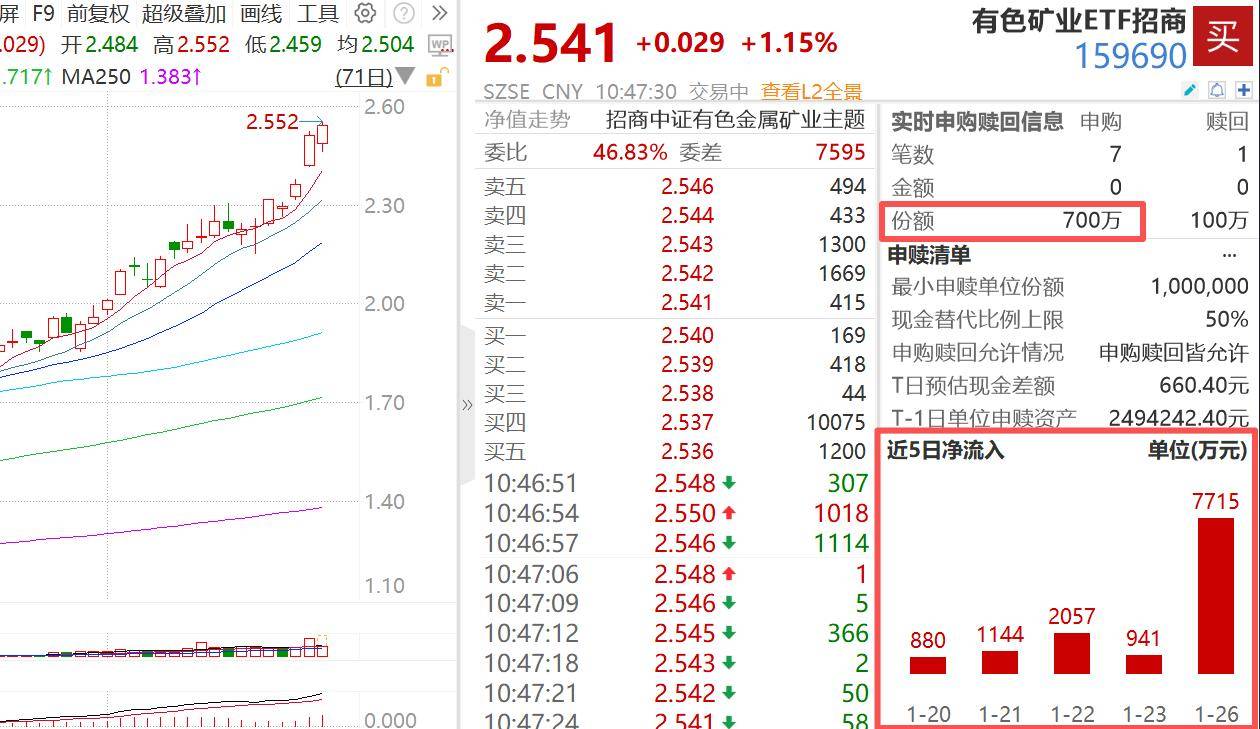
年内第27次新高!有色矿业ETF招商(159690)盘中强势翻红,白银有色、湖南白银双双涨停封板
Jin Rong Jie· 2025-12-29 04:04
Core Viewpoint - The non-ferrous metal mining sector is experiencing strong performance, with related ETF products reaching new highs, indicating structural opportunities within specific sub-sectors [1][2]. Group 1: ETF Performance - The non-ferrous metal ETF (159690) rose by 0.10%, marking its 27th price high of the year, with a year-to-date increase exceeding 102% [1][2]. - The sector shows significant stock performance divergence, with silver-related stocks, including Hunan Silver, hitting the daily limit up, highlighting structural opportunities in specific varieties [1]. Group 2: Market Dynamics - The current market rally is driven by several factors: the index focuses on upstream mining companies benefiting directly from rising commodity prices, enhanced profitability of leading mining firms, and dual support from macroeconomic conditions and industrial demand [2][3]. - Major global economies are adopting looser monetary policies, coupled with sustained structural demand for key minerals in sectors like renewable energy and artificial intelligence, which collectively support the high prosperity of the non-ferrous metal sector [2]. Group 3: Strategic Value of Resources - The strategic value of resources is being re-evaluated by the market, with copper and lithium transitioning from traditional commodities to strategic materials, leading to a fundamental shift in valuation logic for upstream resource companies [3]. - Despite the high volatility in the sector, non-ferrous metal resource assets still possess long-term allocation value as long as the supply-demand dynamics remain unchanged [3].

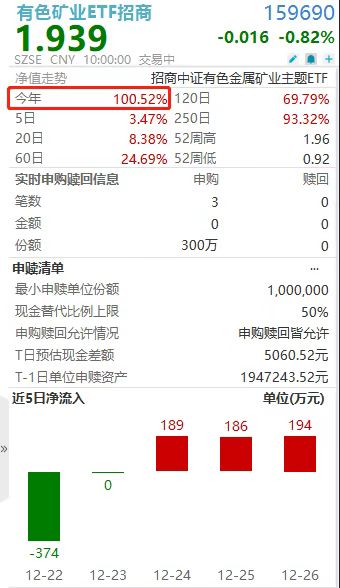
有色金属狂飙60%领涨全市场:降息周期、AI与新能源点燃资源重估 2026年能否延续辉煌?
Xin Lang Cai Jing· 2025-12-26 09:52
Group 1 - The core viewpoint is that the non-ferrous metal sector is expected to lead the market with an annual increase of over 60%, driven by macroeconomic cycles, industrial transformation, and resource competition [1] - The market is characterized by both "blooming" and "structural differentiation," with precious metals like gold and silver shining due to global interest rate cuts and geopolitical risks [2] - The demand for metals such as copper, aluminum, lithium, and rare earths is experiencing exponential growth due to emerging industries like electric vehicles and AI data centers [4] Group 2 - The macroeconomic cycle is benefiting from global major economies entering a "rate-cutting channel," which enhances liquidity and drives funds into commodities [3] - Resource competition is intensifying due to uneven global mineral resource distribution and geopolitical conflicts, making "supply chain security" a strategic focus for countries [5] - Leading companies are leveraging a multi-dimensional approach of "resources + technology + industrial chain" to gain competitive advantages in the resource revaluation wave [6][7][8] Group 3 - The precious metals market is entering a critical window for "macroeconomic expectation verification" and "real demand testing," with gold and silver's financial attributes expected to remain prominent if the rate-cutting cycle officially begins [10] - Industrial metals like tin and nickel need to be monitored for downstream operating rates and inventory changes, with prices likely to maintain high volatility if demand remains resilient [11] - The market is anticipated to shift from a broad rally to a more differentiated approach, focusing on companies that truly possess resource, technology, or recycling advantages to navigate cyclical fluctuations [12]
