达人营销

Search documents
创业者出海必读,3 万字讲清 AI 产品达人营销全流程
Founder Park· 2026-03-26 09:51
Core Insights - The article emphasizes the increasing importance of influencer marketing for AI products due to the rapid growth and homogeneity of the market, where user attention is scarce [10][11][12] - Influencer marketing serves as a critical bridge between product features and user understanding, helping to translate complex AI functionalities into relatable benefits [11][12][18] - The article outlines a comprehensive framework for executing influencer marketing, detailing the entire process from preparation to execution and evaluation [6][7][10] Group 1: Importance of Influencer Marketing - Influencer marketing is essential for AI products as it addresses key challenges in user acquisition, such as high explanation costs and trust issues [10][11] - The article identifies influencers as "translation officers" for product features, helping users understand the practical benefits of AI tools [11][12] - Trust transfer from influencers to products significantly enhances user acceptance and reduces skepticism towards new AI tools [19][20] Group 2: Influencer Marketing Process - The article breaks down the influencer marketing process into stages: awareness, consideration, and conversion, emphasizing the need for a full-funnel approach [64][65][67] - It highlights the importance of selecting the right platforms for different types of content, with YouTube being the primary channel for in-depth product understanding [71][72] - The article discusses the necessity of establishing a structured creator ecosystem, using the example of HeyGen to illustrate effective influencer collaboration [42][44][48] Group 3: Metrics and Evaluation - Key performance indicators (KPIs) such as CPM, CPC, and CTR are essential for evaluating the effectiveness of influencer marketing campaigns [50][55][60] - The article stresses the importance of cross-referencing these metrics to diagnose issues in the marketing funnel and optimize future campaigns [60] - It suggests that understanding the cost of acquiring a customer (CAC) versus their lifetime value (LTV) is crucial for assessing the viability of influencer marketing channels [60]


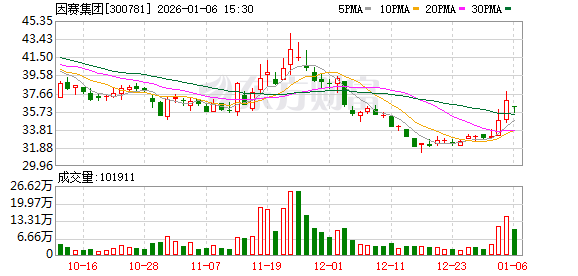
因赛集团推出集团级达人营销投放AI应用“智眸AI2.0”
Zheng Quan Ri Bao· 2026-01-06 10:20
Core Insights - The core viewpoint of the article is the launch of "Zhimou AI 2.0," an AI application for influencer marketing by InSai Group, aimed at transforming the influencer marketing ecosystem through a comprehensive intelligent marketing service capability [2]. Group 1: Product Launch - InSai Group's subsidiary companies, Beijing Yingxing Tianxia Cultural Communication Co., Ltd. and Guangzhou Youyi Digital Information Technology Co., Ltd., have jointly launched the "Zhimou AI 2.0" application [2]. - The application is designed to address the core pain points of influencer marketing teams by creating a full-link intelligent system that includes "selection, delivery, evaluation, and collaboration" [2]. Group 2: Features and Capabilities - Zhimou AI 2.0 features core capabilities in AI identification, AI delivery, AI evaluation, group-level collaboration, and technical architecture, which are tailored to match real work scenarios [2]. - The application has already begun serving brand clients in various industries, including beauty, fast-moving consumer goods (FMCG), and 3C [2]. Group 3: Industry Impact - The current phase of AI is becoming a fundamental basis for determining marketing efficiency [2]. - InSai Group aims to drive a paradigm shift in influencer marketing from an "experience-driven" approach to a "data-driven" model through the intelligent system built by Zhimou AI 2.0 [2].

达人营销的下半场:当知名 AI 公司的达人预算进入规模化,焦虑才真正开始
Founder Park· 2025-12-18 03:30
Core Insights - The article emphasizes the growing importance of influencer marketing as a key growth lever for AI companies, highlighting its advantage of authenticity compared to traditional advertising methods [1] - It points out the challenges of scaling influencer marketing, particularly the difficulty in maintaining control and consistency across different teams, which can directly impact product success and long-term business development [2][3] Group 1: Challenges in Influencer Marketing - Influencer marketing becomes challenging when scaled, as execution gaps between teams can lead to significant differences in outcomes [2] - The execution process is often bogged down by numerous non-standard tasks, such as initial outreach, contract negotiations, content review, and data tracking, which consume valuable strategic and creative resources [5][7] - Brands often face difficulties in finding suitable influencers due to factors like availability, content style, and pricing, leading to a lengthy negotiation process that can feel like a "trust-consuming battle" [5][7][8] Group 2: Solutions and Innovations - Aha offers a dual-sided platform that connects brands with creators, aiming to provide a scalable and manageable solution that surpasses traditional agency models [9][10] - The platform utilizes AI to automate many of the execution tasks, allowing human decision-makers to focus on strategic oversight while ensuring compliance and quality control [10][13] - Aha's system includes a one-price model that calculates optimal pricing for influencers based on various performance metrics, thus addressing the issue of price transparency [12] Group 3: Operational Efficiency and Data Management - Aha's platform allows brands to visualize and manage the entire influencer marketing process, enhancing control over execution timelines and decision-making [15][16] - Brands can track budget expenditures and content performance in real-time, significantly reducing the manual workload associated with data collection and analysis [19] - The platform's structured approach ensures that influencer marketing becomes a sustainable growth asset rather than a project reliant on individual expertise [21][30] Group 4: Market Adoption and Success Stories - Aha has successfully signed over 50,000 creators and served more than 300 enterprise clients, including top AI companies, demonstrating its effectiveness in the market [23][24] - Case studies, such as Manna, illustrate how Aha has transformed influencer marketing execution from a monthly cycle to as fast as three days, resulting in significant efficiency gains and successful campaigns [26] - The platform's growth is driven by a positive feedback loop where increased brand partnerships enhance creator engagement, leading to better matching efficiency and overall satisfaction [23][24]

深度|告别手工作坊,AI时代达人营销的底层逻辑彻底变了
Z Potentials· 2025-12-10 02:08
Core Insights - The article discusses the challenges faced by domestic AI teams in the "great sailing era" from 2024 to 2025, particularly focusing on growth strategies post-product-market fit (PMF) [1] - It emphasizes the shift from relying on simple marketing tactics to a more nuanced approach that involves influencer marketing and understanding user engagement [2][3] Group 1: Growth Strategies - The growth of companies in the early stages heavily relies on word-of-mouth and influencer marketing, with 90% of users coming from less than 10% of viral content [2][3] - Companies are encouraged to invest in identifying effective content and formats through extensive testing across platforms to replicate successful strategies [2][3] Group 2: Challenges in Influencer Marketing - The influencer marketing landscape is characterized by extreme information asymmetry, leading to high transaction costs and inefficiencies [6] - Companies face structural challenges when trying to collaborate with influencers in overseas markets, including difficulties in finding suitable partners and understanding their audience [7][8] Group 3: Pricing and Delivery Issues - Influencer marketing operates in a non-standardized market where pricing can vary significantly based on subjective factors, complicating negotiations [9] - Delivery timelines can be unpredictable due to factors like holidays and influencer availability, leading to risks in content production [10] Group 4: Technological Advancements - The emergence of advanced AI models enhances the ability to understand and judge influencer marketing effectiveness, moving beyond traditional recommendation algorithms [14][15] - Aha, a new platform, aims to streamline influencer marketing processes by utilizing AI to match brands with suitable influencers and automate pricing mechanisms [16][22] Group 5: Aha's Solutions - Aha's system redefines influencer matching by using AI to analyze content and audience fit, improving the efficiency of the selection process [20][28] - The platform also implements a dynamic pricing engine that calculates costs based on multiple factors, reducing reliance on subjective pricing [22][29] - Aha enhances collaboration efficiency by automating communication and contract processes, ensuring that brands can manage influencer relationships more effectively [27][31] Group 6: Future Outlook - The article concludes that the future of AI companies in overseas markets will depend on building a systematic approach to influencer marketing, transforming it into a predictable and calculable process [46] - Aha's advancements suggest a shift towards leveraging technology to free marketers from mundane tasks, allowing them to focus on strategic decision-making [47]

内容有了 , 流量有了 , 为什么汽车营销还不够?
Xin Lang Cai Jing· 2025-12-02 11:59
Core Insights - The automotive marketing landscape is evolving as the industry shifts from a "traffic dividend era" to a "certainty era," necessitating a more structured and quantifiable approach to influencer marketing [1][4][7] - The introduction of "Dongche Star Selection" aims to create a standardized, transparent, and quantifiable influencer marketing infrastructure for the automotive sector [1][4][12] Group 1: Industry Changes - Influencer-driven sales growth in the automotive sector has slowed, indicating a significant adjustment in the influencer economy, which is particularly urgent for automotive brands [3][9] - Unlike fast-moving consumer goods, automotive purchases require long-term engagement and multiple touchpoints, making it challenging to directly correlate influencer content with sales conversions [3][9] - Traditional "flat-rate" collaboration models are difficult to evaluate, relying heavily on superficial metrics like views and likes without identifying genuine purchase intent [3][9] Group 2: Platform Evolution - Platforms are transitioning from merely distributing traffic to building foundational "value infrastructure" that provides standardized tools and ensures data traceability [4][10] - "Dongche Star Selection" was launched to help brands identify genuine car-buying prospects and make influencer collaborations more data-driven and verifiable [4][10][11] Group 3: Content Production and Evaluation - The automotive influencer carnival represents a structural innovation in content production, allowing for a more efficient and cost-effective mechanism [5][12] - The carnival setup enables brands to provide resources and support, allowing influencers to focus on content creation rather than logistical coordination [5][12] - The introduction of the "Quality Content Ranking" shifts the evaluation focus from follower count to the number of new A3 users generated, emphasizing the importance of reaching potential car buyers [6][12][13] Group 4: Future Directions - The automotive marketing sector is moving towards a model that prioritizes professionalism, authenticity, and certainty, with influencers becoming reliable communicators between brands and consumers [7][13] - The industry is expected to increasingly focus on controllable advertising, content authenticity, and precise targeting as it matures [6][13]

从买量到“种心”:社交出海营销的战略升维
Sou Hu Cai Jing· 2025-10-15 02:52
Core Insights - The global social app market is facing stricter regulatory scrutiny, leading to a significant reduction in the number of active advertising social apps, which decreased by 12.43% year-on-year to 4,484 apps [2] - Despite the decrease in the number of apps, the average monthly material volume per advertiser surged by 47.37%, indicating a shift towards higher quality content to attract users and build brands [2] - Social apps must adapt to become "multi-talented," focusing on product quality and understanding diverse user needs while implementing localized marketing strategies [7][8] Market Trends - The social app market is entering a phase of stock competition, with fewer new entrants and existing players focusing on quality over quantity in advertising [2] - TikTok has emerged as a critical platform for social apps seeking explosive growth, with significant user engagement and high conversion potential among Gen Z users [10][11] - In North America, users show a high willingness to pay for dating apps, while Southeast Asia exhibits a strong trend towards video socializing and live streaming [8] Marketing Strategies - Successful social apps are leveraging high-quality content and influencer marketing to drive user engagement and brand awareness [16][17] - The use of data-driven creative optimization tools, such as TikTok One's Top Ads, allows brands to refine their marketing strategies based on historical performance metrics [13] - Influencer marketing is becoming a primary growth strategy for social apps, as traditional sharing models do not translate well in overseas markets [16] Content Creation - The shift from demand-driven to content-driven user acquisition is evident, with users increasingly relying on influencer recommendations before downloading social apps [22][23] - User-generated content (UGC) plays a crucial role in brand conversion, with TikTok's algorithm enabling ordinary users to gain visibility through viral content [25] - TikTok for Business offers solutions to help brands identify and utilize high-quality UGC, addressing challenges related to content authorization and deployment [25] Conclusion - The evolving landscape of social app marketing necessitates a focus on high-quality content and user engagement strategies to build brand loyalty and achieve sustainable growth [22][25]

现在投创作者,品牌怎样才不算亏?
Sou Hu Cai Jing· 2025-09-24 17:27
Core Insights - Influencer marketing has become essential for brands, but dissatisfaction among users, brands, and creators is rising due to declining effectiveness and trust issues [2][3] - The global influencer marketing market is projected to reach $32.55 billion by 2025, with a growth rate of 35.63%, indicating a shift towards more strategic approaches rather than just spending [2] Group 1: Trust and Strategy - The core issue of dissatisfaction stems from a lack of trust, with brands questioning the value of creators and users feeling overwhelmed by repetitive content [3] - Rebuilding trust involves selecting the right platforms, as different platforms have distinct ecosystems and user engagement dynamics [3][5] - Brands are increasingly shifting budgets towards WeChat's content ecosystem, which relies on social relationships rather than just algorithms [5] Group 2: Trust Currency System - The "trust currency" system is a tangible mechanism for building trust, focusing on finding the right creators rather than just high follower counts [6] - Content driven by genuine relationships is more effective, as different platforms have varying content distribution mechanisms that impact engagement [6][8] - Brands should leverage social networks for organic reach, as trust-based sharing can penetrate new audience segments [8] Group 3: Ecosystem and Measurement - Brands are moving towards a "pyramid" strategy in influencer marketing, combining top-tier, mid-tier, and mass creators, but face challenges in measuring the effectiveness of their investments [12][13] - The integration of various resources within ecosystems, such as WeChat, allows for diverse marketing strategies and better tracking of user engagement [13] - Tools like Tencent's advertising platform help brands understand the effectiveness of their spending, transforming influencer marketing from an art to a science [13] Group 4: Future of Influencer Marketing - The future competition in influencer marketing will focus on trust rather than sheer volume, emphasizing long-term value and understanding social relationships [14][15] - Brands that effectively utilize the trust-building potential of social networks are likely to gain a competitive edge in the evolving landscape of influencer marketing [14]


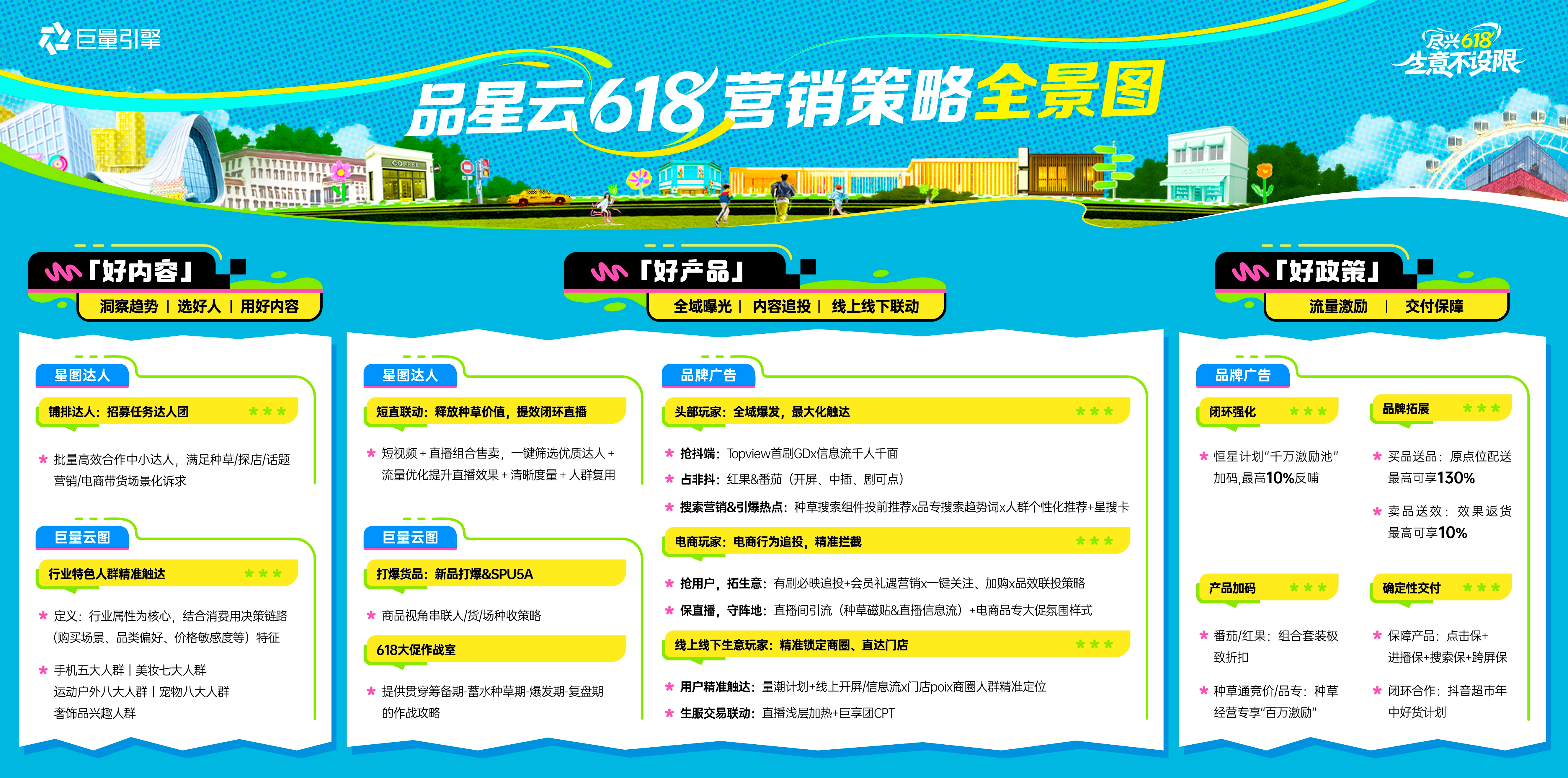
品牌必看!一文读透「品星云」618生意爆发秘籍
Cai Fu Zai Xian· 2025-05-22 01:16
Core Insights - The article emphasizes the importance of leveraging Douyin's ecosystem to drive brand growth during the upcoming 618 shopping festival through a comprehensive marketing strategy that integrates brand advertising, influencer marketing, and data insights [1][21]. Group 1: Marketing Strategy - The "品星云" marketing capability integrates brand advertising, 巨量星图, and 巨量云图 to enhance brand performance during the 618 event [1]. - Brand advertising focuses on "inventory preemption + exposure assurance" to create a reliable flow of traffic, ensuring brands can achieve both volume and sales growth [1][10]. - The "短直联动" feature connects short videos with Douyin's e-commerce live streams, significantly improving conversion rates by enhancing user engagement [8][9]. Group 2: Content and Consumer Insights - 巨量云图 provides deep consumer insights by identifying distinct consumer segments based on behavior and preferences, allowing brands to target their marketing efforts more effectively [3][15]. - The platform has upgraded its industry-specific consumer groups to help brands create and discover high-quality content that resonates with their target audience [3]. Group 3: Influencer Marketing - 巨量星图 enables brands to collaborate with a large number of mid-tier influencers efficiently, enhancing content creation and marketing effectiveness [5]. - The platform offers various influencer groups tailored to specific marketing needs, such as product reviews and promotional events, ensuring a comprehensive approach to influencer marketing [5]. Group 4: Policy and Incentives - The "品星云" initiative introduces a multi-faceted support system, including resource incentives and data empowerment, to help brands maximize their growth potential during the 618 event [17]. - Specific incentives include a "million incentive pool" for brand advertising, with potential rewards reaching up to 200,000 for individual clients, aimed at encouraging increased investment in advertising [17][19]. Group 5: Performance Tracking and Optimization - 巨量云图 offers a real-time operational dashboard for brands to monitor their performance throughout the different phases of the 618 event, allowing for targeted adjustments and strategy optimization [13][15]. - The platform's SPU5A capability tracks new product performance, providing insights into consumer engagement and sales effectiveness, thereby increasing the likelihood of successful product launches [15].
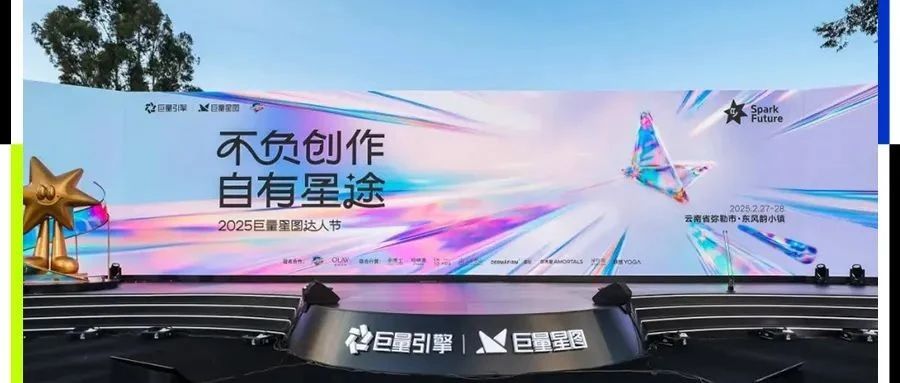
对话巨量星图卢旺达:好内容、好达人、好商单的标准是什么?
乱翻书· 2025-03-06 09:30
Core Viewpoint - The article discusses the evolution of influencer marketing, highlighting the shift from text-based content to video-based formats, particularly through platforms like Douyin, which has led to a new marketing model focused on influencer-driven sales and brand building [1][2]. Group 1: Evolution of Influencer Marketing - Influencer marketing began to take shape after 2010 with the rise of Weibo and WeChat, but was limited by the text-based format, which lacked personal branding and real influence [1]. - The emergence of Douyin introduced short video content, creating a new marketing path known as influencer marketing, which emphasizes conversion and brand building [1][2]. - Influencer marketing has shifted from mere exposure to a "planting grass" model, focusing on traffic conversion and return on investment (ROI) [1]. Group 2: Key Elements of Successful Influencer Marketing - Two key elements for effective influencer marketing are high-quality content and strong influencers, as highlighted during the 2025 Giant Star Map Influencer Festival [2]. - The Giant Star Map platform serves as an intelligent marketing and management tool for influencers, emphasizing the importance of content and creator economy [2]. Group 3: The Role of AI in Content Creation - AI is seen as a tool to enhance creator efficiency but cannot fully replace human creators, especially those with unique personal experiences and emotional resonance [4][5]. - Human creators possess unique creative abilities derived from personal experiences, which AI cannot replicate, particularly in content that evokes emotional responses [6]. Group 4: Content Direction for Influencers - Influencers face a dilemma between specializing in niche content or adopting a broader lifestyle approach, with a recommendation to focus on their strengths for better results [9][10]. - Successful influencers often find their niche and deepen their expertise, which enhances their commercial value and aligns with advertisers' target audiences [10]. Group 5: Innovative Content Examples - Influencer Zhu Tiexiong exemplifies content innovation in the national style transformation niche, producing high-quality, story-driven videos that resonate with audiences [13][14]. - Another influencer, Diandi Lihai, has created a unique content style that combines low-cost materials with high-fashion aesthetics, attracting significant brand partnerships [15]. Group 6: New Monetization Strategies - Influencers are exploring new monetization methods beyond traditional brand deals, such as live streaming and direct sales, which enhance their appeal to brands [16]. - The platform supports influencers in identifying suitable monetization strategies based on their content and audience characteristics [19]. Group 7: Evaluating Influencer Value - Influencer value is assessed based on three dimensions: content creation ability, commercial capability, and fulfillment ability, which help brands select effective partners [25][26]. - Good content is characterized by authenticity, engagement, and the ability to create trends, while good influencers possess strong creative, commercial, and delivery skills [24][23]. Group 8: Influencers in Trend Creation - Influencers play a significant role in creating trends and driving discussions, impacting not only product sales but also broader cultural phenomena [28][29]. - The platform's content insight tools allow influencers to capture and amplify emerging trends, enhancing their visibility and engagement [29]. Group 9: The Impact of Short Videos and New Content Formats - Short videos and new content formats like short dramas are rapidly growing, providing influencers with opportunities to engage audiences and monetize effectively [31]. - The platform facilitates collaborations between brands and influencers to create tailored short dramas that align with marketing goals [31]. Group 10: Future Directions for Influencer Marketing - The influencer marketing market is expected to continue growing, with the platform aiming to innovate monetization models and enhance content quality [44][45]. - The focus will be on optimizing brand partnerships to ensure that high-quality content leads to better business outcomes for both influencers and brands [45].