
通胀与降息预期

Search documents
黄金价格异动下跌,多重因素共振影响
Sou Hu Cai Jing· 2026-02-25 22:34
Core Viewpoint - Gold prices experienced significant fluctuations in late February 2026, primarily influenced by multiple factors including investor behavior and Federal Reserve policies [1] Market Data - As of February 25, COMEX gold futures closed at $5,192.4 per ounce, reflecting a 0.31% increase from the previous day, although it dipped to $5,135.9 during intraday trading, indicating notable volatility [1] - Despite ongoing tensions in the Middle East, gold's response to geopolitical events has diminished, with some investors opting for the dollar as a safe haven, reducing gold's short-term appeal [1] Industry Policy and Environment - The Shanghai Gold Exchange adjusted margin ratios and price limits for certain contracts on February 24 to address market volatility, which may influence short-term trading behavior [1] - Goldman Sachs noted an increase in demand for call options on gold from the private sector, which has raised volatility and temporarily suppressed central bank gold purchases, although this slowdown is expected to be short-lived [1]
每日核心期货品种分析-20260114
Guan Tong Qi Huo· 2026-01-14 11:12
Report Overview - Report Title: Daily Core Futures Variety Analysis - Release Date: January 14, 2026 1. Market Performance Summary 1.1 Futures Market Overview - As of the close on January 14, domestic futures main contracts showed mixed results. Shanghai Tin rose 8%, Shanghai Silver rose over 8%, Fuel Oil rose over 6%, and Platinum rose over 3%. Low-Sulfur Fuel Oil (LU) and Pure Benzene rose over 2%. In terms of declines, Lithium Carbonate fell over 3%, Caustic Soda fell over 2%, and Glass, Polysilicon, Coking Coal, and Rapeseed Meal fell over 1% [6]. - Among stock index futures, the CSI 300 Index Futures (IF) main contract fell 0.29%, the SSE 50 Index Futures (IH) main contract fell 0.62%, the CSI 500 Index Futures (IC) main contract rose 0.94%, and the CSI 1000 Index Futures (IM) main contract rose 0.09%. Among treasury bond futures, the 2-year Treasury Bond Futures (TS) main contract remained flat, the 5-year Treasury Bond Futures (TF) main contract rose 0.03%, the 10-year Treasury Bond Futures (T) main contract rose 0.08%, and the 30-year Treasury Bond Futures (TL) main contract fell 0.04% [7]. 1.2 Capital Flow - As of 15:18 on January 14, in terms of capital inflows into domestic futures main contracts, Shanghai Silver 2604 had an inflow of 4.395 billion yuan, CSI 2603 had an inflow of 4.248 billion yuan, and Shanghai and Shenzhen 2603 had an inflow of 3.545 billion yuan. In terms of outflows, Lithium Carbonate 2605 had an outflow of 785 million yuan, Shanghai Gold 2602 had an outflow of 578 million yuan, and Alumina 2605 had an outflow of 316 million yuan [7]. 2. Market Analysis of Key Varieties 2.1 Shanghai Copper - Shanghai Copper opened high and moved higher, rising during the day. The US inflation data in December increased market expectations of an interest rate cut in April. In terms of supply, copper smelters are facing profit challenges, and refined copper production is expected to decline in January. The merger negotiation between Rio Tinto and Glencore may tighten the copper supply. In terms of demand, terminal demand is growing strongly, but the copper product sector is cautious, and copper inventories have increased significantly. The market is worried about the US refining copper tariff, which supports the copper price [9]. 2.2 Lithium Carbonate - Lithium Carbonate opened high and then declined during the day. In December 2025, production increased, and inventory started to accumulate. The demand for energy storage batteries remains strong, but the export tax rebate policy adjustment and the exchange's trading policy adjustment have affected the market. Despite the downward movement in the short term, the overall sentiment is still bullish, with the risk of CATL resuming production [11]. 2.3 Crude Oil - OPEC+ decided to maintain the production plan in February and March 2026. The US crude oil inventory decreased more than expected, but the refined oil inventory increased. The market is still worried about demand, and the global crude oil market is in a state of oversupply. The situation in Iran and Venezuela may affect the supply, and the oil price is expected to fluctuate [12][13]. 2.4 Asphalt - The asphalt production rate decreased last week, and the expected production in January 2026 also decreased. The downstream demand is weak in the north and average in the south. The situation in Venezuela may affect the raw material supply and production cost of domestic asphalt. It is recommended to focus on the raw material shortage of domestic refineries and consider reverse arbitrage [14][16]. 2.5 PP - The downstream start - up rate of PP is at a low level, and the enterprise start - up rate is at a medium - low level. The cost is affected by the international situation, and the supply is increasing with new capacity. The downstream is in the off - season, and the demand is weak. The upward space of PP is expected to be limited, and the L - PP spread is expected to narrow [17]. 2.6 Plastic - The plastic start - up rate has increased, and the downstream start - up rate is at a low level. The cost is affected by the international situation, and new capacity has been put into production. The downstream demand is weakening, and the upward space is limited. The L - PP spread is expected to narrow [18][19]. 2.7 PVC - The PVC start - up rate is increasing, but the downstream demand is weak, and the export is average. The social inventory is high, and the real estate market is still in the adjustment stage. With the cancellation of export tax rebates, the 03 - 05 contracts are expected to fluctuate strongly [20]. 2.8 Coking Coal - Coking Coal opened low and then adjusted downward nearly 2% during the day. The supply of imported coal decreased, while domestic production increased. Coking enterprises and steel mills are replenishing inventory. Despite the short - term adjustment, Coking Coal is expected to remain strong in the long term [22]. 2.9 Urea - Urea opened low and rose over 2% during the day. The daily production has increased, and the inventory has decreased. The agricultural demand is increasing, but the industrial demand is weakening due to the approaching Spring Festival. The short - term strength of urea is expected to be difficult to sustain, and it will be adjusted at a high level [23].
财经随笔记:黄金新高后回落,关注震荡破位情况(2026.1.14)
Sou Hu Cai Jing· 2026-01-14 00:49
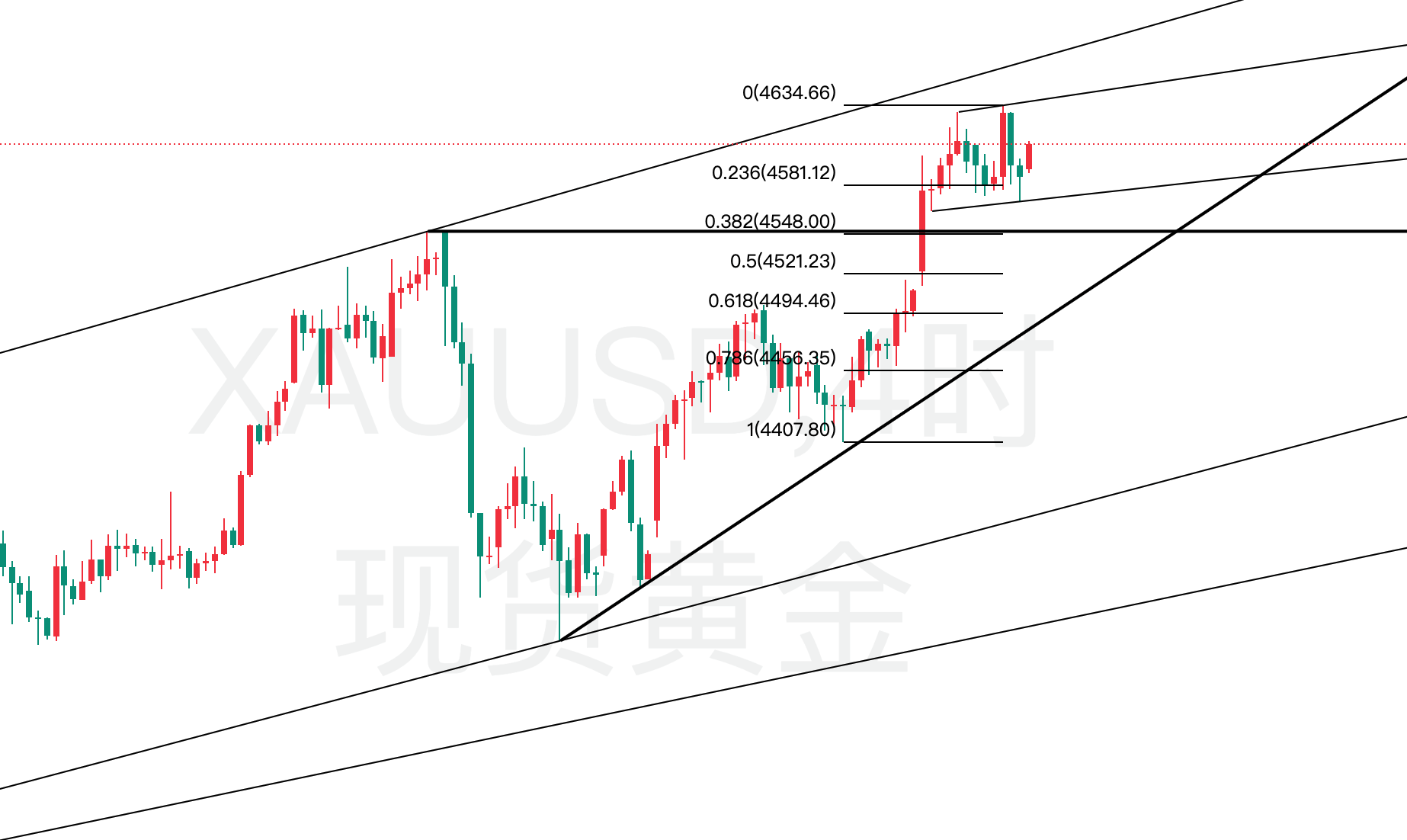
Core Viewpoint - The gold market experienced fluctuations with a slight opening increase, reaching a high of 4634/4635 before retreating, indicating a potential short-term correction while maintaining a long-term optimistic outlook due to factors like interest rate cuts and geopolitical tensions [1][2][3]. Fundamental Analysis - Inflation and Interest Rate Expectations: The US December CPI and core CPI data were lower than expected, reinforcing market bets on two interest rate cuts by the Federal Reserve in 2026. However, the lower inflation also suggests economic cooling, which diminishes gold's appeal as an inflation hedge, leading to profit-taking [2]. - Geopolitical Support: Tensions from the Trump administration's investigation into the Federal Reserve's independence and threats of tariffs on Iran's trade partners have heightened demand for safe-haven assets, providing underlying support for gold prices despite the strength of the dollar [2]. Key Focus for Today - The US Supreme Court will rule on the legality of Trump's tariffs, and several economic indicators, including retail sales and PPI data, will be released. These factors are expected to influence the dollar's movement and gold price volatility [3]. - Overall, while gold faces short-term correction pressure, long-term factors such as the interest rate cycle and geopolitical dynamics support its status as a safe-haven asset, with a positive outlook for 2026 [3]. Technical Analysis - Daily Level: Gold's price action on Tuesday ended with a bearish candle after a series of gains, indicating a potential pause in the upward trend. The 5-day moving average at 4550 is crucial for support; a drop below this level could signal further correction risks [4]. - Four-Hour Level: The price structure remains focused on the upward channel formed since 4274, with key support at 4570 and resistance between 4636-4640. A breakout above these levels could lead to further upward movement, while a drop below 4550 would necessitate caution regarding support levels [6]. Summary of Resistance and Support Levels - Resistance levels to watch: 4635/4640, 4662, and 4689/4690 [6]. - Support levels to monitor: 4570, 4550, 4521, and 4500/4494 [6].

铜冠金源期货商品日报-20250613
Tong Guan Jin Yuan Qi Huo· 2025-06-13 03:05
1. Report Industry Investment Rating No relevant content provided. 2. Core Views of the Report - Overseas, the weakening of US high - frequency employment data and the intensification of the Middle - East geopolitical situation have increased market risk - aversion and expectations of interest rate cuts. Domestically, the A - share market is in a sideways shock, and attention should be paid to the release of May financial and economic data [2][3]. - Precious metals are boosted by factors such as the decline in US inflation and geopolitical risks. Gold is expected to maintain a high - volatility trend, while silver may have short - term profit - taking pressure but its catch - up rally is still worth expecting [4][5]. - The copper price is expected to fall from a high and enter an adjustment phase due to trade policy disturbances, although supply - side tightness can support the medium - term price [6][7]. - The aluminum price is in a favorable pattern due to factors such as the slowdown of inflation, the decline of inventory to a low level, and the weakening of the US dollar index [8][9]. - The alumina price is in a short - term stalemate and shows an oscillating trend. Attention should be paid to the realization of supply increments and cost support [10][11]. - The zinc price is in a weak operation, with the decline trend slowed down due to inventory reduction, but the fundamental weak pattern remains unchanged [12]. - The lead price is oscillating strongly in the short term, with support from supply restrictions and pressure from inventory accumulation and weak consumption [13]. - The tin price is expected to maintain an oscillating and convergent trend, and attention should be paid to inventory data [14]. - The industrial silicon price is expected to continue its low - level weak oscillation as the industry enters the off - season and social inventory rises slightly [15][16]. - The lithium carbonate price may reach a new low in the near future, but the movement of in - market funds needs to be observed [17][18]. - The nickel price is oscillating at a low level, with no significant new drivers in the short term [19][20]. - The oil price is oscillating, and if the sixth round of US - Iran talks releases a mild signal, the oil price may fall from a high [21]. - The steel price is expected to oscillate weakly due to the weak supply - demand situation [22]. - The iron ore price is expected to be under pressure as the spot market is weak and port inventory increases [23][24]. - The soybean meal and rapeseed meal prices may oscillate strongly in the short term, but attention should be paid to stage adjustments [25][26]. - The palm oil price may oscillate in the short term, supported by factors such as the increase in India's import volume [27][28]. 3. Summary According to Relevant Catalogs 3.1 Metal Main Variety Trading Data - The closing prices, price changes, price change percentages, trading volumes, and open interests of various metal futures contracts such as copper, aluminum, zinc, etc. are presented, including both domestic (SHFE) and international (LME) markets [29]. 3.2 Industrial Data Perspective - For copper, data such as the closing prices of SHFE and LME copper, warehouse receipts, inventory, spot quotes, and price spreads are provided and compared between June 12 and June 11 [30]. - Similar data for nickel, zinc, lead, aluminum, alumina, tin, precious metals, steel, iron ore, coke, coking coal, lithium carbonate, industrial silicon, and soybean and rapeseed meal are also presented and compared for different time points [30][31][32][33][34][35][36][37].