
长期耐心资本

Search documents
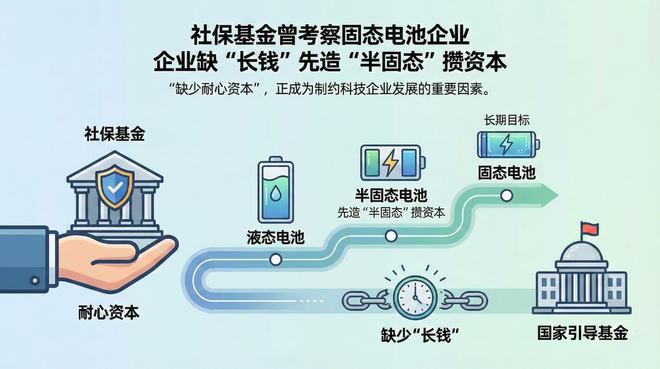
社保基金曾考察固态电池 企业因缺“长钱”先造“半固态”攒资本
Zhong Guo Jing Ying Bao· 2025-12-29 10:02
Core Viewpoint - The lack of patient capital is becoming a significant constraint on the development of technology companies, particularly in the context of critical stages of technological research and development [2] Group 1: Industry Challenges - Technology companies are more concerned about the premature exit of short-term capital than the technology itself during critical R&D phases, which can lead to funding chain disruptions and wasted investments [2] - The commercialization of solid-state batteries requires a systematic restructuring of the entire industry chain and ecosystem, which may take ten to twenty years to achieve [2][3] - Companies fear that investors may demand early exits before solid-state batteries are fully developed, jeopardizing their survival [2] Group 2: Market Strategy - To navigate these challenges, companies are opting for a "detour" strategy by initially entering the market with semi-solid batteries, which have higher technological maturity and lower requirements for existing production lines [3] - This approach allows companies to maintain market competitiveness, accumulate cash flow, and strengthen capital before fully advancing into the solid-state battery sector [3] Group 3: Capital Landscape - The lack of patient capital is a common issue faced by many Chinese technology companies, with long-term and stable capital primarily coming from pension funds and long-term life insurance funds [3] - In the primary market, both venture capital (VC) and private equity (PE) investments often require long cycles from project incubation to eventual exit, with some projects taking over ten years [4] - The current investment structure of many institutions struggles to support such lengthy investment cycles [4] Group 4: Policy Developments - The situation is expected to improve with the launch of the National Venture Capital Guidance Fund, which aims to mobilize social capital and provide stable funding for technology companies [4] - The fund will have a twenty-year lifespan, with ten years allocated for investment and another ten for exit, designed to offer more sustainable financial support for technology innovation [4]

刘世锦等:扩消费、强社保、稳股市协同改革的思路与举措
Xin Lang Cai Jing· 2025-12-19 10:13
Core Viewpoint - China's economy is transitioning from an investment and export-driven model to one focused on innovation and consumption, with structural challenges in consumption that need to be addressed to support stable medium-speed growth [3][48]. Group 1: Economic Recovery and Consumption Challenges - The post-pandemic recovery of China's economy has shown signs of improvement, but it faces pressure from insufficient demand, primarily due to low consumption rather than low investment [4][49]. - Key issues in consumption include a lack of service consumption, particularly in education, healthcare, housing, and social security, with rural residents, especially migrant workers, facing the largest consumption gaps [4][5][49]. - The long-standing urban-rural dual structure is a significant barrier, necessitating structural reforms centered on people and equitable development rights [4][5]. Group 2: Structural Consumption Deficiencies - China's consumption rate is significantly lower than the global average, with final consumption and household consumption as percentages of GDP at 54.1% and 38.3%, respectively, both below global averages by 17.7 and 16.6 percentage points [8][11]. - The low consumption rate is attributed to insufficient growth in service consumption, which is critical for addressing structural deficiencies in the economy [11][12]. Group 3: Income Disparities and Savings Rates - High savings rates in China, which are above the average for middle and high-income countries, are linked to low consumption levels, with a savings rate of 46% and total savings of approximately 55.2 trillion yuan [12][14]. - The disparity in income distribution, particularly the low dividends received by residents from enterprises, contributes to high savings and low consumption [13][14]. Group 4: Pension System and Consumption Potential - The pension system in China has significant gaps, with the average pension for rural residents being only 222 yuan per month, which is insufficient to meet basic living standards [17][21]. - The low pension levels directly affect the consumption capacity of approximately 1.7 billion pensioners and indirectly impact the consumption expectations of 3.7 billion contributors to the pension system [21][22]. Group 5: Proposed Reforms and Expected Outcomes - A proposed reform involves reallocating state-owned capital to enhance the pension fund, aiming to raise the average pension for rural residents to 1,000 yuan per month within five years, which is expected to stimulate consumption and economic growth [36][37]. - The reform is anticipated to create a significant increase in pension income, potentially adding 5.2 trillion yuan to pension income and generating an additional 8.3 trillion yuan in demand, contributing to GDP growth by 0.3 to 0.5 percentage points annually [43][44].

中信证券首席经济学家明明:今年资本市场估值在抬升,背后是长期耐心资本的投入
Bei Jing Shang Bao· 2025-12-18 08:18
Core Viewpoint - The capital market valuation is on the rise this year, driven by the investment of long-term patient capital [1] Group 1: Market Reforms - A series of reform measures in the capital market have positively impacted investor returns and market ecosystem development [1] - The focus has shifted to balancing both financing and investment functions in the capital market, rather than solely emphasizing financing [1] Group 2: Long-term Capital Inflow - Regulatory guidance is encouraging long-term funds, such as insurance capital, to enter the capital market [1] - The increase in capital market valuation is attributed to the influx of long-term patient capital [1]

如何发展长期耐心资本?专家热议资产型养老金体系建立
Mei Ri Jing Ji Xin Wen· 2025-12-06 11:03
Core Viewpoint - The development of pension and long-term insurance is crucial for addressing aging population challenges in China, leveraging financial investments to enhance both returns and services for the elderly [1][3]. Group 1: Pension and Long-term Insurance Development - The financial system in China is large and well-funded but lacks sufficient capital, making pensions and long-term insurance the only true long-term patient capital [1]. - There is a significant gap between China's pension asset scale and its GDP ratio compared to Western countries, necessitating a focus on expanding pension assets and establishing an asset-based pension system [3]. - The development of pension wealth management should adopt a long-term perspective, prioritizing value acquisition over short-term financial returns [3]. Group 2: Challenges and Solutions in Pension Coverage - The narrow coverage of enterprise annuities is attributed to high basic social insurance contribution rates, which primarily involve state-owned enterprises, leaving private and small enterprises underrepresented [4]. - High establishment thresholds, management costs, and inconvenient investment options hinder the attractiveness of enterprise annuities, suggesting a need for reforms such as lowering contribution burdens and promoting collective annuity plans for small businesses [4]. - The balance between government tax incentives and future financial burdens is essential for developing the second and third pillars of pension finance [3].
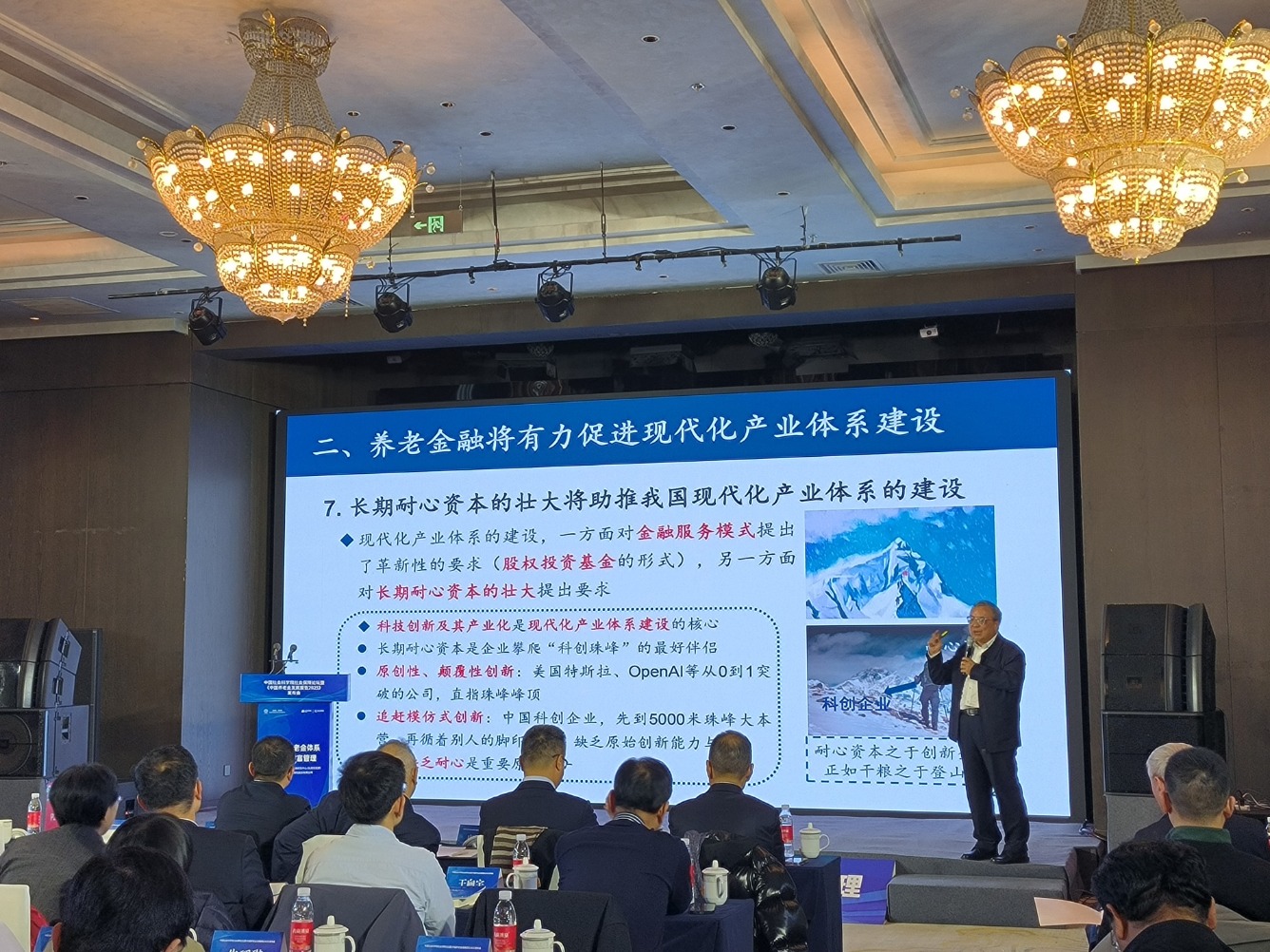
陈文辉:养老金积累主要靠投资,将有力推进现代化产业体系建设
Xin Lang Cai Jing· 2025-11-14 08:46
Core Viewpoint - The accumulation of pension funds relies heavily on investment, which will significantly advance the construction of a modern industrial system [1] Group 1: Pension Fund and Investment - The growth of long-term patient capital is crucial for the development of the modern industrial system [1] - Patient capital will positively impact the development of the entire science and technology innovation industry and enhance pension funds [1] Group 2: Financial Tools and Sustainable Development - It is essential to leverage various financial tools to achieve sustainable development in pension finance [1] - Promoting the development of the science and technology innovation industry is a vital pathway for financial functions [1] - The sustainability of the financial industry is linked to the successful commercialization of science and technology, which also provides significant returns [1] Group 3: Equity Investment Funds - Among various financial tools, equity investment funds are the most significant for the commercialization of science and technology, despite their smaller scale [1]
中金张一鸣:畅通科技—产业—金融循环,培育新质生产力永续动力
2 1 Shi Ji Jing Ji Bao Dao· 2025-11-12 07:48
Core Viewpoint - The integration of technology, industry, and finance is essential for technology companies to grow, generate solid profits, and maintain stable cash flows, attracting long-term patient capital [1] Group 1: Technology and Industry Integration - Connecting technology, industry, and finance can help technology companies become stronger and more profitable [1] - Long-term patient capital is crucial for the growth of technology firms, as it focuses on sustainable returns [1] Group 2: Market Dynamics - A market filled with long-term patient capital can reduce volatility caused by short-term speculation, leading to a stable environment conducive to innovation [1] - The capital market can continuously empower the long-term development of the country's new productive forces, providing ongoing momentum [1]