险资权益投资

Search documents
险资权益投资进入加速期,去年股票、基金投资余额大增1.6万亿元
Xin Lang Cai Jing· 2026-02-24 11:17
Core Viewpoint - The pace of insurance capital allocation in the capital market has significantly accelerated, with a notable increase in equity asset allocation driven by both yield pressure and policy guidance [1][10][12]. Group 1: Insurance Capital Allocation Trends - By the end of 2025, the balance of insurance capital utilization is expected to reach approximately 38.5 trillion yuan, a year-on-year increase of 15.7%, marking a high growth rate in recent years [1][8]. - The combined balance of investments in stocks and securities investment funds is about 5.7 trillion yuan, an increase of approximately 1.6 trillion yuan year-on-year, with a growth rate close to 40% [1][8]. - The weight of equity assets in the insurance capital allocation system is continuously increasing, with stock investments around 3.7 trillion yuan, accounting for nearly 10% of total capital utilization [1][8]. Group 2: Factors Driving Changes in Allocation - The traditional dominance of bond assets, which currently account for over half of total investment assets, is facing challenges due to declining interest rates and compressed returns on fixed-income assets [12][13]. - Policy improvements in regulations regarding equity investments have provided greater allocation space for insurance capital, reducing the impact of short-term market fluctuations on institutional investment behavior [12][13]. - The recovery of the capital market in 2025, with significant increases in major stock indices, has enhanced the willingness to allocate to equity assets [12][13]. Group 3: Market Impact and Future Outlook - The current trend of insurance capital entering the market reflects a shift towards long-term investment characteristics, favoring high-dividend, low-volatility, and stable cash flow assets [14]. - The continuous influx of insurance capital is expected to enhance market liquidity and stability, guiding a transition from a "policy-driven" market to a "market-driven" one [14]. - Forecasts indicate that new equity investments from insurance capital in 2026 are likely to remain in the trillion-yuan range, with estimates from various securities firms suggesting additions between 0.9 trillion and 1.18 trillion yuan [15].


险资巨头积极参与港股IPO“普遍实现浮盈” ,有望提升行业盈利预期
Sou Hu Cai Jing· 2026-01-30 00:55
Group 1 - In early 2026, four insurance companies participated as cornerstone investors in eight Hong Kong IPOs, indicating strong interest in equity investments [1] - Since 2025, seven insurance institutions have participated in 20 Hong Kong IPOs as cornerstone investors, with a total subscription amount of 4.679 billion HKD, and these investors have generally achieved floating profits [1] Group 2 - The enthusiasm of insurance capital in equity investments is significantly supported by policy easing, including a directive from the State Council in March 2025 to enhance long-term investment forces [2] - In April 2025, the National Financial Regulatory Administration raised the upper limit for equity asset allocation to 50% of total assets and simplified regulatory tiers, promoting a "support the strong, limit the weak" approach [2] - A long-cycle assessment mechanism introduced by the Ministry of Finance in July 2025 aims to reduce the impact of short-term market fluctuations on performance evaluations, encouraging long-term holdings [2] - It is projected that in 2026, insurance capital's equity investments will shift from "valuation-driven" to "profit-driven," with expectations of comprehensive improvements on both asset and liability sides [2] - Central enterprise insurance companies are expected to allocate 30% to 40% of new premiums to A-shares, potentially exceeding 250 billion CNY in incremental funds, which may boost profit growth expectations for insurance companies [2] - The current valuation of the insurance sector in the A-share market is relatively low, benefiting from profit recovery and increased equity allocation, indicating potential for valuation recovery [2]
2026险资寻“牛”记权益策略将更趋精细化
Zhong Guo Zheng Quan Bao· 2026-01-04 20:07
Core Insights - The insurance capital market has seen significant activity in 2025, with the highest number of stake acquisitions in a decade and a substantial increase in investments in dividend assets, making insurance capital a key shareholder in many popular tech stocks [1] - In 2026, insurance capital is expected to adopt a more cautious and refined investment strategy, shifting from a focus on overall market elasticity to selecting individual stocks and sectors for excess returns [1][3] - The core variables driving increased equity investment by insurance capital include the macro interest rate environment, policy guidance, and liability-side demand, which are anticipated to continue catalyzing the allocation towards equity assets [2][3] Investment Strategy Adjustments - The investment strategy for 2026 will be more prudent and precise, adapting to the market's transition from valuation-driven to profit-driven dynamics, with a focus on high-dividend assets as a stabilizing factor [3][4] - The dynamic adjustment of equity positions will become more flexible and refined, with an emphasis on structural optimization and close monitoring of market liquidity and corporate profit recovery [4] - The overall strategy for equity investments will prioritize cash flow stability, dividend reliability, and visible profitability, while trading strategies will focus on sectors with rapid profit realization potential [3][4] Key Investment Themes - Insurance capital is expected to focus on investment opportunities arising from China's economic transformation and upgrading, particularly in sectors with genuine technological barriers and clear business models [4][6] - Six major investment themes have been identified: artificial intelligence, "anti-involution" policies, high-value exports, cyclical domestic demand, energy and commodities, and the trend of renminbi appreciation [6] - The emphasis will be on sectors such as AI, advanced manufacturing, and industries with high growth potential, including robotics, quantum computing, and innovative pharmaceuticals [5][6]
质效双升 监管精准发力下行业加速重塑——保险业2025年盘点
Xin Hua Cai Jing· 2025-12-31 07:12
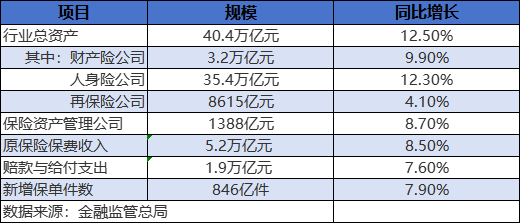
Core Viewpoint - In 2025, China's insurance industry is expected to show a development trend characterized by "steady growth in scale, optimization of structure, controllable risks, and upgraded services" driven by regulatory guidance, policy empowerment, and industry transformation [1] Group 1: Industry Growth and Financial Performance - As of the end of Q3 2025, the total assets of the insurance industry reached 40.4 trillion yuan, an increase of 4.5 trillion yuan or 12.5% from the beginning of the year [2] - The insurance companies' premium income for the first three quarters of 2025 was 5.2 trillion yuan, representing a year-on-year growth of 8.5% [3] - The net profit of five listed insurance companies in A-shares reached 561.88 billion yuan, with an average net profit of 93.65 billion yuan [4] Group 2: Solvency and Risk Management - The comprehensive solvency adequacy ratio of the insurance industry was 186.3% and the core solvency adequacy ratio was 134.3% as of the end of Q3 2025 [3][4] - The solvency ratios for property insurance companies, life insurance companies, and reinsurance companies were 240.8%, 175.5%, and 246.2% respectively [4] Group 3: Policy Developments and Strategic Shifts - In 2025, a series of policies were introduced to enhance the investment of insurance funds in equity markets and improve risk management [6][10] - The policies included adjustments to the regulatory ratios for equity assets, aimed at increasing the allocation of insurance funds to support the capital market and the real economy [8][9] - The industry is shifting from a focus on scale and interest margin to value and management-driven growth [10]
鼓励长期持有 险资权益投资再“松绑”
Jing Ji Guan Cha Wang· 2025-12-06 09:08
Core Viewpoint - The National Financial Regulatory Administration has relaxed regulations on insurance funds' investments in the stock market by lowering risk factors for certain stocks, aiming to support long-term capital and technological innovation [2]. Group 1: Regulatory Changes - The new notification adjusts risk factors for insurance companies investing in stocks, specifically for the CSI 300 index, the CSI Dividend Low Volatility 100 index, and stocks listed on the Sci-Tech Innovation Board [2]. - Risk factors for stocks held over three years in the CSI 300 and CSI Dividend Low Volatility 100 indices have been reduced from 0.30 to 0.27, while those for Sci-Tech Innovation Board stocks held over two years have decreased from 0.40 to 0.36 [2][3]. Group 2: Impact on Capital Efficiency - Lower risk factors will reduce the capital required for insurance companies to cover potential losses, thereby improving capital utilization efficiency [2]. - As of the end of Q3 2025, the total balance of insurance funds reached 37.5 trillion yuan, reflecting a 12.6% increase since the beginning of the year, marking three consecutive years of double-digit growth [3][4]. Group 3: Market Trends - The allocation of insurance funds to equity assets has been increasing, with a total of 5.59 trillion yuan invested in stocks and securities investment funds, accounting for 14.92% of the total insurance fund balance, nearing the significant 15% mark [4]. - The rise in equity asset allocation is influenced by favorable long-term policies and the recent bullish trend in the A-share market, which has increased the fair value of equity assets [5]. Group 4: Investment Activity - The preference for equity assets is also reflected in the growing number of stake acquisitions by insurance funds, with 31 instances reported this year [6].

邮政系三大金融机构同台亮相,核心管理层发声!
券商中国· 2025-12-03 15:13
Core Viewpoints - The 2026 Postal Financial Forum highlighted the importance of risk awareness and effective credit supply in the banking sector, emphasizing the need for banks to combine risk assessment with opportunity recognition [1][3][4] - Insurance funds are evolving into more strategic players in the capital market, focusing on long-term investments and aligning with national strategies [10][11] - The Chinese equity market is expected to enter a long-term structural bull market by 2026, driven by improving corporate profits and strategic investment themes [12][13] Banking Sector Insights - Liu Jianjun, President of Postal Savings Bank, emphasized the need for banks to cultivate a "future-oriented" risk perspective to enhance credit availability, especially in a low-interest-rate environment [3][4] - Eight strategies were proposed to address challenges in the banking sector, including long-termism, capability building, digital transformation, and risk management [4][5][6][7][8][9] Insurance Sector Developments - Han Guangyue, Chairman of China Postal Life Insurance, noted that insurance funds are now prioritizing asset-liability matching and capital efficiency, moving towards lower-risk, high-capital efficiency assets [10][11] - The focus of insurance investments has shifted from cyclical hotspots to sectors like high dividends, technological innovation, and infrastructure, aligning with long-term investment strategies [11] Market Outlook - Huang Fusheng, Chief Economist of China Postal Securities, predicted a structural bull market for Chinese equities starting in 2026, with key investment themes including innovative pharmaceuticals and technology [12] - The bond market is expected to stabilize, with limited room for interest rate cuts, while commodity prices are anticipated to rise due to global economic recovery and supply constraints [13] - Concerns regarding AI stock bubbles were addressed, indicating that current valuations are manageable compared to historical peaks, with increased competition in the tech sector helping to mitigate risks [14]


险资“买买买”模式升级股票和基金持仓再创新高
Zheng Quan Shi Bao· 2025-11-16 23:14
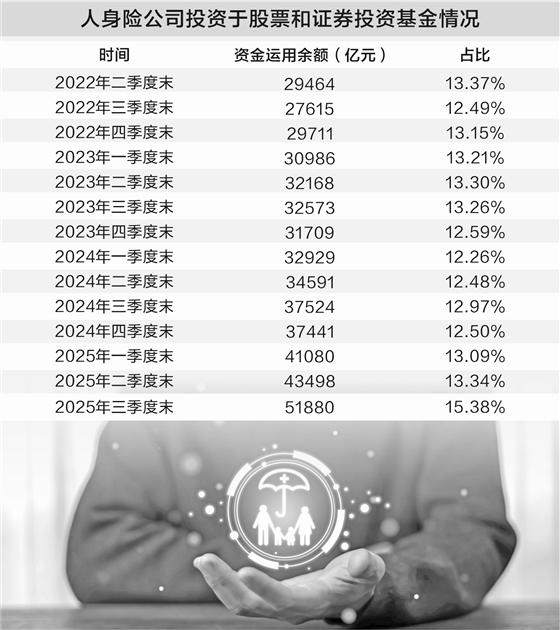
Core Insights - The investment balance of life insurance companies in stocks and securities investment funds reached a record high, with a total of 5.59 trillion yuan, accounting for 14.92% of the total investment balance of insurance companies as of the end of Q3 2023, marking a significant increase since the data was first disclosed in 2022 [3][5]. Group 1: Investment Trends - The proportion of investments in stocks and securities investment funds by insurance companies has surpassed the 14% mark for the first time, indicating a strategic shift towards equity investments [4][5]. - As of Q3 2023, the total investment balance of insurance companies exceeded 37 trillion yuan, reflecting a year-on-year growth of 16.5% [4]. - The investment balance in stocks and securities by life insurance companies reached approximately 5.19 trillion yuan, representing 15.38% of their total investment balance, an increase of 2.04 percentage points from the previous quarter [5]. Group 2: Market Activity - Insurance companies have significantly increased their equity investment activities, with 31 instances of shareholding increases recorded in 2023, surpassing previous highs [6]. - The performance of insurance companies has improved due to rising capital market conditions, with several companies reporting record profits for the first three quarters of the year [6]. Group 3: Asset Allocation - The investment balance in bonds by life and property insurance companies reached 18.18 trillion yuan, maintaining the highest share among various investment types, although the proportion slightly decreased to 48.52% [7]. - The allocation to bank deposits has continued to decline, with life and property insurance companies holding 7.37% and 15.67% of their investment balance in bank deposits, respectively [8].
险资“买买买”模式升级 股票和基金持仓再创新高
Zheng Quan Shi Bao· 2025-11-16 22:24
Core Insights - The balance of investments in stocks and securities investment funds by insurance companies has reached a record high, with a total of 5.59 trillion yuan, accounting for 14.92% of the total investment balance, nearing the significant 15% threshold [1][2][3] Investment Trends - The proportion of investments in stocks and securities investment funds has surpassed the previous range of 11% to 14%, indicating a strategic shift in equity investment strategies by insurance capital [2][3] - As of the end of Q3, the total investment balance of insurance companies exceeded 37 trillion yuan, marking a year-on-year growth of 16.5% [2] - The investment balance in stocks and securities investment funds increased by 35.92% compared to the same period in 2024, with a quarterly increase of over 800 billion yuan [2][3] Company-Specific Investments - By the end of Q3, the investment balance in stocks and securities investment funds for life insurance companies was approximately 5.19 trillion yuan, representing 15.38% of their total investment balance, while property insurance companies had 405 billion yuan, accounting for 16.97% [3] - The enthusiasm for equity investments among insurance companies has surged this year, driven by low interest rates and new accounting standards, prompting a reallocation of assets [3] Increased Equity Investment Activity - Insurance capital has entered a "buying mode," with a record 31 instances of equity stakes taken this year, surpassing previous highs [4] - Notable recent investments include purchases by Changcheng Life and China Ping An, indicating ongoing aggressive positioning in the equity market [4] Performance and Returns - The recovery of the capital market has significantly boosted investment returns for insurance companies, contributing to record-high profits for several firms [4] - For instance, China Life reported a net profit of 167.8 billion yuan for the first three quarters, a 60.5% increase year-on-year, with total investment income reaching 368.6 billion yuan, up 41% from the previous year [4] Bond Investment Trends - The balance of investments in bonds remains the largest among all investment types, totaling 18.18 trillion yuan, although the proportion has slightly decreased to 48.52% [6] - Life insurance companies have a bond investment balance of 17.21 trillion yuan, with a proportion of 51.02%, while property insurance companies have 969.9 billion yuan, with a proportion of 40.62% [6] Bank Deposits - The proportion of investments in bank deposits for life and property insurance companies has continued to decline, standing at 7.37% and 15.67%, respectively [7]
险资最新!股票基金投资超5万亿元,投资余额占比再创新高
券商中国· 2025-11-16 12:37
Core Viewpoint - The investment in stocks and securities investment funds by insurance companies has reached a record high, indicating a strategic shift towards equity investments in the current low-interest-rate environment [2][5][6]. Investment in Stocks and Securities - As of the end of Q3, the total investment in stocks and securities investment funds by life and property insurance companies reached 5.59 trillion yuan, accounting for 14.92% of their total investment, surpassing the 14% threshold [2][4]. - This represents a year-on-year increase of 35.92% compared to the same period in 2024, and a significant rise from 13.05% at the end of Q2 [4][5]. - The total investment balance of insurance companies exceeded 37 trillion yuan, marking a 16.5% year-on-year growth [4]. Shift in Investment Strategy - The increase in equity investment reflects a strategic shift in the asset allocation of insurance companies, moving from a long-standing range of 11%-14% to a new high [5]. - The favorable market conditions and policy changes have encouraged insurance companies to increase their equity investments, contributing to the stability and growth of the capital market [5][6]. Performance of Insurance Companies - The performance of insurance companies has improved significantly due to increased equity investments, with many reporting record profits in Q3 [7]. - For instance, China Life reported a net profit of 167.8 billion yuan for the first three quarters, a 60.5% increase year-on-year, with total investment income reaching 368.6 billion yuan, up 41% from the previous year [7]. Bond Investment Trends - Despite the increase in equity investments, bond investments remain a crucial part of the insurance companies' portfolios, with a total bond investment balance of 18.18 trillion yuan, still the largest among all investment types [8]. - However, the proportion of bond investments has slightly decreased to 48.52% as of Q3, indicating a gradual shift towards equities [8]. Bank Deposits - The proportion of investments in bank deposits by insurance companies continues to decline, with life and property insurance companies holding 7.37% and 15.67% of their total investments in bank deposits, respectively [9].

集体大涨!重磅信号来了
Ge Long Hui· 2025-11-12 10:06
Core Viewpoint - The adjustment of accounting regulations has significantly contributed to the profits from insurance capital's stock investments, driving the rise of insurance stocks. The valuation recovery of insurance stocks is expected to evolve from a cyclical rebound into a long-term value reassessment [2]. Group 1: Investment Trends - Insurance capital has made 31 stake acquisitions this year, surpassing the peak in 2020 and setting a new record since 2015 [4]. - The increase in equity asset allocation by insurance capital is a positive response to regulatory policies, enhancing the overall return on investment and stability of the industry [5]. - The trend shows a substantial increase in the balance of insurance capital utilization and a higher proportion of equity asset allocation [7]. Group 2: Sector Performance - Insurance capital primarily holds positions in high-dividend sectors such as banking, public utilities, and transportation, which serve as the "ballast" for their portfolios [9][10]. - The defensive attributes of undervalued, high-dividend assets align well with the dual demand for safety and profitability from insurance capital [12]. Group 3: Technology Sector Investment - Insurance capital's investment in technology stocks has exceeded expectations, opening up new profit growth opportunities [13]. - In the third quarter, insurance capital's holdings in the electronics sector grew significantly, reaching nearly 11.8 billion, with increased positions in companies like Dongshan Precision, Huaxin Electronics, and Shenzhen Technology [14]. Group 4: Market Dynamics - The role of insurance capital as a "stabilizer" in the capital market is becoming more pronounced, with significant profit growth enhancing the investment value of insurance capital [16]. - Major insurance companies have seen their stock prices reach new highs, with the Hong Kong Stock Connect Non-Bank ETF (513750) rising over 50% this year [16]. Group 5: Financial Performance - The five A+H listed insurance companies reported impressive investment returns, with an average annualized total investment return of 7.3%, a year-on-year increase of 1.2 percentage points [24]. - The implementation of new accounting standards (IFRS 17 and IFRS 9) has further increased the correlation between insurance companies' performance and the stock market [25]. Group 6: Future Outlook - The strong performance of equity investments is expected to boost confidence in the sales of dividend insurance products in 2026, with a forecast of double-digit growth in new premium income [27]. - Insurance companies are likely to continue increasing their allocation to equity assets, benefiting from a sustained "slow bull" market in A-shares [27]. Group 7: Investment Strategy - The valuation recovery of insurance stocks is anticipated to transition from a cyclical rebound to a long-term value reassessment, with significant inflows of southbound capital into the A-share and Hong Kong markets [33]. - The Hong Kong Stock Connect Non-Bank ETF (513750) is highlighted as a convenient tool for investors to access the non-bank financial sector in Hong Kong [34].