需求前景

Search documents
吨利润8000元与0元:电解铝与氧化铝的“冰火两重天”
Qi Huo Ri Bao· 2026-02-05 01:45
Core Viewpoint - The aluminum industry is experiencing a significant divergence in pricing between electrolytic aluminum and its primary raw material, alumina, driven by differing supply constraints and demand outlooks [1][2][3] Group 1: Price Trends - Electrolytic aluminum prices have risen by 20% over the past year, while alumina prices have fallen by 25%, highlighting a stark contrast in market dynamics [1][2] - The theoretical profit for alumina has decreased by 111%, whereas electrolytic aluminum's theoretical profit has increased by 264% [1][2] - The price divergence is attributed to the rigid supply constraints on electrolytic aluminum, which is capped at a production capacity of 45 million tons, with a utilization rate of 97% [1][2] Group 2: Supply and Demand Dynamics - The demand for electrolytic aluminum is bolstered by sectors such as AI, energy storage, and electric vehicles, creating a favorable outlook for its pricing [2][3] - In contrast, alumina faces oversupply, with a projected utilization rate of less than 80% by 2025, and new production capacity being added, particularly in Guangxi [2][4] - The influx of low-cost alumina from overseas, particularly from Indonesia and India, is exacerbating supply pressures, leading to record-high social inventories [2][4] Group 3: Pricing Mechanisms - The pricing of electrolytic aluminum is primarily influenced by demand fluctuations rather than raw material costs, marking a shift from a cost-driven pricing model to one governed by supply-demand dynamics [3][4] - Alumina, lacking pricing power, follows cost changes and is currently under pressure due to a significant drop in production costs, necessitating a search for new lower price equilibrium [4][5] - The contrasting profit dynamics between the two segments illustrate a market mechanism where profits are shifting from upstream alumina to downstream electrolytic aluminum [4][5] Group 4: Future Outlook - Short-term resolution of the price divergence is unlikely unless there is significant production reduction in the alumina sector, which has not yet occurred on a large scale [5] - Long-term improvement in the pricing relationship will depend on the alumina industry's ability to optimize its supply-demand balance and return to healthier profit levels [5]
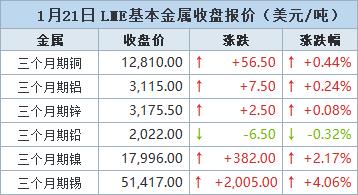
期铜因库存紧张而攀升,交易商质疑需求是否会持续【1月21日LME收盘】
Wen Hua Cai Jing· 2026-01-22 00:38
Group 1 - LME copper prices increased by $56.5, or 0.44%, closing at $12,810.0 per ton on January 21, following a significant drop the previous day, driven by tight inventories outside the U.S. despite concerns over sustained demand [1] - The three-month aluminum price rose by $7.5, or 0.24%, to $3,115.0 per ton, while zinc increased by $2.5, or 0.08%, to $3,175.5 per ton [2] - The three-month tin price surged by $2,005.0, or 4.06%, to $51,417.0 per ton, marking the largest increase among LME metals [6] Group 2 - Structural tightness continues to support prices in the broader base metals market, although demand outlook remains uncertain [3] - The copper premium in the spot market rose above $100 per ton, indicating strong short-term demand, but shifted to a discount of $23.50 per ton the following day [3] - China's refined copper imports for December 2025 were reported at 298,027.32 tons, reflecting a month-on-month decrease of 2.19% and a year-on-year decline of 27.00% [3] Group 3 - The International Copper Study Group (ICSG) reported a global refined copper market surplus of 94,000 tons in November 2025, up from a surplus of 48,000 tons in October [4] - For the period from January to November 2025, the global refined copper market had a surplus of 206,000 tons, compared to a surplus of 105,000 tons in the same period the previous year [5] Group 4 - The International Lead and Zinc Study Group (ILZSG) reported a zinc market shortage of 7,700 tons in November 2025, an increase from a shortage of 2,800 tons in October [8] - The global refined lead market surplus narrowed to 8,900 tons in November 2025, down from 29,200 tons in October [9]

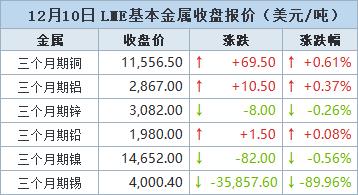
金属普涨 期铜反弹,受需求前景提振【12月10日LME收盘】
Wen Hua Cai Jing· 2025-12-11 00:41
Group 1 - LME copper prices rebounded on December 10, supported by hopes of increased demand, closing at $11,556.5 per ton, up $69.5 or 0.61% [1] - On December 10, the LME reported various base metal closing prices, with three-month copper at $11,556.50, three-month aluminum at $2,867.00, and three-month zinc at $3,082.00 [2] - China's real estate stocks surged on December 10, as the real estate sector is a major consumer of copper and other industrial metals [3] Group 2 - In November, China's consumer price index (CPI) showed a slight month-on-month decrease of 0.1% but a year-on-year increase of 0.7%, indicating a recovery in consumer spending [3] - The producer price index (PPI) rose by 0.1% month-on-month but fell by 2.2% year-on-year, influenced by supply-demand dynamics and international commodity price transmission [3] - LME copper prices have increased by 32% this year due to concerns over mining disruptions and tightening supply in regions outside the U.S. [3]
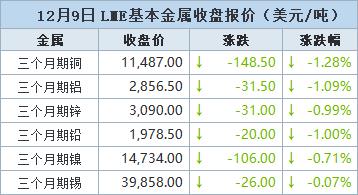
期铜收低,受累于美联储政策决定公布前投资者获利了结【12月9日LME收盘】
Wen Hua Cai Jing· 2025-12-10 00:48
Group 1: Market Overview - On December 9, LME copper prices fell by $148.5, or 1.28%, closing at $11,487.0 per ton after reaching a record high of $11,771 on the previous day [1] - The decline in copper prices is attributed to profit-taking by investors following a significant price surge and concerns over the slowing pace of interest rate cuts in the U.S. [1][3] Group 2: Price Movements of Other Metals - Other base metals also experienced declines, with three-month aluminum down by $31.5 (1.09%), zinc down by $31.0 (0.99%), and lead down by $20.0 (1.00%) [2] - Three-month tin and nickel prices also saw decreases, with tin down by $26.0 (0.07%) and nickel down by $106.0 (0.71%) [2] Group 3: Copper Market Dynamics - Copper prices have surged by 31% this year, with approximately 10% of this increase occurring in the past few weeks [3] - The rise in copper prices is supported by expectations of U.S. tariffs on imported copper, tightening global supply [3] - U.S. copper inventories have more than doubled over the past six months, reaching a record high of 439,510 short tons [3] Group 4: Economic Indicators - Market sentiment is cautious ahead of the Federal Open Market Committee (FOMC) meeting, contributing to profit-taking [3] - A stronger U.S. dollar, following the release of employment data, has put additional pressure on metal prices, making dollar-denominated commodities more expensive for buyers using other currencies [3] Group 5: Demand Outlook - China's copper ore and concentrate imports in November were reported at 2.526 million tons, with a cumulative total of 27.614 million tons from January to November, reflecting an 8.0% year-on-year increase [3] - In contrast, China's exports of unwrought aluminum and aluminum products in November were 570,000 tons, with a cumulative total of 5.589 million tons from January to November, showing a decline of 9.2% year-on-year [4]
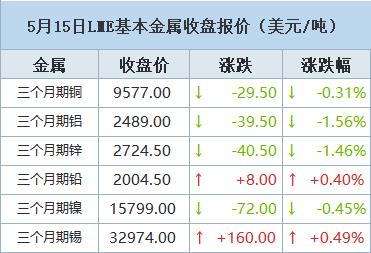
金属普跌 期铜收跌,对长期需求前景的担忧重现【5月15日LME收盘】
Wen Hua Cai Jing· 2025-05-16 00:41
Group 1 - LME copper prices fell by $29.50, or 0.31%, closing at $9,577.00 per ton on May 15, 2023, as optimism over global trade tensions faded and concerns about long-term demand resurfaced [1] - The three-month copper price had previously risen for five consecutive trading days, reaching a high of $9,664.00 on May 14, the highest since April 2 [1] - Other base metals also experienced declines, with three-month aluminum down by $39.50 (1.56%) and zinc down by $40.50 (1.46%) [2] Group 2 - Ole Hansen, head of commodity strategy at Saxo Bank, noted that the industrial metals market is recognizing significant economic damage, leading to renewed concerns about future demand [3] - Citi analysts forecast that the average copper price will drop from $9,300 in the current quarter to $8,800 in Q3, citing that trade tariffs remain significantly higher than before April [3] - JP Morgan predicts an average copper price of $9,225 per ton and aluminum at $2,325 per ton in the second half of the year, emphasizing that easing trade tensions is crucial for reducing recession risks [3]