
高杠杆运营

Search documents
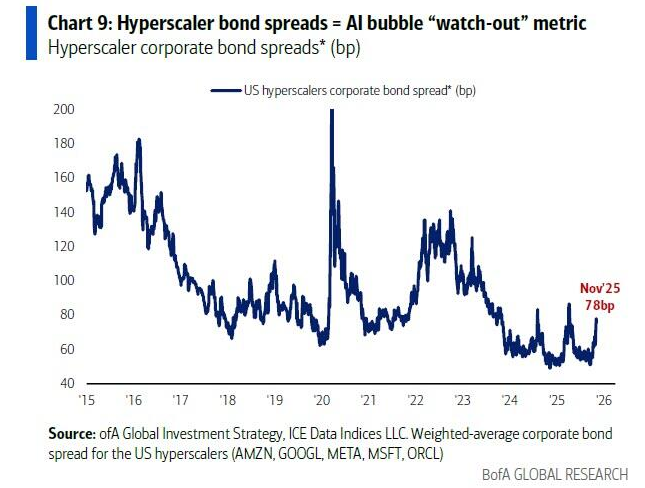
“AI泡沫”的领先指标--美国云厂商的债券遭遇连续抛售
Hua Er Jie Jian Wen· 2025-11-12 00:56
Core Insights - Concerns over AI spending by large tech companies have spread to the bond market, with debt spreads for hyperscale cloud computing firms reaching multi-month highs, indicating a potential risk reassessment of the entire AI narrative [1][3] - Barclays downgraded Oracle's debt rating, citing that the company's capital expenditures for AI contracts have significantly exceeded its free cash flow capacity, leading to a heavy reliance on external financing [1][4] Debt Market Dynamics - The yield spread of bonds issued by hyperscalers, including Alphabet, Meta, Microsoft, and Oracle, has risen to 0.78 percentage points above U.S. Treasuries, marking a significant increase from 0.5 percentage points in September [3] - Over the past seven weeks, tech companies have issued more than $120 billion in bonds, primarily to fund data center construction, raising concerns about overcapacity, long-term profitability, and energy demand [3] Oracle's Financial Strain - Oracle's situation is particularly notable, with Barclays predicting a severe financing gap starting in fiscal year 2027 and potential cash exhaustion by November 2026, driven by a high leverage ratio of 500% compared to Amazon's 50% and Microsoft's 30% [4][5] - Oracle's bond prices have dropped nearly 5% since mid-September, contrasting with a 1% decline in an index tracking high-rated tech bonds, reflecting investor concerns [5] Industry-Wide Implications - The challenges faced by Oracle are indicative of broader industry pressures stemming from the AI investment boom, with JPMorgan strategists warning that building AI infrastructure could cost over $5 trillion, necessitating participation from public capital markets, private credit, alternative capital, and even government [6] - Despite holding approximately $350 billion in cash and investments, tech giants are opting for significant debt issuance, signaling a shift from conservative financial strategies to higher leverage operational models [6] Recent Major Transactions - Meta completed a $30 billion bond issuance at the end of October, the largest corporate bond deal of 2023, and secured a $27 billion private debt agreement for data center funding [7] - Alphabet issued $25 billion in bonds in early November, while Oracle sold $18 billion in bonds in September to finance infrastructure leasing, including the "Stargate" data center for OpenAI [8] Market Reactions and Future Outlook - The credit market's pressure is affecting smaller core participants, with CoreWeave's stock dropping over 20% in the past two weeks, coinciding with the bond sell-off by large tech firms [9] - Some analysts view the bond market sell-off as a healthy market response, suggesting that price corrections following significant bond supply are a positive sign [9]


疯狂加杠杆,甲骨文是AI的恒大?
36氪· 2025-10-28 10:17
Core Viewpoint - The collaboration between Oracle and OpenAI involves a significant $300 billion cloud order, which raises questions about Oracle's ability to deliver such services and OpenAI's capacity to pay for them [4][6]. Financial Data Analysis - The $300 billion order will be delivered over five years starting in 2027, averaging $60 billion per year, potentially doubling Oracle's current business scale [6]. - Oracle's total revenue for FY2025 was $57.4 billion, with cloud and license revenue accounting for $49.2 billion, indicating a substantial growth opportunity if the order is fulfilled [6]. - Building a 4.5GW data center, linked to the order, is estimated to require $225 billion to $270 billion in capital expenditure, necessitating a significant upfront investment [7]. - Oracle's cash flow and financial status are under scrutiny, as its cash reserves of $10.79 billion are insufficient to cover the projected annual capital expenditure of $32.1 billion [10]. Cash Flow and Financing Needs - Oracle's operating cash flow for FY2025 was $20.8 billion, which, if maintained, would still leave a $11.3 billion annual shortfall against the required capital expenditure [10]. - The company has a high debt ratio of 86.33%, with total assets of $180.4 billion and net assets of only $24.7 billion, indicating a reliance on debt financing [13]. - Oracle has recently issued $18 billion in investment-grade bonds and is preparing for a $38 billion bond issuance to fund data center projects, which could cover 50% of the funding gap [15]. Market and Competitive Landscape - OpenAI's projected revenue growth from $12.7 billion in 2025 to between $174 billion and $200 billion in 2030 suggests that the $300 billion order would represent 43% of its total revenue [20]. - However, OpenAI's commitments to other cloud service providers, including Microsoft, pose a risk to its ability to fulfill the order with Oracle [20]. - The successful execution of Oracle's capital expenditure plans hinges on OpenAI's commercial progress, which is reflected in the volatility of Oracle's stock price [21][22].

第一创业晨会纪要-20250707
First Capital Securities· 2025-07-07 02:46
Group 1: Advanced Manufacturing Sector - The core viewpoint is that BYD's "Di Chain" supply chain finance model has evolved from a simple settlement tool to a complex financial strategy that reshapes the company's core competitiveness and risk profile [2] - As of the end of 2024, BYD's nominal debt is reported at 28.6 billion, but when including the "Di Chain," the broad debt scale exceeds 500 billion. The company's current assets are approximately 371 billion, indicating a cash flow gap of over 100 billion, reflecting high financial leverage and potential liquidity risks [2] - A decline in sales could further reduce cash flow, leading to a rapid increase in debt ratios, which may jeopardize the stability of the "Di Chain" and result in systemic collapse. This indicates that BYD has a high requirement for sales volume, and recent significant price cuts may reflect the immense pressure to maintain scale and market share [2][3] Group 2: Consumer Sector - Bilibili's Q1 2025 revenue reached 7 billion, representing a year-on-year growth of 24%. The quarterly gross margin is 36.3%, an increase of 8 percentage points compared to the previous year, exceeding market expectations [6] - The net profit attributable to shareholders under non-GAAP was 363 million, with a profit margin of 5%, marking a 13% year-on-year increase, primarily due to effective control of operating costs [6] - Revenue from the mobile gaming segment was 1.731 billion, surpassing Bloomberg's expectations by 2.73%, with a year-on-year growth of 76%, driven by the strong performance of the exclusive strategy game "Three Kingdoms: Planning the World" [6]

