
高标准市场体系

Search documents
以高标准市场体系赋能高质量发展
Zhong Guo Zhi Liang Xin Wen Wang· 2026-02-09 06:52
Group 1 - The core focus of the Shanxi Provincial Government's work report is to actively serve and integrate into the national unified market, emphasizing the construction of a high-standard market system as a priority for 2026 [1][2] - Key tasks include regular market access barrier clearance actions, implementation of intellectual property initiatives to support transformation, and deepening quality initiatives that integrate quality, standards, and branding [1][2] - The report highlights the goal of completing no less than 1 million batches of agricultural product rapid testing in large agricultural wholesale markets as one of the 15 key livelihood projects for 2026 [1] Group 2 - Shanxi Provincial representatives stress the importance of combining investment in people and material resources, advocating for a robust intellectual property framework to stimulate innovation and improve the business environment [2][3] - Suggestions include establishing a legal commitment to transform "non-prohibited means entry" into actionable policies, creating a dynamic list of hidden barriers, and implementing a comprehensive enterprise complaint response system [2][3] - The need for unified approval standards and the elimination of unnecessary processes in the "One Network" platform is emphasized to enhance service efficiency for businesses [3] Group 3 - Food safety is highlighted as a critical aspect of quality province construction, with calls for revising local food safety regulations and implementing comprehensive monitoring systems for food sources [3][4] - The Shanxi Provincial Market Supervision Bureau plans to enhance administrative and judicial protection mechanisms, promote service-oriented law enforcement, and address monopolistic and unfair competition practices [4][5] - The focus on quality development includes implementing quality management systems, promoting inter-regional quality initiatives, and providing integrated services to support quality improvement across industries [5]
用法治强化国际经贸规则对接
Xin Lang Cai Jing· 2026-02-06 21:01
Core Viewpoint - The newly revised Foreign Trade Law of the People's Republic of China will take effect on March 1, emphasizing the country's commitment to align with high-standard international economic and trade rules, thereby reinforcing the multilateral trade system and fair international economic order [1][2]. Group 1: Domestic Implications - Aligning with international high-standard economic and trade rules is essential for China to build a strong trading nation and is a proactive choice based on its development needs [1]. - The rules regarding market access, fair competition, green development, and digital economy in international high-standard economic and trade rules align closely with China's reform direction towards establishing a high-standard market system [1]. - This alignment will broaden the scope and depth of China's opening up, promoting reform and development in line with the governance direction of comprehensive deepening of reform and expansion of opening up in the new era [1]. Group 2: International Context - The alignment with high-standard international economic and trade rules is a necessary path to reduce institutional transaction costs and enhance rule-making power [2]. - Current high-standard international economic and trade rules, represented by agreements like the CPTPP and DEPA, feature higher levels of liberalization, broader coverage, and stronger disciplinary constraints, with zero-tariff products in goods trade generally exceeding 99% [2]. - The revised Foreign Trade Law will help reduce regulatory barriers for Chinese enterprises in cross-border trade and enable China to take the initiative in rule-making in emerging fields such as digital trade and green transformation [2]. Group 3: Strategic Initiatives - China aims to expand its high-standard free trade zone network, having applied to join the CPTPP and DEPA, demonstrating its willingness and capability to meet high-level rule standards [3]. - The number of free trade pilot zones in China will reach 22 during the 14th Five-Year Plan period, with pilot measures being implemented to align with high-standard economic and trade rules [3]. - Establishing compliance mechanisms that align with international rules and optimizing the open cooperation environment is crucial, focusing on enterprise needs and enhancing compliance management systems [3].
新华述评·聚焦中央经济工作会议|必须做到既“放得活”又“管得好”——学习领会“五个必须”做好明年经济工作
Xin Hua She· 2025-12-17 14:48
Group 1 - The core idea emphasizes the need for a balance between "letting go" and "managing well" in economic work, highlighting the importance of breaking down institutional barriers while ensuring a rule-based economy [1][10] - The "Five Musts" outlined by Xi Jinping provide a framework for addressing development challenges, stimulating internal dynamics, and mitigating risks [1][10] - The focus on creating a fair and competitive market environment is essential for promoting high-quality development, as indicated by the increase in the bidding success rate of private enterprises in Hunan from 73.65% to 82.9% [2] Group 2 - The establishment of a high-standard market system is crucial for maximizing resource allocation efficiency, as stated by experts [3] - Recent measures, such as the approval of the Administrative Law Enforcement Supervision Regulations, aim to clarify responsibilities and enhance market vitality through reduced administrative approvals [4] - The importance of market rules and a conducive environment for fair competition is emphasized, ensuring equal access to production factors for all business entities [5] Group 3 - The government's role is essential in regulating market order, with recent policies focusing on risk prevention and maintaining economic stability [12] - The ongoing reforms aim to enhance the efficiency of resource allocation and reduce institutional costs, as seen in various regional initiatives [16] - The need for continuous improvement in the relationship between an effective market and a proactive government is highlighted as a key focus for future reforms [15]
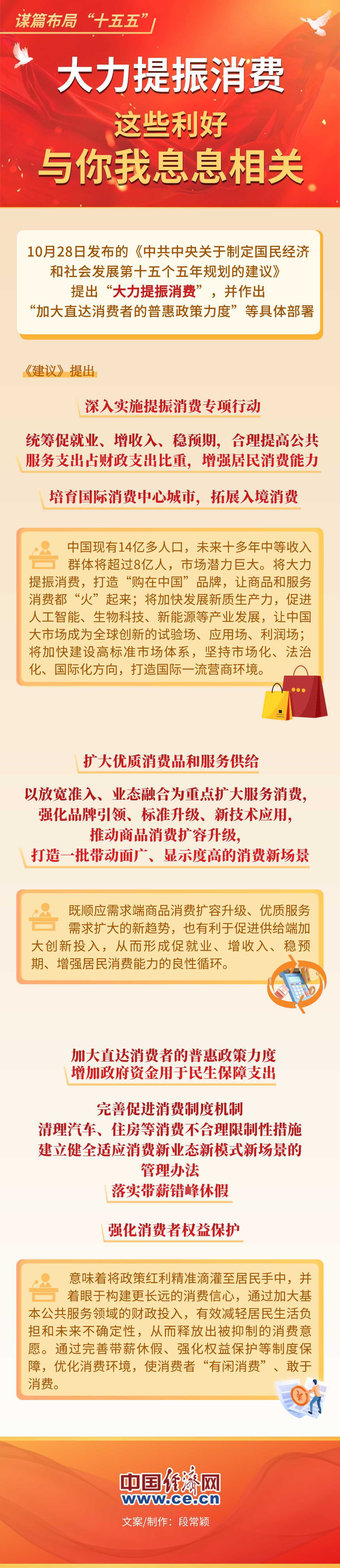
【图解】谋篇布局“十五五”|大力提振消费 这些利好与你我息息相关
Zhong Guo Jing Ji Wang· 2025-11-05 09:09
Core Viewpoint - The article emphasizes the importance of boosting consumption in China as part of the 15th Five-Year Plan, highlighting specific measures to enhance consumer confidence and spending power [2][3][5]. Group 1: Policy Initiatives - The Central Committee's suggestions include implementing special actions to boost consumption, coordinating employment promotion, income increase, and stabilizing expectations [2][3]. - There will be an increase in government funding for public welfare spending to enhance consumer capacity and support the middle-income group, which is expected to exceed 800 million in the next decade [3][5]. - The plan aims to create a high-standard market system that adheres to market-oriented, legal, and international principles, fostering a world-class business environment [3][4]. Group 2: Consumer Empowerment - The government will enhance direct consumer benefits through inclusive policies, such as removing unreasonable restrictions on automobile and housing consumption [6][7]. - Measures will be taken to improve public services and consumer rights protection, which are expected to alleviate residents' living burdens and uncertainties, thereby stimulating suppressed consumption willingness [6][7]. - The focus will be on expanding the supply of quality consumer goods and services, integrating new business formats, and promoting innovative consumption scenarios [4][5].

习近平主持召开中央全面深化改革委员会第十六次会议
Ren Min Ri Bao· 2025-06-06 03:16
Core Points - The article emphasizes the significant breakthroughs achieved in comprehensive deepening reform since the 13th Five-Year Plan and highlights the new stage of development that China will enter during the 14th Five-Year Plan, indicating that reform is at a new juncture [1][6] - It stresses the importance of aligning reform with development needs, addressing new challenges posed by changing social contradictions and complex international environments, and enhancing the strategic, forward-looking, and targeted nature of reforms [1][6] Group 1: Reform Strategies - The meeting approved several key documents aimed at optimizing the layout and structure of state-owned enterprises, establishing a high-standard market system, and enhancing the management and supervision of state assets [2][3] - It was noted that optimizing the layout and structure of state-owned enterprises is crucial for better serving national strategic goals and adapting to high-quality development [2][3] Group 2: Market System and Asset Management - The construction of a high-standard market system is to be guided by new development concepts, focusing on expanding domestic demand and improving market environment and quality [3][5] - Emphasis was placed on the importance of managing state assets effectively, ensuring they serve as a material foundation for the development of the Party and the state, and safeguarding the interests of the people [3][5] Group 3: Social Services and Cultural Responsibility - The meeting highlighted the significance of promoting healthy development in elderly care and childcare services, addressing the "one old and one young" issue to improve people's livelihoods and promote balanced population development [4][5] - Cultural enterprises are urged to uphold social responsibilities, reflect core socialist values, and produce quality cultural products that align with the aesthetic pursuits of the Chinese people [4][5] Group 4: Education Reform - The meeting acknowledged the progress made in educational reform since the 18th Central Committee, emphasizing the need to continue deepening reforms in the education sector to align with national strategic needs and public expectations [5][6] - It called for optimizing the education structure and promoting a balanced public education service system to reduce regional and urban-rural disparities [5][6]
中国经济时报社会责任报告(2024年度)
Sou Hu Cai Jing· 2025-05-30 05:05
Group 1 - The article discusses the significant increase in passenger traffic on China's railways, with a record of 3 billion passengers transported from January to August 2023, marking a historical high [3] - It highlights the challenges in managing electric bicycles and emphasizes the need for improved regulatory frameworks to address these issues [3] - The article also mentions the importance of building a high-level socialist market economy system as part of China's economic strategy [3][20] Group 2 - The China Economic Times is positioned as a leading think tank media outlet under the State Council Development Research Center, focusing on providing valuable insights and authoritative information [6][8] - The media outlet has received recognition for its academic influence, ranking 8th in the economic and management category in the 2024 high academic influence newspaper rankings [11] - It has also won awards in national industry news competitions, showcasing its commitment to quality journalism [11][13] Group 3 - The article outlines the political responsibilities of the China Economic Times, emphasizing adherence to party principles and the promotion of the Communist Party's policies [15] - It details the media's efforts to report on significant events and speeches by President Xi Jinping, ensuring timely dissemination of important political information [16][18] - The media outlet has launched special columns to discuss major themes related to reform and economic governance, reflecting its role in shaping public discourse [40]
TIC行业:五方面发力建设石化强国
Zhong Guo Hua Gong Bao· 2025-05-14 01:46
Core Viewpoint - The TIC industry is a strategic emerging industry in China, playing a crucial role in promoting high-quality development and supporting various national initiatives during the "14th Five-Year Plan" period [1] Group 1: Industry Challenges and Directions - The TIC industry faces challenges such as supply capacity not meeting demand, insufficient social credibility, weak brand influence, and a need to enhance international discourse power [1] - During the "15th Five-Year Plan" period, the TIC industry should focus on innovation-driven, green low-carbon, structural optimization, international cooperation, and cluster development to support China's transition from a petrochemical power to a petrochemical strong nation [1] Group 2: Enhancing Industrial Capabilities - The TIC industry can strengthen technical services for basic chemicals, processes, and infrastructure, and develop impactful certification systems for basic chemical products [2] - By leveraging new technologies like IoT and big data, the industry can enhance quality management capabilities and optimize evaluation schemes across various sectors [2] Group 3: Supporting Industry Upgrades - The TIC industry should promote quality management system certification upgrades in key industries, collaborating with various stakeholders to develop high-end quality certifications [3] - To facilitate domestic and international dual circulation, the industry should develop high-end quality certifications and new service certifications, emphasizing product differentiation and brand value [3] Group 4: Green Transition and Talent Development - The TIC industry must establish green low-carbon standards and certifications for products with significant environmental impacts, focusing on high-emission sectors for clean production evaluations [4] - Collaboration with educational institutions is essential for developing training programs that meet industry and societal needs, enhancing the professional capabilities of TIC personnel [4] Group 5: Business Expansion and Digitalization - TIC institutions can expand their business through partnerships, asset restructuring, and mergers, enhancing their qualification capabilities and service chains [5] - The industry should promote digital applications in quality certification, advancing the development of intelligent detection equipment and data application technologies [5]
建设高标准市场体系 山西明确2025年文旅康养发展"路线图"
Zhong Guo Chan Ye Jing Ji Xin Xi Wang· 2025-04-18 00:50
Group 1 - The core viewpoint of the news is the launch of the "2025 Action Plan for High-Standard Market System Construction in the Cultural Tourism and Health Sector of Shanxi Province," which outlines a roadmap for developing a new pattern of scenic area development and enhancing tourism resources [1] - The plan includes a comprehensive survey of tourism resources in Shanxi Province to establish a clear understanding of the tourism resource base and to promote the creation of A-level tourist attractions [1] - The initiative aims to actively develop leisure and vacation tourism by enhancing the tourism supply system and implementing a "renewal" action for provincial-level tourist resorts, focusing on high-quality development [1] Group 2 - The plan emphasizes the construction of a new space for all-region tourism, particularly in key cities like Taiyuan, Datong, and Yuncheng, to enrich the overall tourism experience [1] - It aims to cultivate new consumption growth points by organizing the 2025 Shanxi Province Tourism Development Conference and promoting the integration of cultural tourism with various industries [1] - The strategy includes innovative promotional methods, optimizing the marketing mechanism across the province, and launching themed promotional campaigns for different seasons [2] Group 3 - The plan seeks to enhance the service evaluation system by improving the "Tourism Satisfaction in Shanxi" standard system and elevating the quality of tourism services [2] - It aims to establish a robust market supervision system, including a credit system for the cultural tourism market and comprehensive governance of the entertainment sector [2] - The initiative includes the development of a "good and bad review" system from the tourist's perspective to create a more tourist-friendly environment [2]