
高等教育提质扩容

Search documents
加快推动教育事业高质量发展 有力支撑社会主义现代化兵团建设
Xin Lang Cai Jing· 2026-02-03 20:48
Core Viewpoint - The article emphasizes the importance of strengthening ideological education and improving the quality of education in the context of building a modern socialist society, focusing on integrating traditional culture and enhancing the educational system to meet the needs of diverse student populations [1] Group 1: Ideological Education - The article advocates for the use of Xi Jinping's thoughts to guide ideological education, aiming to cultivate a strong sense of national identity among students [1] - It highlights the need for high-quality ideological course teachers and the integration of ideological education across all educational levels [1] Group 2: Educational Reform and Development - The article calls for comprehensive reforms in education, including addressing issues identified in central inspections and ensuring effective problem-solving [1] - It stresses the importance of adapting to changes in school-age populations and promoting balanced development in compulsory education [1] - The article also mentions the need to enhance higher education quality and expand vocational education systems to better serve the workforce [1] Group 3: Political and Safety Considerations - The article underscores the necessity of maintaining strong party leadership and ensuring political safety within the education system [1] - It emphasizes the importance of creating a stable and clean political environment for education, ensuring safety and integrity in educational institutions [1]
逼近170万大学生!中国高校第一城背后,城市人才格局重塑
2 1 Shi Ji Jing Ji Bao Dao· 2025-12-11 11:16
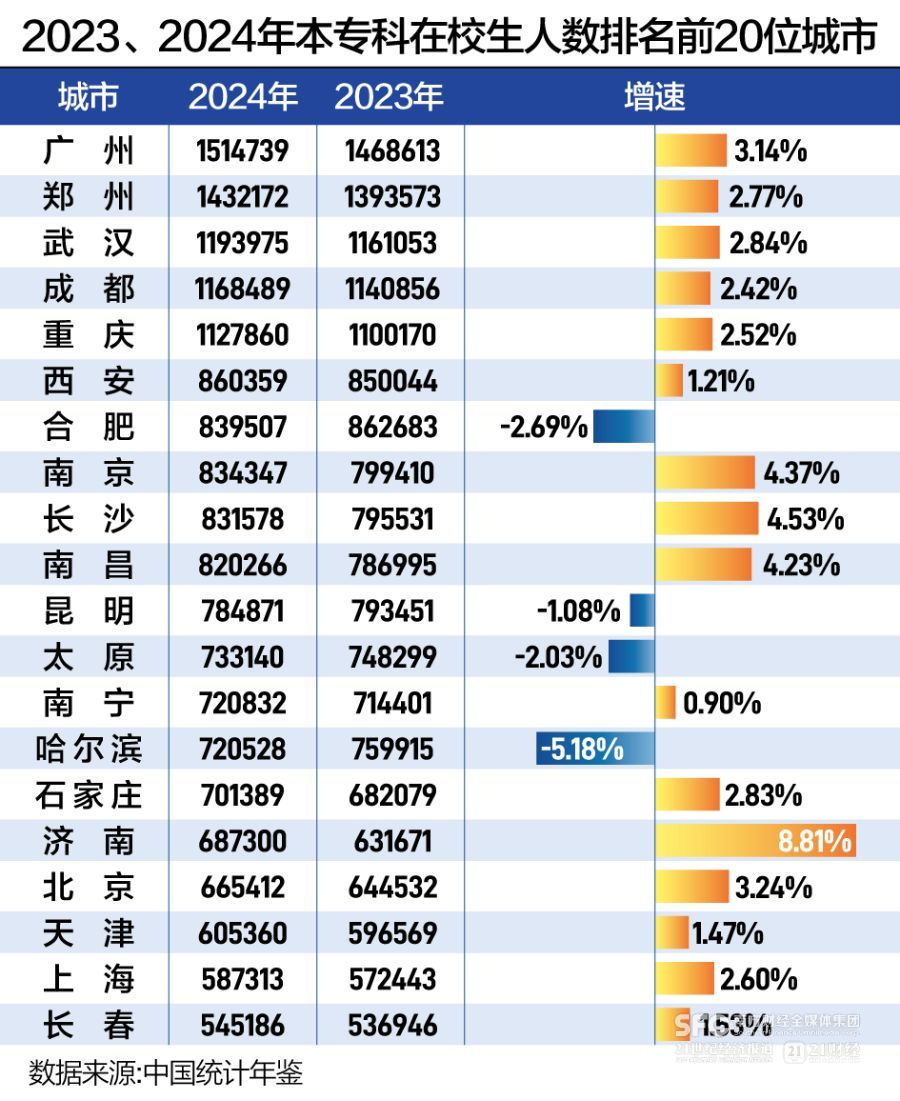
Core Insights - The number of students in higher education institutions in China continues to expand, with 10 cities now having over 800,000 students enrolled in undergraduate and vocational programs [1][3] - Guangzhou leads the country with over 1.5 million students, followed by cities like Zhengzhou, Wuhan, Chengdu, and Chongqing, which have surpassed 1 million students [1][3] - While enrollment numbers are increasing, the growth rate is slowing down, indicating a potential shift in educational dynamics [2] Enrollment Trends - From 2020 to 2024, the growth rates of undergraduate enrollment were 5.74%, 3.50%, 1.32%, 2.73%, and 2.56% respectively, showing a trend of diminishing growth [2] - The total number of students in the top 20 cities increased from 17.03 million in 2023 to 17.37 million in 2024, a growth of 1.97% [3] City-Specific Data - In 2024, Nanchang joined the "800,000 club" with 820,266 students, marking a 4.23% increase from the previous year [4][5] - Cities like Hefei, Kunming, Taiyuan, and Harbin saw a decline in student numbers, with Hefei's enrollment dropping by 2.69% [5][6] Graduate Education Development - Many cities are focusing on developing graduate education, with cities like Beijing and Shanghai having significant numbers of graduate students, indicating a shift towards higher education [6][7] - Beijing has the highest number of graduate students at 475,000, while Shanghai has 269,300, reflecting the concentration of higher education resources in major cities [6][7] Employment and Talent Retention - Cities are implementing strategies to attract and retain graduates, with initiatives like "Million College Students Stay in Wuhan" and "Ten Thousand College Students Stay in Hohhot" [10][11] - Employment opportunities and living costs are critical factors influencing graduates' decisions to stay in their respective cities [11][12] Recommendations for Cities - To retain graduates, cities should enhance job matching, improve salary competitiveness, and provide housing support [14] - Building a vibrant social and cultural environment is also essential to attract and retain young talent [14]

超30个“双一流”高校新校区,进入大规模建设阶段
Di Yi Cai Jing· 2025-12-03 12:44
Core Viewpoint - A number of prestigious universities in China are establishing new campuses and colleges to enhance the quality and capacity of higher education, particularly in response to the growing demand for quality undergraduate education and the adjustment of academic disciplines [2][3][5] Group 1: New Campus Developments - Nanjing University of Aeronautics and Astronautics is set to establish a new campus in Jiangbei New District, covering an area of approximately 265,900 square meters [2] - Southeast University has confirmed plans to build a new campus in Nantong, collaborating with the local government [2] - Over 30 "Double First-Class" universities are entering large-scale construction phases for new campuses to improve educational facilities and student accommodations [2] Group 2: Educational Policy and Strategic Goals - The Central Committee's proposal emphasizes the need to enhance the quality and capacity of higher education, aiming to expand the enrollment of quality undergraduate programs [3] - The current gross enrollment rate in higher education in China exceeds 60%, but the proportion of quality undergraduate programs remains low, indicating a need for improvement [3] - The Ministry of Education's action plan for 2025-2027 focuses on optimizing academic disciplines and professional settings, targeting strategic emerging industries and future industries [4] Group 3: New Academic Programs and Disciplines - A series of new colleges are being established by "Double First-Class" universities, focusing on urgent national needs in cutting-edge technologies and emerging industries such as artificial intelligence, aerospace technology, and quantum science [5] - The action plan includes initiatives for rapid deployment of urgently needed academic disciplines, support for foundational disciplines, and the establishment of interdisciplinary centers [4]
专访周洪宇:探索延长义务教育年限,助力跨越“中等收入陷阱”
2 1 Shi Ji Jing Ji Bao Dao· 2025-11-28 09:21
Core Viewpoint - The "15th Five-Year Plan" emphasizes the construction of a strong education system, focusing on major strategic tasks and policies in the education sector, including the expansion of free education and the exploration of extending compulsory education years [1][11]. Group 1: Education Reform and Development - The plan aims to implement significant educational reforms, including the initiation of a new round of "Double First-Class" construction and the steady expansion of free education [1]. - The integration of education, technology, and talent development is crucial for fostering new productive forces, requiring a unified approach among academic, educational, and market orientations [4][5]. - The expansion of high-quality undergraduate education is prioritized, with plans to increase the number of "Double First-Class" universities from 147 to around 200, focusing on emerging disciplines [5][6]. Group 2: Basic Education and Resource Allocation - The school-age population in China is projected to decline from 233.33 million in 2023 to 140.04 million by 2035, a decrease of 39.98%, necessitating flexible adjustments in educational resource allocation [8][9]. - A three-tiered response mechanism is proposed to monitor and adapt educational resources in line with population changes, ensuring effective resource distribution [9]. - In urban areas with increasing school-age populations, there is a need to enhance educational resource quality and availability, while rural areas should focus on small-scale standardized schools [9][10]. Group 3: Free Education Expansion - The plan suggests gradually expanding free education to include early childhood and high school education, with a focus on supporting economically disadvantaged families [11][12]. - Special education should also be included in the free education framework, with a goal of implementing 15 years of free education for disabled students [12][13]. - The expansion of free education should be gradual and within the limits of national financial capacity to avoid pitfalls seen in other countries [13][15]. Group 4: Compulsory Education and System Reform - The proposal to explore extending compulsory education is seen as a necessary step to enhance national human resources and address social transformation [14][16]. - The current six-three school system may need reform to better align with contemporary educational needs, with suggestions to consider a five-four system or a nine-year integrated system [17][18]. - The adjustment of the education system should be gradual and scientifically structured to meet diverse regional and developmental needs [18].
高等教育学龄人口预计2032年达到峰值
第一财经· 2025-11-17 11:18
Core Viewpoint - The changing population structure in China is driving a transformation in the allocation of educational resources, with a peak in primary school enrollment reached in 2023 and further peaks expected in secondary and higher education in the coming years [3][4]. Group 1: Educational Policy and Reform - The Central Committee's suggestions emphasize the need to establish a resource allocation mechanism that aligns with population changes, focusing on high-quality development in education, technology, and talent [3]. - The Ministry of Education is prioritizing the reform of higher education classification and regional structural layout, aiming to optimize discipline and major settings in line with national strategic needs [4]. Group 2: Higher Education Landscape - There is a significant push for the establishment of new research-oriented universities that focus on innovative governance and talent cultivation, with several institutions already emerging in this category [5]. - The rise of new research universities is expected to reshape the higher education ecosystem in China, providing differentiated supply and innovative models [5]. Group 3: Vocational Education and Employment Trends - The number of vocational colleges has increased, with some institutions achieving high admission scores comparable to top-tier universities, indicating a shift in student preferences towards vocational education [6]. - The phenomenon of university graduates returning to vocational schools highlights the need for higher education institutions to adapt their programs to better meet market demands [7].
聚焦“十五五”规划建议丨推动高等教育提质扩容 扩大优质本科教育招生规模
Xin Hua Wang· 2025-10-29 00:40
Core Viewpoint - The Central Committee's proposal emphasizes the need to enhance the quality and expand the scale of higher education, aiming to build a strong educational nation with a focus on quality undergraduate education [1][2] Group 1: Higher Education Development - During the 14th Five-Year Plan period, China's higher education has reached a recognized stage of popularization, with a gross enrollment rate of 60.8% and a total of 55 million talents delivered to society [1] - Over 75% of national natural science awards and technology invention awards, as well as over 55% of scientific and technological progress awards, have been awarded to higher education institutions [1] Group 2: Quality and Equity in Education - The proposal aims to promote the coverage of quality educational resources to a broader group, enhancing both educational equity and quality [2] - Higher education development should focus on both reasonable quantitative growth and effective qualitative improvement, aligning with national strategic needs and economic development [1][2]
聚焦“十五五”规划建议|推动高等教育提质扩容 扩大优质本科教育招生规模
Xin Hua She· 2025-10-28 16:17
Core Points - The central viewpoint of the news is the emphasis on enhancing the quality and capacity of higher education in China, as outlined in the recently released proposal for the 15th Five-Year Plan [1][2] Group 1: Higher Education Development - The proposal aims to promote high-quality undergraduate education and expand enrollment in prestigious institutions, marking a shift towards a more inclusive and quality-focused higher education system [1] - During the 14th Five-Year period, China's gross enrollment rate in higher education reached 60.8%, with a total of 55 million talents supplied to society [1] - Over 75% of the national natural science awards and technology invention awards, as well as over 55% of the technological progress awards, have been awarded to universities [1] Group 2: Strategic Direction and Implementation - The new directives in the proposal clarify the strategic direction for higher education reform and talent cultivation, providing essential guidance for the high-quality development of higher education [1] - The focus is not only on quantitative growth but also on the effective enhancement of quality in higher education, as stated by officials [1][2] - Universities are encouraged to align their programs and disciplines with national strategic needs and socio-economic development, thereby improving the relevance and adaptability of talent training [2]
教育部:统筹用好中央预算内投资和超长期特别国债,支持高校持续改善办学条件
news flash· 2025-06-10 02:54
Core Viewpoint - The Ministry of Education emphasizes the need to utilize central budget investments and ultra-long-term special bonds to support the continuous improvement of educational conditions in higher education institutions [1] Group 1: Improvement of Educational Conditions - The Ministry plans to improve conditions by effectively utilizing central budget investments and ultra-long-term special bonds to support higher education institutions [1] Group 2: Structural Optimization - There will be a focus on optimizing the structure of higher education resources, with a particular emphasis on directing new resources towards populous provinces in central and western China [1] - The initiative includes support for the establishment of new research-oriented universities and high-level Sino-foreign cooperative education [1] Group 3: Integration of Industry and Education - The Ministry aims to guide universities in adjusting their academic programs to meet the needs of economic and social development, enhancing students' employability and entrepreneurial skills through practical training in collaboration with industries [1]