一体推进教育科技人才发展

Search documents
科技创新三大关键词
2 1 Shi Ji Jing Ji Bao Dao· 2026-02-27 13:23
Group 1: Core Focus Areas - The upcoming National Two Sessions will emphasize technology, with a focus on high-level self-reliance and innovation-driven development as outlined in the "14th Five-Year Plan" [1] - Key topics of interest among representatives include the transformation of scientific achievements, technology empowerment across various sectors, and the role of enterprises in innovation [1][10] - In 2025, 176 proposals related to the transformation of scientific achievements were submitted, focusing on enhancing the role of enterprises in technological innovation and reforming the transformation mechanism [1] Group 2: Transformation of Scientific Achievements - The transformation of scientific achievements is seen as the "last mile" of technological innovation, with a need for smooth transitions from science to technology and then to commercialization [5] - Proposals include expanding the scale of original exploration plans and establishing technology transfer offices in universities to facilitate smoother transitions [5][6] - The medical sector is highlighted for its need to accelerate the market entry of innovative products, with suggestions for opening up application scenarios [6] Group 3: Technology Empowerment - Representatives are focusing on how technology can empower industries, with an emphasis on integrating technology with real-world needs [7] - The development of the marine economy and agricultural technology innovation are highlighted as critical areas for technological advancement [8][9] - There is a call for the introduction of advanced technologies such as robotics and AI in agriculture to enhance production efficiency [9] Group 4: Role of Enterprises - The importance of strengthening the role of enterprises in innovation is emphasized, with a focus on knowledge property rights and the participation of private enterprises in national innovation platforms [10][12] - Suggestions include enhancing judicial protection of intellectual property and creating a supportive environment for "specialized, refined, and innovative" enterprises [12] - The integration of industry and research is seen as essential for fostering a modern industrial system and enhancing national competitiveness [13] Group 5: Emerging Topics - Discussions around artificial intelligence and ethical technology are gaining traction, with a focus on data privacy and algorithm fairness [14] - The need for a structured approach to "silver technology" for the elderly is also highlighted, aiming to make technology more accessible and practical for older adults [9][14]
邢善萍开展春节走访慰问
Shan Xi Ri Bao· 2026-02-14 00:35
Group 1 - The article highlights the visit of Deputy Secretary Xing Shanping to various groups, including veterans, experts, and military personnel, to extend New Year greetings and express care for their well-being [1][2] - Xing Shanping discussed the economic and social development of the province over the past year, encouraging continued support from veterans for provincial work and development [1] - During visits to academicians, Xing Shanping emphasized the importance of scientific innovation and the cultivation of young talents, urging breakthroughs in core technology and the transformation of scientific achievements [1] Group 2 - In Yangling Demonstration Zone, Xing Shanping focused on understanding the daily lives, medical security, and education of underprivileged groups, encouraging them to overcome difficulties with the support of the government and society [2] - The article mentions the emphasis on enhancing the political and organizational functions of grassroots party organizations, particularly in the development of characteristic industries and improvement of living environments [2]
【聚焦2026河南两会】分享履职故事 畅谈发展感悟 传递民生期盼
Xin Lang Cai Jing· 2026-01-26 03:35
Group 1: Aerospace Industry - The Henan province is striving to build a trillion-level aerospace industry chain to inject strong momentum into high-quality development [1] - Zhengzhou University of Aeronautics focuses on integrating innovation to drive industrial upgrades and has developed the first international standard for 5G positioning, enhancing positioning capabilities to meter-level [2] - The university has trained over 200,000 talents in the aerospace field and is accelerating the establishment of doctoral programs in aerospace to cultivate innovative talents for commercial aerospace and low-altitude economy [2] Group 2: Agricultural Machinery - The agricultural sector is prioritized in Henan's "14th Five-Year Plan," emphasizing the importance of strong agricultural machinery for agricultural strength [3] - A domestic team has developed the first six-string baler, doubling operational efficiency and reducing costs by 30% compared to imported equipment [3] - The team is also creating smart farm demonstration sites, integrating technology such as drones and robots to enhance agricultural efficiency [3] Group 3: Ecological Restoration - Significant ecological restoration efforts in Henan have led to the revival of several water sources, showcasing the effectiveness of ecological governance [4][5] - Eight national-level ecological restoration projects have been implemented, improving water retention capabilities and stabilizing water quality in key rivers [5] - The proposal includes more ecological restoration projects during the "14th Five-Year Plan" to support high-quality development and enhance public welfare [5] Group 4: Logistics and Supply Chain - The establishment of a modern logistics system is crucial for Henan to serve as a key hub in the national unified market [6] - The logistics vocational college aims to align talent training with industry needs and promote institutional innovation to support the logistics sector [6] - Recommendations include enhancing supply chain organization and integrating resources to maximize the hub's multiplier effect [6] Group 5: Green Energy Transition - Companies in Henan are increasingly focusing on carbon footprints and green energy as part of their operational strategies [7][8] - The emphasis is on ensuring the traceability of green energy and implementing virtual power plants to optimize energy use [8] - The transition to green energy is seen as essential for sustainable development in the province [7] Group 6: Grassroots Governance - Efficient governance is a key focus in Henan's development strategy, with initiatives aimed at improving service delivery through technology [9][10] - The establishment of community service stations has enhanced support for new employment groups, fostering community engagement [10] - Collaborative efforts have successfully addressed local governance challenges, exemplified by the transformation of a problematic road into a community asset [10] Group 7: Intelligent Manufacturing - The integration of embodied intelligence in manufacturing is essential for advancing Henan's "smart province" initiative [11] - Development of intelligent robots has significantly improved production efficiency and reduced labor intervention in challenging environments [11] - The local industrial ecosystem is being strengthened through supportive policies and initiatives to foster innovation [11] Group 8: Water Network Development - Henan's extensive water system presents opportunities for integrating water network and transportation development [12] - Ongoing projects aim to enhance the navigability of key rivers and optimize water resource management [12] - Recommendations include coordinated water management strategies to support both ecological and transportation needs [12] Group 9: Cultural Promotion - The promotion of Henan's rich cultural heritage is seen as a strategic initiative to enhance its global presence [13][14] - Suggestions include creating impactful cultural IPs and leveraging international platforms for cultural exchange [14] - The goal is to foster a deeper understanding and appreciation of Henan's culture worldwide [14] Group 10: Agricultural Product Export - Henan's agricultural products have significant potential for international markets, but face challenges in meeting international certification standards [15] - Establishing a cooperative framework with Hong Kong for agricultural product certification could facilitate exports [15] - The proposal includes creating a comprehensive service platform to support local producers in navigating international markets [15]

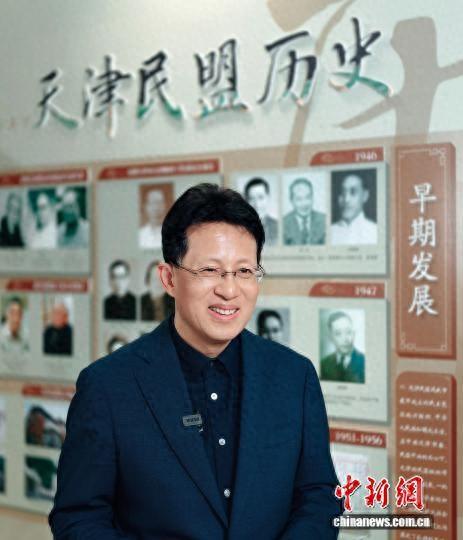
李剑萍:民盟建言天津“十五五”,一体推进教育科技人才发展
Xin Lang Cai Jing· 2026-01-25 06:54
Core Viewpoint - The integration of education, technology, and talent development is essential for China's modernization and is emphasized in recent political reports and meetings [1][3]. Group 1: Education and Talent Development - The Tianjin Municipal Political Consultative Conference emphasizes the importance of education in fostering innovative talent, with a focus on integrating education, technology, and talent development [1][3]. - Tianjin's basic education is ranked among the best in the country, providing a solid foundation for technological innovation [3]. - The Tianjin High Education Science and Technology Innovation Park serves as a key platform for talent aggregation and the transformation of scientific achievements [3][4]. Group 2: Policy and Implementation - The municipal government aims to leverage Tianjin's rich educational resources to enhance innovation capabilities and guide the development of education and technology [3][4]. - A series of policies are needed to support the transformation of scientific achievements and to attract, cultivate, manage, and utilize talent effectively [3][4]. - The "I Contribute a Strategy for Tianjin" initiative has collected over a hundred suggestions from members to improve the High Education Science and Technology Innovation Park [4]. Group 3: Community Engagement and Support - The organization has engaged in various activities to support education in remote areas, including sending experts to teach and establishing funding for educational resources [5]. - A mechanism for targeted assistance has been established to support educational institutions in the Bijie region of Guizhou, demonstrating a commitment to equitable education [5]. - The focus on education, technology, and talent is seen as a strategic foundation for China's modernization efforts [5].
“三股劲”拧成“一股绳”(教育时评)
Ren Min Ri Bao· 2026-01-10 22:09
Group 1 - The core viewpoint emphasizes the integration of education, technology, and talent as foundational and strategic support for building a modern socialist country, highlighting the need for coordinated advancement of these three elements [1][2]. - The article outlines the internal logic of this integration, suggesting that the synergy between education, technology, and talent can create a multiplier effect for high-quality development, leading to significant advancements [2]. - Current statistics indicate that China has the world's largest and high-quality education system, with a higher education gross enrollment rate of 60.8%, a talent resource total of 220 million, and over 72 million skilled workers, showcasing the robust momentum of integrated development [2]. Group 2 - The article discusses ongoing reforms aimed at advancing the integration of education, technology, and talent, including the establishment of leadership groups and innovation zones to facilitate collaboration and research [3]. - It identifies challenges that need to be addressed, such as the need for fair compensation based on merit rather than academic titles, deeper integration of industry and education, and the establishment of equitable intellectual property and benefit-sharing mechanisms [3]. - The direction for advancing this integration is clear, with a focus on fostering innovation and collaboration to drive China's modernization efforts forward [3].
培育“紫丁香”,一体推进教育科技人才发展
Ren Min Ri Bao· 2026-01-06 07:05
Core Viewpoint - The article highlights the innovative efforts of the Harbin Institute of Technology's student team, which has successfully designed and launched multiple satellites over the past decade, emphasizing the importance of interdisciplinary collaboration in education and technology development [1] Group 1: Team Structure and Achievements - The student team, known as the "Purple Lilac" team, consists of students from various disciplines such as aircraft design, microelectronics, and electrical engineering, who collaboratively create feasible satellite designs [1] - Over the past 10 years, the team has independently completed the design, development, and management of several satellites launched into space [1] Group 2: Educational Philosophy - The team operates under a "multidisciplinary mixed composition" model, aiming to leverage interdisciplinary strengths and explore deep integration of industry and education for talent cultivation [1] - The concept of "advancing education and technology talent development" is presented as a practical approach to nurturing talent, with the "Purple Lilac" platform serving as an open collaborative innovation space [1] Group 3: Future Plans - The team plans to align with the commercial space development trend by collaborating with enterprises and research institutions to create an open innovation platform, allowing more students from various disciplines to participate and grow [1]

一体推进教育科技人才发展 加快实现高水平科技自立自强(深入学习贯彻习近平新时代中国特色社会主义思想)
Ren Min Ri Bao· 2025-12-26 01:11
Core Viewpoint - The article emphasizes the importance of integrating education, technology, and talent development as a strategic approach to achieve high-quality development and technological self-reliance in China [2][4]. Group 1: Importance of Integrated Development - Xi Jinping highlights that education, technology, and talent are foundational and strategic supports for building a modern socialist country, advocating for their organic combination to enhance high-quality development [2][4]. - The integration of education, technology, and talent is seen as a necessary evolution of Marxist theory, emphasizing their interdependence and mutual support [3]. Group 2: Strategic Significance - High-quality development is deemed essential for modernizing China, with a focus on optimizing educational structures and talent cultivation to meet new production demands [4]. - The strategic decision to build a strong educational, technological, and talent framework by 2035 aims to leverage these sectors for high-quality development [4]. Group 3: Response to Technological Changes - The article discusses the need to seize opportunities presented by new technological revolutions and industrial transformations, advocating for a coordinated approach to education and talent development [5]. - It notes that the rapid pace of technological change necessitates an adaptive educational model that aligns with emerging fields and technologies [5]. Group 4: Achievements and Current Status - Since the 18th National Congress, China has made significant strides in education and technology, achieving historical advancements and establishing itself as a leader in various metrics, including the number of high-level research papers and patents [6]. - The country has developed a large and diverse talent pool, with over 220 million total talent resources and 7.24 million R&D personnel in 2023, maintaining a leading position globally [6]. Group 5: Implementation Strategies - The article outlines the need for a comprehensive approach to implement the integration of education, technology, and talent, emphasizing the importance of political leadership and policy coordination [8]. - It suggests enhancing the synergy between national strategic technology forces and major scientific tasks to foster innovation and talent development [9]. Group 6: Focus Areas for Talent Development - The article identifies key areas for talent cultivation, including artificial intelligence, integrated circuits, and biotechnology, advocating for the establishment of high-level research platforms and training bases [10]. - It emphasizes the importance of aligning educational programs with national strategic needs and enhancing the training of STEM talents [10]. Group 7: Evaluation and Incentives - The article calls for reforms in evaluation and incentive systems to stimulate innovation and commitment among scientific personnel, advocating for a shift away from traditional metrics towards more effective evaluation methods [12]. - It highlights the need for a supportive environment that encourages talent mobility and the integration of high-level talents into enterprises [12].
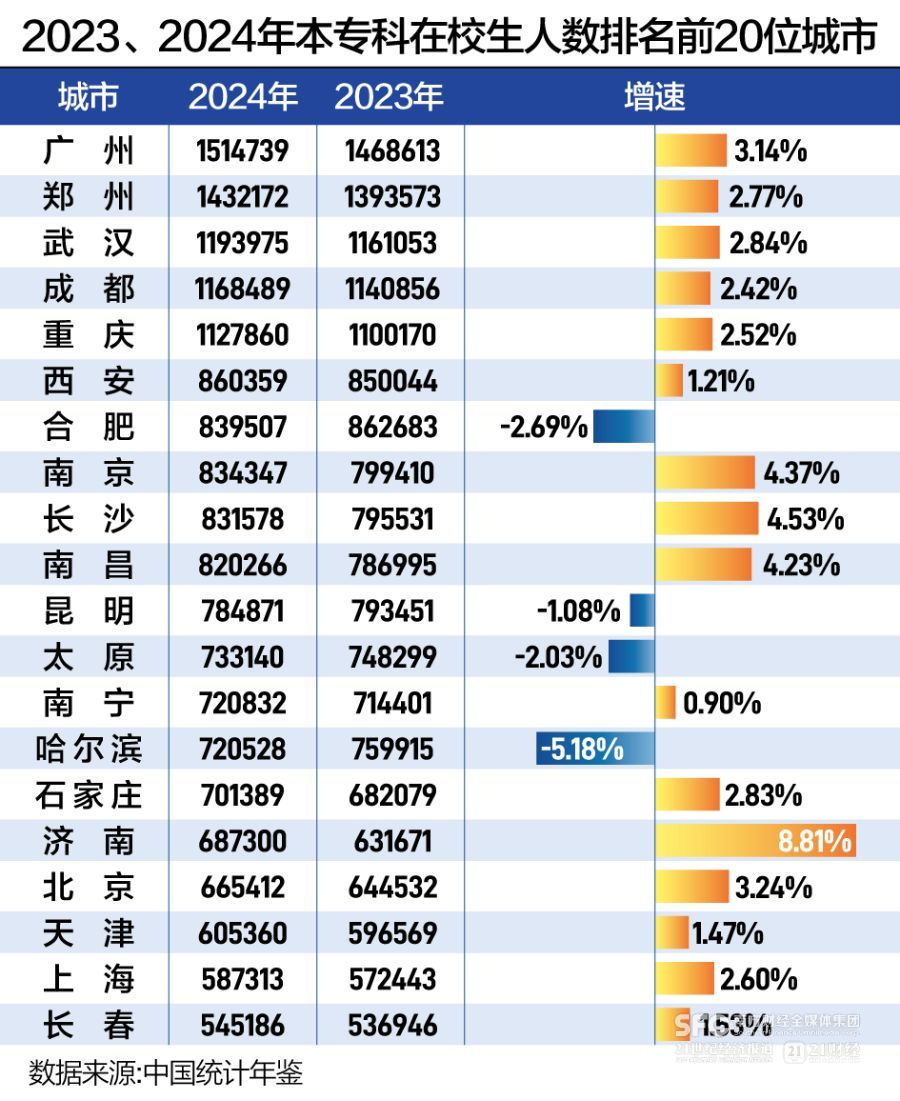
逼近170万大学生!中国高校第一城背后,城市人才格局重塑
2 1 Shi Ji Jing Ji Bao Dao· 2025-12-11 11:16
Core Insights - The number of students in higher education institutions in China continues to expand, with 10 cities now having over 800,000 students enrolled in undergraduate and vocational programs [1][3] - Guangzhou leads the country with over 1.5 million students, followed by cities like Zhengzhou, Wuhan, Chengdu, and Chongqing, which have surpassed 1 million students [1][3] - While enrollment numbers are increasing, the growth rate is slowing down, indicating a potential shift in educational dynamics [2] Enrollment Trends - From 2020 to 2024, the growth rates of undergraduate enrollment were 5.74%, 3.50%, 1.32%, 2.73%, and 2.56% respectively, showing a trend of diminishing growth [2] - The total number of students in the top 20 cities increased from 17.03 million in 2023 to 17.37 million in 2024, a growth of 1.97% [3] City-Specific Data - In 2024, Nanchang joined the "800,000 club" with 820,266 students, marking a 4.23% increase from the previous year [4][5] - Cities like Hefei, Kunming, Taiyuan, and Harbin saw a decline in student numbers, with Hefei's enrollment dropping by 2.69% [5][6] Graduate Education Development - Many cities are focusing on developing graduate education, with cities like Beijing and Shanghai having significant numbers of graduate students, indicating a shift towards higher education [6][7] - Beijing has the highest number of graduate students at 475,000, while Shanghai has 269,300, reflecting the concentration of higher education resources in major cities [6][7] Employment and Talent Retention - Cities are implementing strategies to attract and retain graduates, with initiatives like "Million College Students Stay in Wuhan" and "Ten Thousand College Students Stay in Hohhot" [10][11] - Employment opportunities and living costs are critical factors influencing graduates' decisions to stay in their respective cities [11][12] Recommendations for Cities - To retain graduates, cities should enhance job matching, improve salary competitiveness, and provide housing support [14] - Building a vibrant social and cultural environment is also essential to attract and retain young talent [14]
贯彻落实党的二十届四中全会精神权威访谈 | 勇担科技自立自强新使命 走好科技强国建设新征程——访中国科学院院长、党组书记侯建国
Xin Hua She· 2025-11-20 14:50
Core Viewpoint - The article emphasizes the importance of accelerating high-level technological self-reliance and innovation in China, as outlined in the 14th Five-Year Plan, to support the country's modernization efforts and enhance its strategic technological capabilities [1][2]. Group 1: Contributions of the Chinese Academy of Sciences - The Chinese Academy of Sciences (CAS) has played a crucial role in achieving significant technological advancements during the 14th Five-Year period, focusing on key areas such as manned spaceflight, lunar exploration, deep-sea exploration, and energy security [2][3]. - CAS has successfully overcome critical technological challenges in fields like integrated circuits, artificial intelligence, and advanced materials, providing strong technological support for industrial and supply chain security [3][4]. Group 2: Original Innovation and Key Technology Breakthroughs - CAS is committed to seizing technological development high ground by focusing on original innovation and key technology breakthroughs, aligning with national strategic needs and global scientific frontiers [4][5]. - The organization has initiated collaborative efforts involving over 100 leading institutions and nearly 10,000 experts to tackle significant technological challenges and enhance foundational research [5][6]. Group 3: Integration of Technology Innovation and Industry - CAS has actively engaged in building international technology innovation centers and regional innovation hubs, establishing mechanisms for ongoing collaboration between research institutions and central enterprises to facilitate technology transfer [7][8]. - The organization aims to optimize traditional industries and foster emerging sectors through deep integration of technological and industrial innovation, thereby supporting the construction of a modern industrial system [8][9]. Group 4: Education, Technology, and Talent Development - CAS is focused on the interconnection between education, technology, and talent development, implementing programs to cultivate top-tier innovative talent in critical fields such as artificial intelligence and quantum technology [9][10]. - The organization plans to enhance its talent cultivation structure and quality, aiming to train over 100,000 outstanding young scientific talents by 2035 [10][11].
向西挺进3000公里 在沙漠戈壁办起一所大学
Zhong Guo Qing Nian Bao· 2025-11-16 23:03
Core Viewpoint - The establishment and development of the Karamay campus of China University of Petroleum (Beijing) over the past decade exemplifies the commitment to providing quality higher education in western China, addressing educational imbalances, and supporting national strategic needs [1][5][11]. Group 1: Historical Context and Development - The Karamay campus was approved by the Ministry of Education in October 2015, marking the beginning of a significant educational initiative in a remote area 3,000 kilometers from Beijing [1]. - The campus has become a symbol of high-level engineering education in the western region, attracting numerous faculty and students motivated by the call to serve the nation [1][2]. Group 2: Educational Achievements - The undergraduate enrollment has increased from 510 to 2,820 students, with the number of provinces represented rising from 16 to 31, aiming for a total of nearly 11,000 students by 2025 [5]. - The number of undergraduate programs expanded from 6 to 26, covering various disciplines, and the campus has established a modern industry college focusing on digital and intelligent transformation of key petroleum engineering programs [5]. Group 3: Faculty Development and Support - The campus has implemented a diverse faculty recruitment strategy, combining internal transfers, local hiring, and support from other institutions, resulting in a significant increase in faculty from 47 to 523, with over 54% holding advanced degrees [6][9]. - The "Silver Age Teacher Support Program" initiated by the Ministry of Education has seen participation from numerous experienced educators, enhancing the teaching quality at the Karamay campus [6][7]. Group 4: Practical Training and Industry Collaboration - The campus has developed a robust practical training system, including 24 training facilities covering the entire petroleum and petrochemical industry chain and partnerships with 14 key enterprises [9]. - The focus on integrating education with industry needs has created a pathway for students to engage directly with real-world challenges in the energy sector [9]. Group 5: Future Directions - The university plans to expand its undergraduate and graduate programs while deepening industry-academic cooperation, aiming to become a pivotal point for quality educational resources in Xinjiang [11]. - The commitment to nurturing high-quality engineering talent that can contribute to the development of western China remains a core mission of the Karamay campus [11].