
黄金坐标系

Search documents
2026年策略展望:大类资产定价的K型背离-黄金坐标系的切换与财政风险溢
Sou Hu Cai Jing· 2025-12-07 14:53
Core Insights - The report discusses a fundamental shift in the global asset pricing paradigm from a "monetary-dominated" phase to a "fiscal-dominated" phase, characterized by significant "K-shaped divergence" among various asset classes [1][2][6] - The report highlights that U.S. equities continue to reach new highs despite ongoing employment data declines, indicating a desensitization to recession pricing [1][2] - Gold has broken free from the suppression of high real interest rates, exhibiting an independent market trend, while the relationship between copper prices and inflation expectations has weakened [1][2] Group 1: K-shaped Divergence - The K-shaped divergence is evident as U.S. stocks show a significant deviation from employment data, with a divergence degree of approximately 140%-170% for U.S. stocks and interest rates, and over 400% for gold [1][2][6] - The core driver of this divergence is the embedded "fiscal risk premium" in asset prices, which has become a critical variable since 2022 [1][2][6] Group 2: Quantitative Analysis - Quantitative assessments reveal that the divergence between nominal interest rates and implied rates for gold and copper has reached a maximum of 660 basis points since 2022 [1][2][6] - The initial phase of the fiscal risk premium has been primarily priced through extreme increases in gold, rather than directly impacting nominal interest rates [1][2][6] Group 3: Future Scenarios - Three potential macro paths for the evolution of K-shaped divergence are outlined: 1. A mild recovery scenario where the market remains in the gold coordinate system, awaiting a correction in copper prices and inflation expectations [2][6] 2. An inflation runaway scenario leading to political shocks and visible fiscal risks, resulting in soaring interest rates and a depreciation of the dollar [2][6] 3. A scenario of economic contraction where worsening employment may trigger liquidity pressures, although the safe-haven attributes of U.S. Treasuries may limit their downside [2][6] Group 4: Dollar Dynamics - The dollar's performance is significantly influenced by "relative fiscal risk," with non-U.S. economies facing earlier fiscal pressures, thereby supporting the structural strength of the dollar [2][6]


大类资产定价的 K 型背离--“财政风险溢价”的后续演变
Hua Er Jie Jian Wen· 2025-12-05 13:52
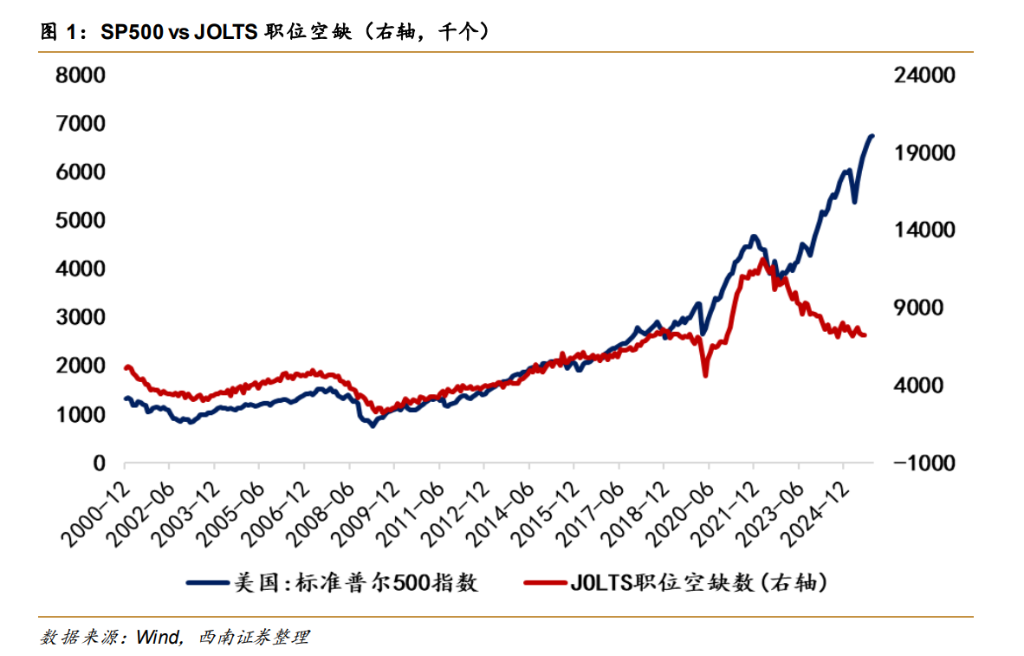
Core Viewpoint - The current market is in a dangerous and divided phase driven by "fiscal dominance," where traditional macroeconomic logic has failed, leading to a significant divergence in asset pricing, particularly between U.S. stocks and gold, which are now tools for hedging fiat currency credit risk [1][2]. Group 1: Market Dynamics - Since 2023, global asset pricing has entered a new "fiscal dominance" phase, with traditional macroeconomic transmission mechanisms largely ineffective [2]. - The market exhibits a pronounced "K-shaped divergence," where U.S. stocks continue to rise despite declining employment signals, while gold reaches new highs in a high real interest rate environment [2][3]. - The core risk stems not from the economic cycle itself but from hidden fiscal pressures, with a current implied interest rate gap of up to 600 basis points [2][10]. Group 2: Asset Pricing Changes - The traditional macro anchors have failed, leading to a decoupling of U.S. stocks from economic fundamentals, as evidenced by the S&P 500 reaching new highs despite declining job openings [3]. - Gold has completely ignored the pressures of high real interest rates, showing an independent trend that diverges from TIPS (Treasury Inflation-Protected Securities) [6]. - Copper's price movements are no longer closely tied to traditional inflation logic, indicating a broader shift in asset pricing dynamics [7]. Group 3: Quantitative Analysis - The deviation of U.S. stocks and interest rates from traditional models is significant, with a divergence of approximately 140%-170% [11]. - Gold exhibits the most extreme "decoupling" characteristics, with a deviation exceeding 400% [13]. - Copper shows a relatively moderate deviation of about 44% [16]. Group 4: Future Pathways - The implied fiscal risk premium will not disappear but will shift between different assets, with three potential macro pathways outlined: a rational return of U.S. stocks, a dual consistency between stocks and gold, and a mutual understanding between stocks and bonds [19][21]. - A mild recovery is likely in the short term, with the market remaining in a "golden coordinate system" illusion, while inflation expectations are suppressed [21]. - If inflation becomes uncontrollable due to political pressures, fiscal risks will become more apparent, leading to rising interest rates and a potential decline in risk assets [22].
黄金坐标系的切换与财政风险溢价的扩散路径:大类资产定价的K型背离
Southwest Securities· 2025-12-04 11:34
Group 1 - The report discusses a significant shift in the pricing paradigm of major assets, characterized by a "K-shaped divergence" where traditional macroeconomic anchors have failed, leading to a decoupling of asset prices from economic fundamentals [4][10][37] - The report quantifies the extent of K-shaped divergence, revealing that the S&P 500 has deviated by approximately 141% from employment data, while gold has shown an extreme deviation of over 400%, indicating a fundamental shift from a "monetary-dominated" phase to a "fiscal-dominated" phase [4][20][37] - The analysis highlights the relationship between interest rates, copper, and gold, noting that since 2022, the nominal interest rates have diverged significantly from implied rates derived from copper and gold, with a maximum gap of 660 basis points [4][38][41] Group 2 - The report introduces a unique "gold coordinate system" perspective, suggesting that in this framework, the S&P 500 aligns more closely with employment data, indicating that the stock market has transformed into a "gold-like" asset that hedges against currency depreciation [4][42][46] - The analysis of various asset models shows that the extreme divergence of the S&P 500 and gold reflects a deep-seated fiscal risk premium embedded in asset prices, with a notable 600 basis point gap between actual interest rates and implied equilibrium rates [4][59][54] - The report outlines potential macro paths for the future evolution of K-shaped divergence, including scenarios of moderate recovery, inflationary pressures leading to political shocks, and recessionary pathways, emphasizing the need for vigilance regarding mid-term recession risks [4][61][69]
