
AI云服务

Search documents
云业务投资不能停!甲骨文今年将融资500亿美元
硬AI· 2026-02-02 11:24
Core Viewpoint - Oracle plans to raise up to $50 billion by 2026 through bond and equity financing to expand its cloud infrastructure to meet the demands of major clients like AMD, Meta, NVIDIA, OpenAI, TikTok, and xAI [1][2][6]. Financing Plan Details - The financing will involve raising approximately $22.5 billion to $25 billion through equity-related instruments and common stock issuance, including mandatory convertible preferred securities and a market equity program with a maximum size of $20 billion [5]. - The remaining funds will be raised through the bond market, with a planned single bond issuance of about $22.5 billion to $25 billion in early 2026 [5]. Debt Concerns - Oracle currently has approximately $95 billion in outstanding debt, making it one of the largest corporate bond issuers outside the financial sector [2][8]. - The company's aggressive investment strategy to transition from a traditional database software provider to a cloud infrastructure provider has led to significant debt accumulation [8]. Market Position and Criticism - Michael Burry, a well-known short seller, has criticized Oracle for its "unnecessary heavy asset expansion" and fragile financial structure, labeling it as a "pure AI bubble vehicle" [3][10]. - Burry's concerns highlight that Oracle's stock price is heavily reliant on the narrative of surging AI cloud service demand, which poses a risk if such demand does not materialize [11].



云业务投资不能停!甲骨文今年将融资500亿美元
Hua Er Jie Jian Wen· 2026-02-02 01:12
Core Viewpoint - Oracle plans to raise up to $50 billion by 2026 through bond and equity financing to expand its cloud infrastructure to meet the demands of major clients, amidst concerns regarding its debt burden and heavy asset transformation strategy [1][4]. Group 1: Financing Plan Details - Oracle intends to raise approximately $22.5 billion to $25 billion through equity-related instruments and common stock issuance, including mandatory convertible preferred securities and a market equity program of up to $20 billion [2]. - The remaining funds will be sourced from the bond market, with a planned single bond issuance in early 2026, estimated at $22.5 billion to $25 billion [2]. Group 2: Client Contracts and Market Position - The funds will specifically be used to expand cloud infrastructure capacity to fulfill contracts with major clients, including key players in the AI industry such as AMD, Nvidia, OpenAI, TikTok, and Meta [3]. Group 3: Debt Concerns and Market Criticism - Oracle currently has approximately $95 billion in outstanding debt, making it one of the largest corporate bond issuers outside the financial sector, raising concerns about its financial sustainability [4]. - Critics, including notable short-seller Michael Burry, have expressed concerns over Oracle's aggressive asset expansion and fragile financial structure, labeling it as a "pure AI bubble vehicle" [4][5]. - Burry argues that Oracle's high-risk transformation under heavy debt could lead to significant vulnerabilities if AI demand does not meet expectations, contrasting it with tech giants like Microsoft and Google that have stronger financial cushions [5][6].
捡剩饭、傍大款,甲骨文拿命搏生存?
3 6 Ke· 2026-01-23 01:51
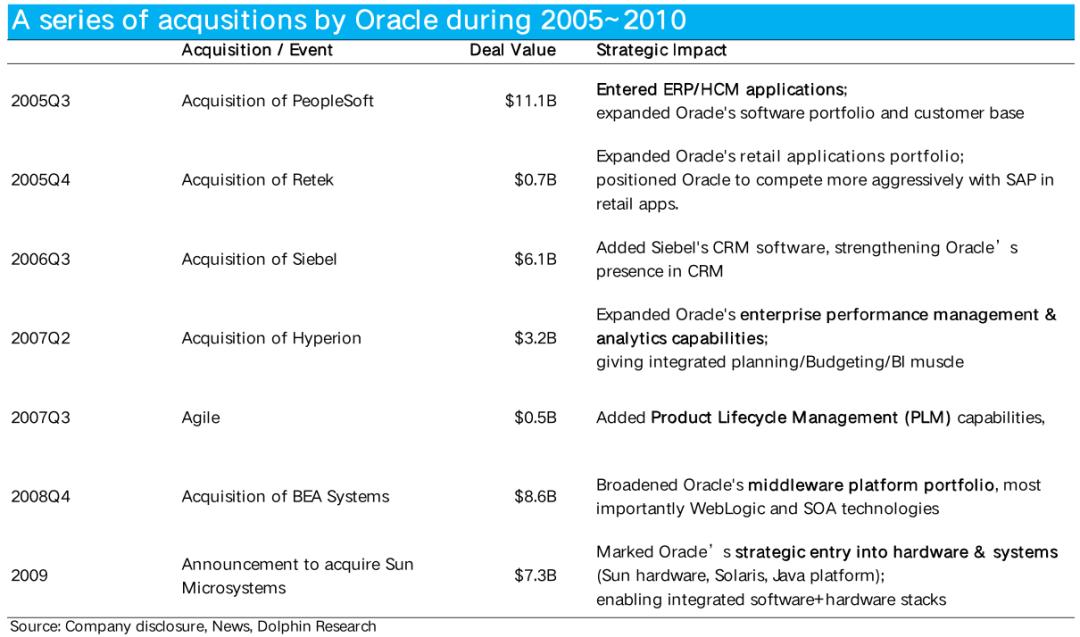
Company History - Oracle has evolved from a traditional database management company established over 50 years ago to a significant player in the cloud services industry, particularly in AI cloud services [1][5]. - The company initially focused on relational database management systems and gradually diversified into enterprise management software, including ERP, CRM, and HCM solutions through both internal development and strategic acquisitions [2][4]. - After acquiring Sun Microsystems, Oracle expanded into hardware and operating systems, integrating its software and hardware offerings into comprehensive solutions [3][5]. Business Structure and Revenue Composition - Oracle's business segments are now classified into four main categories: Cloud, Software, Hardware, and Services, with the cloud segment being the most critical for revenue growth [10][11]. - The cloud business is further divided into IaaS (Oracle Cloud Infrastructure - OCI) and SaaS (Oracle Cloud Applications - OCA), with OCI rapidly gaining importance and surpassing OCA in revenue contribution [12][13]. - Traditional software and hardware segments have seen stagnant or declining growth, with software revenue dropping from over 60% to less than 40% of total revenue [14][15]. Key Trigger Point - $300 Billion Order - Oracle announced a staggering $300 billion in new demand contracts, equivalent to 5.8 times its total revenue for the fiscal year 2025, indicating a significant growth trajectory [25][26]. - The revenue guidance for fiscal years 2026 to 2030 suggests a compound annual growth rate of 31%, with OCI expected to grow from approximately $10 billion in 2025 to $166 billion by 2030 [25][26]. - The majority of this new order is believed to come from OpenAI, with a substantial annual contract value of around $60 billion starting from fiscal year 2027 [31][32]. Partnership with OpenAI - Oracle has replaced Microsoft as OpenAI's primary cloud service partner, which has led to significant revenue opportunities but also comes with risks associated with customer concentration [34][36]. - The partnership allows Oracle to leverage OpenAI's technology while providing substantial cloud computing resources, although it raises concerns about the quality and sustainability of the business [36][39]. - Oracle's reliance on a single client for a large portion of its revenue could pose risks, similar to those faced by other cloud service providers with concentrated customer bases [37][39]. Summary of Opportunities and Risks - Oracle's future growth heavily depends on the success of its OCI business, which is critical for the company's survival as traditional business segments decline [45]. - The company faces challenges related to high capital expenditures and debt levels, which could strain its financial health if not managed properly [39][40]. - While the partnership with OpenAI presents significant revenue potential, it also carries risks of over-reliance on a single client and the possibility of unfulfilled contracts [46].
字节彻底爆发了?
虎嗅APP· 2025-12-02 00:01
Core Viewpoint - ByteDance has officially entered the operating system market with the launch of the Doubao mobile assistant, which redefines the AI mobile era by enabling proactive task management across multiple applications [5][8]. Group 1: Product Launch and Market Reaction - The Doubao mobile assistant can perform various tasks such as ticket booking, file downloads, and service comparisons, showcasing a significant advancement in AI capabilities from passive responses to active task management [5]. - Following the announcement, ZTE's stock surged to its limit in A-shares, and Hong Kong stocks rose over 13%, indicating strong market anticipation for AI agent applications [7]. Group 2: Industry Trends and Competitive Landscape - The AI industry has seen rapid iteration over the past six months, with a shift towards multi-modal capabilities becoming a core trend, contrasting with the previous year's focus on single-modal models [8]. - The demand for AI agents has surged, as evidenced by the explosive growth in "Function Call" requests, highlighting a critical market need for these capabilities [8]. - The recent Gartner report ranked Volcano Engine as the top Chinese AI application development platform, surpassing Alibaba Cloud and Tencent Cloud in execution ability, and placing it fourth globally in multi-modal capabilities [9][12]. Group 3: Competitive Strategies and Market Position - The competition among major cloud service providers has intensified, with Volcano Engine leveraging its model capabilities to gain market share in the MaaS (Model as a Service) era, while traditional players like Alibaba Cloud and Tencent Cloud are adapting their strategies [15][25]. - Volcano Engine's aggressive pricing strategy has significantly increased its platform usage, with daily token processing reaching 30 trillion, a 25,300% increase since its launch [27]. - Despite the rapid growth, concerns remain about the sustainability of Volcano Engine's business model, as it relies heavily on API calls and may struggle to scale profitably compared to established players [30][32]. Group 4: Future Outlook and Industry Dynamics - The AI cloud market is expected to consolidate, with only a few leading players remaining by 2026, emphasizing the need for continuous innovation and cost-effective solutions [35]. - The shift from IaaS to MaaS signifies a fundamental change in cloud service dynamics, with a focus on intelligence rather than just resource provision [36]. - The competitive landscape is characterized by a race for technological advancement and market share, with companies needing to balance model capabilities and engineering efficiency to remain relevant [38][40].

IREN (IREN.US)Q1营收同比大幅增长355%超预期 净利润扭亏为盈至3.846亿美元
Zhi Tong Cai Jing· 2025-11-06 23:58
Financial Performance - For the quarter ending September 30, 2025, the company reported total revenue of $240.3 million, a significant increase of 355% compared to $52.8 million in the first quarter of fiscal 2025, exceeding analyst expectations of $235.5 million by approximately 2.04% [1] - The company achieved a net profit of $384.6 million, recovering from a net loss of $51.7 million in the same period last year [1] - Adjusted EBITDA surged to $91.7 million, a staggering increase of 3568% year-over-year from $2.5 million, while EBITDA reached a record $662.7 million, compared to a loss of $18.8 million in the previous year [1] Business Segmentation - The primary revenue source showed significant differentiation, with Bitcoin mining contributing $232.9 million and AI cloud services generating $7.3 million in revenue [1] - The company mined 2,039 Bitcoins during the quarter, a 150% increase from 813 Bitcoins mined in the same period last year, driven by an increase in average operational hash rate to 45.3 EH/s [1] Operating Expenses and Financial Instruments - Operating expenses rose to $236 million, primarily due to increases in depreciation, stock-based compensation, and impairment costs [1] - The company recorded an unrealized gain of $665 million related to financial instruments associated with convertible note transactions during the quarter [1] Financing and Capital Structure - As of October 31, 2025, the company had $1.8 billion in cash and cash equivalents, maintaining strong liquidity [2] - On October 14, 2025, the company successfully issued $1 billion in zero-coupon convertible bonds, and with an additional $200 million GPU financing, the total financing amount reached $400 million [2] Strategic Outlook - The company continues to expand its AI cloud services business, recently signing a $9.7 billion GPU service contract with Microsoft for its facility in Childress, Texas, marking a strategic shift towards AI cloud services [2] - The company has signed multiple contracts totaling approximately 5,000 GPUs for AI cloud services and maintains $1.03 billion in cash and cash equivalents [2] - For 2026, the company aims to achieve an annual recurring revenue (ARR) of $3.4 billion from AI cloud services by year-end, expanding GPU capacity to 140,000, and targeting an ARR of over $500 million by the end of Q1 2026 through new multi-year contracts with partners [2]

与OpenAI签署380亿美元算力供应协议 亚马逊开盘涨超4%
Di Yi Cai Jing· 2025-11-03 15:46
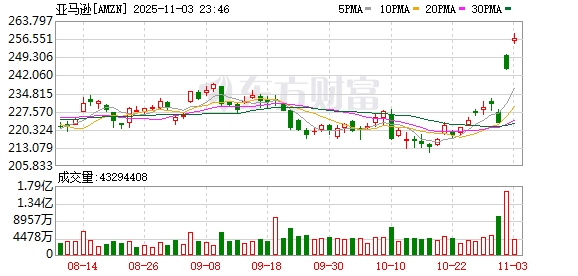
Core Insights - Amazon announced a long-term strategic partnership with OpenAI, involving a financial commitment of $38 billion, with OpenAI utilizing AWS for its AI workloads [2] - The partnership will leverage Amazon EC2 UltraServers, providing access to hundreds of thousands of NVIDIA GPUs and the potential for millions of CPUs, with infrastructure expected to be fully deployed by the end of 2026 [2] - OpenAI's CEO stated that the company's revenue exceeds $13 billion, and the significant infrastructure investments are seen as a forward-looking bet to become a major AI cloud service provider [4] Financial Performance - Amazon reported a 12% increase in net sales for Q3 2025, reaching $180.2 billion, with a net profit of $21.2 billion, marking a 38.6% year-over-year growth [4] - AWS growth has reached its highest level since 2022, driven by strong demand for AI and core infrastructure [4] Industry Trends - There is a growing trend among Silicon Valley AI companies to expand partnerships with computing power providers to secure necessary resources, with OpenAI favoring GPU usage over proprietary AI chips [3] - Recent discussions in the market have raised concerns about a potential AI bubble, questioning whether the substantial investments in AI infrastructure will yield the expected capital returns [4]

沙利文AI云报告:阿里百度合计份额超五成,双雄格局初现
Cai Fu Zai Xian· 2025-10-27 05:11
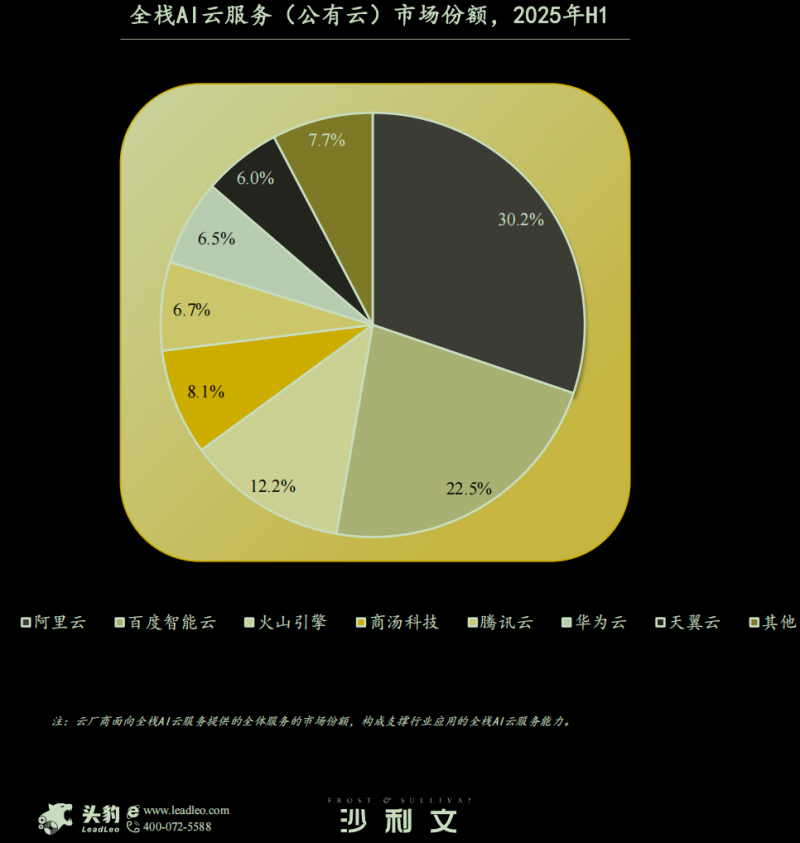
Core Insights - The report by Frost & Sullivan indicates that the Chinese full-stack AI cloud service market is projected to reach 25.9 billion yuan in the first half of 2025, with Alibaba Cloud holding a 30.2% market share and Baidu Smart Cloud at 22.5%, together surpassing 50% market share, establishing a duopoly in the AI cloud sector [1][3][4] Market Dynamics - The competition in AI cloud services has entered an "ecosystem war" phase, requiring cloud vendors to integrate services at different levels and build a triad model of IaaS, PaaS, and MaaS to enhance competitive capabilities [3][4] - High investment in AI strategies by Baidu and Alibaba has led to significant returns, as evidenced by their consistent top rankings in various third-party research reports [3][4] Company Strategies - Baidu and Alibaba have been early adopters of AI application transformation, with Baidu aiming to revamp all its products using AI and Alibaba pushing for comprehensive "AIification" of its existing business [4][5] - Both companies have adopted a full-stack approach to AI cloud services, creating a self-research closed loop from chips and computing power to models and applications [4][5] Financial Performance - In the first half of 2025, Baidu's AI new business revenue reached 19.4 billion yuan, marking a 36% year-on-year growth, the highest among cloud vendors, while Alibaba Cloud's revenue grew by 22% [5] External Collaborations - Baidu and Alibaba have been increasingly visible in external collaborations, including joint advertising efforts and partnerships with Apple for AI technology support, which may lead to significant market opportunities by the end of 2025 [6][8]


报告:上半年阿里、百度智能云市场份额位居中国AI云市场前二
Ge Long Hui A P P· 2025-10-27 04:52
Core Insights - The report by Sullivan indicates that the Chinese full-stack AI cloud service market is projected to reach a scale of 25.9 billion yuan in the first half of 2025 [1] Company Summaries - Alibaba Cloud holds the largest market share at 30.2%, making it the leading player in the Chinese full-stack AI cloud service market [1] - Baidu Smart Cloud ranks second with a market share of 22.5%, contributing to a combined market share of over 50% for the top two companies [1]
华为云CEO张平安连降三等,多名云业务高管被问责
Nan Fang Du Shi Bao· 2025-10-17 09:26
Core Viewpoint - Huawei's cloud computing CEO, Zhang Pingan, has been demoted due to internal disciplinary actions related to cloud business fraud and economic misconduct, reflecting significant management issues within Huawei's cloud division [1][4]. Group 1: Internal Disciplinary Actions - On September 23, Huawei's Discipline Inspection Committee issued penalties against Zhang Pingan, resulting in a three-level demotion and a severe warning, with his salary adjusted to the maximum of the new rank [1]. - Other executives, including Zhang Yuxin, Shi Jilin, and Kang Ning, were also demoted by two levels for inadequate management [1]. - Huawei's internal ranking system consists of 10 main levels, with further subdivisions, indicating that a three-level drop for Zhang Pingan means moving from level 22a to 21a [1]. Group 2: Zhang Pingan's Background - Zhang Pingan, born in 1972 and a Zhejiang University graduate, has held various significant positions within Huawei since joining in 1996, including roles in product lines, strategy, and cloud services [4]. - Previously, he was under the leadership of Yu Chengdong, a prominent figure in Huawei, but now ranks higher than him in the current board structure [4]. Group 3: Huawei Cloud Business Adjustments - In August, Huawei made substantial organizational changes to its cloud business unit, merging and eliminating several core departments, potentially affecting thousands of employees [4]. - The restructured Huawei Cloud will focus on a "3+2+1" business model, emphasizing computing, storage, AIPaaS, databases, and security [4]. Group 4: Market Position and Financial Performance - At the Huawei Connect conference, Zhang Pingan highlighted advancements in AI cloud services and the company's commitment to enhancing cloud offerings through innovation [5]. - According to IDC, the Chinese AI public cloud service market is projected to reach 19.59 billion yuan in 2024, with Baidu and Alibaba leading the market [5]. - Huawei's annual report indicates that its cloud computing business is expected to generate 38.523 billion yuan in revenue for 2024, reflecting an 8.5% year-on-year growth [5].

Tokens经济崛起:中国AI云服务半年用量飙四倍,火山引擎领跑市场
2 1 Shi Ji Jing Ji Bao Dao· 2025-10-17 07:47
Core Insights - The AI market driven by large models is accelerating with a new metric, Token consumption, becoming a "real benchmark" for AI application deployment [1] - The IDC report reveals a staggering growth projection, with the volume of large model calls on public cloud in China expected to reach 536.7 trillion Tokens in the first half of 2025, a nearly 400% increase from 114 trillion Tokens in 2024 [1] - The market landscape is becoming clearer, with Volcano Engine holding a 49.2% market share, expanding its lead from 46.4% in 2024 [1] Market Dynamics - Volcano Engine leads the Chinese large model public cloud service market with a 49.2% share, followed by Alibaba Cloud at 27.0% and Baidu Smart Cloud at 17.0% [2] - A different report by Omdia shows Alibaba Cloud leading with a 35.8% share when considering the entire cloud service chain, indicating a shift from infrastructure competition to deepening model applications [2] Token Consumption as a Metric - The choice of "Token call volume" as a core statistic reflects a rethinking of evaluation standards in the AI industry, focusing on actual model usage rather than just computational supply [3] - Token consumption is closely tied to application deployment, showcasing a more sustainable and exponentially growing model for the AI industry [4] Growth Catalysts - Two key technological breakthroughs have significantly impacted market growth: the first in July 2024, when the YoY growth rate for large model public cloud services exceeded 160% following cost reductions from the Doubao model [5][6] - The second breakthrough occurred in February 2025, marked by the popularity of the DeepSeek-R1 inference model, indicating a shift from model training to inference services [6] Volcano Engine's Competitive Edge - Volcano Engine's rapid growth in the large model business is attributed to its strategic, technological, and scale advantages [7] - The Doubao model family has a leading iteration speed in the industry, covering multiple modalities including text, image, audio, and video [8] - The performance of Volcano Engine's MaaS platform, "Volcano Ark," has been significantly enhanced, with output rates for the DeepSeek-R1 model being 2.6 times that of some competitors [9] Industry Penetration - The AI cloud service market is expanding from the internet sector into traditional industries, with Volcano Engine serving major clients across various sectors, including automotive and finance [10] - The market is expected to have hundreds of times growth potential, with multi-modal models and Agent applications driving future growth [11] Future Trends - Volcano Engine is continuously upgrading its products and services, recently launching several new models and a "smart model routing" service to balance performance and cost [11] - The daily Token consumption has surpassed 30 trillion, reflecting a growth of over 80% since May 2025 [11] - The competition in the "Tokens economy" will favor those who provide the best performance at the lowest cost, shaping a more mature ecosystem in the AI cloud market [12]