
AI开发

Search documents
Claude手搓3D建筑编辑器火爆GitHub!数万年费的专业软件瑟瑟发抖
量子位· 2026-03-29 04:24
Core Viewpoint - The article introduces Pascal Editor, a web-based 3D architectural design tool that eliminates the need for expensive software subscriptions and installations, allowing users to design directly in their browser with ease and efficiency [1][7]. Group 1: Product Features - Pascal Editor is an open-source project that quickly gained popularity on GitHub, reaching 5.4k stars shortly after its launch [7]. - The tool integrates essential design functions such as selecting areas, placing furniture, and adjusting perspectives into a single, user-friendly toolbar [10][13]. - It offers real-time geometric processing, allowing users to modify building components easily, with a focus on a seamless user experience [13][22]. - The latest version (v0.3.0) introduced 2D editing capabilities, enabling users to view and edit designs in both 2D and 3D simultaneously for improved accuracy [27][28]. Group 2: Technical Aspects - Pascal Editor utilizes WebGPU technology, which enhances performance by leveraging the computer's graphics card, resulting in smooth operations even with complex structures [31][32]. - The application supports various visual effects, such as stacking and exploding views, to facilitate better spatial understanding during the design process [24][25]. Group 3: Market Implications - The availability of a free, browser-based design tool like Pascal Editor could disrupt the traditional architectural software market, appealing to interior designers, gaming enthusiasts, and real estate agents [1][9]. - The article highlights the potential for individual users to operate a virtual game development studio using Claude, an AI-driven project that provides access to numerous specialized AI agents for game development tasks [34][38].


马斯克“世纪大合并”:一场对xAI的单方面输血
华尔街见闻· 2026-02-03 10:43
Core Viewpoint - The merger of SpaceX and xAI aims to create a "space data center," but immediate cash needs are a pressing concern for xAI, which has only been operational for three years [2][4]. Group 1: Financial Overview - SpaceX's valuation is set at $1.5 trillion, while xAI is valued at $250 billion following a completed registration on February 2 [3]. - xAI burned approximately $9.5 billion in cash over the first nine months of 2025, with revenues of only about $210 million, significantly lagging behind competitors like OpenAI and Anthropic [4][9]. - In contrast, SpaceX generated $1 to $2 billion in free cash flow last year, driven by the growth of its Starlink satellite internet business, with total revenues reaching around $16 billion [11]. Group 2: Investor Sentiment - Some SpaceX investors reacted negatively to the merger, with shares of EchoStar, a major shareholder, dropping nearly 5% since the announcement [6][7]. - Investors are seeking more clarity on the narrative surrounding the merger, as expressed by Michael Sobel from Scenic Management [8]. Group 3: Strategic Implications - The ambitious plan for a "space data center" is met with skepticism, as the feasibility and cost-effectiveness of generating AI computing power in space remain uncertain [13]. - The merger complicates SpaceX's IPO ambitions, as the financial strain from xAI's cash burn could overshadow its recent successes in the rocket launch sector [10][11]. Group 4: Regulatory Environment - The current regulatory landscape is favorable for Musk, with the Trump administration rolling back various regulations that could impact the merger [15]. - The Federal Trade Commission is now led by Andrew Ferguson, who is less likely to block large tech deals compared to previous leadership [15]. Group 5: Historical Context - Musk has a history of complex transactions, such as the acquisition of SolarCity and the leveraged buyout of Twitter, which have involved significant financial maneuvering [17]. - The interconnected nature of Musk's ventures creates a "Musk economy," where the success of one entity is crucial for the stability of others [18].


马斯克“世纪大合并”:一场对xAI的单方面输血
Hua Er Jie Jian Wen· 2026-02-03 08:34
Core Viewpoint - Elon Musk has merged SpaceX with AI startup xAI to build a "space data center," but this vision will take at least two to three years to realize, while xAI's immediate need is cash [1]. Group 1: Financial Overview - SpaceX has valued xAI at $250 billion and itself at $1.5 trillion, seeking to raise $50 billion at this valuation [1]. - xAI burned approximately $9.5 billion in cash over the first nine months of 2025, with revenues of only about $210 million, significantly lagging behind competitors like OpenAI and Anthropic [3]. - SpaceX generated $1 to $2 billion in free cash flow last year, with revenues reaching around $16 billion and EBITDA of about $8 billion [4]. Group 2: Investor Sentiment - Some SpaceX investors reacted negatively to the merger, with EchoStar's stock dropping nearly 5% since news of the transaction emerged [2]. - Investors are seeking more clarity on the narrative surrounding the merger and its implications for SpaceX [2]. Group 3: AI Development Challenges - xAI's financial situation highlights the rapid cash consumption in AI development, with monthly expenditures exceeding $1 billion for high-end chips and data center construction [3]. - Musk has expressed frustration over delays in the new Grok AI model, reflecting broader challenges faced by AI companies [4]. Group 4: Strategic Ambitions - Musk aims to establish a "space data center" within two to three years, believing that the lowest cost for generating AI computing power will be achieved in space [6]. - SpaceX has ambitious plans to launch up to 1 million satellites into orbit as part of this data center initiative, complicating its existing project commitments [7]. Group 5: Regulatory Environment - The current regulatory environment is favorable for Musk, with the Trump administration rolling back various regulations that could impact the merger [8]. - Musk's connections, including a former SpaceX investor now leading NASA, may facilitate the expansion of contracts with the agency [8]. Group 6: Historical Context of Mergers - Musk has a history of rapid mergers and acquisitions, such as Tesla's $2.6 billion acquisition of SolarCity, which he was heavily involved in [9]. - The interconnected nature of Musk's ventures creates a "Musk economy," where the success of one entity supports the others, fostering investor confidence [10].
金山云星流全面升级,副总裁刘涛:四大模块能力实现“开箱即用”的AI开发体验
Xin Lang Cai Jing· 2026-01-21 12:42
Core Insights - Kingsoft Cloud's intelligent computing platform, StarryFlow, has completed a strategic upgrade from a resource management platform to a one-stop AI training and inference platform [1][3] - The upgraded StarryFlow platform creates a full-loop ecosystem that includes heterogeneous resource scheduling, self-healing for training task failures, support for robotic industry applications, and commercialization of model API services [1][3] Platform Efficiency - The StarryFlow training and inference platform offers complete lifecycle management from model development to inference, featuring four key capabilities: development, training, inference, and data processing [1][3] - By reducing the complexity of multi-module collaboration, the platform enables an "out-of-the-box" AI development experience [1][3] - The self-developed GPU self-healing technology, combined with task observability design, allows for real-time monitoring of hardware health and task progress, automatically triggering fault migration and task rescheduling to minimize computing interruptions and ensure stable long-term training task operations [1][3] Robotic Platform Integration - The StarryFlow robotic platform deeply integrates core processes such as data collection, storage, annotation, model development, training, deployment, and simulation, creating a unified engine for data, models, and simulation tailored to specific scenarios [2][4] - The model API service on the StarryFlow platform provides high availability and easy integration for model invocation and management, covering the entire lifecycle of model usage [2][4] - This service supports high-concurrency inference and multi-model management, enabling users to efficiently access various model resources, thus facilitating the implementation of large model applications [2][4] - Currently, the StarryFlow platform's model ecosystem supports nearly 40 different models, including DeepSeek, Xiaomi MiMo, Qwen3, and Kimi, allowing clients to access multiple models through a one-stop interface while focusing on AI business innovation and value creation [2][4]
估值1亿的"死了么"APP有多好抄?5分钟AI就能复刻,去年有人一下午做出原型
AI前线· 2026-01-14 06:33
Core Viewpoint - The "死了么" app, now renamed Demumu, has experienced explosive growth following its launch, with a 100-fold increase in downloads and a valuation soaring to 100 million yuan. The app aims to provide safety for solitary individuals, particularly targeting the younger generation living alone [2][11][14]. Group 1: App Development and Features - The app was initially developed with a cost of just over 1,000 yuan and was created by a team of three individuals born in the 1990s, who worked remotely [11][12]. - The core functionality of the app is simple: users fill in their name and emergency contact, and if they do not check in for two consecutive days, an email is sent to the emergency contact [11]. - The app's pricing has increased from 1 yuan to 8 yuan to ensure sustainable development and cover rising operational costs [11]. Group 2: Market Response and Competition - Following the app's success, it has topped the paid app charts in multiple countries, including Singapore, Belgium, and the Netherlands, indicating strong international interest [12]. - The app's name change to Demumu has sparked debate, with some users believing the original name contributed significantly to its popularity [16]. - Several similar apps have emerged in the market, including "活了么," which is a free version, highlighting the competitive landscape that has developed in response to the original app's success [16]. Group 3: Investment and Valuation - The company behind the app has engaged with multiple investors, planning to sell 10% of the company for 1 million yuan, which reflects an initial valuation of 10 million yuan [14]. - The app's user base has reportedly grown by 800 times, leading to a current valuation of nearly 100 million yuan as of the latest updates [14].

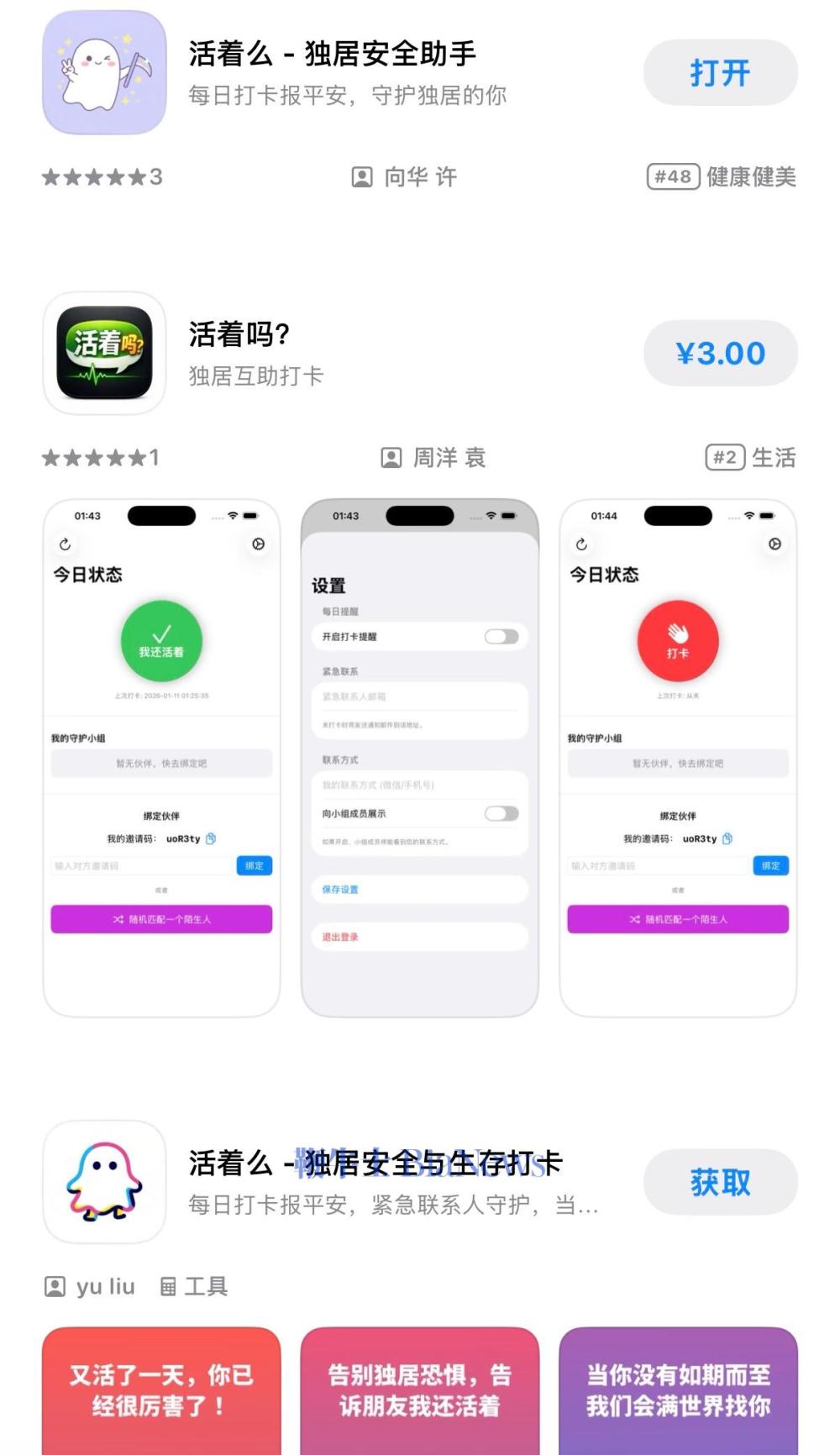
死了么App爆火后更名,有开发者用AI 6小时做出「活着么」
Di Yi Cai Jing· 2026-01-14 03:20
Core Viewpoint - The "Dead or Alive" app, which gained significant attention due to its name, has officially rebranded to "Demumu" to promote a global identity while continuing to focus on safety for solitary individuals [1][12]. Group 1: App Performance and User Engagement - The app has seen explosive growth, ranking first on the Apple App Store's paid list for four consecutive days starting January 10, with daily new user registrations increasing to 500 times the pre-viral rate [1]. - Within three days, over 60 investors approached the app's team, raising its valuation to several tens of millions [2]. - The app's initial development cost was under 1,500 yuan, and it features a simple daily check-in function that alerts emergency contacts if the user fails to check in for two consecutive days [5][10]. Group 2: Competition and Market Dynamics - Following the app's success, a competing app named "Alive or Not" was developed in just six hours using AI, highlighting the low technical barriers for creating similar applications [2][6]. - Industry experts noted that the low technical threshold makes it easy for similar apps to be replicated, and many new variants have already appeared in the App Store [2][10]. - The app's core value is perceived as limited, with the potential for user retention being low unless new features that resonate emotionally with users are developed [10][11]. Group 3: Target Audience and Future Prospects - The app primarily targets young individuals aged 25 to 35 in first- and second-tier cities, with a focus on solitary young women [11]. - Despite its current popularity, the app's long-term viability is questioned, as many similar applications have short lifespans unless they can establish a deeper connection with users [10][11]. - The app's team initially aimed to sell 10% of the company for 1 million yuan, but due to investor interest, the price has surged to nearly 10 million yuan, indicating strong market interest [12].
死了么App爆火后更名 有开发者用AI 6小时做出“活着么”
Di Yi Cai Jing· 2026-01-14 02:52
Core Viewpoint - The "Dead or Alive" app, which gained significant attention due to its name, has officially rebranded to "Demumu" to promote a global identity while continuing to focus on safety for solitary individuals [1][12]. Group 1: App Performance and User Engagement - The app has seen explosive growth, ranking first on the Apple App Store's paid list for four consecutive days starting January 10, with daily new user numbers increasing to 500 times the previous rate [1]. - In just three days, over 60 investors expressed interest, raising the app's valuation to several tens of millions [1][11]. - The app's initial user base primarily consists of young women aged 25 to 35 living in first- and second-tier cities, indicating a target demographic focused on entertainment rather than long-term engagement [11]. Group 2: Development and Competition - The app was developed by a team of three individuals with minimal costs, reportedly under 1,500 yuan, and features a simple daily check-in function [5][6]. - A competing app, "Alive or Not," was created within six hours using AI technology, highlighting the low technical barriers for replication in this market [2][5]. - Industry experts note that the low technical threshold makes such apps easy to replicate, with many similar applications already appearing in the App Store [2]. Group 3: Market Challenges and Future Outlook - Despite initial success, the longevity of such apps is questioned, as their core value is perceived to be limited, and user retention may decline over time [9][11]. - The app's concept was inspired by community discussions and internet trends, but it faces criticism for potential plagiarism regarding its design and functionality [12][13]. - The app's future success may depend on its ability to innovate and connect emotionally with users, as many similar apps have failed to maintain user interest [9][11].
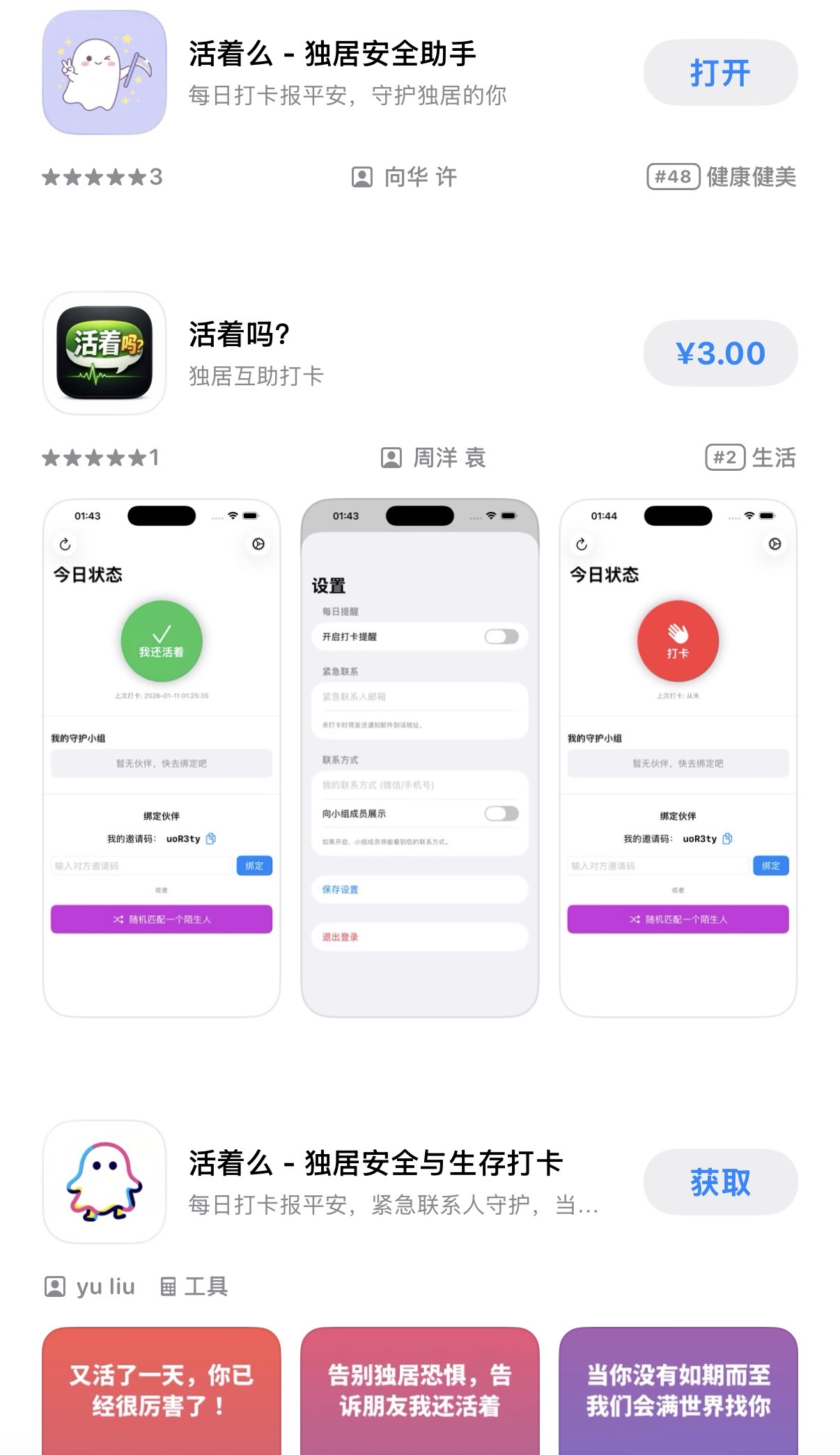
“死了么”App更名,有开发者用AI 6小时做出“活着么”
Di Yi Cai Jing Zi Xun· 2026-01-14 00:56
Core Viewpoint - The app "死了么" has officially rebranded to "Demumu" after gaining significant attention and user growth, with a focus on promoting safety solutions for solitary individuals globally [2][12]. Group 1: App Performance and User Growth - "Demumu" reached the top of the Apple App Store paid chart for four consecutive days starting January 10, with daily new user numbers increasing to 500 times pre-viral levels [2]. - The app's valuation has surged to several tens of millions, with over 60 investors expressing interest within three days [12][13]. Group 2: Competition and Market Dynamics - The low technical barrier for similar apps has led to the emergence of multiple clones, including "活着么," which was developed in just six hours using AI tools [3][6]. - Industry experts suggest that the success of such apps often relies on luck rather than technical complexity, with many similar apps failing to achieve lasting popularity [3][11]. Group 3: Development Insights - The development cost of "死了么" was under 1500 yuan, and its functionality is relatively simple, primarily involving daily check-ins and emergency notifications [6]. - The developer of "活着么" utilized AI to streamline the development process, completing the project in less than six hours, highlighting the potential of AI in app development [9][10]. Group 4: User Demographics and Market Potential - The primary target demographic for "Demumu" includes young adults aged 25 to 35 in first- and second-tier cities, with a focus on solitary individuals [12]. - Despite initial popularity, the app's long-term retention may be challenged, as users may prefer more established platforms that can integrate similar functionalities [12]. Group 5: Controversies and Challenges - The app has faced criticism for alleged plagiarism regarding its concept and design, with claims that it closely resembles a previously released concept video [13]. - The team behind "Demumu" asserts that the app's idea was inspired by community discussions rather than any single individual's input [13].

死了么App爆火后更名,有开发者用AI 6小时做出“活着么”
Di Yi Cai Jing· 2026-01-14 00:25
Core Viewpoint - The "Die or Not" app, which gained rapid popularity, has rebranded to "Demumu" and aims to expand its services globally, targeting the safety of solitary individuals [1][12]. Group 1: App Popularity and User Growth - The app reached the top of the Apple App Store's paid chart for four consecutive days starting January 10, with daily new user numbers increasing to 500 times prior levels [1]. - Over a span of three days, more than 60 investors expressed interest, raising the app's valuation to several tens of millions [2][11]. - The app's initial development cost was under 1,500 yuan, and it was designed to send alerts to emergency contacts if users fail to check in for two consecutive days [5][10]. Group 2: Competition and Replication - The low technical barrier of the app has led to the emergence of similar applications, such as "Alive or Not," which was developed in just six hours using AI tools [2][5]. - Industry experts noted that the ease of replication for such apps poses a significant challenge for long-term success [2][9]. Group 3: Market Positioning and Target Audience - The app primarily targets young adults aged 25 to 35 in first- and second-tier cities, focusing on solitary individuals, particularly young women [10]. - There is skepticism about the app's long-term viability, as many similar applications have short lifespans unless they can establish a deeper emotional connection with users [9][10]. Group 4: Investment and Future Prospects - The app's valuation surged from an initial offer of 1 million yuan for 10% equity to nearly 10 million yuan due to competitive bidding among investors [11]. - Investors are attracted by the potential for user aggregation and various monetization strategies, including advertising and potential shifts towards social and entertainment features [11]. Group 5: Controversies and Challenges - The app has faced accusations of plagiarism regarding its concept and logo, with claims that it closely resembles a previously released concept video [11][12]. - The team asserts that the app's idea originated from community discussions rather than a single source, emphasizing the collaborative nature of its development [12].
阿里千问Qwen Code更新至v0.5.0版本,推出VSCode插件,发布TypeScript SDK
Ge Long Hui A P P· 2025-12-31 00:49
Core Insights - The update to Qwen Code version 0.5.0 marks a significant transition from a "command-line tool" to a "development ecosystem" [1] Group 1: Product Enhancements - The update includes functional enhancements that improve the overall capabilities of Qwen Code [1] - The official launch of the Qwen Code VSCode plugin is part of this update, expanding its usability [1] - The release of the Qwen Code TypeScript SDK allows developers to integrate Qwen Code's intelligent capabilities programmatically [1] Group 2: Future Developments - Currently, the SDK supports TypeScript, with plans for versions in Java, Python, and other languages in the pipeline [1]
