
AI算力散热

Search documents
华峰铝业(601702):25年产销量同比提升,重庆二期投产在即打开成长空间:华峰铝业(601702):
Shenwan Hongyuan Securities· 2026-03-27 10:05
Investment Rating - The report maintains a "Buy" rating for the company [2] Core Insights - The company achieved a revenue of 12.49 billion yuan in 2025, reflecting a year-on-year growth of 14.8%, while the net profit attributable to shareholders was 1.20 billion yuan, showing a slight decline of 1.3% year-on-year due to pressure on processing fees [6] - The company is focusing on high-end products in the automotive thermal management aluminum sector and expanding into emerging markets such as energy storage and air conditioning [6] - The upcoming production capacity from the Chongqing Phase II project is expected to enhance shipment capacity and reduce costs, with an anticipated addition of 150,000 tons of high-end aluminum products [6] Financial Data Summary - Projected total revenue for 2026 is 16.06 billion yuan, with a year-on-year growth rate of 28.6% [5] - The estimated net profit for 2026 is 1.56 billion yuan, representing a year-on-year increase of 29.6% [5] - The company's gross margin is projected to be 13.5% in 2026, with a return on equity (ROE) of 19.6% [5]

华峰铝业(601702):25年产销量同比提升,重庆二期投产在即打开成长空间
Shenwan Hongyuan Securities· 2026-03-27 07:42
Investment Rating - The report maintains a "Buy" rating for Huafeng Aluminum [2] Core Insights - The company achieved a revenue of 12.49 billion yuan in 2025, reflecting a year-on-year growth of 14.8%, while the net profit attributable to shareholders was 1.20 billion yuan, a slight decline of 1.3% year-on-year [6] - The production volume for 2025 was 499,000 tons, up 13.7% year-on-year, and sales volume reached 488,000 tons, an increase of 12.5% year-on-year, driven by growth in the new energy vehicle and energy storage sectors [6] - The company is focusing on high-end products and optimizing its product structure to adapt to industry changes, including expanding its offerings in the new energy vehicle sector and exploring overseas markets [6] - The upcoming production capacity from the Chongqing Phase II project is expected to enhance shipping capacity and reduce costs, with an anticipated addition of 150,000 tons of high-end aluminum plate and foil materials [6] Financial Summary - Projected total revenue for 2026 is 16.06 billion yuan, with a year-on-year growth rate of 28.6% [5] - The estimated net profit for 2026 is 1.56 billion yuan, representing a year-on-year increase of 29.6% [5] - The company's gross margin is projected to be 13.5% in 2026, with a return on equity (ROE) of 19.6% [5]
三花智控拓展液冷服务器业务,股价近期波动上行
Jing Ji Guan Cha Wang· 2026-02-13 09:17
Core Viewpoint - The company is actively expanding its business in the liquid cooling server sector, indicating progress in entering the AI computing cooling market, which may benefit from the growing demand for computing power and the trend towards liquid cooling technology [1] Group 1: Business Development - The company is focusing on liquid cooling servers, with products such as valves, pumps, and heat exchangers being suitable for this application [1] - The technology of the company's products shows homogeneity, and it is continuously promoting cooperation with enterprises related to liquid cooling [1] Group 2: Stock Performance - Over the past 7 days (February 7 to 13, 2026), the company's A-share stock price has shown a fluctuating upward trend, with a cumulative increase of 4.62% [2] - On February 13, the stock closed at 53.48 yuan, rising by 1.54% in a single day, with a trading volume of 6.977 billion yuan and a turnover rate of 3.55% [2] - The stock experienced significant volatility, reaching a daily high of 53.90 yuan, indicating high market attention [2] Group 3: Financial Performance - The company's 2025 earnings forecast indicates an expected net profit attributable to shareholders of 3.874 billion to 4.649 billion yuan, representing a year-on-year growth of 25% to 50% [3] - This growth is primarily driven by the synergistic increase in the refrigeration and air conditioning components and automotive thermal management businesses [3]

黄仁勋来华,英伟达牵手“钻石”材料破解 AI 算力散热难题
DT新材料· 2026-01-30 16:06
Core Insights - The article discusses the critical role of diamond materials in thermal management for high-power electronic devices, particularly in the context of AI and semiconductor applications. It highlights the advancements in diamond-based materials and their potential to address the increasing thermal challenges posed by modern high-performance chips [2][4]. Group 1: Diamond Thermal Management Materials - Diamond is recognized as a leading thermal management material due to its exceptional thermal conductivity, which can reach 2000-2200 W/m·K for natural single crystal diamonds, significantly surpassing copper (approximately 400 W/m·K) and aluminum (approximately 240 W/m·K) [7][4]. - The main types of diamond thermal management materials include single crystal diamonds, diamond-copper composites, diamond-aluminum composites, and diamond/SiC substrates, each tailored for specific applications and performance requirements [6][8]. Group 2: Single Crystal Diamond - Single crystal diamond is considered the "ultimate material" in thermal management, offering unparalleled thermal conductivity and potential applications in AI data centers, laser heat sinks, and high-power devices [7]. - Despite its superior performance, challenges such as high costs, size limitations, and interface thermal resistance hinder its widespread adoption [7]. Group 3: Diamond-Copper and Diamond-Aluminum Composites - Diamond-copper composites achieve a balance between high thermal conductivity (up to 600 W/m·K) and good machinability, making them suitable for various applications, including chip cooling and high-power semiconductor packaging [10][11]. - Diamond-aluminum composites provide a lightweight alternative with thermal conductivity around 500 W/m·K, ideal for aerospace and portable high-power electronic devices [14][15]. Group 4: Diamond/SiC Composite Substrates - Diamond/SiC composite substrates are emerging as ideal materials for electronic packaging due to their high thermal conductivity, thermal expansion matching, and low density, although challenges in fabrication and cost remain [16][17]. Group 5: Semiconductor Packaging Solutions - The article emphasizes the need for improved thermal management solutions in semiconductor packaging, as traditional materials often fail to meet the high thermal demands of modern devices [18]. - Direct bonding techniques between diamond and semiconductor materials are being explored to enhance thermal conductivity, although challenges in surface quality and bonding conditions persist [21][22]. Group 6: Future Thermal Management Strategies - The collaboration between companies like TSMC and NVIDIA is highlighted, focusing on advanced packaging techniques and materials to address the thermal challenges posed by next-generation AI chips, which may reach power densities of 2000-5000W [25][27]. - The evolution of thermal management is seen as critical to the performance of high-density chips, necessitating a multidisciplinary approach to optimize thermal solutions from the atomic level to system-wide integration [50].


交割完成!领益智造正式收购立敏达,全力抢占AI算力散热电源新蓝海
Zhong Jin Zai Xian· 2026-01-30 10:27
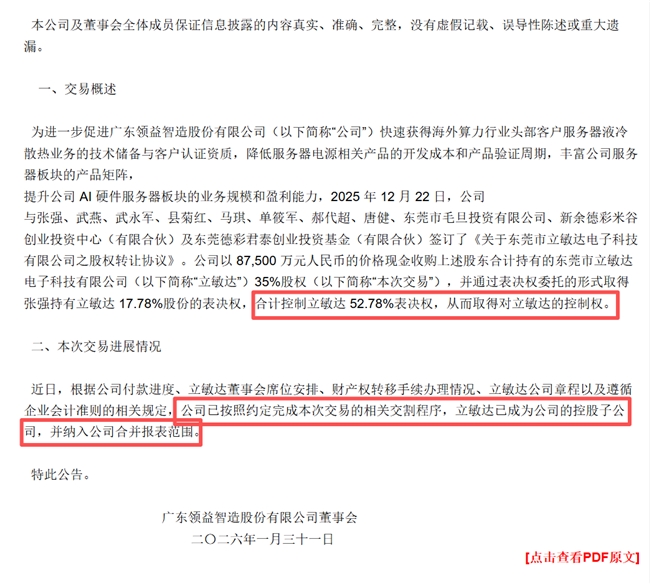
Group 1 - The core point of the article is that Lingyi Zhizao has completed the acquisition of 35% equity in Limin Da for 875 million yuan, gaining control of 52.78% of voting rights, marking a strategic move into the AI computing cooling and power supply sector [1][3] - The acquisition is seen as a key initiative for Lingyi Zhizao to position itself in the rapidly growing AI computing cooling market, aiming to quickly acquire technical reserves and customer certifications for liquid cooling business [3][4] - Limin Da is recognized as a quality enterprise in the AI computing thermal management field, specializing in liquid cooling connectors and modules, and has established significant partnerships with major clients like NVIDIA and Intel [3][4] Group 2 - The AI computing liquid cooling market is experiencing an annual growth rate exceeding 50%, indicating substantial development potential [4] - Following the acquisition, Lingyi Zhizao is expected to leverage its manufacturing scale and global supply chain to enhance Limin Da's production capacity and address bottlenecks [4] - The collaboration aims to create an integrated solution combining air cooling, liquid cooling, and power supply, thereby strengthening competitive differentiation in the AI computing sector [4]

对话基金经理汤戈:储能需求爆发叠加固态电池加速,看好锂电设备投资机会
Sou Hu Cai Jing· 2026-01-15 08:53
Core Viewpoint - The A-share market is expected to reach a total market value of 100 trillion yuan by 2025, with the Shanghai Composite Index breaking 4,000 points, marking a nearly ten-year high. The focus for 2026 will be on identifying new investment opportunities across various sectors, particularly in the context of the ongoing trends in the lithium battery industry [1]. Group 1: Market Performance and Trends - The active start of 2026 is influenced by the market momentum from 2025, driven primarily by margin trading and private equity funds that favor growth themes, leading to increased market activity [4]. - Short-term thematic trading, while lively, is often unsustainable, and the market is expected to shift towards sectors with long-term industrial trends and solid performance support [4][5]. - The current market environment is characterized by rapid rotation of hot topics, with funds likely to shift focus to new sectors after the initial excitement fades [4]. Group 2: Investment Opportunities in Lithium Industry - Investment opportunities in the lithium battery sector are seen as a complex interplay of "cyclical" and "growth" factors, with improvements in supply-demand dynamics and new demands from energy storage and solid-state batteries [1]. - The equipment segment is favored for its direct reflection of expansion expectations, offering the highest valuation elasticity but also experiencing significant volatility [2]. - Continuous demand for energy storage and advanced cooling solutions driven by AI is a key focus area for investment [3]. Group 3: Solid-State Battery Insights - The solid-state battery market has transitioned from experimental phases to engineering stages, with significant investment opportunities emerging in equipment and materials [5][6]. - The equipment segment is expected to have the greatest elasticity due to clear order expectations once technology routes are confirmed, while the materials segment offers both performance and elasticity benefits [6]. - Solid-state batteries are anticipated to coexist with traditional lithium batteries, serving different market needs, with high-end applications likely to adopt solid-state technology first [7]. Group 4: Investment Strategy and Recommendations - The investment strategy should focus on long-term trends and sectors with improving fundamentals rather than chasing short-term market fads [5][8]. - Investors are advised to have a clear logic behind their investments, focusing on sectors driven by industrial trends and price-volume changes, while being cautious of valuation risks [8].