
AI驱动的生产力繁荣

Search documents
终结“逢低买入”!沃什的提名意味着美联储救市门槛大幅提高?
Hua Er Jie Jian Wen· 2026-02-10 13:23
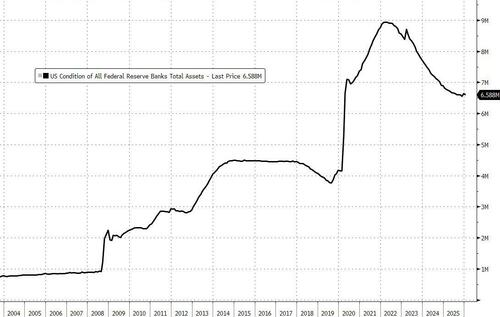
Group 1: Federal Reserve and Market Implications - The nomination of Waller as Fed Chair may signal a new era for the central bank, fundamentally reshaping investor risk expectations [1] - The long-standing reliance on the Fed's liquidity support is facing significant challenges, indicating a substantial reduction in future tolerance for market errors [1] - Waller has criticized the Fed's balance sheet expansion, advocating for a structural reduction of the current $6.6 trillion balance sheet, suggesting that liquidity support should only be a crisis response rather than a routine operation [1][3] Group 2: Market Reactions and Sector Performance - The tech sector is under pressure, with software stocks dropping approximately 25% this year, reflecting concerns over competition and the sustainability of existing revenue streams [4] - The ongoing weakness in digital assets, with Bitcoin down over 50% since last October, has negatively impacted risk sentiment across various asset classes [5] - Despite sector-specific volatility, the overall macroeconomic fundamentals in the U.S. remain robust, with cyclical stocks performing well and strong earnings reported by tech companies [6] Group 3: Liquidity and Debt Concerns - Waller's potential push for accelerated quantitative tightening could lead to a loss of bank reserves and tighter collateral conditions, increasing the risk of liquidity shortages and potentially limiting credit supply [3][7] - The shift in the Fed's approach may lead to higher systemic risks, especially if liquidity tightens while facing external or internal shocks [7] - Major cloud companies are ramping up capital expenditures significantly, with projected spending exceeding $600 billion by 2026, raising investor concerns about return on investment [8]

华创证券张瑜:美联储的“沃什时刻”?
Xin Lang Cai Jing· 2026-02-01 07:32
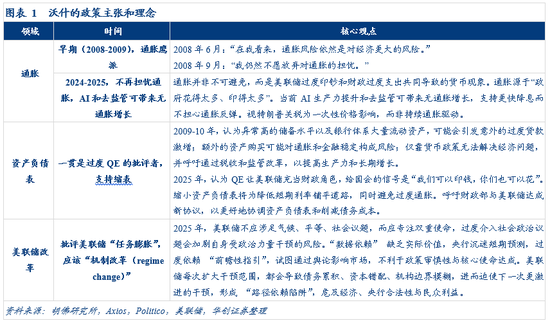
Core Viewpoint - The article discusses the potential impact of the nomination of Walsh to the Federal Reserve, highlighting three significant changes: a shift in decision-making mechanisms, a new inflation theory, and opposition to excessive quantitative easing (QE) while supporting balance sheet reduction. The success of these changes and their mid-term effects on dollar assets may depend more on the realization of the narrative of productivity prosperity in the U.S. than on Walsh himself [1][21]. Group 1: Walsh's Background and Policy Stance - Walsh is a former Federal Reserve governor with a diverse background in politics, business, and academia, known for being the youngest governor in Fed history at age 35 and having experience in the 2008 financial crisis [2][10][22]. - His policy stance is characterized by pragmatism, criticism of excessive QE, and support for balance sheet reduction. He is flexible on inflation, previously known as a "hawk," but now supports faster rate cuts without fearing inflation rebound [2][12][22]. Group 2: Immediate Market Impact - Walsh's nomination may trigger significant adjustments in the commodity market, potentially halting the narrative of de-dollarization, leading to a rebound in the dollar index and a sharp decline in precious metals [4][24]. - The volatility in the market is primarily driven by fluctuations, as evidenced by the increase in implied volatility for silver options, which rose from 55% to around 90% since January, far exceeding normal levels of 20-30% [4][24]. Group 3: Short- and Mid-Term Monetary Policy Implications - The decision-making framework of the Federal Reserve may shift from a "data-dependent + forward guidance" model to a more strategic, long-term perspective, potentially reducing communication and increasing policy flexibility [5][25][36]. - In the short term, the likelihood of significant rate cuts this year is low, as Walsh has not indicated a preference for drastic reductions, and the Fed remains divided on opinions [6][26][38]. - In the mid-term, if Walsh can lead the Fed to a consensus on allowing lower rates without triggering inflation, it could open up further rate cut opportunities, contingent on the realization of productivity growth narratives [19][27][38]. Group 4: Opposition to Excessive QE and Support for Balance Sheet Reduction - Walsh opposes excessive QE as a routine tool, advocating for a reduction in the Fed's balance sheet to pave the way for rate cuts while avoiding excessive inflation [20][39]. - Currently, there is limited space for further balance sheet reduction, as the Fed has paused this process and resumed reserve management purchases to maintain liquidity in the money market [8][39].
美联储的“沃什时刻”?
一瑜中的· 2026-02-01 07:23
Core Viewpoint - The article discusses the potential impact of the nomination of Walsh to the Federal Reserve, emphasizing changes in decision-making mechanisms, new inflation theories, and opposition to excessive quantitative easing (QE) while supporting balance sheet reduction [2][6][17]. Group 1: Walsh's Identity and Policy Proposals - Walsh is a former Federal Reserve governor with a diverse background in politics, business, and academia, known for his pragmatic approach and criticism of excessive QE [3][11]. - His policy stance includes a flexible approach to inflation, viewing it as a result of excessive monetary and fiscal policies, and advocating for quicker interest rate cuts without fearing inflation rebound [12][19]. - Walsh is a critic of excessive QE, arguing it has led the Fed to take on a fiscal role, and he supports reducing the balance sheet to pave the way for lower interest rates [13][22]. Group 2: Immediate Market Impact - Walsh's nomination may trigger significant adjustments in commodity markets, with a notable rebound in the dollar index and a sharp decline in precious metals, attributed to increased market volatility [5][16]. - The volatility in markets, particularly in silver options, has surged, indicating that sustained high volatility levels are unlikely [5][16]. Group 3: Short- and Medium-Term Impacts on Monetary Policy - The Fed's decision-making framework may shift from a "data-dependent + forward guidance" model to a more strategic, long-term perspective, potentially increasing market volatility in the short term [6][18]. - In the medium term, if the market adapts to this new framework, Fed actions may become more predictable, reducing confusion around policy signals [18]. - Walsh's new inflation theory posits that tariffs are one-time price shocks and that AI-driven productivity growth could lead to non-inflationary growth, supporting quicker rate cuts without inflation concerns [19][20]. Group 4: Opposition to Excessive QE and Support for Balance Sheet Reduction - Walsh opposes the use of excessive QE as a regular tool, advocating for a reduction in the Fed's balance sheet, although he has not indicated immediate plans for such actions [8][22]. - In the short term, there may be limited space for further balance sheet reduction due to recent market conditions, while in the medium term, the potential for QE may still exist if a crisis arises, albeit with less intensity than previous rounds [22][8].

沃什时代前瞻:美联储政策框架的三个转向
GF SECURITIES· 2026-01-31 14:35
Group 1: Nomination and Background - Trump nominated Kevin Warsh to succeed Jerome Powell as the next Federal Reserve Chair, with Powell's term ending in May 2026[3] - Warsh has a diverse background, including experience in Wall Street mergers, White House economic policy, and serving as a Federal Reserve governor from 2006 to 2011[4] - He was the youngest Federal Reserve governor at age 35 and played a key role during the 2008 financial crisis[5] Group 2: Economic Perspectives - Warsh believes the U.S. economy is experiencing a productivity boom driven by AI, which could double living standards in a generation without causing inflation if labor productivity growth increases by just 1% annually[8][13] - He criticizes the Fed's past reliance on demand-side management and argues for a shift towards supply-side policies to enhance economic growth[21] - Warsh views inflation as a choice and holds the Fed primarily responsible for it, rejecting the notion that external factors are to blame for recent inflation spikes[14] Group 3: Monetary Policy and Interest Rates - Warsh advocates for a gradual reduction in interest rates, suggesting that high growth driven by productivity does not necessarily lead to inflation[16] - He proposes a new Treasury-Fed Accord to clearly delineate the roles of the Fed and the Treasury, focusing the Fed on interest rate management while the Treasury handles fiscal policy[18][19] - His framework suggests that the Fed should not automatically maintain high interest rates in response to strong economic data, especially if growth is productivity-driven[17] Group 4: Market Implications - If Warsh's supply-side logic dominates policy, it could open up space for interest rate cuts while maintaining high growth expectations, but this depends on substantial productivity improvements[22] - His critical stance on the Fed's balance sheet expansion implies a more aggressive approach to reducing the balance sheet, potentially steepening the yield curve and increasing long-term interest rate volatility[22] - The market may face risks of rising term premiums and inflationary pressures if supply-side reforms lag behind expectations[24]
【UNFX课堂】市场风云突变:地缘政治阴霾消散,聚焦美联储
Sou Hu Cai Jing· 2025-06-24 06:52
Group 1 - The market experienced a dramatic reversal on Monday, initially driven by geopolitical tensions, with Brent crude oil prices soaring by 6% before collapsing by 7% as the situation stabilized [1][2] - The easing of geopolitical risks led to a shift in focus towards macroeconomic factors, particularly the Federal Reserve's potential policy changes, as market participants anticipated a possible interest rate cut in July [2][3] - The dollar faced significant pressure, marking its worst first half since 1986, as investors adjusted their positions and reduced exposure to the currency [4][6] Group 2 - The shift in market sentiment indicates a potential transition in the macroeconomic landscape, with the possibility of a more dovish stance from the Federal Reserve becoming apparent [3][8] - The ongoing adjustments in the foreign exchange market reflect a systematic move towards de-dollarization, particularly in Asia, where U.S. bondholders are actively re-hedging their positions [6][7] - The current market dynamics suggest a focus on momentum trading, with investors chasing favorable capital flows while underlying macroeconomic changes are brewing [8][9]