GLP-1药物

Search documents
速递|全年减重超30斤,信达生物玛仕度肽再披露关键临床数据
GLP1减重宝典· 2026-03-31 09:34
Core Insights - The article discusses the Phase II clinical trial results of the GLP-1/GCG dual receptor agonist, Ma Shidu (玛仕度肽), developed by Innovent Biologics, which showed significant weight loss and metabolic improvements in obese participants [4][5]. Group 1: Clinical Trial Results - The Phase II trial included 80 Chinese adult participants with obesity (BMI ≥ 30 kg/m²), with an average baseline weight of 96.9 kg [4]. - At week 24, the Ma Shidu 9 mg group achieved a weight loss of 15.4% compared to the placebo, with 81.7% of participants losing over 5%, 65.0% over 10%, and 21.7% over 20% [5]. - By week 48, weight loss increased to 18.6%, with 34.9% of participants losing over 20% of their body weight, equating to more than 30 pounds based on baseline weight [5]. Group 2: Metabolic Improvements - The study also reported improvements in various cardiovascular and metabolic indicators, including waist circumference, blood pressure, blood lipids, and uric acid levels [5]. - For participants with baseline liver fat content ≥ 5%, liver fat content decreased by 73.3% at week 24, with 83.3% of participants returning to normal liver fat levels [5]. Group 3: Safety Profile - The safety profile of Ma Shidu was favorable, with no serious adverse events reported and no participants discontinuing due to adverse reactions [5]. - The most common adverse effects were mild to moderate gastrointestinal symptoms, primarily occurring during the dose escalation phase [5]. Group 4: Regulatory and Development Status - Ma Shidu is a collaboration between Innovent Biologics and Eli Lilly, and it is expected to be approved in China for long-term weight management in overweight or obese adults by June 2025 [5]. - The Phase III clinical trial (GLORY-2) for the 9 mg dose has reached its primary endpoint, showing a weight reduction of 20.1%, and the related market application has been accepted [5].


礼来口服减重药逼近4月窗口,司美格鲁肽真正的压力来了
GLP1减重宝典· 2026-03-30 08:26
Core Viewpoint - The article discusses the upcoming approval and market entry of Eli Lilly's oral GLP-1 drug, orforglipron, which is expected to significantly impact the obesity treatment market, particularly affecting the oral semaglutide segment [4][5]. Group 1: Product Overview - Eli Lilly's orforglipron is a daily oral GLP-1 medication that can be taken without food or water restrictions, unlike Novo Nordisk's oral semaglutide products, which require fasting and specific conditions for administration [4]. - In a head-to-head Phase III study, orforglipron demonstrated a reduction in HbA1c of 2.2% and weight loss of 9.2% in type 2 diabetes patients, compared to oral semaglutide's 1.4% and 5.3% respectively [5]. Group 2: Competitive Landscape - Novo Nordisk has a first-mover advantage with its oral semaglutide, which is set to be approved in late December 2025, indicating that Eli Lilly will enter a market that has already been partially established [7]. - While orforglipron shows promising efficacy, it does not yet have a decisive advantage over Novo Nordisk's products, as the latter's key study reported an average weight loss of 16.6% [7]. Group 3: Market Dynamics - The approval of orforglipron could expose vulnerabilities in the semaglutide market, shifting competition from efficacy to factors like pricing, convenience, and patient access [8][9]. - Novo Nordisk has warned of unprecedented pricing pressures in 2026, suggesting that the market may enter a phase of price competition and cash payment battles as Eli Lilly's product approaches approval [8]. Group 4: Future Implications - The introduction of orforglipron is expected to primarily impact the oral semaglutide market, potentially affecting pricing structures and patient inflow rates, rather than immediately displacing the injectable versions of semaglutide [9]. - The competitive focus is likely to shift towards patient experience, channel efficiency, and affordability, rather than solely on therapeutic outcomes [9].


速递|恒瑞出手了:一款胰岛素+GLP-1复方注射液申报上市,直指2型糖尿病升级治疗
GLP1减重宝典· 2026-03-14 12:41
Core Viewpoint - Heng Rui Medicine has received acceptance for its application for the marketing license of Shudi Insulin Noreglutide Injection, aimed at improving blood sugar control in adults with type 2 diabetes [4][6]. Group 1: Product Development - Shudi Insulin Noreglutide Injection is a fixed-ratio combination formulation consisting of long-acting basal insulin analog and GLP-1 receptor agonist [4][6]. - The application is based on two pivotal Phase III clinical studies (HR17031-301 and HR17031-302) involving 401 and 393 participants, respectively, demonstrating significant efficacy and safety compared to control groups [6]. Group 2: Market Context - The global market already includes similar products, such as Novo Nordisk's Ico Insulin Semaglutide Injection and Sanofi's Soliqua 100/33, indicating a competitive landscape for GLP-1 combination therapies [6][7]. - The total R&D investment for Shudi Insulin Noreglutide Injection has reached approximately 330 million yuan, reflecting the company's commitment to this therapeutic area [6].

减肥药太多,中国胖子要不够用了
GLP1减重宝典· 2026-03-14 12:41
Core Viewpoint - The Chinese weight loss drug market is rapidly evolving from a two-player competition between foreign companies to a multi-player landscape that includes local innovations and subsequent entrants [2] Group 1: Market Dynamics - The approval and market entry of multiple GLP-1 drugs in China, including Wegovy and Mounjaro, indicate a shift towards a competitive environment with various players [2][3] - The first tier of products includes established players like Novo Nordisk and Eli Lilly, which have proven market capabilities and are targeting self-paying consumers in China [3] - The second tier consists of local innovative drugs like Innovent's Ma Shidu and Senwa's Enoglutide, which aim to differentiate themselves through efficacy and commercialization speed [5] Group 2: Competitive Landscape - The influx of new drugs leads to increased competition for doctors, patients, and distribution channels, creating a challenging environment for new entrants [9] - Upcoming oral GLP-1 drugs, such as Eli Lilly's orforglipron, could change the competitive dynamics by lowering barriers to use and shifting focus to convenience and cost [7] - Multi-target products are raising the efficacy standards, with candidates like UBT251 showing significant weight loss results, indicating a push for better performance in the market [7] Group 3: Future Outlook - The market is expected to favor products that demonstrate clear efficacy, convenient administration methods, competitive pricing, and additional metabolic benefits [11] - Many projects may struggle to reach the market due to the crowded landscape, with only a few types of products likely to survive [11][12] - The window for new entrants is narrowing as the market becomes increasingly saturated with established and upcoming competitors [12]
Stevanato Group(STVN) - 2025 Q4 - Earnings Call Transcript
2026-03-04 14:32
Financial Data and Key Metrics Changes - For fiscal 2025, total company revenue increased by 9% at constant currency rates and 7% on a reported basis compared to 2024, reaching EUR 1.26 billion to EUR 1.29 billion for 2026 guidance [5][25] - Gross profit margin rose by 160 basis points compared to 2024, with Q4 gross profit margin increasing by 120 basis points to 30.9% [7][18] - Net profit for Q4 totaled EUR 47.6 million, with diluted earnings per share at EUR 0.17 [19] Business Line Data and Key Metrics Changes - The Biopharmaceutical and Diagnostic Solutions (BDS) segment delivered double-digit growth, with revenue increasing by 13% at constant currency and 10% on a reported basis in Q4 [17][20] - Revenue from high-value solutions grew 31% to EUR 171 million in Q4, representing approximately 49% of total company revenue for the quarter [18][20] - Engineering segment revenue decreased by 23% to EUR 39.4 million in Q4 due to lower revenue in glass conversion and assembly [21] Market Data and Key Metrics Changes - Revenue from GLP-1s accounted for approximately 19%-20% of total company revenue in 2025, growing more than 50% compared to 2024 [9] - The company expects GLP-1s to serve as a meaningful tailwind as patient demand continues to grow, with a projected mid-teens growth rate for 2026 [32][49] - Biologics represented 41% of BDS revenues in 2025, up from 34% in 2024, indicating a growing market presence [11] Company Strategy and Development Direction - The company is focused on high-value solutions and has invested in expanding capacity for high-value syringes in Fishers, Indiana, and Latina, Italy [8][12] - The strategy includes pivoting away from non-high-value product categories and increasing participation in other injectable biologics [7][11] - The company aims to align growth investments with customer demand trends and capitalize on the evolving market for injectable biologics and biosimilars [16][27] Management's Comments on Operating Environment and Future Outlook - Management expressed confidence in the robust demand for biologics and the company's ability to meet this demand through its integrated value proposition and innovative products [27] - The company anticipates continued operational progress and productivity gains, particularly in the engineering segment, to support long-term sustainable growth [28] - Management acknowledged challenges in the engineering segment due to lower order intake but remains optimistic about future opportunities [15][35] Other Important Information - The company ended fiscal 2025 with cash and cash equivalents of EUR 130.6 million and net debt of EUR 337.7 million, indicating a solid liquidity position [23] - Capital expenditures for 2025 totaled EUR 294.9 million, with approximately 89% allocated for growth projects [24] Q&A Session Summary Question: Expectations for GLP-1 growth in 2026 - Management expects GLP-1 revenue growth in the mid-teens for 2026, consistent with previous growth rates [32] Question: Insights on engineering segment order intake - Management noted that the sales cycle for engineering projects is longer than anticipated, impacting order intake, but the pipeline remains healthy [35] Question: Capacity constraints for high-value solutions - Management confirmed that capacity constraints exist but are being addressed through ramping up production in Fishers and Latina [40] Question: Drivers of margin expansion - Management highlighted that margin expansion will be driven by a favorable product mix and operational improvements in new facilities [44] Question: Long-term growth outlook for GLP-1s - Management believes GLP-1s will continue to be a significant growth driver, although the exact configuration of the market remains uncertain [49] Question: Performance of other biologic categories - Management indicated strong performance in monoclonal antibodies and other biologics, with a focus on injectable formats [75]

速递|刚刚,质肽生物融资超5亿元,把月制剂和口服GLP-1同时推上牌桌
GLP1减重宝典· 2026-03-02 15:17
Core Viewpoint - The article discusses the recent financing round of ZhiTai Bio, which raised over 500 million RMB to enhance its capabilities in the weight loss sector, focusing on the development and commercialization of innovative GLP-1 receptor agonists [5][8]. Financing and Product Development - ZhiTai Bio completed a C round financing of over 500 million RMB, led by OrbiMed with participation from Tencent, Qiming, Wuyuan, Xingze Capital, and Huagai, indicating strong investor confidence in the weight loss market [5]. - The main product, ZT002, is an innovative monthly formulation of GLP-1RA, currently undergoing Phase III clinical trials in China, with promising results showing a weight reduction of up to 13.8% at 24 weeks in Phase II trials [5][7]. - The HORIZON-1 trial has already commenced, with the first subject dosed in January 2026, marking a significant step towards commercialization [5]. Dual Development Strategy - ZhiTai Bio is pursuing a dual strategy by developing both injectable and oral formulations, with ZT006, an oral GLP-1 receptor agonist, currently in Phase II trials in China, targeting a competitive oral market [7]. - Additionally, ZhiTai is exploring a dual-target mechanism with ZT003, a GLP-1/FGF21 agonist, which is in Phase I trials in Australia, aimed at metabolic-related conditions such as obesity and metabolic liver disease [7]. Commercialization and Collaboration - The company has established collaborations for its biosimilar ZT001 with Tonghua Dongbao and Aimeike, focusing on diabetes and weight loss indications, which will help in building a robust supply chain and commercialization framework [7][8]. - These partnerships are expected to provide a more predictable revenue stream and support the clinical progress of ZT001, enhancing the company's overall commercial capabilities [7]. Industrialization and Competitive Positioning - ZhiTai Bio emphasizes its capabilities in peptide engineering and scalable manufacturing, which are crucial for maintaining competitive cost structures and meeting clinical demands [8]. - The recent financing is viewed as an acceleration mechanism, allowing ZhiTai to enhance its product differentiation through ZT002, expand its market reach with ZT006, and explore new therapeutic avenues with ZT003, while ZT001 provides immediate cash flow support [8].
速递|司美格鲁肽持续暴击!礼来口服小分子GLP-1三期再次头对头赢下
GLP1减重宝典· 2026-02-27 08:15
Core Viewpoint - The article discusses the significant results of Eli Lilly's oral GLP-1 receptor agonist Orforglipron in a head-to-head trial against oral semaglutide, highlighting its superior efficacy in both glycemic control and weight loss for type 2 diabetes patients [5][6]. Group 1: Clinical Trial Results - Eli Lilly's Orforglipron demonstrated a more pronounced dose-response relationship in the ACHIEVE-3 trial, showing a greater reduction in HbA1c levels compared to oral semaglutide at a dosage of 14mg, along with a more significant weight loss [5]. - The trial lasted for 52 weeks, providing robust evidence of Orforglipron's efficacy in a direct comparison rather than relying on indirect comparisons from different studies [5]. Group 2: Market Positioning - In the diabetes indication, the head-to-head victory of Orforglipron is crucial as it establishes the oral small molecule not only as a convenient option but also as a potentially more effective treatment [6]. - The oral formulation is expected to have advantages in production and supply chain scalability, making it more accessible and cost-effective in real-world applications [6]. Group 3: Weight Loss Indication - In the obesity indication, the market is more focused on the extent and stability of weight loss rather than just the ability to lose weight [6]. - Orforglipron's results in the ATTAIN-1 trial showed a double-digit weight loss in the high-dose group over 72 weeks, but it still lags behind the significant weight loss achieved by injectable semaglutide [6]. Group 4: Dosage Strategy - Semaglutide employs different dosage strategies for diabetes and weight loss, with lower doses for diabetes and higher doses for weight loss, which affects the efficacy outcomes [7]. - Orforglipron's current research indicates a closer dosage strategy for diabetes and weight loss, leading to stronger performance in diabetes but not yet achieving the same level of advantage in obesity [7]. Group 5: Future Implications - The results from ACHIEVE-3 suggest that oral GLP-1s can compete effectively in the diabetes market, appealing to patients who prefer not to inject [7]. - The competition in the obesity market will depend on the ability to balance weight loss magnitude, tolerability, and long-term maintenance, indicating that a single trial victory does not determine overall success [7].
速递|华东医药双靶点HDM1005硬刚信达玛仕度肽,头对头三期开打
GLP1减重宝典· 2026-02-27 08:15
Core Viewpoint - The article discusses the competitive landscape of GLP-1 drugs, focusing on East China Pharmaceutical's initiation of a head-to-head Phase III clinical trial for its dual-target drug HDM1005 against Innovent Biologics' Ma Shidu peptide, aiming to establish dominance in the diabetes and weight management sectors [4][6]. Group 1: Clinical Trial Details - East China Pharmaceutical has launched a head-to-head Phase III clinical trial for HDM1005, targeting approximately 912 patients with type 2 diabetes who have inadequate blood sugar control despite treatment with metformin or SGLT2 inhibitors [4]. - The trial design is multi-center, randomized, open-label, and includes a positive drug control, which aligns with clinical practices and reduces variability in administration frequency [4][5]. Group 2: Market Focus and Expectations - The market is particularly interested in three aspects following the initiation of the Phase III trial: the ability of HDM1005 to outperform competitors in combined endpoints of blood sugar reduction and weight loss, the profile of adverse reactions especially gastrointestinal issues and discontinuation rates, and the implications of dose escalation, adherence, and long-term benefits for commercialization [5]. - The approach taken by East China Pharmaceutical is not merely to advance a Phase III trial but to directly compete for market share in the dual-target weekly formulations for diabetes and weight management [6].

替尔泊肽躺赢!诺和诺德CagriSema减重23%却未超越礼来替尔泊肽
GLP1减重宝典· 2026-02-24 03:02
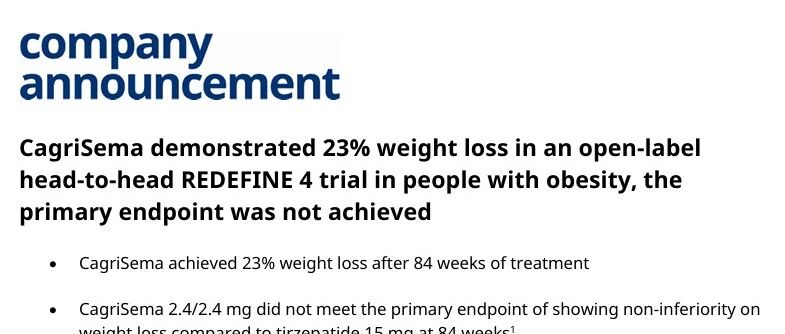
Core Viewpoint - Novo Nordisk's CagriSema, a combination weight loss drug, failed to demonstrate non-inferiority to Eli Lilly's Tirzepatide in the REDEFINE 4 trial, leading to a significant market reaction with a 16% drop in stock price [6][8][12]. Group 1: Clinical Trial Results - In the REDEFINE 4 trial, CagriSema 2.4/2.4 mg achieved an average weight loss of 23.0% over 84 weeks, while the control group using Tirzepatide 15 mg had an average weight loss of 25.5% [6][8]. - The trial's primary endpoint was to prove that CagriSema was not inferior to Tirzepatide in weight loss, which it did not achieve [8][12]. - Two sets of data were provided: one based on complete adherence showing 23.0% weight loss for CagriSema, and another reflecting real-world conditions showing 20.2% for CagriSema versus 23.6% for Tirzepatide [8][9]. Group 2: Competitive Landscape - The failure to meet the primary endpoint in REDEFINE 4 signifies a broader challenge for Novo Nordisk, as it aims to position CagriSema as a successor to Wegovy [12][14]. - The competitive landscape is shifting, with Eli Lilly's Tirzepatide setting a higher benchmark for weight loss drugs, making it crucial for challengers to not only match but exceed these results [12][14]. - Novo Nordisk's strategy involves exploring higher doses and better adherence management to enhance CagriSema's weight loss potential, but time is of the essence as competitors advance [14][16]. Group 3: Market Implications - Eli Lilly's success in the trial strengthens its market position, enhancing prescription confidence and negotiation power with payers, shifting the narrative from "who can approach Tirzepatide" to "who can surpass it" [16]. - The market is increasingly focused on relative advantages rather than absolute efficacy, making it essential for new entrants to demonstrate clear benefits over established products [12][14]. - Novo Nordisk's future strategies will need to address the urgency of establishing CagriSema's market presence before payer and physician habits solidify around existing products [14][16].
速递|诺和诺德再押三靶点:UBT251全球二期启动,333人入组到2027
GLP1减重宝典· 2026-02-12 15:11
Core Viewpoint - Novo Nordisk is advancing its weight loss pipeline with the addition of UBT251, a GLP-1/GIP/GCG tri-receptor agonist, which aims to enhance weight loss efficacy and metabolic improvements while addressing safety and tolerability concerns [6][8][11] Group 1: UBT251 Development - A global Phase II study for UBT251 has been registered, targeting 333 participants, with completion expected by January 2027 [6] - UBT251's long half-life of approximately 136 to 170 hours supports a once-weekly dosing regimen, showing superior weight loss compared to placebo in early trials [8] - The drug's tri-receptor approach aims to suppress appetite, improve glucose metabolism, and enhance energy expenditure for greater weight loss [6][8] Group 2: Competitive Landscape - The initiation of UBT251's Phase II trial coincides with heightened industry interest following Eli Lilly's Retatrutide Phase III results, which demonstrated significant weight loss and functional benefits [11] - Novo Nordisk's strategy includes leveraging its established GLP-1 system and commercial capabilities while responding to new competitive benchmarks set by emerging therapies [11] - The key focus for UBT251 in Phase II will be to achieve substantial weight loss while maintaining acceptable safety and tolerability profiles [11] Group 3: Financial and Strategic Considerations - In March 2025, Novo Nordisk entered a licensing agreement with a $200 million upfront payment and potential milestone payments up to $1.8 billion, reflecting a strategic investment in UBT251's potential [9] - This deal structure allows Novo Nordisk to manage initial cash outflows while betting on the drug's future clinical success to justify further investments [9]