
K型经济格局

Search documents
“信誉锚”就位,大摩:沃什提名将放缓美元跌势
Jin Shi Shu Ju· 2026-02-02 14:32
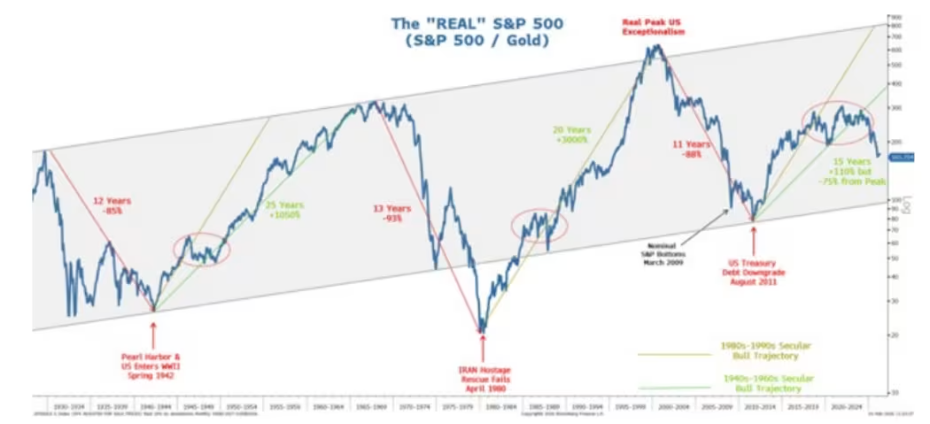
Group 1 - Morgan Stanley's chief equity strategist Mike Wilson believes that the nomination of Kevin Warsh as the next Federal Reserve Chairman should restore market confidence that has been shaken in recent months [1] - Wilson views Warsh as the most hawkish candidate, suggesting his appointment could act as a "credibility anchor" to slow the decline of the US dollar, which remains a core policy goal of the Trump administration [1] - The recent parabolic rise in precious metal prices indicates market unease regarding the speed of the dollar's decline, and Warsh's appointment may temper the upward momentum of gold and silver [1] Group 2 - Wilson and his equity strategy team propose a "three-layer rebalancing framework," which contrasts with the views of most market participants, suggesting that the Trump administration plans to address external trade imbalances through a weaker dollar and tariffs [2] - The administration aims to resolve domestic imbalances (excessive consumption/insufficient investment) through capital expenditure incentives and trade policies outlined in the "Big and Beautiful" Act [2] - The White House's strategy to address the current K-shaped economic recovery focuses on increasing wages for low-income groups rather than direct cash subsidies [2] Group 3 - Morgan Stanley indicates that the decline in gold prices and subsequent productivity improvements may provide further upside potential for the stock market, recommending investors shift from commodity cyclical stocks to consumer cyclical/non-essential consumer stocks [4]

美元或进一步走低,其贬值对美国经济而言是一把“双刃剑”
Xin Lang Cai Jing· 2026-01-28 14:41
Core Viewpoint - The US dollar has entered a bear market, with analysts warning that a weakening dollar is a "double-edged sword" for the US economy [3][4][14] Group 1: Dollar Performance - The dollar experienced a significant depreciation last year, and despite President Donald Trump's assertion that the dollar is performing "excellently," it fell again this week [4][14] - The dollar index, which measures the dollar against a basket of major currencies, has dropped over 9% in 2025 and has further declined by 2.2% in 2026 to date [3][13] Group 2: Economic Implications - Neela Richardson, chief economist at Automatic Data Processing, stated that the dollar's depreciation reflects cracks in the US economic picture, indicating that the economy is facing complex challenges [4][17] - The weakening dollar can enhance the competitiveness of US exports but may not always support market confidence domestically, especially amid persistent inflation and high deficits [17][18] Group 3: Market Sentiment - Market observers believe the dollar is in a bear market and likely to decline further, with some suggesting that the recent sell-off of US assets is not yet over [4][19] - Cole Smid, CEO of Smid Capital Management, noted that historical patterns suggest a prolonged period of dollar weakness, as seen from 2002 to 2008 when the dollar index fell approximately 41% [19][20] Group 4: Consumer Confidence and Spending - The consumer confidence index has dropped to a multi-year low, with concerns about a K-shaped recovery in consumer spending, where the top 20% of earners drive most consumption while the bottom 25% struggle due to high inflation [18][19] - This K-shaped recovery is also reflected in the labor market, where demand is strong in high-cost sectors like healthcare, but non-essential services are less accessible to lower-income consumers [18][19]

美国12月小非农数据温和复苏,但职位空缺率续降,PMI数据制造和服务呈两重天趋势,对此你怎么看?
Sou Hu Cai Jing· 2026-01-08 04:26
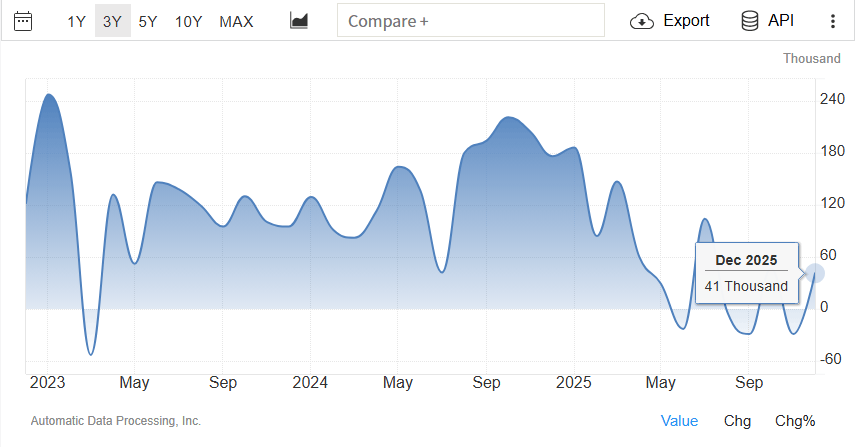
Employment Market - The US private sector added 41,000 jobs in December, reversing a decline of 29,000 jobs in November, indicating a slight recovery in the labor market [1] - Job growth is heavily concentrated in the service sector, with education and healthcare contributing 39,000 jobs and leisure and hospitality adding 24,000 jobs, while the goods-producing sector lost 3,000 jobs, including a net loss of 5,000 jobs in manufacturing [2] - There is a significant regional and enterprise size disparity, with robust job growth in the South and Northeast, while the West saw a reduction of 61,000 jobs, and large enterprises are nearly halting recruitment, relying heavily on small and medium enterprises for job growth [2] Job Openings and Labor Market Dynamics - The number of job openings in the US fell to 7.146 million in November, the lowest level since September 2024, and significantly below the market expectation of 7.6 million, reflecting weakened hiring intentions among employers [4] - The current labor market is characterized by "low hiring, low layoffs," indicating a decline in growth momentum, similar to a "stagflation" scenario in the US economy [4] - Wage growth is slowing, with annual salary increases for retained employees stabilizing at 4.4%, while the increase for job switchers rose slightly to 6.6%, but remains below mid-year highs, indicating a soft landing for wages and reduced inflation rebound risks [4] PMI Trends - The divergence between the ISM manufacturing and services PMI highlights structural imbalances in the US economy, with the services PMI rising to 54.4, the highest since October 2024, driven by resilient consumer spending and eased financial conditions [6] - Conversely, the manufacturing PMI fell to 47.9 in December, the lowest since October 2024, remaining below the 50 mark, indicating contraction [6] - The persistent weakness in manufacturing is attributed to three main pressures: slowing global demand, ongoing inventory destocking, and increased tariffs raising production costs [8] Economic Outlook and Policy Implications - The moderate recovery in the US employment market has avoided recession risks, with strong service sector performance supporting economic resilience, while easing inflation pressures provide room for policy adjustments [12] - However, declining job vacancy rates, manufacturing contraction, and economic structural disparities suggest that the recovery foundation is not solid [12] - The Federal Reserve's monetary policy will face challenges in precise adjustments, with market expectations pointing to potential rate cuts in the second quarter of 2026, contingent on continued weak non-farm data [12] Economic Disparities - The K-shaped economic recovery is becoming more pronounced, with high-income groups benefiting from financial market recovery and service sector growth, while low- and middle-income households face pressures from housing and healthcare costs [14] - This disparity undermines the inclusivity of the economic recovery and may further suppress sustained consumer market growth, leading to potential financial crises if consumption stalls [14]
美国重磅数据将公布
Di Yi Cai Jing Zi Xun· 2025-12-18 01:07
Core Viewpoint - The upcoming November Consumer Price Index (CPI) report is expected to provide insights into future policy directions for Wall Street and the Federal Reserve, amid concerns about the U.S. economy's momentum and the impact of tariffs on inflation [2][3]. Data Outlook - The CPI saw a year-on-year increase of 2.3% in April, the lowest in nearly four years, but inflation rose to 3% by September, significantly above the Federal Reserve's 2% target due to increased tariffs [3][4]. - The November CPI report is anticipated to show a slight increase in overall CPI from 3.0% to 3.1%, with core CPI expected to remain stable at 3% [4]. - Service prices, a major driver of inflation, increased by 3.5% year-on-year as of September, but this is the smallest increase since the pandemic began, indicating potential for inflation to decline if service price growth slows [4]. Federal Reserve Internal Disagreements - Recent surveys indicate that U.S. economic growth is facing obstacles, with rising prices due to tariffs suppressing consumer demand and leading to tighter hiring policies [5][6]. - Retail sales showed no growth in October, particularly affecting low-income households, while high-income households continue to drive non-essential spending, highlighting a widening economic gap [5]. - The Federal Reserve has cut interest rates three times since September, but Chairman Powell indicated that further cuts are unlikely until labor market and inflation trends are clearer [5][6]. Future Projections - The Federal Reserve's updated dot plot suggests only one rate cut may occur this year, while futures markets indicate a nearly 80% probability of a cut by June [7]. - The complexity of future rate cuts will depend on employment and inflation performance, with potential resistance from hawkish members of the Fed if the labor market remains stable [7]. - The impact of a new Federal Reserve chair is uncertain, with expectations that significant rate cuts may only occur in response to rising recession fears, which could negatively affect the Republican midterm election outlook [7].

重磅数据!美国11月CPI来袭,如何扰动美联储降息预期
Di Yi Cai Jing· 2025-12-17 23:31
Core Viewpoint - The article discusses the rising dissatisfaction among the American public regarding high inflation and increasing living costs, with the upcoming November Consumer Price Index (CPI) report expected to provide insights into future economic policies for Wall Street and the Federal Reserve [1]. Data Outlook - The CPI saw a year-on-year increase of 2.3% in April, the lowest in nearly four years, but has since risen to 3% by September due to tariffs imposed by the Trump administration, which are at their highest levels in decades [2]. - The upcoming CPI report is anticipated to show a slight increase in overall CPI from 3.0% to 3.1%, while core CPI is expected to remain stable at 3% [3]. - Service prices have increased by 3.5% year-on-year, marking the smallest rise since the pandemic, indicating a potential slowdown in inflation if this trend continues [3]. Federal Reserve Discrepancies - Recent surveys indicate that U.S. economic growth is facing obstacles, with rising prices due to tariffs suppressing consumer demand and leading to tighter hiring policies by businesses [4]. - Retail sales showed no growth in October, particularly affecting low-income households, while high-income households continue to drive non-essential spending, highlighting a widening economic gap [4]. - The Federal Reserve has cut interest rates three times, now at a range of 3.50%-3.75%, but Chairman Powell indicated that further cuts are unlikely until labor market and inflation trends are clearer [4]. Internal Divisions within the Federal Reserve - Recent comments from Federal Reserve officials reveal internal divisions regarding the outlook for inflation and interest rates [5]. - Atlanta Fed President Bostic warned against complacency regarding inflation, suggesting that the economy may see upward pressure from tax reforms and a rebound from the government shutdown [6]. - In contrast, Fed officials Miran and Waller maintain a dovish stance, believing inflation will ease in the coming months, with Waller suggesting the possibility of significant rate cuts [6]. Future Rate Expectations - The updated Federal Reserve dot plot indicates only one potential rate cut this year, while futures markets suggest an 80% probability of a cut by June [7]. - The complexity of future rate cuts will depend on employment and inflation performance, with the labor market showing signs of stability [7]. - The impact of a new Federal Reserve chair remains uncertain, with potential rate cuts likely only in response to rising recession fears, which could negatively affect the Republican midterm election outlook [7].