
动力和储能电池

Search documents
“卷价格”如何转向“优价值”(产经视野)
Ren Min Ri Bao· 2026-02-24 22:25
Core Viewpoint - The Chinese government is intensifying efforts to regulate "involutionary" competition and promote a unified national market, shifting from rule-setting to institutionalized regulation in 2026 [1][2]. Group 1: Regulatory Actions - Since the beginning of 2026, regulatory bodies have conducted over ten actions to address "involutionary" competition, focusing on potential monopoly risks among leading enterprises [2]. - The State Administration for Market Regulation has explicitly prohibited leading companies from engaging in practices such as capacity agreements and price fixing during discussions with top photovoltaic companies [2]. - Recent irrational competitive behaviors among platform enterprises, particularly in the food delivery sector, have drawn regulatory scrutiny due to practices like "subsidy dumping" and "choose one from two" [2][3]. Group 2: Policy Framework and Implementation - The regulatory framework for addressing "involutionary" competition has been continuously improved, forming a comprehensive governance loop covering pre-, mid-, and post-implementation stages [3]. - The focus of regulatory enforcement in 2026 will be on institutionalization and normalization, with an emphasis on inter-departmental collaboration and industry self-regulation [3][4]. Group 3: Market Transition - The shift in focus from "price competition" to "quality and innovation" is aimed at fostering high-quality competition across various sectors, including photovoltaic and new energy vehicles [4][5]. - The revision of pricing laws and the introduction of rules for internet platform pricing behavior are designed to curb unfair pricing practices and clarify market competition boundaries [4]. Group 4: Economic Implications - The return to reasonable pricing is expected to enhance profit margins, creating a positive cycle where profits drive research and development, ultimately leading to higher quality outputs [5][7]. - The government aims to resolve the issue of oversupply and improve price relationships, which are essential for transitioning from "involutionary" competition to "value-oriented" competition [5][6]. Group 5: Future Outlook - The regulatory approach in 2026 will emphasize a systematic and precise strategy, focusing on innovation encouragement, intellectual property protection, and quality standards [8]. - The expectation is that positive changes will manifest within a year in key industries, although the maturation of the entire market ecosystem may take 2 to 3 years [8].
多部门部署规范招商引资,“反内卷”制度性政策将落地
第一财经· 2026-01-23 00:34
Core Viewpoint - The article discusses the recent policy initiatives aimed at building a unified national market in China and addressing "involution" competition through institutional reforms rather than mere administrative measures [2][3]. Group 1: Policy Initiatives - The National Development and Reform Commission (NDRC) and other ministries are focusing on enhancing competition mechanisms and promoting high-quality economic development by addressing "involution" in various sectors [2]. - New policy documents, including regulations for the unified national market and lists of encouraged and prohibited investment behaviors, are expected to be released, providing legal support for the "anti-involution" efforts [2][3]. - The NDRC aims to shift market regulation from price competition to value competition, addressing the oversupply issues in certain sectors [2]. Group 2: Government Regulation - The government is working to standardize local government economic promotion behaviors to eliminate local protectionism and market segmentation [3][4]. - The Ministry of Finance is taking steps to rectify any illegal subsidy practices by local governments, with a focus on ensuring compliance by 2025 [3][4]. - A unified list of behaviors for local investment promotion will be established to clarify what is permissible and what is not, aiming to reduce excessive competition among local governments [4][5]. Group 3: Industry-Specific Measures - The Ministry of Industry and Information Technology (MIIT) is monitoring key industries for capacity management and addressing irrational competition, particularly in sectors like new energy vehicles and photovoltaics [8][9]. - The focus is on establishing a regulatory framework that encourages industry self-discipline and enhances market order [8][9]. Group 4: Economic Environment - The article highlights the importance of creating a conducive business environment by reducing barriers and improving the regulatory framework for investment [5][10]. - Local governments are encouraged to align their investment strategies with the national goal of a unified market, promoting a more integrated economic landscape [5][10]. Group 5: Future Directions - The central government emphasizes the need for a comprehensive approach to advance the unified national market, focusing on both effective market mechanisms and proactive government involvement [10][11]. - The construction of a robust legal framework and regulatory systems is deemed essential for the successful implementation of these policies [10][11].

宋雪涛:今年市场的两条主线
智通财经网· 2026-01-17 01:46
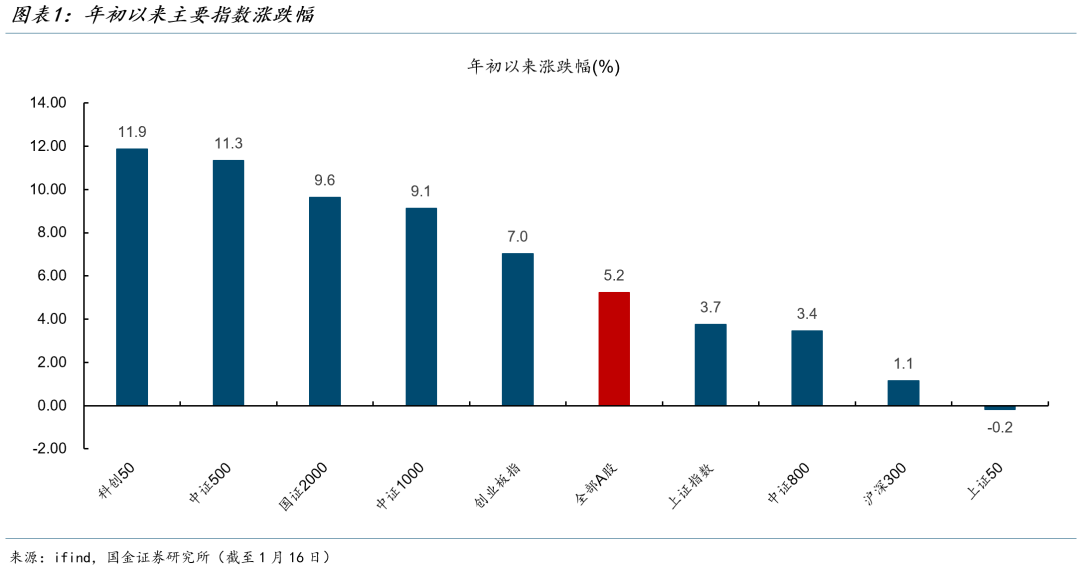
Market Performance - The A-share market has shown a "good start" in 2026, with the total return of the Wind All A index reaching 5.2% and the average daily trading volume exceeding 30 trillion yuan [1] - The leading sectors include technology and small-cap stocks, with the Sci-Tech 50, CSI 500, and National Index 2000 showing cumulative gains of 11.9%, 11.3%, and 9.6% respectively [1] Sector Analysis - The media, computer, non-ferrous metals, and military industries have led the market, with year-to-date gains of 16.0%, 14.0%, 14.0%, and 9.0% respectively, indicating a market focus on "AI and geopolitics" [1] - The AI-driven market trend is extending from upstream computing infrastructure to downstream AI applications, with geopolitical conflicts in regions like Venezuela and Iran catalyzing the non-ferrous and military sectors [1] Economic Indicators - The Producer Price Index (PPI) in China rose by 0.2% month-on-month in December 2025, marking the highest monthly increase since 2024, with AI contributing to this improvement, particularly in non-ferrous and technology prices [3] - Prices in the non-ferrous metal mining and smelting industries increased by 3.7% and 2.8% respectively, driven by rising electricity demand due to AI [3] - In the technology sector, prices for external storage devices and integrated circuits rose by 15.3% and 2.4%, respectively, with high-end AI chips impacting the availability of other chips [3] Policy and Structural Changes - The "anti-involution" policy is gaining traction, contributing to the PPI recovery, with lithium-ion battery manufacturing prices increasing by 1.0% and new energy vehicle manufacturing prices turning from a decline of 0.2% to an increase of 0.1% [4] - The strategic choices made by China and the U.S. in the current global macro context are expected to shape A-share pricing in 2026, focusing on "AI and geopolitics" and "anti-involution" [6] - The "anti-involution" initiative is transitioning from capacity governance to operational entity management, emphasizing quality competition and regulatory compliance [7][8] Government Initiatives - Local governments are shifting their focus from unsustainable policy incentives to sustainable business environments and professional service capabilities in attracting investments [10] - Recent central government actions have intensified the regulation of anti-monopoly and unfair competition, signaling a stronger push for "anti-involution" [10] - The cancellation of export tax rebates for photovoltaic products reflects the national level's commitment to "anti-involution," aiming to enhance the competitiveness of leading enterprises [8]
规范动力和储能电池产业竞争秩序
Ren Min Ri Bao· 2026-01-12 03:37
Core Viewpoint - The meeting held by the Ministry of Industry and Information Technology and other departments aims to further regulate the competitive order in the power and energy storage battery industry, addressing issues such as irrational competition and blind construction that disrupt market order and weaken sustainable development capabilities [1] Group 1: Industry Development - The power and energy storage battery industry in China has developed rapidly and achieved a competitive advantage globally [1] - There are issues of blind construction and low-price competition within the industry, which are considered irrational behaviors that disrupt normal market order [1] Group 2: Regulatory Measures - The Ministry of Industry and Information Technology emphasizes the need to strengthen market supervision and enhance price enforcement inspections [1] - There will be increased supervision of production consistency and product quality, along with efforts to combat intellectual property violations [1] Group 3: Capacity Management - The ministry plans to optimize capacity management by establishing capacity monitoring and early warning mechanisms to prevent risks of overcapacity [1] - Support for industry self-discipline will be provided, with a focus on guiding enterprises to scientifically layout their capacities and promoting a fair competitive market order [1] Group 4: Regional Coordination - Strengthening regional collaboration and central-local coordination is essential, with comprehensive measures to guide local enterprises and strictly control redundant construction [1] - The goal is to promote healthy and orderly development within the industry [1]
多部门联合召开座谈会 规范动力和储能电池产业竞争秩序
Ren Min Ri Bao· 2026-01-12 00:39
Core Viewpoint - The meeting held by the Ministry of Industry and Information Technology and other departments aims to regulate the competitive order in the power and energy storage battery industry, addressing irrational competition and ensuring sustainable development [1] Industry Development - The power and energy storage battery industry in China has developed rapidly and achieved a competitive advantage globally [1] Market Challenges - The industry faces issues such as blind construction and irrational low-price competition, which disrupt normal market order and weaken sustainable development capabilities [1] Regulatory Measures - The Ministry of Industry and Information Technology emphasizes the need to strengthen market supervision, enhance price enforcement inspections, and increase monitoring of production consistency and product quality [1] - There will be a crackdown on intellectual property violations and an optimization of capacity management, including the establishment of capacity monitoring and early warning mechanisms [1] Industry Self-Regulation - Support for industry self-discipline will be promoted, with industry associations playing a role in guiding enterprises to layout capacity scientifically and fostering a fair competitive market order [1] Regional Coordination - Strengthening regional collaboration and central-local coordination is essential, with comprehensive measures to guide local enterprises and control redundant construction, promoting healthy and orderly industry development [1]
动力和储能电池行业,为能源行业高质量发展打个样
中国能源报· 2026-01-11 23:34
Core Viewpoint - The recent policy signal to "further regulate the industrial competition order" provides a reference for the future development of the energy storage and other energy industries amidst challenges like price wars, overcapacity risks, and safety hazards [1][3]. Group 1: Industry Regulation and Development - A meeting held by multiple government agencies emphasized the need to strengthen market regulation, optimize capacity management, support industry self-discipline, and enhance regional collaboration [3]. - The shift in management philosophy from merely encouraging growth to preventing poor practices marks a significant change in the approach to the renewable energy industry [3][5]. - The industry is currently experiencing a "growing pain" period characterized by irrational behaviors such as blind construction and low-price competition, which undermine profitability and pose safety risks [5]. Group 2: Transition from Price Competition to Value Competition - The storage industry is transitioning from a "price war" to a "value war," where customer focus is shifting from initial pricing to the overall lifecycle value of products [4][6]. - Strengthening market regulation and quality supervision is expected to enhance product quality standards and encourage technological innovation [6]. - The meeting proposed creating a "fair competition market order" that rewards companies with superior technology and quality, thus breaking the cycle of unhealthy competition [6]. Group 3: Full Lifecycle Regulation and Quality Assurance - The concept of "full lifecycle regulation" was established to extend oversight beyond planning to include production processes, product quality, and after-sales service [8]. - Emphasizing "production consistency" is crucial for enhancing the safety and reliability of new energy equipment, addressing current industry pain points such as rapid technological iteration and safety hazards [8]. - Knowledge property rights protection is highlighted as essential for fostering innovation, with calls for stricter enforcement against infringement [8][9]. Group 4: Capacity Management and Market Dynamics - The meeting introduced an innovative "capacity macro-control" mechanism to establish a tiered early warning system to address overcapacity risks [10]. - Companies are encouraged to adopt a "demand-based, phased construction" approach to ensure that capacity expansion aligns with market needs [10]. - The balance between scale effects and overcapacity risks is seen as a new path for companies under policy guidance [10]. Group 5: Broader Implications for the Energy Sector - The insights from the battery and energy storage industry are viewed as a "high-quality development guide" for other emerging energy sectors like wind, solar, and hydrogen [12][14]. - The meeting's emphasis on balancing speed and quality serves as a warning to other energy sectors to avoid unsustainable practices [12]. - The proposed "central-local linkage and regional collaboration" mechanism aims to mitigate local protectionism and promote efficient resource allocation across regions [13].
进一步规范动力和储能电池产业竞争秩序
Zhong Guo Jing Ji Wang· 2026-01-11 05:21
Core Viewpoint - The meeting held by multiple government agencies aims to regulate the competitive order in the power and energy storage battery industry, which has seen rapid development and gained a competitive edge globally, but is currently facing issues such as irrational competition and blind construction [1] Group 1: Industry Development - The power and energy storage battery industry in China has developed rapidly and achieved a phase of competitive advantage on a global scale [1] - There are issues within the industry, including blind construction and irrational low-price competition, which disrupt normal market order and weaken sustainable development capabilities [1] Group 2: Regulatory Measures - The meeting emphasized the need to strengthen market regulation, enhance price enforcement inspections, and increase supervision of production consistency and product quality [1] - There will be a focus on combating intellectual property violations and optimizing capacity management through improved monitoring and early warning mechanisms [1] Group 3: Industry Self-Regulation and Coordination - The meeting called for supporting industry self-discipline and leveraging the role of industry associations to guide enterprises in scientific capacity layout [1] - It highlighted the importance of regional collaboration and strengthening central-local coordination to control redundant construction and promote healthy industry development [1]
多部门部署 “反内卷”整治行动向纵深推进
Yang Guang Wang· 2026-01-11 02:02
Group 1 - The central economic work conference has identified the "in-depth rectification of 'involutionary' competition" as a key task for economic work in 2026, continuing the "anti-involution" actions into the new year [1] - The Ministry of Industry and Information Technology, along with three other departments, held a meeting targeting irrational behaviors such as blind construction and low-price competition in the power and energy battery industry, aiming to regulate industry competition order [1] - "Involutionary" competition is characterized by low price, low quality, and low-level competition, which disrupts market signals, reduces resource allocation efficiency, and erodes long-term competitiveness of enterprises, ultimately hindering high-quality development [1] Group 2 - Since the 2024 central economic work conference proposed "comprehensive rectification of 'involutionary' competition," China has implemented a series of institutional constructions to guide key industries like steel, photovoltaics, and electric vehicles from low-quality involution to innovation and efficiency [2] - The National Development and Reform Commission plans to research and formulate regulations for the construction of a unified national market, while the State Administration for Market Regulation aims to promote amendments to foundational laws such as the pricing law to enhance the legal and policy tools against "involutionary" competition [2] - To effectively address "involutionary" competition, industries and enterprises must accelerate reforms, eliminate outdated momentum, and shift towards efficiency and innovation, thereby creating a true "moat" for their development through technology, branding, and service upgrades [2]
我国将进一步规范动力和储能电池产业竞争秩序
Jing Ji Ri Bao· 2026-01-10 21:57
Core Viewpoint - The meeting held by the Ministry of Industry and Information Technology, National Development and Reform Commission, State Administration for Market Regulation, and National Energy Administration aims to further regulate the competitive order of the power and energy storage battery industry [1] Group 1: Market Regulation - Emphasis on strengthening market supervision and increasing price enforcement inspections [1] - Enhancement of production consistency and product quality supervision checks, along with a crackdown on intellectual property rights violations [1] Group 2: Capacity Management - Optimization of capacity management and establishment of capacity monitoring and tiered early warning mechanisms [1] - Strengthening macro-control to prevent the risk of overcapacity [1] Group 3: Industry Self-Regulation - Support for industry self-discipline and the role of industry associations in guiding enterprises to scientifically layout capacity [1] - Promotion of a market order characterized by quality and fair pricing [1] Group 4: Regional Coordination - Strengthening central-local coordination and comprehensive policy measures [1] - Guidance for local enterprises to strictly control redundant construction and promote healthy and orderly industry development [1]
工信部等4部门联合召开动力和储能电池行业座谈会 部署规范产业竞争秩序工作
智通财经网· 2026-01-09 03:17
Core Viewpoint - The meeting highlighted the rapid development of China's power and energy storage battery industry, which has achieved a competitive advantage globally, but also identified issues such as blind construction and irrational price competition that disrupt market order and weaken sustainable development capabilities [1][2]. Industry Development - China's power and energy storage battery industry is developing rapidly and has gained a phase-specific competitive advantage on a global scale [2]. Market Regulation - There is a need to strengthen market regulation, enhance price enforcement inspections, and increase supervision of production consistency and product quality [2]. Capacity Management - The meeting emphasized the importance of optimizing capacity management, establishing capacity monitoring and early warning mechanisms, and enhancing macro-control to prevent the risk of overcapacity [2]. Industry Self-Regulation - Support for industry self-discipline was discussed, with a focus on the role of industry associations in guiding enterprises to scientifically layout capacity and promote a fair competitive market order [2]. Regional Coordination - The meeting called for enhanced regional collaboration, strengthening central-local coordination, comprehensive policy measures, and strict control of redundant construction to promote healthy and orderly industry development [2]. Participation - Representatives from relevant departments, key enterprises in the battery sector, and industry associations participated in the meeting, indicating a collaborative approach to addressing industry challenges [2].