电子信息等

Search documents
跃马扬鞭,一起为梦想奋斗为幸福打拼!
Guang Xi Ri Bao· 2026-02-03 03:40
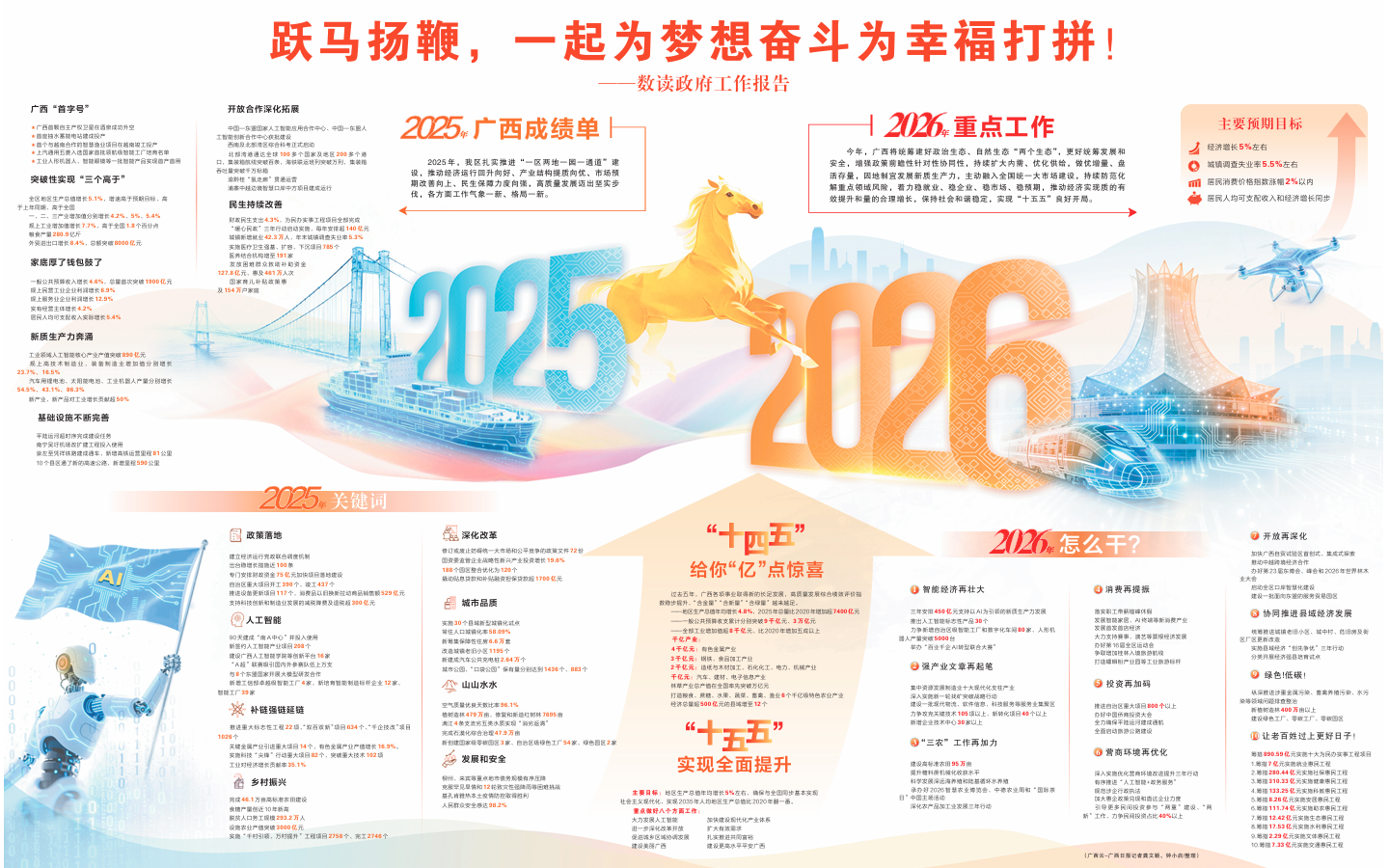
Core Insights - In 2025, Guangxi has made significant progress in economic recovery, industrial structure improvement, market expectation enhancement, and strong social welfare, marking a solid step towards high-quality development [3] Economic Performance - The GDP of Guangxi grew by 5.1%, exceeding the expected target, last year's performance, and the national average [5] - The value added of primary, secondary, and tertiary industries increased by 4.2%, 5%, and 5.4% respectively [5] - The industrial output value of large-scale enterprises rose by 7.7%, surpassing the national average by 1.8 percentage points [5] - Foreign trade imports and exports increased by 8.4%, with total trade exceeding 800 billion yuan [5] - General public budget revenue grew by 4.6%, surpassing 190 billion yuan for the first time [5] Industrial Development - The core industry output value of artificial intelligence in the industrial sector exceeded 89 billion yuan [6] - The value added of high-tech manufacturing and equipment manufacturing increased by 23.7% and 16.5% respectively [6] - Production of lithium batteries for vehicles, solar cells, and industrial robots grew by 54.5%, 43.1%, and 86.3% respectively [6] - The contribution of new industries and products to industrial growth exceeded 50% [6] Infrastructure and Connectivity - The construction of the Pinglu Canal was completed ahead of schedule [6] - The expansion of Nanning Wuxu Airport was put into operation [6] - The railway from Chongzuo to Pingxiang was completed, adding 81 kilometers of high-speed rail [6] - New highways were opened in 10 counties, adding 590 kilometers [6] Social Welfare and Employment - The actual per capita disposable income of residents increased by 5.4% [6] - Urban employment increased by 423,000, with an urban survey unemployment rate of 5.3% [6] - Financial expenditure on people's livelihood increased by 4.3%, with all projects completed [6] Future Goals and Strategies - The expected economic growth target for 2026 is around 5% [10] - Plans to support AI-driven new productivity development with 45 billion yuan over three years [10] - Aiming to establish 80 new intelligent factories and digital workshops [11] - Focus on enhancing the manufacturing industry and tackling key technologies [11] Environmental and Sustainable Development - New afforestation efforts aim to plant over 4 million acres [12] - The establishment of green factories and zero-carbon parks is prioritized [12] - The air quality has improved, with a 96.1% rate of good air quality days [8]

2027目标倒计时:人工智能如何重塑中国制造业竞争力
Xin Lang Cai Jing· 2026-01-10 10:14
Core Objectives and Quantifiable Indicators (2027) - The implementation opinion establishes a "five-in-one" development goal focusing on technology, application, product, entity, and ecosystem, with clear and quantifiable core indicators to form a closed-loop traction system [2][4] - By 2027, the plan aims to cultivate 2-3 globally influential leading enterprises and identify 1,000 benchmark companies, while nurturing specialized "little giant" enterprises and manufacturing champions [4] Key Tasks and Implementation Pathways - The implementation opinion outlines nine key tasks, focusing on four dimensions: - Strengthening computing power supply capabilities and developing high-level industry models [6][7] - Expanding high-value application scenarios across industries and processes [9][10] - Upgrading intelligent equipment and fostering new business models [11] - Enhancing ecosystem support through market entity cultivation, safety governance, and international cooperation [12][13] Policy Highlights and Innovative Breakthroughs - The "1+2" policy system provides comprehensive coverage, addressing the core issues of policy implementation, industry transformation, and enterprise application [14] - Quantifiable indicators enhance policy operability, providing clear guidance for local assessments and enterprise implementation [14] - The dual-driven approach of scenarios and demand aims to match supply and demand accurately, addressing the challenge of "heavy technology, light application" [14] Realistic Challenges - Data governance and integration difficulties arise from the fragmentation of manufacturing data across various systems and devices [15] - A significant talent gap exists, particularly for professionals who understand both artificial intelligence technology and manufacturing processes [15] - High transformation costs and long cycles pose challenges for small and medium-sized enterprises [16] - Model adaptation and security risks coexist, complicating the deployment of AI models in industrial settings [16]
我市累计吸纳京津技术合同成交额超480亿元
Xin Lang Cai Jing· 2026-01-10 08:10
Core Insights - The city is focusing on collaborative innovation with Beijing and Tianjin during the "14th Five-Year Plan" period, aiming to enhance the transformation and industrialization of scientific and technological achievements [1] Group 1: Policy and Framework - The city is improving the environment for the transformation of scientific achievements by establishing a technology innovation system that integrates enterprises, markets, and research [1] - A series of policies have been introduced to attract high-level innovation resources from Beijing and Tianjin, including measures to facilitate the transfer and transformation of scientific achievements [1] - Since the beginning of the "14th Five-Year Plan," the city has absorbed over 48 billion yuan in technology contract transactions from Beijing and Tianjin [1] Group 2: Resource Utilization - The city is leveraging resources from various research institutes, such as the Chinese Academy of Sciences and the China National Pulp and Paper Research Institute, to attract and implement technological achievements from Beijing and Tianjin [2] - Collaborations have led to the development of over 10 new technologies, including a high-performance organic silicon fireproof sealing material that fills a domestic gap [2] - More than 30 high-tech projects have been introduced to the city, enhancing the local industrial chain [2] Group 3: Project Support and Outcomes - A total of 69 major scientific and technological achievement transformation projects have been initiated, with over 30 collaborations involving Beijing and Tianjin [3] - These projects span key sectors such as modern logistics, electronic information, biomedicine, aerospace, new energy, and new materials, resulting in significant financial impacts [3] - The projects have led to an increase of 7.08 billion yuan in R&D investment, 48.1 billion yuan in new sales revenue, and 5.17 billion yuan in new tax contributions, alongside the application of 370 patents [3]
工信部:到2028年 工业互联网与人工智能融合赋能水平显著提升
Yang Shi Wang· 2026-01-07 10:21
Core Viewpoint - The Ministry of Industry and Information Technology has issued an action plan to enhance the integration of industrial internet and artificial intelligence, aiming for significant improvements by 2028 in various sectors through upgraded infrastructure, data model interoperability, innovative application modes, and a cohesive industrial ecosystem [1][2][3]. Summary by Sections Overall Requirements - The action plan aims to deepen the integration of artificial intelligence in the industrial sector, enhancing the competitiveness of the information and communication industry and supporting the transition to a higher-end global value chain by 2028 [3]. Infrastructure Upgrade Actions - Accelerate the intelligent upgrade of industrial networks using technologies like 5G, edge computing, and cloud control to meet new industrial demands [4]. - Improve the intelligence level of industrial internet platforms by leveraging deep learning and low-code technologies to enhance resource allocation and application development [5]. - Strengthen the supply of industrial computing power by integrating industrial internet with various computing centers and promoting the deployment of intelligent devices [6]. Data Model Interoperability Actions - Encourage the sharing of industrial data across various sources and establish a national industrial data directory to enhance data collaboration and analysis [7]. - Support the construction of high-quality industry data sets to meet the needs of industrial model training and application [8]. - Enhance the efficiency of industrial model development and deployment by standardizing and encapsulating industrial knowledge and processes [9]. Application Mode Innovation Actions - Promote the transformation of application modes in industries by utilizing industrial internet to streamline data flows between production and consumption, enhancing intelligent analysis and decision-making capabilities [10]. - Accelerate the promotion of industrial internet applications in key industries, providing guidelines and resources for digital transformation [11]. Industrial Ecosystem Integration Actions - Foster the development of intelligent solution providers by encouraging collaboration among industrial enterprises, internet companies, and AI firms [13]. - Support innovation in technology products, focusing on the intelligent upgrade of industrial communication and control systems [14]. - Optimize public service capabilities to provide low-cost intelligent services to small and medium-sized enterprises [14]. Guarantee Measures - Strengthen coordination for the integration of industrial internet and AI, encouraging local governments to develop supportive policies and funding mechanisms [15].
山西“十五五”规划建议:前瞻布局量子科技、生物制造、绿色氢能、脑机接口等未来产业
Xin Lang Cai Jing· 2025-12-05 02:14
Core Viewpoint - The proposal from the Shanxi Provincial Committee of the Communist Party emphasizes the cultivation and expansion of emerging industries and the forward-looking layout of future industries, aiming to accelerate the large-scale development of new industries and establish new pillar industries [1] Group 1: Emerging Industries - Focus on developing new energy, new materials, high-end equipment manufacturing, electronic information, modern coal chemical industry, low-altitude economy, energy conservation and environmental protection, and modern medicine [1] - Accelerate the construction of industrial chains, including strengthening and supplementing existing chains to promote the development of strategic emerging industry clusters [1] Group 2: Advanced Manufacturing - Strengthen and expand industries such as rail transportation, intelligent coal machinery, engineering machinery, new energy heavy trucks, optoelectronic equipment, new energy equipment, power equipment, high-end casting and forging, aerospace, low-altitude equipment, and robotics [1] - Implement industrial innovation projects to advance the construction of innovation facilities, technology research and development, and product iteration upgrades [1] Group 3: Future Industries - Proactively layout future industries such as quantum technology, biological manufacturing, green hydrogen energy, brain-computer interfaces, embodied intelligence, and sixth-generation mobile communication [1] - Gradually establish a number of pilot zones for future industries [1] Group 4: Industrial Ecosystem and Investment - Innovate regulatory methods, develop venture capital, and establish mechanisms for growth and risk-sharing in future industry investments [1] - Strengthen the reconstruction of industrial foundations to enhance the resilience and safety level of the industrial system [1]
培优育强、聚势赋能,威海构建优质企业梯度培育新格局
Qi Lu Wan Bao· 2025-11-28 08:01
Core Viewpoint - The government of Weihai City is focusing on nurturing high-quality enterprises as a core strategy to drive economic growth and industrial upgrading during the "14th Five-Year Plan" period [1] Group 1: Enterprise Development Strategies - The city has established a command center for key enterprise cultivation and introduced special incentive policies for enterprise expansion, aiming to create a tiered cultivation structure and a full-cycle service system [1] - The "Hundred Billion Enterprises" cultivation project has led to six industrial enterprises achieving annual revenues exceeding 10 billion yuan, with new projects like Hengbang Mining and Haomai Heavy Industry accelerating growth [2] - The number of industrial enterprises above designated size in Weihai has been steadily increasing, reaching 1,451 by the end of October 2025 [2] Group 2: Quality Improvement Initiatives - A project to enhance quality among small and medium-sized enterprises has resulted in 16 national champion enterprises and 65 "specialized, refined, distinctive, and innovative" small giants [2] - 82% of quality SMEs have filled gaps in key links of the industrial chain, strengthening the stability of supply chains [2] Group 3: Service and Support Mechanisms - The city has implemented a "one enterprise, one policy" approach to address development challenges, collecting and addressing 2,812 requests from businesses related to land, talent, funding, and technology [3] - A specialized enterprise acceleration center has been established, attracting over 60 professional institutions to provide comprehensive support for policy interpretation, technological innovation, and financial integration [3] Group 4: Talent Development and Brand Building - The city is focusing on talent cultivation by developing five key talent teams, with three enterprises recognized as provincial-level talent-leading pilot enterprises [4] - The "Three Products" initiative aims to enhance product variety, quality, and branding, resulting in five companies being recognized as national quality benchmarks [4]
谋划 “十五五”| 着力推动新型工业化和工业高水平对外开放
Xin Lang Cai Jing· 2025-11-18 03:03
Core Insights - The article emphasizes the need for China to enhance its industrial development and global competitiveness during the "14th Five-Year Plan" period, focusing on five key overall positions [1][2]. Group 1: Industrial Development Goals - Ensure that the industrial sector maintains a certain scale and proportion within the economy [1]. - Accelerate the transformation of the industrial sector into one of China's most internationally competitive industries [1]. - Utilize the industrial sector as a crucial platform for innovation in new technologies, industries, and business models [1]. - Enhance the role of the industrial sector in driving economic development in relatively underdeveloped regions [1]. - Strengthen the industrial sector's contribution to increasing people's income [1]. Group 2: New Industrialization - Promote new industrialization by optimizing the policy environment to activate market vitality and enterprise motivation [2]. - Strengthen competition policies to ensure fair competition and enhance the development of strategic emerging industries through innovation [2]. - Establish a new type of national system that coordinates the entire industrial chain and enhances communication among government departments [3]. Group 3: Development of New Productive Forces - Focus on key core technologies and systematically layout critical areas to accelerate the development of new productive forces [4][5]. - Support the growth of strategic emerging industry clusters such as new energy, advanced manufacturing, and electronic information [4]. - Foster a collaborative innovation ecosystem led by enterprises to drive the development of new technologies and products [5]. Group 4: Modern Industrial System - Strengthen the integrity of the industrial system by addressing weak links in key industrial chains and promoting upstream and downstream collaboration [6][7]. - Accelerate the digital transformation and high-end upgrading of traditional industries [7]. - Enhance the safety and resilience of industrial supply chains to withstand external shocks [8]. Group 5: Core Competencies for Industrial Transformation - Improve strategic capabilities to seize opportunities from the new industrial revolution by focusing on cutting-edge technologies [9]. - Enhance the ability to smoothly transition development dynamics and support domestic demand [10]. - Address critical self-sufficiency issues in advanced manufacturing sectors to enhance industrial security [11]. Group 6: High-Level Opening Up of Industry - Strengthen the ability to track and predict industrial and trade policies of major trading nations to navigate international trade relations effectively [13]. - Expand institutional openness to enhance China's global industrial competitiveness [14].
瞭望丨云浮谋进
Nan Fang Du Shi Bao· 2025-11-16 04:01
Core Viewpoint - Yunfu, as the youngest prefecture-level city in Guangdong, is characterized by its unique cultural and historical significance, and is actively pursuing high-quality development through strategic positioning and industrial upgrades [1][4][5]. Historical Context - The name "Yunfu" dates back to the Tang Dynasty, with its administrative evolution leading to its current status as a prefecture-level city since 1994 [1]. - Significant archaeological findings, such as the Moding Mountain site, have pushed back the timeline of human activity in the region, highlighting its ancient civilization [3]. Cultural Significance - Yunfu is deeply rooted in Zen culture, with historical figures like Master Huineng influencing its cultural landscape [2]. - The city embodies a spirit of loyalty and patriotism, with historical contributions from its residents in various national movements [2]. Economic Development - Yunfu is focusing on developing three major trillion-yuan industrial clusters: metal manufacturing, green building materials, and modern agriculture, while also nurturing emerging industries like clean energy and biomedicine [4]. - The city aims to achieve a breakthrough in "unicorn" enterprises and has set ambitious goals to elevate its economic status to match the Pearl River Delta region [6][8]. Social Progress - Yunfu prioritizes the well-being of its residents, boasting a forest coverage rate of nearly 70% and maintaining high water quality standards [5]. - The city has implemented a collaborative model involving government, banks, enterprises, and villages, resulting in significant increases in collective income for local communities [5]. Future Aspirations - Yunfu is committed to a long-term vision of development, aiming to bridge the gap with the Pearl River Delta's average economic levels while addressing challenges such as economic scale, fiscal strength, and talent shortages [6][8]. - The city is poised to leave a significant mark on the narrative of modern China, with aspirations for continued growth and modernization [7][8].
拓展双向投资合作空间更多细化措施将出台
Zhong Guo Zheng Quan Bao· 2025-11-02 20:16
Group 1 - The core viewpoint of the article emphasizes the importance of expanding bilateral investment cooperation and enhancing foreign investment attraction as key strategies during the "15th Five-Year Plan" period [1][2] - The Ministry of Commerce reported that from January to September this year, 48,921 new foreign-invested enterprises were established, a year-on-year increase of 16.2%, with actual foreign investment amounting to 573.75 billion yuan, reflecting a growth of 11.2% in September alone [1][2] - The focus on high-tech industries is evident, with over one-third of foreign investment directed towards high-tech sectors, including automotive, healthcare, and electronic information [1][2] Group 2 - The article highlights the need to simplify approval processes and ensure both market entry and operational ease for foreign investors, particularly in the service sector [2][3] - The negative list for foreign investment access will be further reduced, particularly in telecommunications, internet, education, culture, and healthcare sectors [3] - The government aims to create a favorable investment environment by enhancing intellectual property protection and providing policy incentives to attract high-tech industries and R&D centers [2][3] Group 3 - The article discusses the significance of optimizing foreign investment management to facilitate China's deeper participation in global industrial division and cooperation [4][5] - In 2024, China's outward direct investment is projected to reach 192.2 billion USD, marking an 8.4% increase from the previous year, maintaining a global share of 11.9% [4] - The establishment of a comprehensive overseas service system is emphasized to support enterprises going abroad, ensuring compliance and enhancing the supply chain's resilience [5]
工信部|2025年度智能制造系统解决方案“揭榜挂帅”项目申报工作启动
机器人圈· 2025-10-23 10:09
Core Viewpoint - The Ministry of Industry and Information Technology and the State Administration for Market Regulation have jointly issued a notice to initiate the 2025 annual application for the "Leading the Way" project for intelligent manufacturing system solutions, focusing on digital transformation and intelligent upgrades in key industries such as raw materials, high-end equipment, consumer goods, and electronic information [2][4]. Group 1: Project Application - The 2025 project application aims to address the pain points in intelligent factory construction and cultivate specialized suppliers with core technologies in specific industries [3][4]. - Eligible applicants must be registered enterprises or research institutions in China with independent legal status, capable of forming joint applications [5][19]. - Each applicant can lead one project and cover up to three tasks related to intelligent manufacturing system solutions [30][32]. Group 2: Implementation and Evaluation - The application process involves online submission of materials by November 10, 2025, followed by a review by local industrial and information departments [7][32]. - The evaluation of already approved projects will be conducted by the Ministry of Industry and Information Technology and the State Administration for Market Regulation, ensuring that the solutions are advanced, applicable, and replicable [10][44]. - Successful applicants must complete their commitments within two years and request evaluation from their recommending units [8][32]. Group 3: Requirements and Standards - Applicants must demonstrate a solid foundation in technology innovation and application, with necessary facilities and successful case studies in relevant industries [5][20]. - The evaluation process includes submitting verification materials and undergoing a thorough review by experts to assess the completion of tasks and indicators [11][45]. - The project execution period is limited to two years, with an emphasis on promoting successful outcomes and experiences in the intelligent manufacturing sector [13][14].