
中药材

Search documents
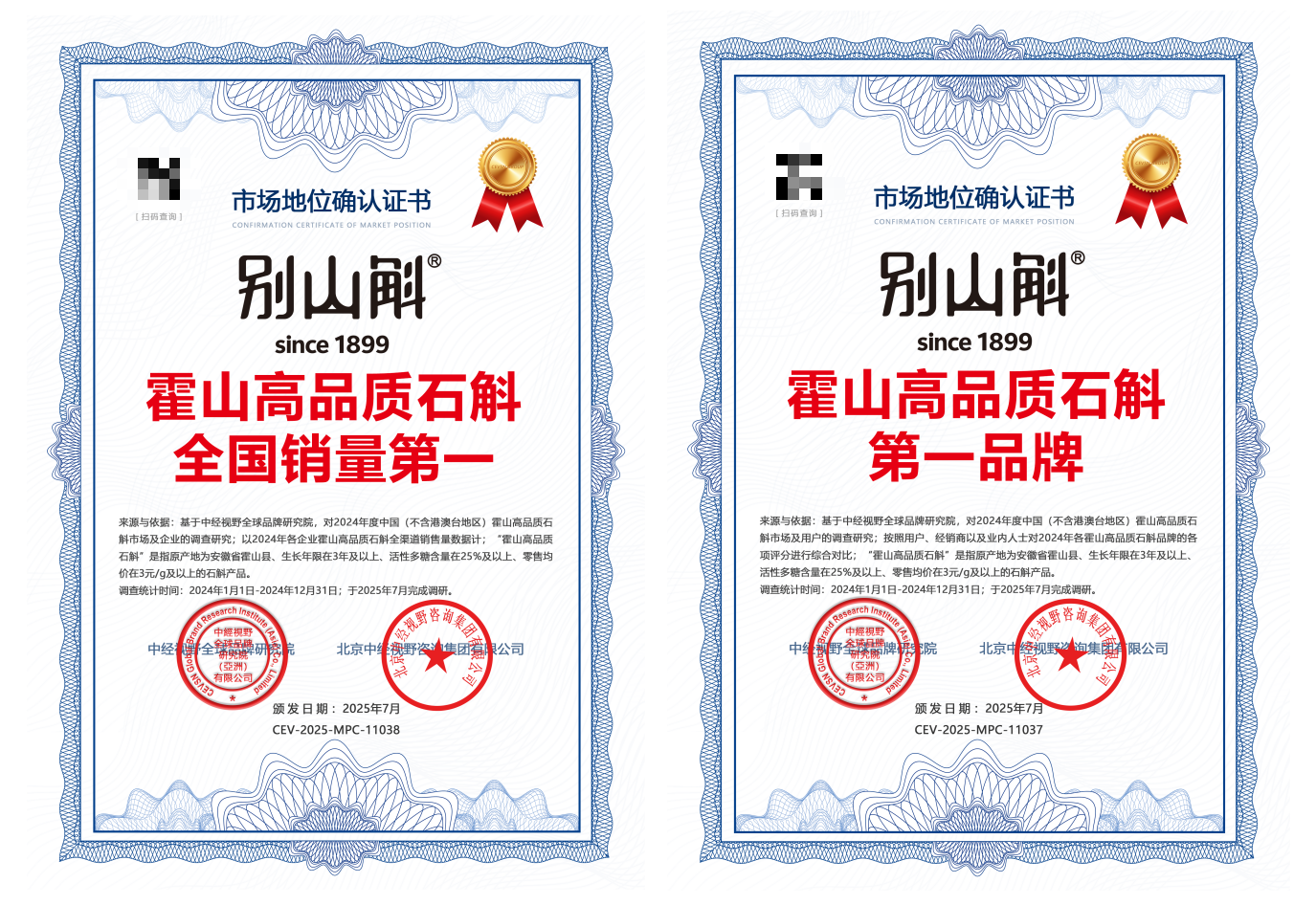
别山斛荣获中视野全球品牌研究院双认证,助力霍山高品质石斛蓬勃发展
Zhong Guo Chan Ye Jing Ji Xin Xi Wang· 2025-08-20 08:24
Core Insights - Bieshan Dendrobium has been awarded two authoritative certifications as the "National Sales Champion of High-Quality Dendrobium" and "First Brand of High-Quality Dendrobium" by the China Economic Vision Global Brand Research Institute, highlighting its leading position in the industry and boosting the market for high-quality Dendrobium from Hushan [1][3][13] Company Overview - Bieshan Dendrobium is rooted in the Dabie Mountain region, known as the "Hometown of Dendrobium" in Anhui, where the unique climate and soil conditions contribute to the high quality of its products [7] - The company has a rich history dating back to 1886, when He Qingcai began using local medicinal herbs, leading to the establishment of "Dabie Mountain Chinese Medicine Hall" in 1899, which laid the foundation for Bieshan Dendrobium's brand [4] Product Quality and Production Techniques - Bieshan Dendrobium emphasizes traditional craftsmanship, utilizing 18 non-heritage processes to ensure the quality of its products, with a significant focus on the meticulous production of Dendrobium [8] - The company maintains a commitment to high-quality standards, with a production ratio of 10:1 for fresh Dendrobium to finished product, showcasing its dedication to quality [8] Market Position and Strategy - The demand for high-quality health supplements is increasing, and Bieshan Dendrobium has positioned itself as a leader in the Hushan high-quality Dendrobium market, leveraging its brand reputation and product quality [3][10] - The company employs a "company + base + cooperative + farmer" model, creating a community of shared interests that addresses the challenges faced by farmers and contributes to local economic development [10] Brand Development and Marketing - Bieshan Dendrobium focuses on brand building as a core strategy, integrating traditional craftsmanship with modern technology to enhance product value and consumer trust [12] - The company utilizes innovative online platforms to expand its sales channels, combining e-commerce with physical retail to enhance market reach [12]


一市监局超期扣押药材,被判违法
Nan Fang Du Shi Bao· 2025-08-19 07:00
Core Viewpoint - The case highlights the violation of administrative enforcement laws by the Xiangtan Market Supervision Administration, which led to the illegal prolonged detention of pharmaceutical products, ultimately resulting in a court ruling against the agency's actions [1][2][3] Group 1: Administrative Actions - The Xiangtan Market Supervision Administration conducted an inspection on a traditional Chinese medicine business and found it operating without necessary licenses, leading to the seizure of products [1] - The agency extended the detention of seized products beyond the legal timeframe, which was deemed a violation of the Administrative Enforcement Law [2] - The court ruled that the prolonged detention of the products posed risks to public health and safety, necessitating proper administrative handling of the situation [2] Group 2: Legal Proceedings - The first-instance court confirmed the illegal nature of the agency's actions and mandated remedial measures, which were upheld by the second-instance court [2] - The Supreme Court emphasized the need for strict enforcement of laws by courts to protect public health rights [2] Group 3: Resolution and Impact - The case resulted in a resolution where both parties reached a settlement, with the agency destroying some expired products and the business improving its compliance [3] - The local government allowed the traditional Chinese medicine business to participate in the development of a local herbal medicine industry park, indicating a collaborative outcome [3]
最高人民法院发布第二批涉企行政强制典型案例
Yang Shi Wang· 2025-08-18 02:16
Group 1 - The Supreme People's Court has released a second batch of five typical cases related to administrative enforcement involving enterprises, aiming to protect the property rights and legitimate interests of market entities and prevent similar administrative violations [1][2] - The cases highlight the court's efforts to resolve administrative disputes effectively and ensure the implementation of the Central Committee's decisions on the development of the private economy [1][3] Group 2 - In the case of a traditional Chinese medicine company against the Xiangtan Market Supervision Administration, the court ruled that the prolonged seizure of goods exceeded the legal time limit, confirming the administrative action as illegal [2][3] - The court emphasized the importance of strict regulatory standards and the need for administrative agencies to act within their legal authority, thereby protecting public health and safety [3] Group 3 - A plastic products factory challenged the fire safety authority's order to cease operations due to safety violations, leading to a ruling that the authority lacked the legal basis to enforce such measures [4][6] - The court's decision reinforced the need for administrative bodies to adhere to legal procedures and protect the rights of businesses [7] Group 4 - A media company contested the forced demolition of its rooftop advertisement by the local enforcement agency, which was deemed illegal due to the lack of proper legal procedures [8][9] - The ruling highlighted the necessity for administrative bodies to respect existing licenses and provide compensation when revoking permits [10][11] Group 5 - A cultural dissemination company faced forced demolition of its bus stop facilities, which the court ruled as illegal due to the absence of legal grounds and failure to follow due process [12][13] - The case underscored the principle of protecting the trust interests of enterprises and the requirement for administrative agencies to consider prior agreements and investments [14] Group 6 - A small lubricant technology company was subjected to a fine for false advertising, but the court recommended against enforcement due to the company's status and lack of revenue [15][17] - The case illustrates the balance between punishment and education in administrative enforcement, particularly for small enterprises, promoting their healthy development [18]
山东延长中药材产业链 开出增收“新良方”
Zhong Guo Xin Wen Wang· 2025-08-14 19:23
Group 1: Industry Development - The traditional Chinese medicine industry in various regions of Shandong is extending its industrial chain from cultivation to deep processing, enhancing rural income and efficiency [1][2] - In Juyecounty, the local industry has transitioned from merely selling raw materials to producing health products like mugwort fluff and pillows, generating an annual stable income of 1.5 million RMB for the town [1] - The total transaction volume of the traditional Chinese medicine market in Jucheng County reached 6.05 billion RMB in the first half of the year, with an increase of 18,000 acres in planting area [2] Group 2: Specific Products and Innovations - The development of products from mulberry mushrooms, known as "forest gold," is being promoted in Linqing City, with over 50 high-quality products developed, aiming for a production value of 350 million RMB by 2024 [2] - The Jinan Yuesheng Traditional Chinese Medicine Planting Cooperative focuses on developing extracts and health foods from various medicinal herbs, with over 10,000 acres of Dan Shen planted, generating an annual income exceeding 30 million RMB [3] Group 3: Community and Economic Impact - The "Yandu Medicine Valley" in Weifang Anqiu City has established a comprehensive development model integrating high-end seedling cultivation, standardized planting, and processing, benefiting local communities [3][4] - Approximately 2,000 villagers are engaged in labor services and self-sustained wild-like cultivation of medicinal herbs, leading to an income increase of 600 million RMB, with an average annual increase of over 40,000 RMB per person [4]
湖北将打造千亿级中药材全产业链
Chang Jiang Shang Bao· 2025-08-11 23:29
Core Viewpoint - The Hubei Provincial Rural Work Leading Group has issued the "Three-Year Action Plan for Revitalizing Hubei Authentic Medicinal Materials (2025-2027)", aiming to enhance the quality and market presence of local medicinal herbs, promote the development of leading enterprises, and expand both domestic and international markets [1][2]. Group 1: Action Plan Objectives - The plan focuses on key varieties such as Qiai and Fubai chrysanthemum, selecting leading counties for each variety to promote coordinated development across the medicinal materials industry [1]. - By 2027, the plan aims to stabilize the planting area of traditional Chinese medicinal materials at approximately 5.6 million acres, with ecological planting of authentic medicinal materials reaching 2.8 million acres [1]. - The plan targets an industry output value exceeding 100 billion yuan for the entire medicinal materials supply chain [1]. Group 2: Technological and Quality Enhancements - Hubei will release a directory of authentic medicinal materials and promote suitable planting practices, focusing on the "Top Ten Hubei Medicines" and establishing around 30 main production counties [2]. - The plan includes the implementation of a 515 action for agricultural industry chain technology services, promoting new ecological planting techniques and enhancing quality assurance in medicinal materials [2]. - Emphasis is placed on technological innovation to support the transformation of medicinal materials into medicines, including research on the mechanisms of authentic medicinal materials and the development of traditional Chinese medicine preparations [2]. Group 3: Supply Chain and Market Development - The plan aims to enhance the trading market for authentic medicinal materials and create a comprehensive online service platform for the industry [2]. - It includes the construction of storage facilities for medicinal materials at production bases and the establishment of a logistics hub for medicinal materials in Hubei [2].
暴跌,“曾经论克卖的药材,如今按斤称都嫌贵”
Di Yi Cai Jing· 2025-08-08 10:58
Core Viewpoint - The significant decline in traditional Chinese medicine (TCM) herb prices reflects a broader downturn in the TCM market, with many herbs experiencing price drops of nearly 90% from previous highs [2][3]. Price Trends - Prices for TCM herbs such as Ziwun and Cat Claw Grass have plummeted from 80 yuan and over 1,000 yuan per kilogram to 9 yuan and 66 yuan, respectively [2]. - A total of 835 out of 1,095 TCM herb varieties tracked by Kangmei TCM Network have seen price declines this year, representing approximately 75% of the total [2]. - The TCM Comprehensive 200 Index has dropped from 3549.47 on July 18, 2024, to 2812.85 on August 4, 2025 [2]. Market Dynamics - The current price drop is attributed to the aftermath of previous speculative trading, leading to overproduction and excess inventory in the TCM market [3]. - The decline in prices has caused panic among stockpilers and traders, prompting them to liquidate their holdings, further driving down prices [3]. - Experts indicate that the market has not yet fully adjusted, with many industry participants facing significant financial losses due to the price drop [4]. Supply and Demand Factors - The supply of TCM herbs is heavily influenced by weather conditions and regional planting volumes, making it less flexible compared to chemical drug raw materials [5]. - The demand for TCM herbs is driven by consumer health needs, processing into TCM tablets, and production of traditional Chinese patent medicines [5]. - Despite the short-term benefits of lower herb prices for manufacturers and consumers, the long-term implications could harm the stability of the industry due to the adverse effects on farmers [5].
暴跌!“曾经论克卖的药材,如今按斤称都嫌贵”
第一财经· 2025-08-08 10:35
Core Viewpoint - The article highlights a significant decline in the prices of traditional Chinese medicinal herbs, reflecting a broader downturn in the industry after a period of speculative price increases. Price Decline Overview - The price of Ziwun has dropped from 80 yuan per kilogram to 9 yuan, while the price of Cat Claw Grass has fallen from over 1,000 yuan to 66 yuan, indicating a nearly 90% decrease in prices for these herbs this year [3][4] - A total of 835 out of 1,095 monitored medicinal herb varieties have seen price declines this year, accounting for approximately 75% of the market [3] - Notable herbs with price drops exceeding 30% include Bai Zhu, Lian Qiao, Jin Yin Hua, Niu Huang, Ban Lan Gen, and Dang Gui [3] Market Dynamics - The current price drop is attributed to the aftermath of previous speculative trading, which led to overproduction and excess inventory in the market [4] - The market has experienced a panic sell-off as traders rush to liquidate stock, further driving down prices [4] - Experts suggest that the price adjustments have not yet reached a stable level, with many industry participants facing significant financial losses due to the downturn [5] Supply and Demand Factors - The supply of medicinal herbs is heavily influenced by environmental factors, making it less flexible compared to chemical raw materials [5] - The demand for medicinal herbs is driven by consumer health needs, processing into medicinal slices, and production of traditional Chinese medicine [5] - The current imbalance between excess supply and stagnant demand from downstream manufacturers is a key factor in the price decline [6] Long-term Implications - While the price drop may temporarily reduce costs for manufacturers and benefit consumers, it poses risks to the long-term stability of the industry, as low prices can harm farmers [6]
1095个品种有835个今年价格累计下跌,中药材价格缘何现暴跌
Di Yi Cai Jing· 2025-08-08 09:46
Core Viewpoint - The significant decline in traditional Chinese medicine (TCM) herb prices reflects a broader downturn in the industry, with many herbs experiencing price drops of nearly 90% from previous highs, indicating a market correction after years of speculation and overproduction [1][3]. Price Trends - Prices of specific herbs like Cat's Claw and Aster have plummeted, with Cat's Claw dropping from over 1,000 yuan per kilogram to 66 yuan, and Aster from 80 yuan to 9 yuan [1]. - A total of 835 out of 1,095 TCM herb varieties tracked by Kangmei TCM Network have seen price declines this year, representing approximately 75% of the market [1]. - The TCM Comprehensive 200 Index has decreased from 3549.47 on July 18, 2024, to 2812.85 by August 4, 2025, indicating a significant market downturn [1]. Market Dynamics - The current price drop is attributed to the aftermath of previous speculative trading, leading to overproduction and excess inventory in the TCM sector [3]. - Market panic has led to wholesalers and traders rushing to liquidate stock, further driving down prices [3]. - Experts suggest that the decline in prices has not yet reached a stable adjustment point, indicating ongoing volatility in the market [3]. Supply and Demand Factors - The supply of TCM herbs is heavily influenced by environmental factors, making it less flexible compared to chemical drug production [4]. - The demand for TCM herbs is driven by consumer health needs, production of herbal tablets, and traditional Chinese medicine formulations [4]. - The current imbalance between overproduction and insufficient demand from downstream manufacturers is contributing to the price decline, which may benefit short-term costs but poses long-term risks to industry stability [4].
2025年中国黄连市场政策汇总、产业链图谱、供需现状、进出口贸易、竞争格局及发展趋势研判:黄连衍生产品日渐丰富[图]
Chan Ye Xin Xi Wang· 2025-08-05 02:10
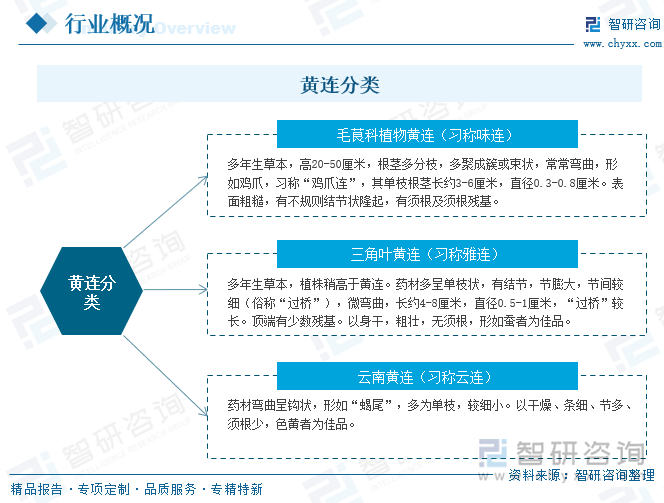
Overview - The increasing national health awareness and the recognition of traditional Chinese medicine's "preventive treatment" concept have led to a growing demand for Huanglian, which has properties such as clearing heat and dampness, and detoxifying [1][9] - The demand for Huanglian in China is projected to reach 2,938 tons in 2024, representing a year-on-year growth of 8.4% [1][9] Market Policy - The Chinese government has issued several policies to support the development of the traditional Chinese medicine industry, creating a favorable environment for the Huanglian industry [4][6] - Key policies include measures to strengthen scientific regulation of traditional Chinese medicine, promote innovation, and enhance the quality of traditional Chinese medicine [4][6] Industry Chain - The Huanglian industry chain includes upstream planting, midstream processing, and downstream sales, with a focus on high-quality cultivation and various product forms [7] - Products include raw Huanglian, processed slices, traditional Chinese medicine, health products, and cosmetics [7] Development Status - The market demand for Huanglian is increasing, with applications in pharmaceuticals and health products [9] - In addition to meeting domestic needs, Huanglian is also exported, with an expected export volume of 234.67 tons and an export value of $10.81 million in 2024 [11] Competitive Landscape - The Huanglian industry is characterized by a fragmented market with many small-scale enterprises; over 80% of registered Huanglian-related companies have a registered capital of less than 1 million [13] - Notable companies include Jiuxin Traditional Chinese Medicine Group and Hongya County Wawushan Pharmaceutical Co., Ltd., which focus on quality control and product development [15][17] Development Trends - Future applications of Huanglian are expected to expand into health products, functional foods, and cosmetics, driven by consumer demand [20] - The international market's growing demand for natural medicines presents opportunities for Huanglian exports, prompting companies to enhance quality standards and product quality [20]
打造人才生态“磁场” 激活创新发展“动能”
Qi Lu Wan Bao Wang· 2025-08-04 12:43
Group 1 - The third Youth Scientist Innovation Development Conference was held in Jinan, Shandong, focusing on supporting young scientific talents and fostering their growth through various activities and platforms [1][2][3] - The conference emphasized the importance of mentorship from experienced scientists to guide and inspire young talents, creating a collaborative environment for knowledge transfer [4][5] - A significant feature of the conference was the industry demand matching event, which facilitated direct interactions between young scientists and business leaders, leading to potential collaborations [7][8] Group 2 - The Shandong Provincial Youth Talent Support Project has been instrumental in providing resources and opportunities for young scientists, with 342 talents selected since its inception in 2018 [10][11] - The establishment of a new online service platform aims to enhance the connection between young scientific talents and industry needs, promoting efficient technology transfer and collaboration [11] - The conference showcased various activities designed to support young scientists, including forums, dialogues, and workshops, all aimed at enhancing their innovation capabilities and career development [2][3][10]