债券发行

Search documents
俄罗斯首次发行人民币计价国债
日经中文网· 2025-11-13 08:00
受美欧制裁影响,俄罗斯减少了美元和欧元的贸易结算。俄罗斯主张称,2024年中俄贸易额达到创历史 新高的2450亿美元,99%的结算用卢布和人民币进行。自2022年以来,俄罗斯企业陆续发行了人民币计 价公司债。 由于军费不断膨胀,补充财政收入的必要性也在提高。预计俄罗斯2025年的财政赤字将占国内生产总值 (GDP)的2.6%,比2024年的1.7%扩大。匿名接受采访的俄罗斯经济学家认为:"作为被认为风险较高 的卢布计价的替代选项,决定以人民币计价发行"。 俄罗斯总统普京(资料图,reuters) 俄罗斯从海外融资依然困难。俄乌冲突后外国投资者对俄罗斯国债的交易大幅减少。俄罗斯央行的数据 显示,非居民持有俄罗斯国债(以卢布计价)的比例在10月份仅为3.9%。俄乌冲突前约为2成。 在财政赤字扩大的背景下,俄政府寻求向通过对中国能源出口而持有大量人民币的企业等筹资…… 俄罗斯财政部11月12日宣布,将首次在俄罗斯发行以人民币计价的国内债券。在乌克兰问题长期化导致 财政赤字扩大的背景下,俄政府正寻求向通过对中国能源出口而持有大量人民币的企业等筹措资金。 12月8日将发行偿还期限为3~7年的国债。发行额将根据12月2日 ...


只有中国敢这么干!发行美债狂揽1182亿,华尔街沉默,美联储头疼
Sou Hu Cai Jing· 2025-11-12 17:47
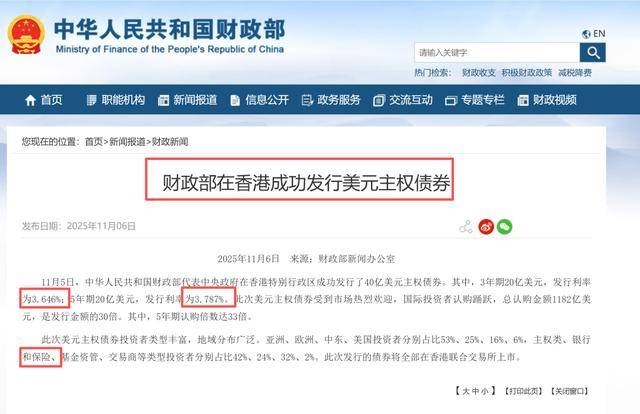
Core Viewpoint - The issuance of $4 billion in sovereign bonds by the Chinese Ministry of Finance in Hong Kong attracted an unprecedented $118.2 billion in global subscriptions, marking a historical record in market response [1] Group 1: Bond Issuance Details - The bond issuance was highly sought after, with an overall subscription rate nearing 30 times, and the 5-year bonds reaching a staggering 33 times [3] - The yields on these bonds were comparable to U.S. Treasury yields, with the 3-year yield at 3.646% and the 5-year yield at 3.787%, only slightly higher than U.S. bonds by 0.02 percentage points [3] Group 2: Market Sentiment and Trust - The overwhelming demand for these bonds, despite minimal additional interest incentives, signals a collective vote of confidence in China's sovereign credit [5] - In contrast, U.S. Treasury bond subscriptions were much cooler, typically ranging between 2.5 to 2.7 times [7] Group 3: Credit Ratings and Economic Fundamentals - There is a stark contrast between the market's perception and the official ratings from international agencies, with China rated A1 by Moody's while the U.S. holds a higher AA1 rating [8] - Investors are focusing on China's strong fundamentals, including over $3 trillion in foreign exchange reserves and a consistent trade surplus, which bolster its debt repayment capacity [8] Group 4: Implications for Global Finance - The successful bond issuance challenges the traditional pricing power of the U.S. dollar in global liquidity, suggesting a new offshore dollar credit benchmark is emerging [17] - This development enriches investor choices and undermines the status of U.S. Treasuries as the sole "risk-free" asset, positioning China as an alternative safe haven for international capital [19] Group 5: Strategic Financial Maneuvers - The issuance can assist developing countries caught in "debt traps" by providing flexible dollar loans, allowing repayments in various currencies, including the renminbi [21] - This process not only promotes the international use of the renminbi but also facilitates capital flow back to China, potentially reducing global demand for the dollar [23][24] Group 6: Broader Market Impact - The bond issuance sets a precedent for other emerging markets, demonstrating that strong fundamentals can lead to fairer pricing in international capital markets [28]

特朗普没想到中国敢这么干,发行美债狂揽 1182 亿,美联储急刹车
Sou Hu Cai Jing· 2025-11-12 07:59
Core Viewpoint - China's issuance of $4 billion in sovereign bonds in Hong Kong attracted overwhelming interest, with subscription amounts reaching $118.2 billion, resulting in a subscription ratio of 30 times, highlighting a significant shift in global capital preferences towards Chinese bonds over U.S. Treasuries [1][3][5] Group 1: Market Reaction - The subscription amount for China's bonds was $118.2 billion against a $4 billion issuance, indicating a staggering demand with a 29-fold oversubscription [3][5] - In contrast, U.S. Treasury bonds saw a subscription ratio of only 2.6 times, reflecting a stark decline in investor confidence in U.S. debt [1][3] Group 2: Creditworthiness and Investor Confidence - Investors are drawn to Chinese bonds not due to higher interest rates but because of China's strong credit backing, supported by $3 trillion in foreign exchange reserves and a stable trade surplus [5][10] - China's debt repayment capability is perceived as more stable compared to many countries, enhancing the attractiveness of its bonds as a safe investment [5][10] Group 3: Strategic Objectives of Bond Issuance - The primary goal of issuing these bonds is to establish a "capital safe haven" alternative to U.S. Treasuries, challenging the long-held belief that U.S. assets are the safest [7][9] - This issuance serves as a strategic move to diversify global financial options and reduce reliance on U.S. dollar assets [7][9] Group 4: Implications for U.S. Financial Dominance - The influx of capital into Chinese bonds may force the U.S. to raise its borrowing costs, as it competes for limited global capital [14][16] - The Federal Reserve's policy-making space is constrained, complicating its ability to manage inflation and economic slowdown due to the competitive pressure from Chinese bonds [14][16] Group 5: Long-term Financial Landscape Changes - The current dynamics suggest a potential decline in U.S. financial hegemony, as investor confidence shifts towards Chinese bonds, reminiscent of historical shifts in global currency dominance [16][18] - China's proactive integration into the global financial system through bond issuance is aimed at enhancing its international credibility and providing a viable alternative for global capital [18][20]

中国发行美元美债,打破美元垄断,美国以后别想收割世界了?
Sou Hu Cai Jing· 2025-11-09 18:23
Core Viewpoint - China announced the issuance of $4 billion in U.S. dollar sovereign bonds in Hong Kong, signaling a strategic move in the international financial market [1][3]. Group 1: Issuance Details - The bond issuance was clearly planned, with all necessary materials prepared in advance, indicating a well-organized approach [3]. - The roadshow emphasized a market-oriented issuance process, adhering to international practices regarding interest rates, terms, and repayment methods [5]. - The issuance took place in Hong Kong, leveraging its offshore financial network and the concentration of international investors [7]. Group 2: Market Reaction - The subscription volume exceeded expectations, reflecting strong market liquidity and investor confidence [5]. - Investors compared the bond's yield and liquidity with U.S. Treasury bonds, seeking safe and profitable investment options [7]. - The issuance was perceived not just as a financing effort but also as a demonstration of creditworthiness, with discussions around the potential for flexible settlement options involving the renminbi [11]. Group 3: Capital Flow and Implications - The capital raised will support overseas projects and international cooperation, potentially providing relief to countries under dollar debt pressure [9]. - The flow of global funds is being adjusted, with some dollars returning and others directed towards supported overseas projects, impacting market dynamics [13]. - The event has increased trading activity in Hong Kong, reinforcing its role as a financial bridge and window for international investors [15]. Group 4: Investor Behavior - The issuance offers a new option for institutional investors seeking diversification in their asset allocation amid rising global uncertainties [17]. - The entire process, from announcement to fund allocation, was conducted under market scrutiny, highlighting the importance of transaction-based credibility [19][21].

中国发行美元债,属于顶级阳谋,一鱼多吃,利用美元潮汐虹吸全世界资产的游戏,中国人开始当玩家了
Sou Hu Cai Jing· 2025-11-09 14:31
Core Viewpoint - The issuance of US dollar bonds by the Ministry of Finance is a strategic move to leverage global capital markets rather than a sign of financial distress [3][5][9] Group 1: Issuance of US Dollar Bonds - The Ministry of Finance recently issued several billion dollars in sovereign bonds in Hong Kong, which raises questions about the need for borrowing amidst high foreign exchange reserves [3][5] - The high interest rates in the US, with the federal funds rate exceeding 5%, make borrowing expensive, suggesting that the decision to issue dollar bonds is not merely about cost [3][5] - This strategy allows the country to use its credit to borrow dollars from global markets, indicating a shift in approach from traditional methods of accumulating dollars through trade surpluses [5][9] Group 2: Investment Strategy - The funds raised from issuing dollar bonds are likely to be used for investments in high-quality overseas assets, such as mines, ports, or technology, rather than being held in banks for interest [5][9] - This approach mirrors strategies employed by Wall Street players, where borrowed funds are used to generate returns through investments [5][9] Group 3: Global Capital Dynamics - The issuance of dollar bonds allows the country to capture capital that might otherwise flow to the US, thereby redirecting global liquidity towards its own financial instruments [7][9] - The high subscription rates and lower interest rates compared to US Treasury bonds indicate strong global demand for these bonds, reflecting confidence in the country's creditworthiness [7][9] Group 4: Currency Strategy - The issuance of dollar bonds also addresses the challenge of limited international circulation of the Renminbi, as it provides a mechanism to offer Renminbi to international investors upon bond maturity [9][11] - This strategy effectively facilitates the internationalization of the Renminbi, allowing foreign investors to engage in the Chinese market, thus enhancing the currency's global presence [11][13] Group 5: Strategic Implications - The success of this strategy relies on maintaining strong national credit and military strength, as it positions the country to capitalize on vulnerabilities in the global financial system [13] - The approach represents a calculated move to assert influence in international finance, potentially leading to significant geopolitical ramifications [13]

不缺外汇,为何要发美元债、欧元债?误解背后是我国“精明布局”
Sou Hu Cai Jing· 2025-11-09 03:43
Core Viewpoint - The issuance of foreign currency bonds by China, despite having substantial foreign exchange reserves, is a strategic move aimed at establishing a pricing benchmark for domestic enterprises, enhancing global trust, and expanding financial networks [2][3][5][6]. Group 1: Foreign Currency Bond Issuance - China recently issued $4 billion in bonds in Hong Kong and plans to issue €4 billion in Luxembourg, raising questions about the necessity of such actions given its ample foreign exchange reserves [1]. - The total external debt of China, as of June, stands at approximately $24,368 billion, with RMB debt constituting 52% of this total, indicating a significant presence of RMB in the external debt structure [2]. - The issuance of foreign currency bonds serves to set favorable interest rates for Chinese enterprises in international markets, thereby reducing their financing costs [2][3]. Group 2: Strategic Considerations - Issuing foreign currency bonds is a method of credit management and gaining global trust, as evidenced by the high demand for recent bond offerings, including over $100 billion in subscriptions for the Hong Kong bonds [3][5]. - The choice of locations for bond issuance, such as Hong Kong and Luxembourg, is intended to deepen connections with local financial markets and attract diverse international investors [5][6]. - The issuance of foreign currency bonds is also a strategic gesture to facilitate the internationalization of the RMB, as it helps to gain acceptance in major financial centers [5][6]. Group 3: Long-term Implications - Regular issuance of foreign currency bonds maintains cooperation with the international financial ecosystem, ensuring that China remains relevant in global capital markets [6][8]. - The trust established through foreign currency bonds can be leveraged to promote RMB-denominated products in the future, creating a pathway for the internationalization of the RMB [8][9]. - The long-term goal is to convert the established trust into demand for RMB assets, potentially leading to a gradual process of currency substitution [11].

中国在香港发美元债,美国为啥只能干瞪眼?这招釜底抽薪太狠了
Sou Hu Cai Jing· 2025-11-08 17:05
Core Insights - China recently issued $4 billion in bonds in Hong Kong, attracting an overwhelming demand of $118 billion, indicating a 30-fold oversubscription, which highlights a significant shift in global capital perception towards China's creditworthiness compared to the U.S. [1][2] Group 1: Bond Issuance and Demand - The issuance of sovereign bonds by China, despite its strong financial position, raises questions about the need for low-interest borrowing [2] - The interest rates for the bonds were set at 3.646% for 3-year bonds and 3.787% for 5-year bonds, which are lower than the U.S. federal funds rate, suggesting a shift in global investor confidence [2] Group 2: Global Financial Dynamics - The bond issuance is seen as a strategic move in the context of global finance, where the U.S. has traditionally held a dominant position as the "casino boss" of the world economy [4][6] - China's actions are perceived as a challenge to U.S. financial hegemony, as it positions itself as a reliable alternative for countries seeking to avoid high-interest loans from the U.S. [9][12] Group 3: Strategic Implications - The issuance of U.S. dollar bonds by China is viewed as a "reverse casino mutual fund," allowing countries with excess dollars to invest in safer Chinese bonds while China uses these funds to assist nations in debt distress [9][10] - This strategy enhances China's image as a "white knight" in global finance, while simultaneously undermining the U.S.'s ability to leverage its financial power for geopolitical gains [12][17] Group 4: Long-term Consequences - The bond issuance is not merely a financial maneuver but a significant geopolitical strategy that could reshape the global economic landscape over the next century [12][18] - The ongoing competition between China and the U.S. is framed as a battle of endurance and comprehensive national credit, with China demonstrating a sustainable capacity to attract global capital [18]
用抢火车票比喻,让您秒懂:中国美元债为何总被超额认购、利率低
Sou Hu Cai Jing· 2025-11-08 03:42
Core Viewpoint - The issuance of $4 billion in bonds by China in Hong Kong has garnered significant market interest, with total subscriptions reaching $118.2 billion, but the actual amount raised remains $4 billion, highlighting the distinction between subscription and issuance amounts [3][4][6]. Group 1: Bond Issuance Details - China issued $4 billion in bonds in Hong Kong, which received nearly 30 times oversubscription, indicating strong international investor confidence in China's sovereign credit and long-term economic prospects [7][8]. - The issuance included a 3-year bond at a rate of 3.646%, which is only 25 basis points higher than the corresponding U.S. Treasury rate, and a 5-year bond at 3.787%, 30 basis points higher [8][10]. Group 2: Market Implications - The low interest rate spread (or "risk premium") of 25 to 30 basis points compared to U.S. Treasuries reflects high market recognition of China's sovereign creditworthiness, contrasting with higher spreads faced by many emerging and developed markets [10][11][12]. - The issuance serves as a signal of China's commitment to deepening financial openness and integrating into global financial markets, while also providing quality investment options for the Hong Kong financial market [7][6].
中国在港发行40亿美债,再动美元根基?华尔街:金融地震来了!
Sou Hu Cai Jing· 2025-11-07 18:30
Core Insights - On November 3, 2025, China issued $4 billion in U.S. dollar sovereign bonds in Hong Kong, signaling a strategic move in the global capital market [1][3] - The issuance is perceived as a demonstration of China's creditworthiness rather than a sign of financial distress, aiming to attract global capital [3][6] - The bonds were oversubscribed, with interest rates approximately 25 to 30 basis points higher than comparable U.S. Treasury bonds, indicating a favorable risk-return profile for investors [3][8] Group 1 - The issuance of bonds serves multiple purposes, including providing liquidity support to countries in need of U.S. dollars, particularly in Latin America and the Middle East [5] - This move is also part of a broader strategy to promote the internationalization of the Renminbi, gradually integrating it into global transactions [5][10] - The choice of Hong Kong as the issuance location is strategic, leveraging its status as a hub for offshore U.S. dollar and Renminbi transactions, ensuring ample liquidity and diverse investor participation [8][10] Group 2 - The timing of the bond issuance aligns with changing global interest rates, geopolitical dynamics, and capital flows, reflecting a calculated approach to market opportunities [10][12] - The bond structure, with both three-year and five-year maturities, caters to different investor preferences, balancing short-term and medium-term investment strategies [12] - The gradual capital flow adjustments post-issuance suggest a long-term impact on asset allocation habits among global investors, indicating a shift in capital dynamics [14]
很好!俄罗斯发行“人民币主权债”,激活沉睡资金,全球第一次
Sou Hu Cai Jing· 2025-11-07 10:58
Core Insights - Russia plans to issue RMB bonds domestically for the first time to activate dormant RMB reserves and supplement government finances [1][5] - This move is significant as it marks a shift from traditional offshore RMB bond issuance to onshore issuance, reflecting Russia's pivot away from Western currencies [5][8] Group 1: RMB Bond Issuance - Other countries issue RMB bonds as "Panda bonds" in mainland China or "Dim Sum bonds" in offshore markets, primarily in Hong Kong [3][5] - Indonesia's recent issuance of RMB Dim Sum bonds indicates a growing acceptance of RMB assets in international markets [5][6] Group 2: Strategic Implications for Russia - Russia's decision to issue RMB bonds domestically is a strategic response to its economic isolation from Western nations post-Ukraine conflict, aiming to utilize the substantial RMB reserves accumulated through trade with China [5][8] - The planned issuance includes up to four bonds totaling 400 billion rubles (approximately 35 billion RMB), with maturities ranging from 3 to 10 years, addressing both short-term liquidity and long-term development needs [6][9] Group 3: Impact on RMB Internationalization - The issuance of RMB bonds in Russia signifies a qualitative leap in the international status of the RMB, transitioning from a trade settlement currency to an investment and reserve currency [8][9] - This initiative may encourage other countries with close trade ties to China to adopt similar practices, contributing to a more diversified and resilient international financial ecosystem [9][11] Group 4: Broader Financial Trends - The diversification of RMB bond issuance models, including Panda bonds, Dim Sum bonds, and now domestic RMB sovereign bonds, reflects a trend towards a more flexible and multi-faceted integration of the RMB into global finance [9][11] - Russia's pioneering move not only provides an outlet for dormant funds but also offers a new strategy for other nations to mitigate single currency risks in a multipolar economic landscape [11]