家电制造业

Search documents
董明珠称企业健康国家就强大,格力累计纳税超2000亿
Xin Lang Ke Ji· 2025-11-19 11:18
在主旨演讲环节,董明珠围绕制造业发展与企业责任进行分享。她说道:"税收是检验企业价值的首要 指标。"格力电器累计纳税突破2000亿元,从早期每年纳税不足10亿,到2024年的168.67亿,这一跨越 式增长的纳税金额是企业社会价值不断壮大的象征。在董明珠看来,这一成就源于格力坚定不移地走自 主创新之路,将关键核心技术牢牢掌握在自己手中,深刻践行"真学真懂真信真用"。 作为大湾区企业,董明珠表示格力电器将积极响应"十五五"规划与大湾区发展规划,担起更多责 任。"企业就像人体的细胞,企业越健康,国家就越强大。"她呼吁每一个企业都要努力做一个健康 的"细胞",秉持"利他"思想,用心干实事,以健康的企业发展助力国家强大。(董明珠自媒体) 【#董明珠称企业就像人体细胞##董明珠称企业健康国家就强大#】11月18日,第二十届中国经济论坛在 广州南沙举行。本届论坛聚焦"中国式现代化与'十五五'中国经济展望",汇聚了国家部委领导、权威学 者与优秀企业家代表,共商高质量发展新蓝图。格力电器董事长@董明珠自媒体 受邀出席,并发表主 旨演讲。 ...



格力已注册格力玫瑰商标
3 6 Ke· 2025-11-19 06:46
Core Viewpoint - Gree Electric Appliances' chairman Dong Mingzhu stated that the recently discussed Rose Air Conditioner represents an innovative attempt by the company [1] Group 1: Company Developments - Gree Electric Appliances has applied for the registration of trademarks including "Gree Rose," "Golden Rose," and "All-Rounder - Rose," classified under lighting and air conditioning [1] - Some of the aforementioned trademarks have already been successfully registered [1]
优质标的AH股溢价倒挂不稀奇
Bei Jing Shang Bao· 2025-11-17 16:40
Core Viewpoint - The narrowing of the AH share premium indicates a shift in investor perception, with international capital increasingly favoring high-quality Chinese assets, leading to the possibility of H-shares surpassing A-shares in price [1][2][3] Group 1: Market Dynamics - The AH share premium has significantly narrowed compared to the same period last year, with companies like CATL, China Merchants Bank, and others experiencing instances of H-share prices exceeding A-share prices [1] - Historically, the AH premium existed due to differences in market liquidity and investor structure, with A-shares being dominated by retail investors and H-shares by institutional investors, leading to higher valuations in A-shares [1][2] - The current shift is driven by increased demand from international capital for high-quality Chinese assets and a continuous inflow of southbound funds, enhancing liquidity and valuation levels in the Hong Kong market [1][2] Group 2: Investment Trends - The direct cause of the premium inversion is the strong preference of international capital for Chinese assets, which are recognized for their stable fundamentals and growth potential [2] - Long-term capital from mainland insurance and public funds is focusing on companies' dividend capabilities and long-term growth rather than short-term fluctuations, further compressing the AH premium [2] - The premium inversion phenomenon is concentrated among two types of companies: industry leaders with global competitiveness and stable, low-volatility assets, which are the main targets for value investors [2] Group 3: Future Outlook - The current narrowing of the AH premium may be just the beginning of a shift in investor recognition, with expectations for more H-shares to exceed A-shares in price as market connectivity improves [3] - Future changes will include the integration of valuation systems, with A-shares gradually aligning with the rational pricing style of H-shares, and an increase in institutional investor participation reducing market volatility [3] - Ultimately, as investor rationality increases and company valuations converge, the prices of A-shares and H-shares should align, achieving a state of no premium and equal rights [3]
侃股:优质标的AH股溢价倒挂不稀奇
Bei Jing Shang Bao· 2025-11-17 13:10
Core Viewpoint - The narrowing of the AH share premium indicates a shift in investor perception and highlights the increasing preference of international capital for high-quality Chinese assets, leading to the possibility of H-shares surpassing A-shares in price in the future [1][2][3] Group 1: Market Dynamics - The AH share premium has significantly narrowed compared to the same period last year, with companies like CATL, China Merchants Bank, and Midea Group showing instances of H-share prices exceeding A-share prices [1] - Historically, the AH share premium existed due to differences in market liquidity and investor structure, with A-shares being dominated by retail investors and H-shares by institutional investors [1][2] - The current shift is driven by increased international capital allocation towards high-quality Chinese assets and sustained inflows of southbound funds, enhancing the liquidity and valuation levels of the Hong Kong market [1][2] Group 2: Investment Trends - The direct cause of the AH share premium inversion is the strong preference of international capital for Chinese assets, which are recognized for their stable fundamentals and growth potential [2] - Long-term investors, such as domestic insurance and public funds, are focusing on companies' dividend capabilities and long-term growth potential, further compressing the AH premium [2] - The premium inversion phenomenon is concentrated among two types of companies: industry leaders with global competitiveness and stable, low-volatility assets, which are the main targets for value investment [2] Group 3: Future Outlook - The current narrowing of the AH share premium may be just the beginning of a broader change in investor recognition, with expectations of more H-shares surpassing A-shares in price as market connectivity improves [3] - Two significant changes are anticipated: the integration of valuation systems, leading A-shares to adopt a more rational pricing style akin to H-shares, and an optimization of the investor structure with a higher proportion of institutional investors [3] - Ultimately, as investor rationality increases and company valuations align, the prices of A-shares and H-shares should converge, achieving a state of equal pricing and rights [3]




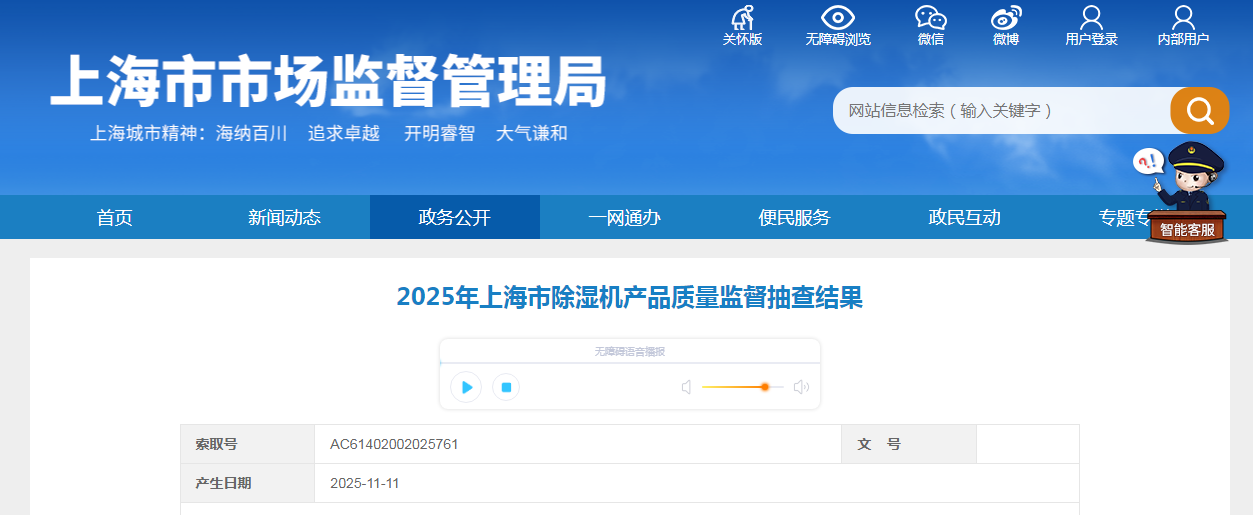
2025年上海市除湿机产品质量监督抽查结果公布
Zhong Guo Zhi Liang Xin Wen Wang· 2025-11-13 05:22
Core Insights - The Shanghai Municipal Market Supervision Administration conducted a quality inspection of dehumidifiers, revealing that out of 15 batches tested, 1 batch was found to be non-compliant [2][3][5] - The inspection covered products from various regions including Shanghai, Guangdong, Zhejiang, and Jiangsu, with 7 batches produced in Shanghai and 8 from other provinces, where only 1 non-compliant batch was identified [2][3] Summary by Category Inspection Results - A total of 15 batches of dehumidifiers were sampled, with 1 batch failing to meet quality standards [2][3] - The non-compliant product has been handed over to the relevant market supervision authorities for further action [3] Product Details - The inspection included various brands and models, such as DeLonghi, THKOM, and GREE, with specific details on production dates and sales platforms provided [3][4] - The non-compliant product identified was the "众有除湿机" (Zhongyou Dehumidifier) model DH-858B-1, produced by Shanghai Zhongyou Industrial Co., Ltd., and sold through Taobao [5]
研报掘金丨长江证券:维持格力电器“买入”评级,渠道变革带来的经营阵痛或逐步缓解
Ge Long Hui A P P· 2025-11-12 08:59
Core Viewpoint - Gree Electric Appliances has experienced a decline in revenue due to channel transformation and other factors, but the disturbances are expected to gradually narrow in the future [1] Group 1: Financial Performance - In the first three quarters of 2025, the company's operating revenue decreased by 6.50% year-on-year, with Q1/Q2/Q3 showing growth of +14.14%, a decline of -11.99%, and -15.09% respectively [1] - In Q3 alone, the home air conditioning industry saw a total sales volume decline of 2.71% year-on-year, with domestic sales increasing by 5.51% and exports decreasing by 12.94% [1] - The company's revenue growth rate is lower than the overall industry performance [1] Group 2: Profitability and Business Strategy - The gross profit margin has declined year-on-year, but profitability has improved due to impairment factors [1] - The company has established multiple industrial brand matrices, covering both consumer goods and industrial equipment sectors, and has achieved upstream and downstream extension in its industrial chain [1] Group 3: Future Outlook - It is anticipated that the operational pain caused by channel transformation will gradually ease, and terminal competitiveness is expected to recover [1] - Projected net profits for the company from 2025 to 2027 are 31.781 billion, 33.530 billion, and 35.712 billion yuan, with corresponding P/E ratios of 7.13, 6.76, and 6.35 times [1] - The company maintains a "buy" rating [1]
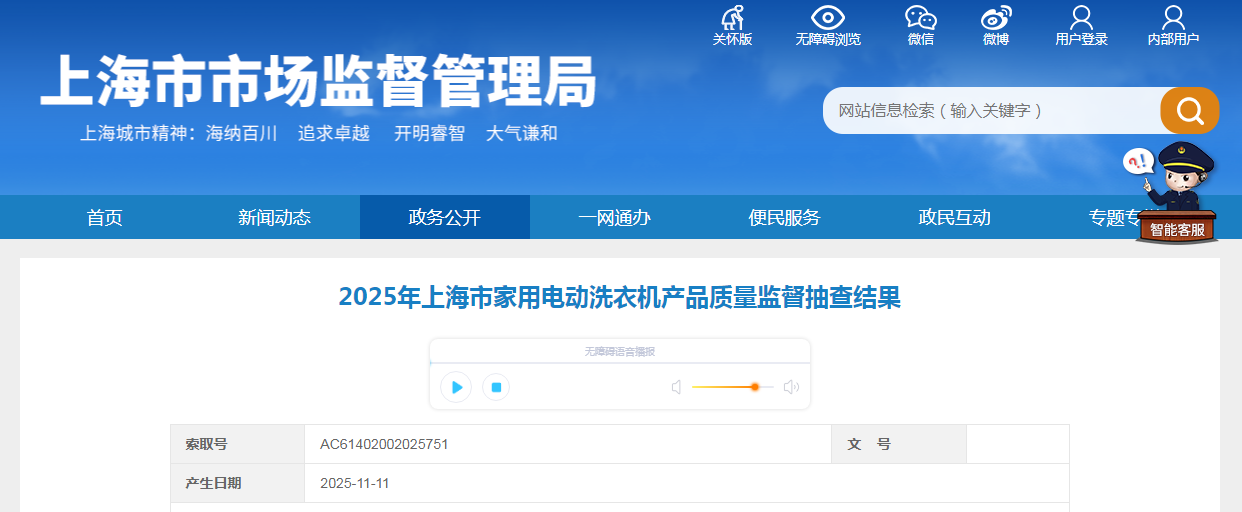
2025年上海市家用电动洗衣机产品质量监督抽查结果公布
Zhong Guo Zhi Liang Xin Wen Wang· 2025-11-12 08:57
Core Points - The Shanghai Municipal Market Supervision Administration conducted a quality inspection of household electric washing machines, with 20 products tested and no non-compliant items found [1] - The inspection included 1 batch from production, 15 batches from physical sales, and 4 batches from e-commerce sales [1] - The sampled products originated from six provinces and cities, including Shanghai, Anhui, Jiangsu, and Zhejiang, with 5 batches produced in Shanghai and 15 from other provinces [1] Group 1 - The inspection was organized based on the implementation rules SHSSXZ0036-2025 for product quality supervision of washing machines in Shanghai [1] - The tested washing machines met relevant standards, indicating a high level of product quality in the market [1] - The report includes detailed information about the brands, models, production dates, and manufacturers of the tested washing machines [1][2]
前三季度“两新”政策成效显著
Ren Min Ri Bao· 2025-11-09 22:20
Core Viewpoint - The Chinese government is implementing policies to boost domestic consumption and investment, with a focus on promoting the replacement of old products and updating equipment in various industries, which is expected to drive economic growth. Group 1: Consumption and Market Trends - In 2023, the total retail sales of consumer goods reached 36.59 trillion yuan, a year-on-year increase of 4.5%, accelerating by 1.0 percentage point compared to the previous year [1] - The per capita consumption expenditure of residents was 21,600 yuan, growing by 4.6% [1] - The contribution rate of final consumption expenditure to economic growth was 53.5% [1] - Sales of products related to the "old-for-new" policy, such as communication equipment and home appliances, saw significant growth, with retail sales increasing by 16.2% for communication equipment and furniture, and 6.2% for cultural and office supplies [1] - The retail volume of passenger cars reached 2.241 million units, an increase of 6.3% [1] - As of October 22, 2023, applications for the automobile "old-for-new" subsidy exceeded 10 million [1] - Sales of smart wearable devices and robotic vacuum cleaners grew by over 15%, while the retail volume of new energy passenger vehicles reached 1.296 million units, increasing by 15.5% with a penetration rate of 57.8% [1] Group 2: Investment and Equipment Update - The scale of investment support from super long-term special bonds for equipment updates has increased to 200 billion yuan, expanding to various sectors including electronic information and agricultural facilities [2] - Approximately 8,400 projects have been supported by the investment subsidy funds, leading to a total investment exceeding 1 trillion yuan, with a leverage effect of 1:5.3 [3] - Investment in the purchase of equipment and tools increased by 14.0% year-on-year, contributing 2.0 percentage points to overall investment growth [3] - The digital design tool adoption rate among large-scale industrial enterprises reached 85.4%, and the CNC rate for key processes was 67.7% as of the first half of the year [2] Group 3: Policy Implementation and Future Outlook - The government emphasizes the importance of ensuring that subsidy funds are effectively utilized and monitored to prevent fraud and ensure the success of the "old-for-new" policy [3] - The National Development and Reform Commission is working to streamline the approval process for equipment update projects, ensuring timely funding and project execution [2] - The "14th Five-Year Plan" aims to maintain a strategic focus on expanding domestic demand, with policies expected to enhance the interaction between consumption and investment, thereby sustaining economic growth [4]
2025年9月中国微波炉出口数量和出口金额分别为507万台和2.37亿美元
Chan Ye Xin Xi Wang· 2025-11-07 03:21
Core Insights - The report by Zhiyan Consulting highlights a significant decline in China's microwave oven exports in September 2025, with a total of 5.07 million units exported, representing a year-on-year decrease of 20.9% [1] - The export value for the same period was $237 million, which also reflects a year-on-year decline of 20.6% [1] Industry Overview - The data is sourced from Chinese customs, indicating a challenging market environment for the microwave oven industry in China [1] - Zhiyan Consulting is recognized as a leading industry consulting firm in China, specializing in comprehensive industry research and providing tailored consulting services [1]

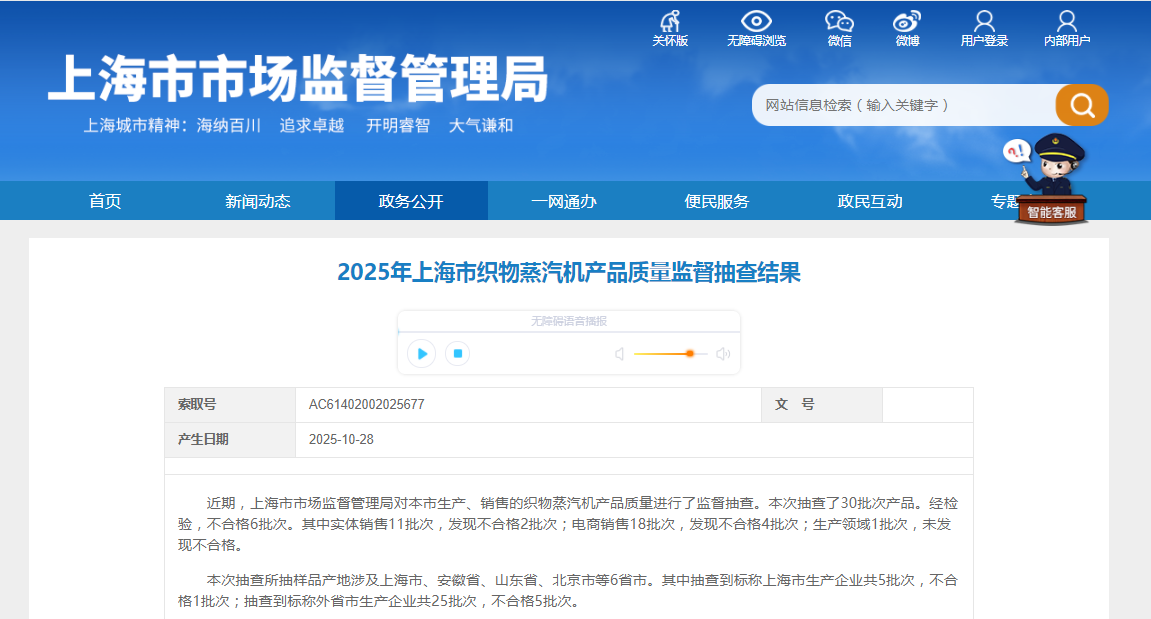
2025年上海市织物蒸汽机产品质量监督抽查结果公布
Zhong Guo Zhi Liang Xin Wen Wang· 2025-11-06 03:13
Core Insights - The Shanghai Municipal Market Supervision Administration recently published the results of a quality inspection on fabric steamers, revealing that out of 30 batches tested, 6 were found to be non-compliant with quality standards [2][5]. Summary by Categories Inspection Results - A total of 30 batches of fabric steamers were inspected, with 6 batches failing to meet quality standards. This includes 2 out of 11 batches sold in physical stores and 4 out of 18 batches sold online [2][4]. - The inspection covered products from 6 provinces and cities, with 5 batches produced in Shanghai and 25 from other regions. Among these, 1 batch from Shanghai and 5 batches from other provinces were found non-compliant [2][4]. Non-compliance Issues - The non-compliance issues identified include: - Input power and current discrepancies, which could lead to overheating and potential fire hazards [5][6]. - Failure to operate normally under expected fault conditions, increasing the risk of electric shock or fire [5][6]. - Structural issues that could lead to burns or explosions due to steam pressure [5][6]. - Deficiencies in power connection and external wiring, which could result in electric shock or fire [6]. - Inadequate grounding measures, posing a risk of electric shock [6] [7]. Consumer Guidance - Consumers are advised to choose fabric steamers based on their usage frequency and types of clothing. Handheld models are suitable for light use, while upright models are better for heavier fabrics [7][8]. - It is recommended to prioritize well-known brands for better quality assurance and after-sales service [7][8]. - Key factors to consider when purchasing include steam output and pressure, heating speed, water tank capacity, and safety features such as overheat protection and automatic shut-off [8][9].