智能电动汽车

Search documents
零跑十周年朱江明发布内部信 公布2026年四大工作要点
Feng Huang Wang· 2025-12-24 01:58
零跑汽车成立于2015年,业务覆盖智能电动汽车研发制造,其核心零部件自研自制比例达65%。朱江明 在信中透露,零跑汽车2025年全年销量预计将接近60万辆,其中海外交付约6万辆;累计销量预计突破 120万辆。公司已连续实现季度盈利,2025年有望首次达成全年盈利。此外,零跑汽车已于11月提前完 成全年50万辆销量目标,并将2026年的销量目标定为100万辆。 凤凰网科技讯 12月24日,零跑汽车在成立十周年之际,其创始人、董事长兼CEO朱江明发布全员内部 信。信中回顾了公司十年发展历程,并提出"不能再以'新势力'自居,而要以一家可持续发展、值得尊 敬的世界级车企来要求自己"。内部信同时公布了2026年的四大工作要点:技术持续创新、品质做到极 致、加速海外市场拓展以及组织保持高效敏捷。 此外,公司宣布将于12月28日在杭州举办以"向上,领跑"为主题的十周年发布会,届时将公布未来十年 规划,并进一步解密旗舰D系列产品。 ...



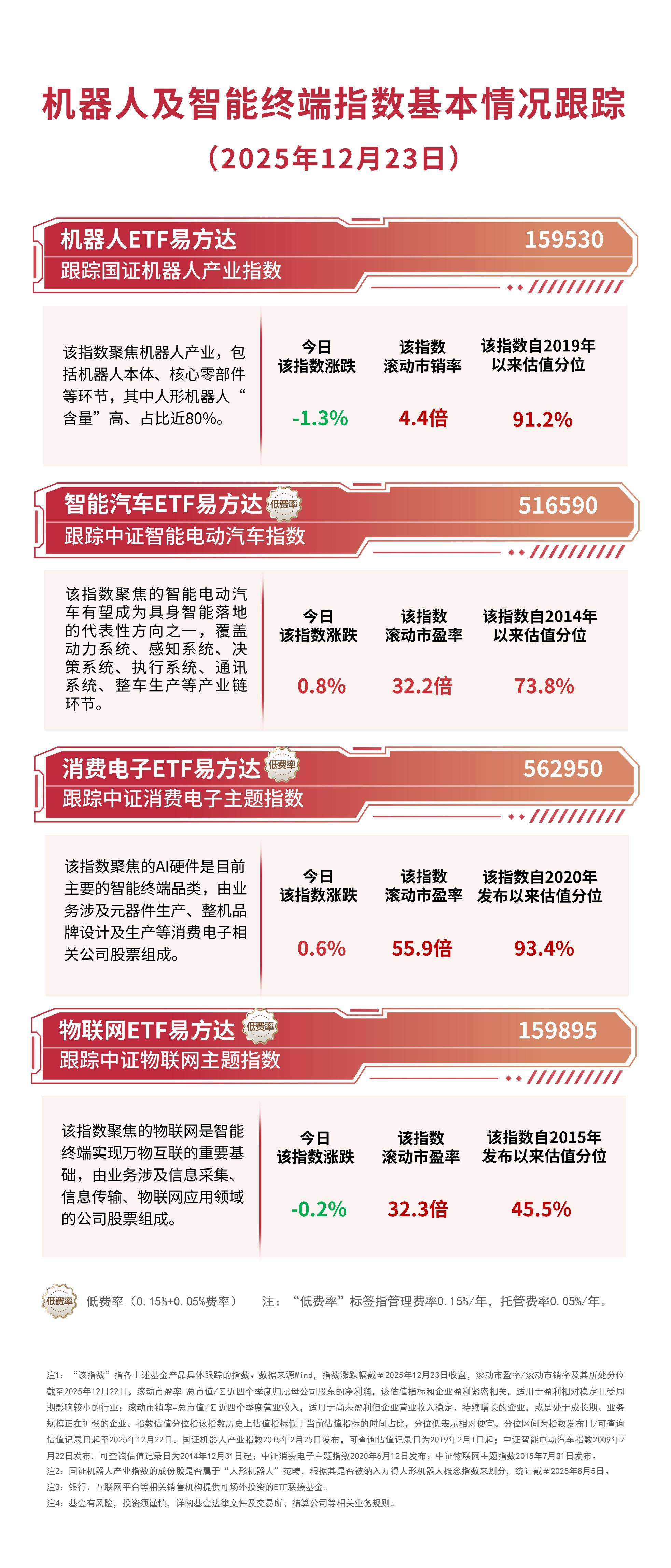
机器人板块午后持续回落,资金加仓,机器人ETF易方达(159530)全天净申购近1.3亿份
Sou Hu Cai Jing· 2025-12-23 12:02
Group 1 - The core viewpoint of the news is that the robotics sector is experiencing a decline, with the National Securities Robotics Industry Index dropping by 1.3%, while the Intelligent Electric Vehicle Index and the Consumer Electronics Index saw increases of 0.8% and 0.6% respectively. Despite the overall decline, there was significant net subscription activity in the robotics ETF, indicating investor interest [1] - The robotics ETF managed by E Fund (159530) has seen a net subscription of nearly 130 million units throughout the day, reflecting strong investor confidence in the sector [1] - Recent adjustments to the components of the National Securities Robotics Industry Index have included five companies from the robotics parts supply chain, enhancing the index's relevance to humanoid robots and aligning it more closely with investor needs and industry trends [1] Group 2 - The Intelligent Electric Vehicle ETF managed by E Fund tracks the China Securities Intelligent Electric Vehicle Index, which focuses on various aspects of the electric vehicle industry, including power systems, perception systems, decision-making systems, execution systems, communication systems, and vehicle production [3][4] - The Consumer Electronics ETF managed by E Fund tracks the China Securities Consumer Electronics Theme Index, which emphasizes AI hardware as a primary category of smart terminal products, involving companies engaged in component production and complete product design and manufacturing [7][8] - The Internet of Things (IoT) Index focuses on companies involved in information collection, transmission, and application within the IoT sector, which is crucial for achieving connectivity among smart terminals [11]

问界M8荣获最高五星评级 赛力斯智能安全引领汽车安全标准升级
Quan Jing Wang· 2025-12-23 10:44
Core Insights - The AITO M8 has achieved a "Platinum Level" certification in the China Automotive Corrosion and Aging Performance Evaluation (CA-CAP), scoring an impressive 97.5, which sets a new record for the highest score in CA-CAP history [1] - This achievement reflects the high-quality standards of AITO products and highlights the advanced capabilities of the Seres Intelligent Safety System [1] Group 1: Performance and Safety - Corrosion resistance is now a fundamental aspect of vehicle safety architecture in the era of smart electric vehicles, beyond just affecting vehicle lifespan and aesthetics [2] - The AITO M8 excels in appearance, functionality, and scratch resistance, thanks to Seres's meticulous attention to details such as body structure, coating technology, and sealing systems [2] - Seres has established an intelligent safety system that encompasses over 190 safety scenarios, including remote driving, parking, and accident management, with more than 340 safety features [2] Group 2: Market Impact and User Trust - The Seres Intelligent Safety System has significantly contributed to AITO's market success, with 900,000 users trusting the brand, and the M9 model surpassing 260,000 deliveries, setting a record for luxury vehicles in the 500,000-unit category [3] - The AITO M8 has also exceeded 140,000 deliveries, consistently leading the sales in the 400,000-unit luxury vehicle segment [3] - The total mileage of AITO's assisted driving systems has surpassed 4.45 billion kilometers, preventing over 2.39 million potential collisions for users, demonstrating the effectiveness of the Seres Intelligent Safety System [3]


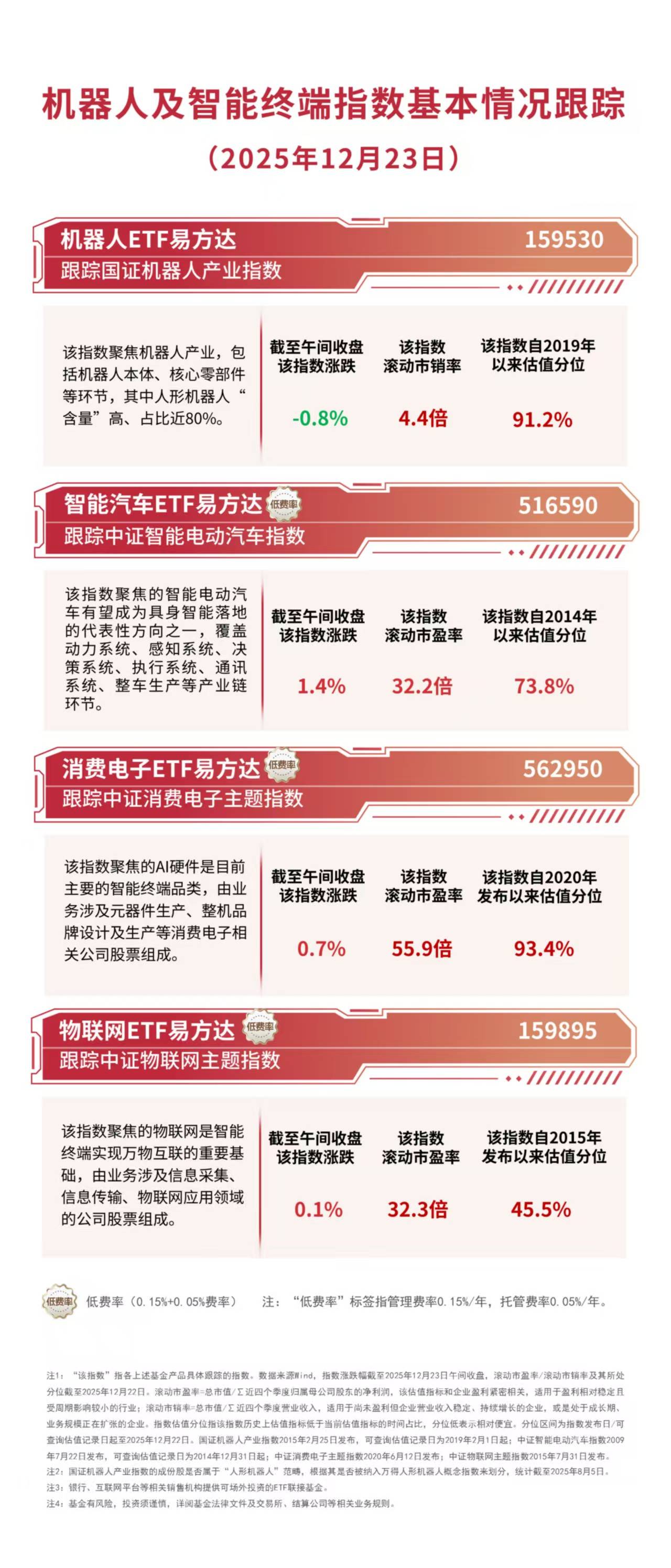
机器人板块震荡调整,资金逆势加仓,机器人ETF易方达(159530)半日净申购近7000万份
Sou Hu Cai Jing· 2025-12-23 04:48
Group 1 - The index experienced a rise of 0.7% with a rolling price-to-earnings ratio of 55.9 times, reflecting a valuation increase of 93.4% since its inception [4] - Another index showed a slight increase of 0.1% with a rolling price-to-earnings ratio of 32.3 times, indicating a valuation growth of 45.5% since its launch [5]
雷军“网红营销”再升级:56岁生日发红包、95后AI少女站台,小米AI布局胜算几何?
Sou Hu Cai Jing· 2025-12-20 17:14
Core Viewpoint - Xiaomi is leveraging the presence of AI talent, specifically the young AI expert Luo Fuli, to enhance the visibility of its newly launched AI model, Xiaomi MiMo-V2-Flash, despite skepticism regarding the actual contributions of Luo to the model's development [5][10][18] Group 1: Xiaomi's AI Model Launch - Xiaomi officially launched its self-developed AI model, Xiaomi MiMo-V2-Flash, which is claimed to perform comparably to DeepSeek-V3.2 [3][9] - The initial version of the MiMo model was open-sourced on April 30 but did not gain significant attention [9] - The MiMo-V2-Flash model reportedly reduces input costs to 0.7 yuan per million tokens, which is half of DeepSeek-V3.2's cost [42] Group 2: Talent Acquisition and Marketing Strategy - Luo Fuli, referred to as a "genius" in AI, was reportedly recruited with a salary of tens of millions, highlighting Xiaomi's strategy to attract top talent [3][5] - The marketing strategy appears to prioritize generating buzz around Luo's presence rather than focusing solely on the technical merits of the AI model [8][10] - Xiaomi's approach to marketing, reminiscent of past strategies, aims to create a strong public image of valuing technology and talent [11][13] Group 3: Challenges and Market Position - Despite the talent acquisition, Xiaomi is still considered a newcomer in the AI model space, facing competition from established players like Alibaba and Baidu [7][21] - The complexity and resource-intensive nature of AI model development necessitate more than just talent; significant computational resources and data are also critical [7][18] - Xiaomi's ongoing efforts in AI and other high-tech fields, such as electric vehicles and chip development, reflect its ambition to remain competitive in cutting-edge technology [21][29][32] Group 4: Future Considerations - Xiaomi's future success in the AI domain may depend on its ability to balance marketing with genuine technological advancements [40][44] - The company needs to shift public perception from being seen as a marketing-driven entity to one that is recognized for its technological capabilities [40][41] - Historical examples suggest that Xiaomi has the potential to achieve breakthroughs in new fields, but the outcome in the AI sector remains uncertain [51]


机器人板块本周回调,关注机器人ETF易方达(159530)等产品投资价值
Sou Hu Cai Jing· 2025-12-19 10:46
本周,中证消费电子主题指数下跌3.7%,中证物联网主题指数下跌2.4%,国证机器人产业指数下跌2.5%,中证智能电动汽 车指数下跌2.3%。Wind数据显示,截至昨日,机器人ETF易方达(159530)本周前4个交易日合计获5500万元资金净流 入,最新规模超120亿元,流动性较好。 Wind数据显示,机器人ETF易方达(159530)跟踪的国证机器人产业指数于近日进行成分股调整。在本次调整中,三花智 控等5只机器人零部件产业链公司被纳入国证机器人产业指数,使指数与人形机器人的相关度进一步提升。 人形机器人"含量"高、占比近80%。 中证智能电动汽车指数 H 聚焦的智能电动汽车有望成为具身智能落地的代表性方向之一, 覆盖动力系统、感知系统、决策系统、执行系统、通讯系统、整 车生产等产业链环节。 ai 中证消费电子主题指数 聚焦的AI硬件是目前主要的智能终端品类,由业务涉及元器件 生产、整机品牌设计及生产等消费电子相关公司股票组成。 注3: 银行、互联网平台等相关销售机构提供可场外投资的ETF联接基金。 注4:基金有风险,投资须谨慎,详阅基金法律文件及交易所、结算公司等相关业务规则 A 指数历史涨跌幅 国计制 ...

万安科技(002590.SZ):已战略投资同川科技,布局机器人核心部件
Ge Long Hui· 2025-12-18 10:38
Group 1 - The company has made a strategic investment in Tongchuan Technology to focus on the core components of robotics [1] - The company aims to leverage its advantages in deep research and development, precision manufacturing, and efficient collaboration accumulated in the smart electric vehicle sector to expand into the robotics business [1] - The company will pay close attention to development opportunities in the robotics industry [1]

万安科技:公司已战略投资同川科技,布局机器人核心部件
Zheng Quan Ri Bao Wang· 2025-12-18 09:43
Group 1 - The core viewpoint of the article is that Wan'an Technology has strategically invested in Tongchuan Technology to expand into the robotics sector, leveraging its advantages in smart electric vehicle development [1] - The company aims to utilize its deep research and development, precision manufacturing, and efficient collaboration capabilities accumulated in the smart electric vehicle industry to facilitate this transition [1] - Wan'an Technology will focus on identifying development opportunities within the robotics industry [1]
小鹏汽车上涨2.02%,报18.68美元/股,总市值178.37亿美元
Jin Rong Jie· 2025-12-16 15:33
据交易所数据显示,12月16日,小鹏汽车(XPEV)盘中上涨2.02%,截至23:07,报18.68美元/股,成交 3596.32万美元,总市值178.37亿美元。 财务数据显示,截至2025年06月30日,小鹏汽车收入总额340.85亿人民币,同比增长132.51%;归母净 利润-11.42亿人民币,同比增长56.95%。 大事提醒: 11月18日,小鹏汽车将披露2025财年三季报(数据来源于纳斯达克官网,预计披露日期为美国当地时 间,实际披露日期以公司公告为准)。 资料显示,小鹏汽车有限公司是中国领先的智能电动汽车公司,设计、开发、制造及营销吸引庞大且不 断增长的热衷科技的中产阶层消费者的智能电动汽车。其使命为通过科技驱动智能电动汽车的变革,引 领未来出行方式。为优化客户的出行体验,小鹏汽车自主研发其全栈式智能辅助驾驶技术和车载智能操 作系统,以及包括动力总成和电子电气架构在内的核心车辆系统。小鹏汽车总部位于中国广州,并在北 京、上海、硅谷、圣地亚哥和阿姆斯特丹设有主要办事处。本公司的智能电动汽车主要于广东省肇庆市 和广州市的工厂生产。 本文源自:市场资讯 作者:行情君 ...
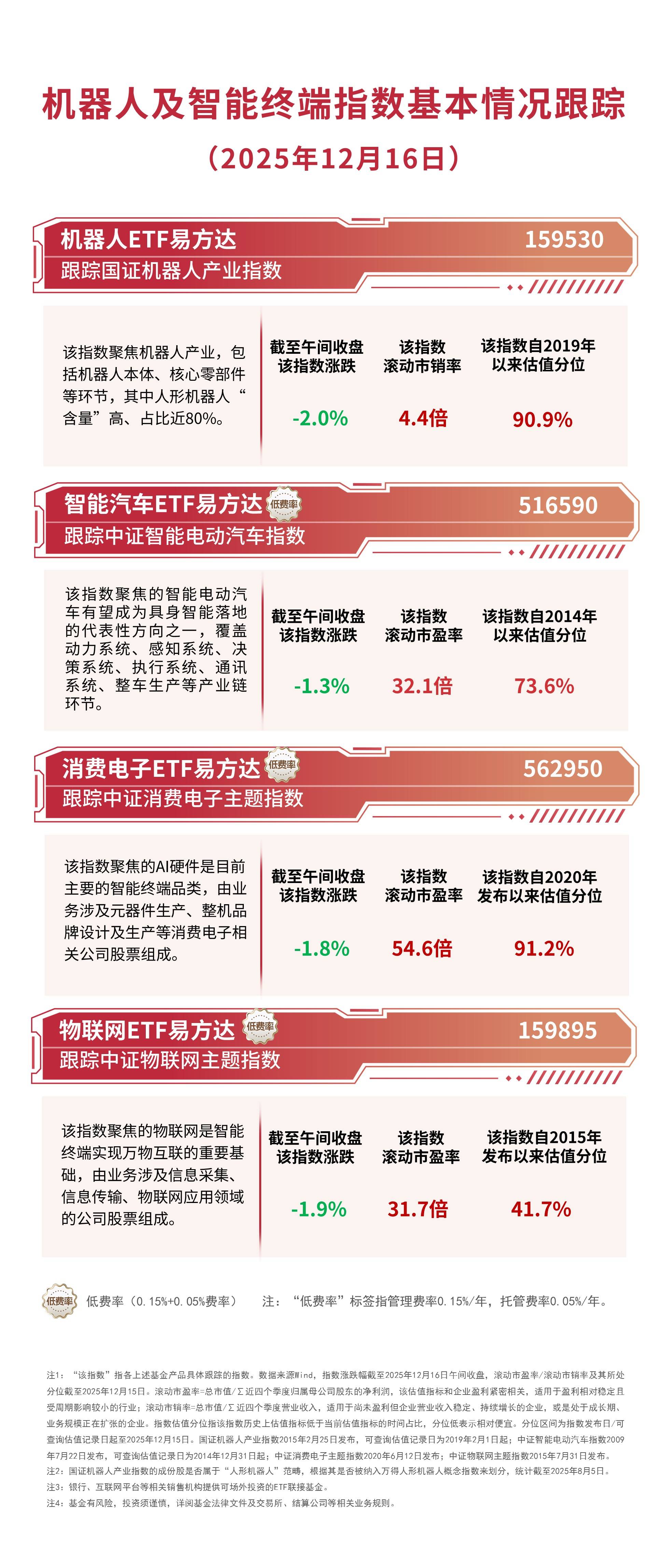
机器人板块回调现布局机会,机器人ETF易方达(159530)半日净申购达2500万份
Sou Hu Cai Jing· 2025-12-16 05:27
Group 1 - The National Securities Robot Industry Index decreased by 2%, the China Securities Intelligent Electric Vehicle Index fell by 1.3%, the China Securities Consumer Electronics Theme Index dropped by 1.8%, and the China Securities Internet of Things Theme Index declined by 1.9% as of midday closing [1][4][6][7] - The ETF for robots, E Fund (159530), saw a net subscription of 25 million units in the first half of the day [1] Group 2 - The China Securities Intelligent Electric Vehicle Index focuses on the intelligent electric vehicle sector, which is expected to become a representative direction for embodied intelligence, covering various industry chain links including power systems, perception systems, decision systems, execution systems, communication systems, and vehicle production [3] Group 3 - The China Securities Consumer Electronics Theme Index emphasizes AI hardware, which is currently a major category of smart terminal products, consisting of stocks from companies involved in component production, complete machine brand design, and production [5]